The future of AI search data: why ChatGPT's console won't bring keywords back

By Esteve Castells




Table of contents
- What we know about ChatGPT's business analytics
- Five reasons AI search data will never look like SEO data
- We've seen this before: (not provided)
- Collecting it from the outside is getting harder too
- Why a free console won't kill prompt tracking
- Direction is enough
- What to do now
- I hope I'm wrong
- Frequently asked questions
On November 6, Juozas Kaziukėnas shared on LinkedIn a banner he had spotted inside ChatGPT: "Claim your business in ChatGPT". Behind it sits what looks like a Business Hub, and inside it, a chart with two daily lines: how often your business appeared in ChatGPT answers, and how many people clicked through to your site. Search Engine Roundtable covered it the same day, and the reaction across the industry was something close to relief. ChatGPT is getting its own Search Console.
It's good news, and I'll be among the first to use it. But I want to temper the excitement with a thesis that isn't very popular: whatever this panel becomes, and whatever comes after it, we are not getting back the kind of data we had in SEO. Not from OpenAI, not from Google, and not from anyone else building an assistant.
This piece explains why, and what to measure instead.
What we know about ChatGPT's business analytics
OpenAI hasn't announced anything, so treat every detail as provisional. From what has been seen so far:
- It lives inside a broader Business Hub. Beyond analytics, the hub lets a business add its latest products, keep its details current and run an agent that answers customer questions with context the business controls.
- Access requires verification. Connecting a Shopify store is the only method shown so far. Other routes, markets and eligibility rules haven't been described.
- Two metrics, by day. Impressions (appearances in ChatGPT answers) and clicks (visits to your website).
- No prompts, no user data, no competitors. You see your own line and nothing around it.
- It has been in the works for months. Kaziukėnas says he first saw early versions in August.
The open questions matter as much as the features. How is an impression counted when a business shows up three times in one conversation? Does a product card count the same as a name in the third paragraph? How are clicks attributed? Until OpenAI documents it, nobody can tell you what a single impression means.
There is one place where this panel could improve on what we have today. Since GPT-6 rolled out, a large share of ChatGPT clicks reach websites without a referrer or a UTM tag, so GA4 files them as Direct. Across the sites we monitor, the ChatGPT line in analytics fell by around 46% from October 9. A click count reported by OpenAI itself wouldn't have that blind spot. That's useful, and it's also about as far as the panel goes.
Kaziukėnas put it well: it can tell you whether your GEO work is paying off, but not why your mentions go up or down. Think about the queries report in Search Console. It's the reason most of us open the tool at all. Take it away and you're left with a thermometer: it confirms you have a fever, not what's causing it.
Five reasons AI search data will never look like SEO data
1. A console covers one assistant, and the market is splitting
If you could only get first-party data from one AI platform, ChatGPT would still be the one to pick. But even a perfect ChatGPT console is still a ChatGPT console.
The timing is ironic. According to Similarweb, ChatGPT's share of worldwide visits to generative AI websites went from about 76% in June 2025 to roughly 53% in May 2026, while Gemini climbed to around 27% and Claude to close to 9%. The most complete first-party data may end up coming from the platform that is losing the most share.
Here is what the rest of the market gives site owners today:
- Google. Since June, Search Console has a generative AI performance report. It counts impressions in AI Overviews and AI Mode together, with no clicks, no queries and no position, and those impressions are already included in your Web search totals.
- Microsoft. Bing Webmaster Tools has had an AI Performance report since February: citations, cited pages and a sample of grounding queries. No clicks, and Copilot, Bing's AI summaries and unnamed partner integrations are blended together.
- Gemini, Claude and Perplexity. Nothing, and no public sign that anything is coming.
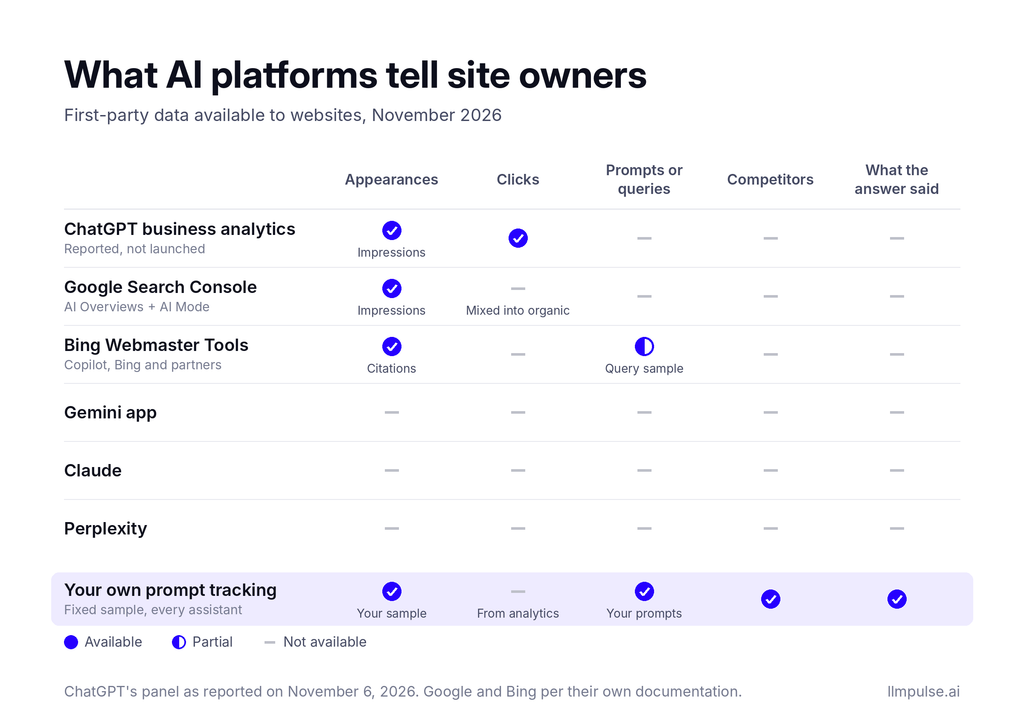
When most of the market isn't even working on it, that tells you how much this is likely to improve.
2. A prompt is a private conversation, not a keyword
On Google, people typed "divorce lawyer barcelona". In ChatGPT, they explain that their partner has left, that there are two kids involved, what they earn and what worries them. A prompt carries the kind of personal detail a keyword never did, and no AI company is going to expose that to third parties. The legal exposure alone rules it out.
Google already hides a significant share of queries in Search Console for privacy reasons, and those are three-word searches. Conversations are a different order of sensitivity.
3. Prompts don't aggregate
Keyword data worked because thousands of people typed exactly the same string. You could add them up and call it volume.
Prompts don't behave that way. I recently spent a weekend going through a dataset of 15 million real prompts. The most repeated prompt appeared 7 times. A second commercial dataset I reviewed had no duplicates at all. And in one test of query fan-out, the most frequent sub-query appeared 3 times across 738 variations of the same underlying question.
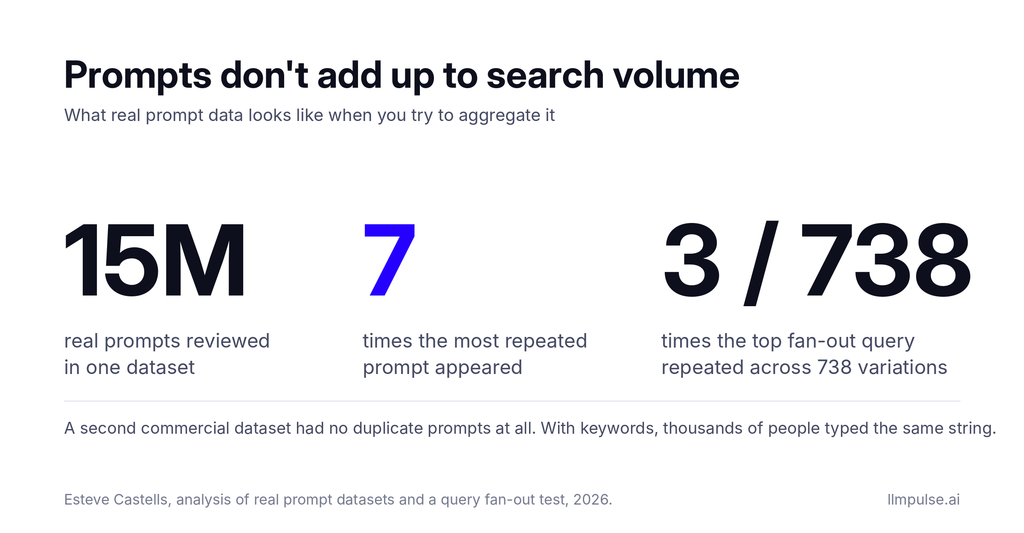
Two things follow from that. A report saying "this prompt had 2 impressions" would be useless and a privacy risk at the same time, so the most we can realistically expect from any platform is topics or categories. And any tool that shows you a "search volume" for a prompt is modeling or guessing, because no AI company shares that data.
There is a second layer that gets less attention. Even if you had the prompt, it isn't what retrieved your page. Assistants break a question into sub-searches before they cite anything, a reasoning model can run dozens of them for a single complex question, and in our data those searches often run in English even when the prompt was written in Spanish. Bing's grounding queries are a useful window into that layer, but they describe what the machine searched for, not what the person asked.
4. Personalization is a convenient excuse, and a smaller one than it looks
Memory and chat history mean two people can get different answers to the same question. That is the perfect argument for never sharing prompt-level data.
But the personalization that meaningfully changes an answer is concentrated among logged-in, paying users, and they are a minority. In February, OpenAI said ChatGPT had passed 900 million weekly users and 50 million paying subscribers. That's around 5%. Most people see something close to the logged-out answer.
So it's worth asking anyone who wants personalized data: if you had it, what would you do differently? A personalized answer is, by definition, seen by one person.
It also cuts the other way. When an executive asks ChatGPT about their own brand from their own account, memory and history shape the answer, and adding "ignore that I'm the founder" to the prompt doesn't undo it. That answer is the least representative one in the building.
5. The incentives point to ads, not to your reporting
For me, this is the reason that decides everything else.
Right now ChatGPT is the only assistant with a business reason to give you data, and that reason is advertising. Look at the sequence:
- February 9, 2026: ChatGPT starts showing ads to Free and Go users in the US.
- May: the Ads Manager opens in self-serve mode to US businesses.
- August 31: OpenAI says ChatGPT Ads has reached a $1 billion annualized run rate in under 200 days, and opens self-serve in 31 European markets.
- November: a free panel showing businesses their organic impressions and clicks surfaces.
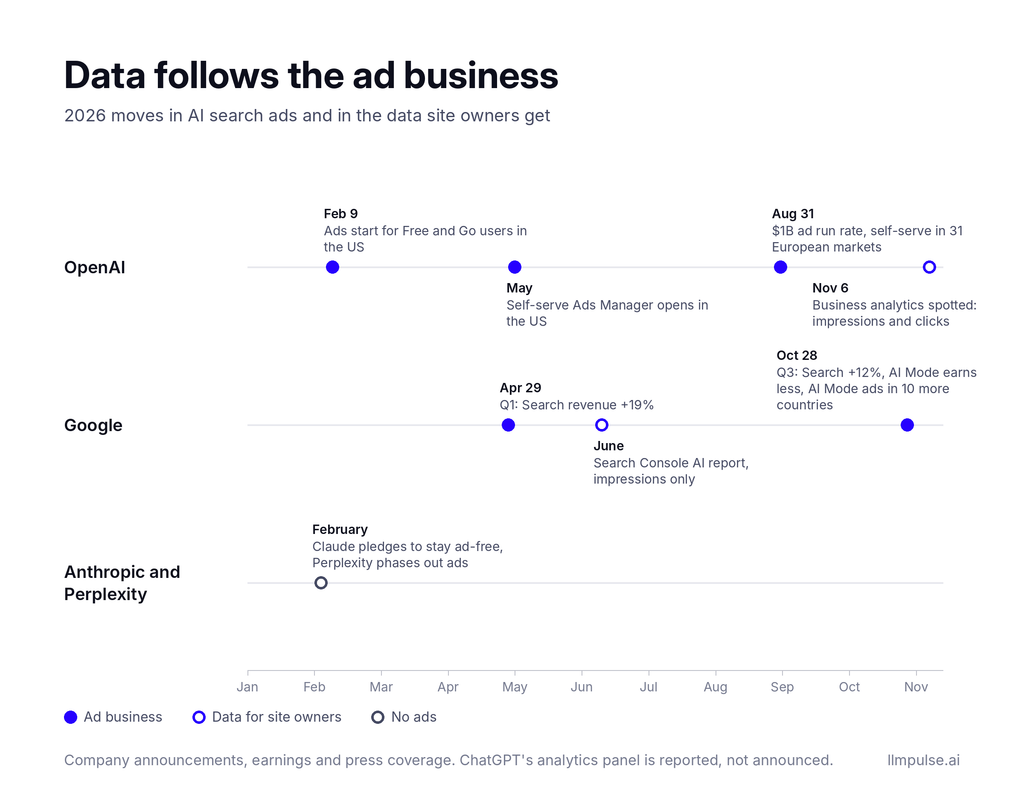
It's Google's playbook, step for step: give Search Console away so people get used to the numbers, then sell Google Ads to cover what the numbers say is missing. And ads are already the normal state of a ChatGPT answer in the US. In our analysis of 36,153 US answers this summer, 71.9% carried at least one ad.
Look also at what each company chooses to show. Google's AI report gives you impressions only, while clicks from AI Overviews and AI Mode stay mixed into organic, with no way to separate them. The ChatGPT panel, from what has been seen, shows the clicks ChatGPT sends you. That isn't generosity. OpenAI needs to prove that ChatGPT sends traffic in order to sell advertising. Google has no reason to show you how many clicks its AI sends.
And the others? Anthropic pledged in February that Claude will stay ad-free. Perplexity phased out its ads the same month. The Gemini app doesn't run ads, for now. Without an ad business, a console for site owners is a cost with no return. Until everyone sells ads, and Anthropic has said Claude won't, nobody else has much of a reason to build one.
Google's latest earnings show where priorities go when AI search monetizes worse. At the end of October, Alphabet reported third-quarter Search revenue growth of 12%, down from 19% in the first quarter, and executives acknowledged that an AI Mode query earns less than a traditional search. The stock fell more than 11% after the results. The response was more ads in AI Mode: ten more countries, and ads inside follow-up questions in the US. Nothing about giving websites better data. When AI search monetizes worse, the priority is to monetize it better, not to hand you a richer report.
The uncomfortable part is that even ads create only a limited incentive. What these platforms sell is a match between an advertiser and the right intent. For that they don't need you to know what was asked. They need you to trust that the system gets it right. Google Ads has been walking that road for years: fewer visible search terms, broader match types, Performance Max and a bigger black box with every release.
We've seen this before: (not provided)
In October 2011, Google started encrypting searches for logged-in users and "(not provided)" appeared in Google Analytics. We were told it would affect a small share of searches. By September 2013 it covered practically all of them.
The industry adapted. We learned to work with landing pages, the Search Console sample and third-party tools. Keywords never came back to analytics.
Keyword-level data in AI search will go the same way, and this time for two reasons at once: the data can't be aggregated, and the platforms have no wish to share it.
It's worth being honest about the data we're nostalgic for, too. When Google dropped the num=100 parameter in September 2025, impressions in Search Console fell for most sites, because a good part of what we called visibility was rank tracker bots loading position 87. Years of click-through rates had been calculated against an inflated denominator. And on October 9 of this year, a single ChatGPT release stripped the label from roughly half the ChatGPT visits in GA4. The data we trusted was never as solid as it looked.
Collecting it from the outside is getting harder too
If the platforms won't give you the data, the alternative is to observe the answers yourself. That is getting more expensive.
Google deployed SearchGuard in January 2025 to stop automated access, removed num=100 in September 2025 and sued SerpApi that December. In July 2026, a judge dismissed the DMCA claims over search results, ruling that public search results aren't a protected work, and Google filed an amended complaint on August 10. The case goes on, but the direction is clear: turn off the tap. AI platforms are moving the same way, adding defenses against automated traffic every quarter.
How the data is collected also decides what it can tell you. APIs often return the text without the citations, shopping cards or video blocks people see in the app, and may run a different model from the free product. A dataset that never contains the sources and blocks real users see is describing a product nobody uses.
Why a free console won't kill prompt tracking
Since the rumor broke, I've read more than once that this is the end of prompt trackers: if OpenAI hands you the data for free, why pay for a tool?
Full disclosure: this is what we do at LLM Pulse, so I'm not neutral. Here is why I don't think it plays out that way, and I think each reason stands on its own.
The console answers whether, never why. It will tell you how often you appeared and how many clicks you got from ChatGPT. It won't tell you in which conversations, which sources were cited, who was recommended instead of you or what was said about you. Decisions get made with exactly that.
Logged-out answers are the mode. Since meaningful personalization affects a minority, the answer a clean, logged-out session gets is the one most people see. That is what a rank tracker always gave you on Google: nobody saw exactly those ten results, but they were an excellent approximation. The difference is that AI answers vary from one run to the next, so the mode has to be measured across many answers. When we asked Claude the same 400 buying questions 18 times each, one answer named a median of 6 brands, and the 18 answers named 15. A systematic, repeated sample is the only way to read that.
It's the only view across assistants. A ChatGPT panel, a Google report and a Bing report use three different definitions and cover three different surfaces. The same prompt set, run the same way across ChatGPT, Gemini, AI Mode, Perplexity and Claude, is the only comparable view of all of them.
First-party data grows the market. Search Console has been free for over 15 years and SEO tools never stopped growing. When platforms publish data, people need context to interpret it. The console is the thermometer, tracking is the map.
What will get harder is the life of tools whose whole output is "you were mentioned, yes or no". That was already happening before the banner.
Direction is enough
If you take one idea from this piece, take this one: AI search data is directional, and that's fine. You don't need to know that a prompt gets 1,300 searches a month. You need to know where the questions in your category are heading, whether your visibility is rising or falling, which sources help or hurt you, and which competitor is gaining ground.
We never really made SEO decisions on precision either. Google Ads search volume was a rounded average, shown as a range if you didn't spend enough, and nobody rewrote a strategy because a keyword had 1,300 searches instead of 1,600.
Some teams already work this way. One large brand I work with approved an AI visibility KPI next to its SEO KPI, measured as share of voice across a sample of prompts. It took seven months, and the name mattered: leadership already understood share of voice, so nobody had to learn a new metric. Another company doesn't report its AI reputation as a sentiment percentage at all. It counts the negative source URLs it has identified and how many it gets corrected each quarter. Neither needs to know what any individual user typed.
A directional sample still needs discipline to be worth anything:
- Enough prompts. Around 100 per brand at a minimum, and closer to 300 before the numbers feel solid.
- Mostly non-branded prompts. Branded prompts flatter your visibility and, because they force the model to give an opinion about you, tend to surface more negativity than real buyers see. Around 20% branded and 80% non-branded works for most brands. Inside the non-branded share, keep most prompts conversational and a smaller part in keyword style, because AI Overviews still matter.
- Tags that match the business. Persona, product line, market. Localize prompts instead of translating them.
- The same method everywhere. Same prompts, same cadence and same locales across assistants, with model updates annotated.
Our guide to choosing the prompts you track and our measurement methodology go deeper on both.
What to do now
- Record your baseline this week. Pull ChatGPT sessions (utm_source=chatgpt.com) from analytics, plus Direct traffic on your top ChatGPT landing pages since October 9, so you have a "before" when the panel ships.
- Get ready to claim your business. Clean product data (titles, prices, stock) and consistent business details are what you'll be connecting.
- Export from day one. Search Console keeps 16 months of history. Don't assume a new panel will keep more, and store your own copy.
- Use platform data to validate, not to diagnose. It will tell you whether something worked. To learn why, you have to read the answers.
- Measure direction on a broad sample. Track the share of answers you appear in across a fixed prompt set, and read trends rather than single snapshots.
- Triangulate. Analytics, the Search Console AI report, Bing's AI Performance report, AI bot logs and external tracking each see a different slice. None of them tells the whole story alone.
- Change expectations, not tools. The data of 2015 isn't coming back. Report the KPIs that hold up, frame them in terms leadership already knows, and the sooner the room accepts it, the better the decisions get.
I hope I'm wrong
I really do. There will be improvements: OpenAI may add topics, Google may add clicks, Bing may sharpen its report. But I don't expect we'll ever see the depth of data we had five or ten years ago. And if we're honest, SEO data had been less reliable than we liked to believe for a long time.
Perfect data never existed. The difference now is that we can't pretend it did.
A shorter version of this piece first appeared in Spanish in Seopatía, my newsletter on SEO and GEO.
Frequently asked questions
Does ChatGPT have a Search Console?
Not officially. On November 6, 2026, a Business Hub was spotted inside ChatGPT that shows verified businesses their daily impressions and clicks. OpenAI hasn't announced it, and it reportedly shows no prompts, user data or competitor data.
Will ChatGPT show which prompts mentioned my brand?
Very unlikely. Prompts carry personal information, they rarely repeat (in a dataset of 15 million real prompts, the most repeated one appeared 7 times), and platforms have little incentive to share them. Expect topics or categories at best.
Is there search volume for AI prompts?
Not in any reliable sense. No AI company shares prompt data and real prompts barely repeat, so any prompt volume a tool shows is modeled. Work with direction instead: the share of answers you appear in across a broad, fixed prompt sample.
Does ChatGPT's business panel replace AI visibility tracking?
No. It covers one assistant and tells you whether you appeared, not in which answers, next to which competitors, with which sources or with what said about you. Use it to validate, and pair it with a repeated prompt sample across assistants.
What AI search data do Google and Bing give site owners?
Google Search Console's generative AI report shows impressions in AI Overviews and AI Mode combined, with no clicks or queries. Bing Webmaster Tools' AI Performance report shows citations, cited pages and a sample of grounding queries, with no clicks. Gemini, Claude and Perplexity offer no data to site owners.
What should I do before ChatGPT's business analytics launch?
Record a baseline of ChatGPT sessions and of Direct traffic on your top ChatGPT landing pages, clean your product data, and set up a fixed prompt sample so you can compare the panel's numbers with what the answers actually say.






Discover your brand's visibility in AI search effortlessly
Esteve Castells
Co-Founder of LLM Pulse and AI search expert. With extensive experience working as an SEO for global brands and large enterprises, he's the subject matter expert building the product to deliver value to our users.
- The future of AI search data: why ChatGPT's console won't bring keywords back
- Best Tools to Track Competitors in AI Search (2026)
- How to Set Up Alerts for AI Brand Mentions
- Prompt Tracking Explained: How to Choose the Prompts You Track
- Claude Rarely Gives the Same Answer Twice: We Asked It 400 Buying Questions 18 Times