



Last updated: September 14, 2026
ChatGPT ads went from a US pilot to a real ad product this year. OpenAI turned them on in Australia, New Zealand and Canada in April, added the UK in June, and has been signing up advertisers with a self-serve manager since the spring. What nobody outside OpenAI can see is the inventory: how often an ad actually appears, on what kind of question, and who is buying.
Table of Contents
We can see part of it. LLM Pulse runs tens of thousands of questions through ChatGPT every week on behalf of the brands we track, and we record the ad blocks that come back with the answer. This is a snapshot of 137,038 ChatGPT answers collected between 25 July and 4 August 2026, of which 36,153 were served to US users and carried 34,514 ads. Two live versions of this data run continuously at ad coverage by country and top US ChatGPT advertisers. The numbers below come from the fixed window.
Headline findings
- 71.9% of US ChatGPT answers carried at least one ad. That is 26,003 of 36,153 answers. An ad is now the normal state of a ChatGPT answer in the US, not the exception.
- Ads are not reserved for shopping questions. Commercial questions drew an ad 74.6% of the time, but purely informational ones drew one 69.5% of the time. The gap between “which CRM should I buy” and “how does a CRM work” is five percentage points.
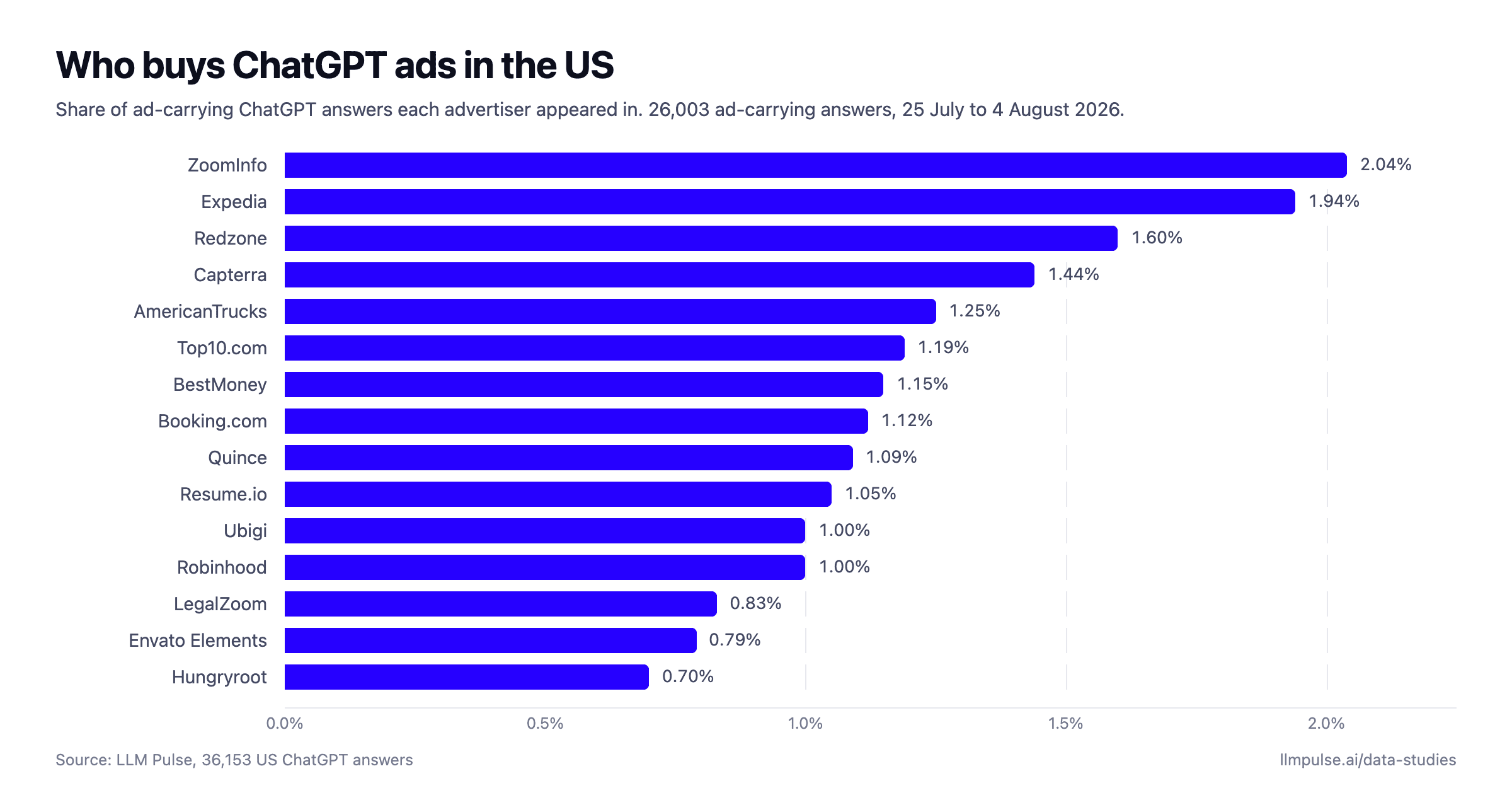
- Nobody owns this auction yet. 3,033 distinct advertisers appeared in the US sample. The biggest, ZoomInfo, is in 2.04% of ad-carrying answers. The top 10 together account for 13.8%, and 1,170 advertisers showed up in exactly one answer.
- The ad and the answer are two different worlds. Only 2.8% of ads pointed at a domain the same answer also used as a source. Across the whole sample, 73% of advertisers never appeared as a source in any answer. Brands buying ChatGPT ads are, for the most part, brands ChatGPT does not cite.
- The UK is live but nearly empty. OpenAI switched the UK on in June. In 8,436 UK answers we found 7 ads, a rate of 0.08%. Australia (73.6%), Canada (60.4%) and New Zealand (65.4%) all run at US-like levels.
How often ChatGPT shows an ad, by country
Ads reach only ChatGPT’s free and Go tiers, so these rates describe what a logged-in free user sees, not what a Plus or Enterprise user sees. We only report countries where ads are switched on and where we collected enough answers to be worth quoting.
| Country | Answers | Answers with an ad | Ad rate |
|---|---|---|---|
| Australia | 1,642 | 1,209 | 73.63% |
| United States | 36,153 | 26,003 | 71.92% |
| New Zealand | 586 | 383 | 65.36% |
| Canada | 639 | 386 | 60.41% |
| United Kingdom | 8,436 | 7 | 0.08% |
The UK number is the one worth staring at. OpenAI announced UK availability in June and the market has had two months to fill. Our UK sample is the second largest in the study, and it produced seven ads: a family law mediator, an AI language tutor, a luggage storage service, a compliance platform, and three advertisers that also run in the US. Whatever inventory exists in the UK is not reaching a normal free-tier session in any volume.
What kind of question triggers an ad
The intuition from search advertising is that ads follow commercial intent, and that informational queries are a poor place to sell. ChatGPT does not work that way.
| Question type | Answers | Answers with an ad | Ad rate |
|---|---|---|---|
| Commercial (comparing options) | 18,033 | 13,449 | 74.58% |
| Informational (learning something) | 16,593 | 11,529 | 69.48% |
| Transactional (ready to buy) | 1,436 | 954 | 66.43% |
Transactional questions, the ones closest to a purchase, have the lowest ad rate of the three. The spread across all types is under nine points, which says the placement decision is being made at the level of “this is a topic somebody buys against”, not “this user is about to check out”.
The same flatness holds when you split by whether the question names a brand. Questions naming the tracked brand drew an ad 70.3% of the time, questions naming a different brand 73.3%, and generic questions with no brand in them 72.0%. Asking ChatGPT about a specific company does not protect that company’s answer from carrying somebody’s ad.
How many ads an answer carries
Most answers carry one ad, and three is effectively the ceiling.
- One ad: 18,920 answers (72.8% of ad-carrying answers)
- Two ads: 5,692 (21.9%)
- Three ads: 1,356 (5.2%)
- Four or more: 35 (0.1%)
So the ad load per answer is light even though the ad rate per answer is high. ChatGPT is closer to one sponsored card in most answers than to a stack of paid results above the content.
The 25 biggest ChatGPT advertisers in the US
Ranked by the number of ad-carrying answers each advertiser appeared in. “Also a source” counts the US answers in the same window where that domain appeared as one of the answer’s own sources, out of 36,153.
| # | Advertiser | Category | Ad answers | Share | Also a source |
|---|---|---|---|---|---|
| 1 | zoominfo.com | B2B software | 531 | 2.04% | 13 |
| 2 | expedia.com | Travel | 504 | 1.94% | 181 |
| 3 | rzsoftware.com | B2B software | 417 | 1.60% | 0 |
| 4 | capterra.com | Software marketplace | 375 | 1.44% | 459 |
| 5 | americantrucks.com | Retail | 325 | 1.25% | 63 |
| 6 | top10.com | Comparison site | 309 | 1.19% | 7 |
| 7 | bestmoney.com | Comparison site | 299 | 1.15% | 0 |
| 8 | booking.com | Travel | 291 | 1.12% | 257 |
| 9 | quince.com | Retail | 284 | 1.09% | 8 |
| 10 | resume.io | Consumer software | 274 | 1.05% | 4 |
| 11 | ubigi.com | Telecom | 259 | 1.00% | 34 |
| 12 | robinhood.com | Finance | 259 | 1.00% | 2 |
| 13 | legalzoom.com | Consumer services | 216 | 0.83% | 2 |
| 14 | envato.com | B2B software | 205 | 0.79% | 6 |
| 15 | hungryroot.com | Retail | 181 | 0.70% | 5 |
| 16 | doit.com | B2B software | 178 | 0.68% | 6 |
| 17 | hoka.com | Retail | 168 | 0.65% | 0 |
| 18 | yodeck.com | B2B software | 167 | 0.64% | 25 |
| 19 | packetlabs.net | B2B services | 165 | 0.63% | 0 |
| 20 | intuit.com | B2B software | 153 | 0.59% | 114 |
| 21 | waldenu.edu | Education | 137 | 0.53% | 15 |
| 22 | monday.com | B2B software | 136 | 0.52% | 103 |
| 23 | sofi.com | Finance | 136 | 0.52% | 8 |
| 24 | zoho.com | B2B software | 124 | 0.48% | 217 |
| 25 | careerminds.com | B2B services | 123 | 0.47% | 2 |
It is a B2B list. We classified the 100 biggest advertisers by hand: 50 of them sell B2B software or B2B services. Consumer retail, travel and finance are present but they do not dominate the way they do in early coverage of the product. The single most common ad in our sample is a piece of business software being sold to somebody who asked ChatGPT a work question.
Universities are buying heavily. Six of the top 100 advertisers are degree-granting institutions running enrolment campaigns. Online and for-profit programs have been the most aggressive paid-search buyers for twenty years, and they moved into this inventory early.
Comparison and affiliate sites are bidding against the brands they review. Top10.com, BestMoney and ConsumerPicks all rank in the top 30. These are sites whose entire business is ranking products, now paying to sit next to an AI answer that also ranks products.
Breadth varies a lot inside the ranking. ZoomInfo and Capterra turn up across a wide spread of unrelated topics, which looks like broad national coverage. AmericanTrucks and Ubigi rank high on volume but concentrate in a single vertical, so read those rows as a strong campaign in one niche rather than as the fifth-biggest advertiser in America.
The ad and the answer are two different worlds
For every ad we recorded, we checked whether the same answer also used that advertiser’s domain as one of its sources. Out of 34,040 ads placed in answers that had at least one source, 946 matched. That is 2.8%.
Widen it and the picture holds. Of the 3,033 advertisers, 819 appeared as a source in at least one answer somewhere in the sample. The other 2,214, or 73%, never did.
This cuts both ways for anyone working on generative engine optimization.
- Buying an ad does not get you into the answer. OpenAI says ads do not influence ChatGPT’s answers. Our low overlap is consistent with that policy, but this observational study does not establish a causal effect of advertising on citations.
- Brands that already win organically mostly are not buying. The domains ChatGPT cites most in our US sample are Reddit, TechRadar, NIH, arXiv and G2, and not one of them buys an ad. Forbes is the only heavily cited domain that also advertises, with 36 placements. The advertisers are, disproportionately, the brands the answer left out.
A handful of companies do both. Capterra, Booking.com, Zoho, Intuit and monday.com appear as advertisers and as frequently cited sources, which is what you would expect from companies large enough to run a paid program and an earned-visibility program side by side. They are a small minority of the list.
When someone asks about your brand, the ad is usually not yours
We isolated the questions that name a tracked brand: 2,611 of those answers carried an ad. Of those:
- 45 carried an ad from the brand being asked about (1.7%)
- 133 carried an ad from a brand tracked as a direct competitor (5.1%)
- 2,433 carried an ad from somebody else entirely (93.2%)
So when a prospect asks ChatGPT about your company, you are three times more likely to see a competitor’s ad in that answer than your own. And 5.1% is a floor, not a ceiling: it only counts advertisers already tracked as direct competitors, so real conquesting is higher.
The volume is still small in absolute terms, but it points the same way brand-term bidding did in paid search fifteen years ago.
What this means if you are a brand
- Assume an ad sits next to your answer. At 72% in the US, planning for an ad-free ChatGPT answer is planning for the exception. Check what runs alongside your brand questions the way you would check the paid results on a branded Google query.
- Do not treat ads as a shortcut into the answer. OpenAI says ads do not influence answers; the 2.8% overlap alone cannot establish how the systems make their decisions. Paid placement buys you the card; it does not buy you the citation. Getting cited is still an earned-visibility problem.
- Advertiser appearances are spread widely in this sample. We found 3,033 advertisers, a leader at 2%, and 1,170 one-appearance advertisers. These counts do not reveal auction prices or competition within each category.
- If you sell B2B, your competitors are probably already here. Half the top 100 is B2B, and much of it is mid-market software nobody would call an early adopter of experimental channels.
- Watch the UK. Seven ads across 8,436 answers two months after launch point to either a slow advertiser ramp or conservative serving. Whichever it is, the market that gets to 70% next may move quickly, based on how quickly the US, Canada, Australia and New Zealand filled.
Methodology
Every answer in this study is a real ChatGPT response to a question tracked in LLM Pulse, collected between 25 July and 4 August 2026. The full sample is 137,038 answers across 70,760 distinct questions. An “ad” is a sponsored card ChatGPT returned with the answer and marked as rendered; shopping carousel products are stored separately and are not counted here.
The denominator is the part that has to be right. ChatGPT only serves ads in the countries where OpenAI has switched them on, and only to free and Go users, so an answer from a market without ads has no ad data rather than no ads. Quoting a global ad rate across every country we track would manufacture a number we never measured. We therefore report ad rates only for the markets where ads are live and where we collected enough answers for the rate to mean something: the United States, Australia, New Zealand, Canada and the United Kingdom.
Advertiser identity comes from the advertiser URL in the ad payload, not from the click URL, which is often an ad network’s redirect. Where a network keeps the destination in the URL we unwrap it back to the advertiser; where the destination is encrypted, 328 ads in this window, we drop the ad from the advertiser ranking rather than credit an ad network as an advertiser. Subdomains are folded onto the parent domain, so a campaign landing page counts toward the brand. An advertiser must have appeared across several separate tracked brands to enter the ranking, which stops one brand’s question set from inventing a national advertiser.
“Also a source” compares the advertiser’s domain against the domains the same answer cited, matched at the registrable-domain level. Question types (informational, commercial, transactional) are the classification LLM Pulse already assigns to every tracked question.
Two limits worth naming. First, our question mix is commercially skewed: these are questions brands choose to monitor, so they lean toward categories where somebody sells something. A random sample of consumer ChatGPT usage would very likely show a lower ad rate than 71.9%. Second, this is a ten-day window during an active rollout, so read the country rates as a snapshot rather than a trend.
About LLM Pulse
LLM Pulse is an all-in-one AI search visibility platform. It tracks how brands appear in AI answers across ChatGPT, Google AI Mode and AI Overviews, Gemini, Perplexity and other LLMs: which questions surface you, which sources the models cite, where you rank inside answers, which ads run alongside your category, and how sentiment and share of voice move over time.
FAQ
How many ChatGPT answers contain ads?
In the United States, 71.9% of ChatGPT answers we collected between 25 July and 4 August 2026 carried at least one ad, based on 36,153 answers. Australia ran at 73.6%, New Zealand 65.4% and Canada 60.4%. Ads only appear for free and ChatGPT Go users.
Do ChatGPT ads only appear on shopping questions?
No. Commercial questions drew an ad 74.6% of the time and informational questions 69.5%, a gap of five points. Transactional questions, the ones closest to a purchase, had the lowest rate at 66.4%.
Who advertises on ChatGPT?
3,033 distinct advertisers appeared in our US sample. The largest were ZoomInfo, Expedia, Redzone, Capterra and AmericanTrucks, none of them above 2.04% of ad-carrying answers. Of the 100 biggest advertisers, 50 sell B2B software or services and 6 are universities.
Does buying a ChatGPT ad help you get cited in the answer?
There is no sign of it in this data. Only 2.8% of ads pointed at a domain the same answer also used as a source, and 73% of advertisers never appeared as a source anywhere in the sample. The ad block and the model’s source selection look like separate systems.
Are ChatGPT ads live in the UK?
Officially yes, since June 2026, but we found almost no inventory. Across 8,436 UK answers in this window, 7 carried an ad, a rate of 0.08%.
How many ads does a ChatGPT answer show?
Usually one. Of the ad-carrying answers, 72.8% had a single ad, 21.9% had two and 5.2% had three. Four or more is rare, at 0.1%.