Get evidence-based content recommendations
We analyze your tracked prompts, AI-cited URLs, and your existing content, then use GPT to generate specific, prioritized recommendations with evidence links. Each recommendation references the exact data points that informed it.
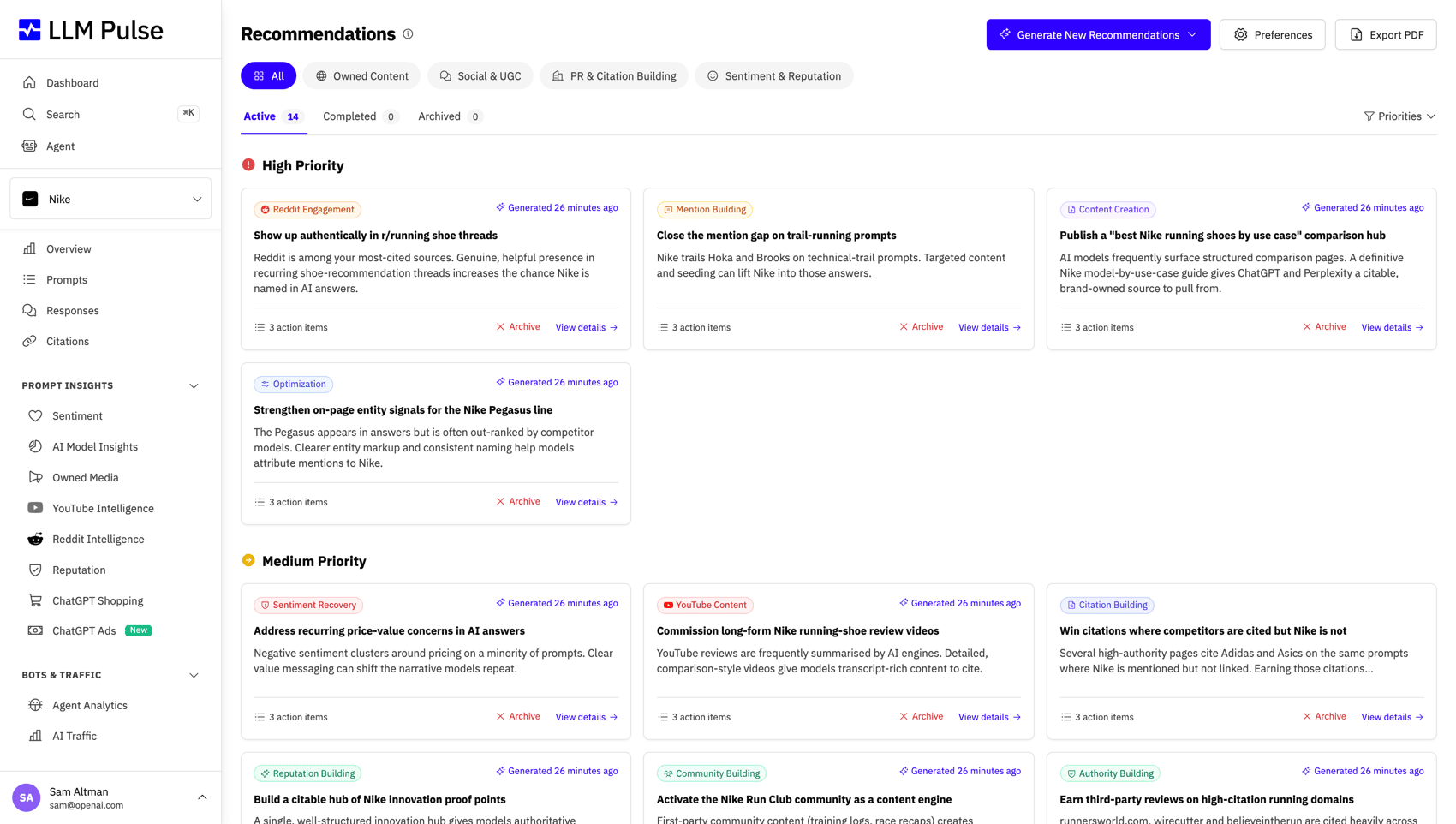
Features
Data-Driven Content Strategy
Recommendations analyzes your tracked prompts, AI-cited URLs, and your existing content to generate actionable, evidence-based recommendations for improving AI visibility.
Analyze Your Prompt & Citation Data
We gather your tracked prompts (up to 30), cited URLs (up to 30), and your own website pages (up to 25) to understand your current visibility landscape.
GPT-Generated Action Items
Using GPT with your actual data as context, we generate specific, evidence-based recommendations for content creation, optimization, authority building, and technical improvements.
Evidence-Linked Recommendations
Each recommendation includes source_refs linking back to specific prompts (P1, P2...), citations (C1, C2...), and your content (O1, O2...). See exactly why each recommendation was made.
High/Medium/Low Priority
Recommendations are categorized by priority, high (significant impact), medium (valuable improvement), low (nice-to-have). Focus your efforts where they matter most.
Organized by Type
Recommendations fall into four categories, content_creation (new content), optimization (improve existing), authority (build signals), and technical (infrastructure improvements).
Specific Action Steps
Each recommendation includes concrete action_items, specific steps to implement the suggestion. No vague advice, just clear next actions.
How Recommendations Works
Analyze your data and generate evidence-based recommendations
-
1
Gather Data
We collect your tracked prompts (up to 30), cited URLs (up to 30), your website pages (up to 25), competitor data, and live site metadata.
-
2
Build Context
Data is indexed (P1, P2... for prompts, C1, C2... for citations, O1, O2... for your content) and sent to GPT with detailed instructions.
-
3
Generate Recommendations
GPT analyzes the context and generates prioritized recommendations across content creation, optimization, authority, and technical categories.
-
4
Review & Act
Each recommendation includes priority, action_items, and source_refs linking to the evidence. Focus on high-priority items first.
Recommendations Use Cases
How teams use Recommendations for data-driven strategy
Content Teams
Get specific content briefs based on citation gaps. Know exactly what topics to cover and why, with links to the evidence.
SEO & AEO Teams
See which of your pages could be optimized for better AI citation. Recommendations link to specific prompts where you're not cited.
Strategy Teams
Prioritize content investments based on data. High-priority recommendations show where you'll get the most visibility improvement.
Technical Teams
Get technical recommendations for improving how AI can access and understand your content. Structured data, schema, crawlability.
"LLM Pulse is a pioneering response to the need to measure performance across different LLMs. At TecnoCampus we need maximum transparency, the ability to parameterize results and to carry out visibility audits for our brand, now also in the increasingly established field of AI. LLM Pulse gives us all of that in a single place."

Frequently Asked Questions
Technical details about how Recommendations generates actionable insights.
Ready to optimize your content?
Generate a Recommendations report and get specific action items to improve your AI visibility.
Trusted by 7,000+ users worldwide