What Score Does AI Give Zelda: Ocarina of Time? We Asked 4 AIs in 10 Countries

By Daniel Peris




Table of contents
The Legend of Zelda: Ocarina of Time came out on Nintendo Switch 2 on November 5, 2026, and the reviews followed the usual ritual: a poster full of 10/10s and 5/5s from outlets around the world, and a Metascore of 96.
But a growing share of players will never read those reviews. They will ask an AI: is it worth it? So we asked the AI the question critics answer for a living: what score would you give it?
We asked four AI platforms, in ten countries and ten languages, and recorded every score and every source they used. The short version: AI agrees on what the critics said, not on its own score, and the opinion it gives depends on which local media it reads in each country.
How we ran the study
We set up one LLM Pulse project with two prompts, translated into the local language of each market:
- "What score from 0 to 10 would you give The Legend of Zelda: Ocarina of Time for Nintendo Switch 2? Reply with the score and one sentence."
- "What average score have critics given The Legend of Zelda: Ocarina of Time for Nintendo Switch 2?"
| Parameter | Value |
|---|---|
| Prompts | 2 per country (the AI's own score and the critics' average) |
| AI platforms | ChatGPT, Perplexity, Gemini, Google AI Mode |
| Countries | Spain, Mexico, United States, United Kingdom, Germany, France, Italy, Brazil, Japan, Netherlands |
| Languages | The local language of each country (Spanish, English, German, French, Italian, Portuguese, Japanese, Dutch) |
| Answers analyzed | 76 (37 own scores, 39 critic averages) |
| Runs | One run per prompt, November 10, 2026 |
ChatGPT had not returned three answers when we closed the data (its own score in Mexico and Brazil, and the critics' average in Brazil), so those cells are empty and the Mexico and Brazil averages use three platforms. We left Google AI Overviews out of the scores, since it summarizes search results rather than answering as an assistant (in Germany it declined to give a score at all).
A single run is a snapshot, not a trend: AI answers vary from one run to the next, as we showed when we asked Claude the same buying questions 18 times. Read the scores below as what each AI said on that day.
The critics' score: total agreement
All 39 answers to the second prompt gave the same number: 96/100 on Metacritic. The details varied (the number of reviews ranged from 81 to 95, and some answers added OpenCritic at 95 or 96, or Famitsu's 37/40), but every AI, in every country and language, landed on 96.
When a fact is published widely and consistently, AI reports it consistently. Opinions are a different story.
The AI's own score: from 9 to 10
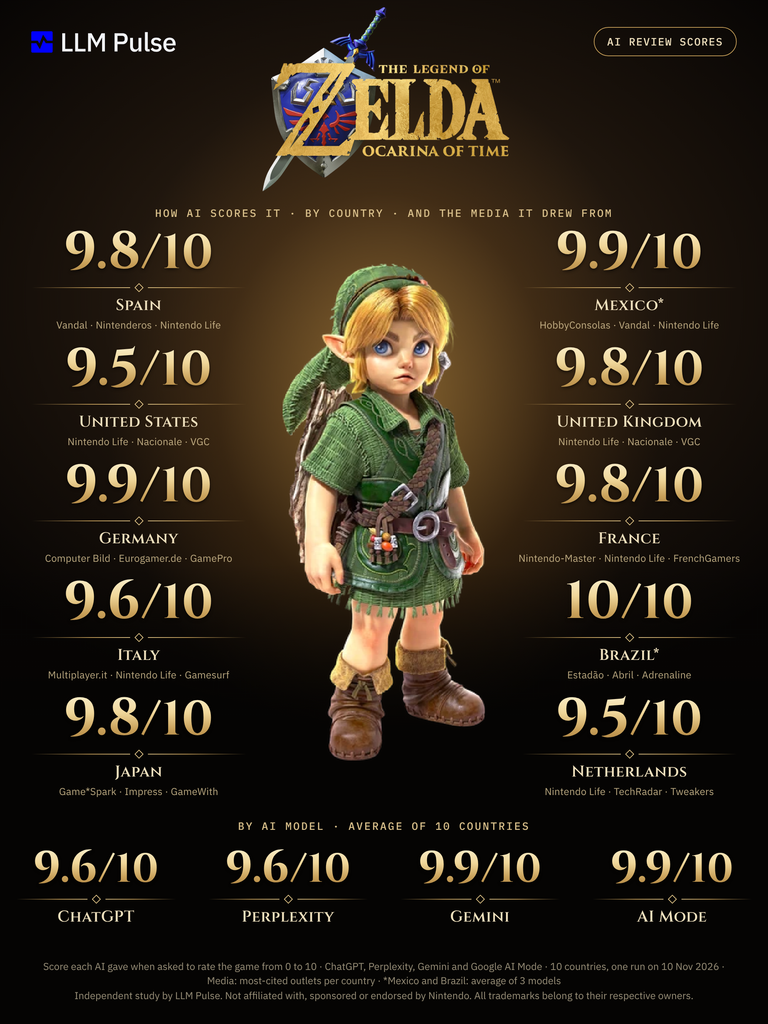
Asked for their own score, the AIs did not agree. Scores ranged from 9 to 10, and 20 of the 37 answers gave a perfect 10/10.
| Country | ChatGPT | Perplexity | Gemini | AI Mode | Average |
|---|---|---|---|---|---|
| Spain | 9.5 | 9.7 | 10 | 10 | 9.8 |
| Mexico | n/a | 9.6 | 10 | 10 | 9.9 ‡ |
| United States | 9.5 | 9.6 | 9 | 10 | 9.5 |
| United Kingdom | 9.5 | 9.6 | 10 | 10 | 9.8 |
| Germany | 10 | 10 | 10 | 9.5 | 9.9 |
| France | 9.5 | 9.5 | 10 | 10 | 9.8 |
| Italy | 9.5 | 9.5 | 9.5 | 10 † | 9.6 |
| Brazil | n/a | 10 | 10 | 10 | 10 ‡ |
| Japan | 10 | 9 | 10 | 10 | 9.8 |
| Netherlands | 9.5 | 9 | 10 | 9.5 | 9.5 |
| Average | 9.6 | 9.6 | 9.9 | 9.9 |
† AI Mode in Italy answered, literally, "10/11". We counted it as a 10.
‡ Average of three platforms (no ChatGPT answer).
By AI platform
- Google's AIs are the most generous. AI Mode and Gemini average 9.9, with eight perfect 10s each out of ten countries.
- ChatGPT settles on 9.5. It gave a 9.5 in six of the eight countries where it answered, and a 10 in Germany and Japan.
- Perplexity is just as strict, also at 9.6, and the only platform that gave a 9 in two countries (Japan and the Netherlands).
By country
- Brazil gives a unanimous 10. All three AIs that answered gave a perfect score in Portuguese.
- Germany and Mexico follow at 9.9, then Spain, the UK, France and Japan at 9.8.
- The US and the Netherlands are the toughest markets, at 9.5. In the US, Gemini gave its only 9 of the study.
Same game, same question, and the average moves half a point depending on the language you ask in.
Where the AI's opinion comes from
The more interesting question is not the score, but what each AI uses to justify it. The citations behind each answer show four very different behaviors:
- Perplexity does not have an opinion, it borrows one. Its 9.6 in the US, UK and Mexico is the Metacritic 96 divided by 10, and it says so: in English it explained its score as critics averaging 96/100 and players rating it 9.6.
- AI Mode justifies its score with the official product page. In Spain, Mexico, the US, France, Italy and Brazil, the source behind its 10/10 was Nintendo's own store or game page.
- ChatGPT reads reviews. Its most-cited source for its own score was the Nintendo Life review, plus local reviews such as jeuxvideo.com in France and Tweakers in the Netherlands. In Germany and Japan, it gave a 10 without citing anything.
- Gemini often cites shops. Several of its scores came with a store or price-comparison page as the only source (a retailer in Mexico, idealo in France, Kakaku in Japan), or with no source at all.
This matches what we saw in our pre-launch study of who AI cites about the remake: every AI platform has its own idea of which sources matter.
The local media AI drew from in each country
Across both prompts, the AIs leaned heavily on local outlets in each market. These are the most-cited editorial outlets per country (we excluded Metacritic and OpenCritic, Nintendo's own site, Reddit, YouTube, social networks, retailers and Wikipedia):
| Country | Most-cited outlets |
|---|---|
| Spain | Vandal, Nintenderos, Nintendo Life |
| Mexico | HobbyConsolas, Vandal, Nintendo Life |
| United States | Nintendo Life, Nacionale, VGC |
| United Kingdom | Nintendo Life, Nacionale, VGC |
| Germany | Computer Bild, Eurogamer.de, GamePro |
| France | Nintendo-Master, Nintendo Life, FrenchGamers |
| Italy | Multiplayer.it, Nintendo Life, Gamesurf |
| Brazil | Estadão, Abril, Adrenaline |
| Japan | Game*Spark, Impress (Game Watch), GameWith |
| Netherlands | Nintendo Life, TechRadar, Tweakers |
Two patterns stand out:
- Nintendo Life is the closest thing to a global source. It appears in the top three of six countries, in five different languages.
- Language decides the rest. Spanish-language answers in Mexico cite Spanish outlets like Vandal and HobbyConsolas. Japanese answers stay almost entirely within Japanese sites. Several of these outlets (Nintenderos, Multiplayer.it, Eurogamer and GamePro among them) also appear on the official review poster, so the AI's opinion is, in part, the press's opinion translated.
Samples per country are small (about eight to ten answers), and the outlet counts include Google AI Overviews answers collected in the same run, so read this as a map of which outlets show up, not a precise ranking. For a larger-scale view of the same effect, see our analysis of the news outlets AI cites most.
Two answers worth a screenshot
- AI Mode in Italy scored the game "10/11". It then cited Nintendo's Italian product page as its source.
- Gemini in Brazil may have rated the wrong game. It gave a 10 and then offered to explain the technical improvements the game "would get" on Switch 2, as if the remake did not exist yet.
What this means for your brand
This is a study about a video game, but the mechanics apply to any product people ask AI about.
- AI does not have an opinion, it has sources. When you ask for a verdict, each AI rebuilds one from what it reads: aggregators for Perplexity, official pages for AI Mode, reviews for ChatGPT, shops for Gemini.
- Facts converge, opinions do not. The Metascore was identical in every answer. The AI's own score moved half a point by country and by platform.
- Every market has its own sources. The outlets shaping the answer in Japan are not the ones shaping it in Germany or Spain. If you sell in several countries, you need to know who AI reads in each one.
- Your own pages count. Google's AI Mode used the official product page as evidence for a 10/10 in six countries. Clear, complete product pages are part of how AI forms its verdict.
The practical step is to check your brand the same way: the same prompt, in every market and language you sell in, on every AI platform, and look at the sources behind each answer. Our guide to choosing the prompts you track explains how to build that set, and how to measure AI visibility without fooling yourself covers how to read single runs like this one.
Run this study for your own brand
This whole study came out of one LLM Pulse project: 20 prompts across 10 countries, the five base AI platforms included in every plan, and the Sources view to see what each answer was built on. LLM Pulse tracks any country and language at no extra cost, starting from €49/mo.
Start your 14-day free trial, no sales call needed, or see pricing.
Independent study by LLM Pulse. Not affiliated with, sponsored or endorsed by Nintendo. All trademarks belong to their respective owners. Data reflects AI answers collected on November 10, 2026, in one run per prompt; AI answers change over time.
Frequently asked questions
What score does AI give The Legend of Zelda: Ocarina of Time on Switch 2?
Across ChatGPT, Perplexity, Gemini and Google AI Mode in 10 countries, the AIs' own scores ranged from 9 to 10, and 20 of 37 answers gave a perfect 10/10. AI Mode and Gemini averaged 9.9, and ChatGPT and Perplexity 9.6.
What critic score does AI report for the remake?
All 39 answers reported a Metacritic score of 96/100, in every country and language we tested. Some answers also mentioned OpenCritic (95 or 96) and Famitsu's 37/40.
Does the score change by country or language?
Yes. The average went from 10 in Brazil to 9.5 in the United States and the Netherlands, with the same prompt translated into each local language. Each country's answers also leaned on different local outlets.
Which sources do the AIs use to justify their score?
It depends on the platform. Perplexity derived its score from the Metacritic average, Google AI Mode cited Nintendo's official product pages, ChatGPT cited reviews such as Nintendo Life's, and Gemini often cited store pages or no source at all.
How was this study done?
We used LLM Pulse to run two prompts (the AI's own score and the critics' average) in 10 countries and their local languages on ChatGPT, Perplexity, Gemini and Google AI Mode, in a single run on November 10, 2026. Scores reflect that one run, and AI answers can change between runs.
Is this study affiliated with Nintendo?
No. This is an independent study by LLM Pulse and it is not affiliated with, sponsored or endorsed by Nintendo. All trademarks belong to their respective owners.
Can I run the same analysis for my own brand?
Yes. LLM Pulse lets you run the same prompts in any country and language, compare answers across AI platforms and see the sources behind each one. Plans start at €49/mo with a 14-day free trial.






Discover your brand's visibility in AI search effortlessly
Daniel Peris
Daniel Peris is a serial entrepreneur and one of the Co-Founders of LLM Pulse. With a strong background in SEO and ASO, he has spent over 15 years building and scaling digital businesses. He brings extensive experience in SaaS, both in product and growth, focusing on refining the product and executing growth strategies.
- What Score Does AI Give Zelda: Ocarina of Time? We Asked 4 AIs in 10 Countries
- Best AI Search Engines in 2026 (ChatGPT, Perplexity, Gemini, Claude)
- Best Keyword.com alternatives for AI tracking in 2026
- The Legend of Zelda: Ocarina of Time Remake: Who AI Cites (Pre-Launch Study)
- Best LLM Monitoring Tools in 2026 (Brand Visibility, Not Observability)