




Last updated: September 14, 2026
AI answers are becoming a primary place people discover what to read. When someone asks ChatGPT or Google’s AI which laptop to buy or how to pick travel insurance, the sources those answers cite are the new front page. So we looked at which news and media outlets the AI engines actually reach for.
Table of Contents
LLM Pulse analyzed 5,348,765 citations from 470,380 AI answers to generic, non-branded questions tracked in the United States, collected between April 12 and July 10, 2026 across ChatGPT, Google AI Mode, Google AI Overviews, Gemini and Perplexity, plus a small volume from Copilot. We tagged every citation that pointed to a news or media outlet (editorial publications that employ journalists) and ranked them. You can explore the full interactive study at llmpulse.ai/data-studies/top-us-news-outlets. Here is what the AI engines actually read.
Headline findings
- AI answers cite the press less than you would think: just 3.26% of all citations go to news and media outlets. The other 96.7% goes to Reddit, YouTube, retailers, product pages, academic and government sources, review platforms, and company sites. When AI does reach for a publisher, it is not usually a newspaper.
- TechRadar is the single most-cited news outlet in US AI answers, ahead of Forbes, PCMag and Mashable. The New York Times ranks 10th. TechRadar collected 14,311 citations, nearly 4 times the NYT’s 3,628. AI answers reward hands-on product and service journalism over hard news.
- Tech media dominates the press that AI cites: 51.9% of all news-outlet citations go to technology publications. Business and finance media take 18.8%, national and legacy news 11.7%, lifestyle and consumer 8.2%, entertainment and gaming 5.0%, sports 3.8%.
- Gemini and ChatGPT lean on the press most, not Perplexity. Share of citations going to news outlets by engine: Gemini 4.63%, ChatGPT 4.31%, Copilot 4.24%, Perplexity 3.10%, Google AI Mode 2.92%, Google AI Overviews 2.75%. The two Google AI surfaces, which produce the most citations overall, lean on journalism the least.
- Each engine has a favorite outlet. ChatGPT sends 18.5% of its news citations to TechRadar alone. Gemini leans hardest on PCMag (16.5%). Google’s AI surfaces favor Mashable, PCMag and U.S. News. Perplexity is the one engine where The New York Times over-indexes, at 2.8 times its overall share.
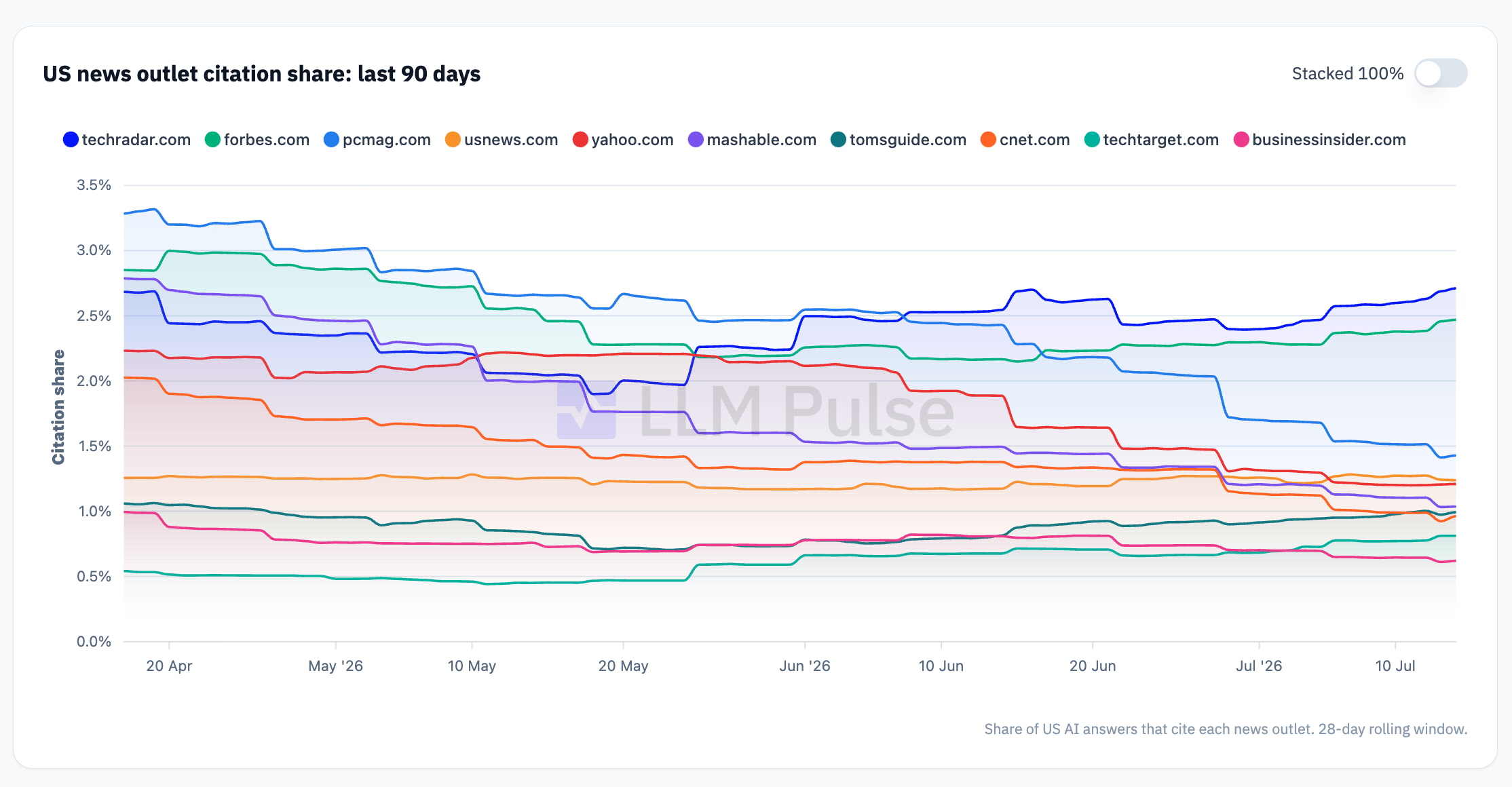
The 25 most-cited news and media outlets
Ranked by citations across all six engines. “Share of news” is the outlet’s share of all news-outlet citations. “Share of all” is its share of every citation in the dataset. “Avg. position” is the mean rank of the citation inside the answer, where lower is more prominent. The full ranking of all 102 outlets is in the full interactive study.
| # | Outlet | Category | Citations | Share of news | Share of all | Avg. position |
|---|---|---|---|---|---|---|
| 1 | TechRadar | Tech | 14,311 | 8.21% | 0.268% | 4.3 |
| 2 | Forbes | Business/Finance | 12,294 | 7.05% | 0.230% | 5.78 |
| 3 | PCMag | Tech | 11,371 | 6.52% | 0.213% | 7.07 |
| 4 | Mashable | Tech | 11,227 | 6.44% | 0.210% | 6.92 |
| 5 | Yahoo (News/Finance) | Business/Finance | 8,396 | 4.82% | 0.157% | 9.56 |
| 6 | U.S. News & World Report | National/Legacy | 7,021 | 4.03% | 0.131% | 7.22 |
| 7 | CNET | Tech | 6,353 | 3.65% | 0.119% | 8.36 |
| 8 | Tom’s Guide | Tech | 5,303 | 3.04% | 0.099% | 2.77 |
| 9 | TechTarget | Tech | 3,714 | 2.13% | 0.069% | 4.5 |
| 10 | The New York Times | National/Legacy | 3,628 | 2.08% | 0.068% | 8.75 |
| 11 | Business Insider | Business/Finance | 3,468 | 1.99% | 0.065% | 8.09 |
| 12 | WIRED | Tech | 2,427 | 1.39% | 0.045% | 8.74 |
| 13 | Cybernews | Tech | 2,206 | 1.27% | 0.041% | 7.28 |
| 14 | ZDNET | Tech | 2,174 | 1.25% | 0.041% | 5.87 |
| 15 | Fortune | Business/Finance | 2,157 | 1.24% | 0.040% | 6.79 |
| 16 | Gizmodo | Tech | 2,140 | 1.23% | 0.040% | 6.81 |
| 17 | MakeUseOf | Tech | 2,129 | 1.22% | 0.040% | 3.79 |
| 18 | XDA Developers | Tech | 2,127 | 1.22% | 0.040% | 10.0 |
| 19 | Glamour | Lifestyle/Consumer | 2,126 | 1.22% | 0.040% | 6.13 |
| 20 | Consumer Reports | Lifestyle/Consumer | 2,090 | 1.20% | 0.039% | 4.81 |
| 21 | GamesRadar+ | Entertainment & Gaming | 1,801 | 1.03% | 0.034% | 2.9 |
| 22 | How-To Geek | Tech | 1,764 | 1.01% | 0.033% | 4.07 |
| 23 | Creative Bloq | Tech | 1,647 | 0.94% | 0.031% | 6.08 |
| 24 | Stuff | Tech | 1,593 | 0.91% | 0.030% | 5.36 |
| 25 | CNBC | Business/Finance | 1,573 | 0.90% | 0.029% | 8.64 |
Per-engine press diets
The engines do not read the same publications.
ChatGPT is the most concentrated. TechRadar (18.5% of its news citations), Forbes (8.7%) and Tom’s Guide (8.4%) dominate. Tom’s Guide, TechTarget, Reuters and Axios all over-index on ChatGPT versus their overall share.
Google AI Mode spreads wider: Mashable (8.7%), Yahoo (8.0%), PCMag (7.3%), Forbes and U.S. News (6.2% each). SportsLine, USA Today and Baseball America over-index here, a sports and national-news tilt.
Google AI Overviews looks similar to AI Mode: Mashable (9.4%), PCMag (8.1%), U.S. News (7.1%), Forbes (6.4%). The Financial Times over-indexes on Overviews.
Gemini is a tech monoculture: PCMag (16.5%), Mashable (10.7%), TechRadar (9.7%), Forbes (9.2%). ZDNET over-indexes 3.8 times here and Stuff 3.0 times.
Perplexity cites the widest mix of traditional news. PCMag (10.1%) and TechRadar (7.1%) still lead, but The New York Times is 3rd (5.7%) and over-indexes 2.8 times versus every other engine. If any engine rewards traditional journalism, it is Perplexity, though it still leans tech-first.
Copilot produces few citations, and they skew to gaming media (Game Rant, TheGamer).
Who wins each category
- Tech (51.9% of news citations): TechRadar (14,311), PCMag (11,371), Mashable (11,227).
- Business and finance (18.8%): Forbes (12,294), Yahoo News/Finance (8,396), Business Insider (3,468).
- National and legacy news (11.7%): U.S. News & World Report (7,021), The New York Times (3,628), The Guardian (1,340).
- Lifestyle and consumer (8.2%): Glamour (2,126), Consumer Reports (2,090), Good Housekeeping (994).
- Entertainment and gaming (5.0%): GamesRadar+ (1,801), GameSpot (1,148), Game Rant (1,140).
- Sports (3.8%): RotoWire (1,218), FOX Sports (1,048), SportsLine (1,001).
Within national and legacy news, the story is that a rankings-and-reviews brand, U.S. News & World Report, beats every traditional newspaper. Its “best of” content (best colleges, best cars, best insurance) matches exactly the kind of question AI answers most often.
Notable findings
- Service journalism beats hard news. The top of the list is “best X” and “how to Y” publishing: TechRadar, PCMag, Mashable, Tom’s Guide, CNET, TechTarget. Outlets built on breaking news and reporting (NYT, CNN, NBC News, Reuters, USA Today) sit far lower. AI answers are mostly recommendations and explanations, and they cite the outlets that write recommendations and explanations.
- Forbes is the broadest outlet in AI answers. It turns up across more distinct subject areas than any other outlet, ahead of Yahoo and TechRadar. Its mix of contributor and staff content spans nearly every subject an AI answer might cover.
- Prominence differs from volume. Good Housekeeping (avg. position 2.06), Game Rant (1.57) and Android Authority (2.08) are cited less often but land near the top of answers when they appear. TechRadar and Tom’s Guide combine high volume with strong average position (4.3 and 2.77), a rare double.
- Yahoo is bigger than it looks. Grouping Yahoo News, Yahoo Finance and Yahoo’s other editorial into one outlet puts it 5th overall with 8,396 citations, a reminder that syndication and aggregation still earn AI citations.
- Gaming and sports media punch above their reputation. GamesRadar+, GameSpot, Game Rant, RotoWire and FOX Sports each clear 1,000 citations. Niche, high-output verticals get cited when the question is niche.
Methodology
Every citation is a link that one of six AI engines (ChatGPT, Google AI Mode, Google AI Overviews, Gemini, Perplexity, and a small volume from Copilot) placed in an answer to a question tracked in LLM Pulse. We restricted the dataset to citations shown to US users, tied to generic non-branded questions (for example “best travel insurance” or “how to speed up a laptop”, not questions naming a specific brand), collected in the 90 days ending July 10, 2026. We excluded citations pointing to a tracked brand’s own domain and citations flagged as belonging to a tracked competitor (competitor links were 0.36% of the base and do not affect the ranking). That leaves 5,348,765 citations from 470,380 AI answers to 16,973 distinct questions.
We counted editorial publications that employ journalists and produce news, reporting, reviews or service journalism, and grouped all of an outlet’s domains and editions into one entry (for example Yahoo Finance and Yahoo News both count as Yahoo). We deliberately excluded user-generated and social platforms (Reddit, YouTube, Medium, Quora, LinkedIn, TikTok), reference sites (Wikipedia), academic and government sources, retail and marketplace pages, software and review directories, health-information publishers (Healthline, WebMD, Mayo Clinic and the like), personal-finance reference sites, and press-release wires. Reasonable analysts could move some of these across the line. We chose a tight definition of “outlet employing journalists to produce journalism” and documented every exclusion so the ranking is reproducible. These are questions brands choose to monitor, so the topic mix reflects those interests rather than all questions people ask AI. Citation frequency measures source selection in this dataset, not editorial quality or trust.
About LLM Pulse
LLM Pulse is an all-in-one AI search visibility platform. It tracks how brands appear in AI answers across ChatGPT, Google AI Mode and AI Overviews, Gemini, Perplexity, Copilot and other LLMs: which questions surface you, which sources the models cite, where you rank inside answers, and how sentiment and share of voice move over time. Teams use LLM Pulse to measure and grow their presence in AI search the way they once measured and grew their presence in Google.
FAQ
Which news outlet do AI engines cite most?
TechRadar is the single most-cited news outlet in US AI answers, with 14,311 citations across ChatGPT, Gemini, Perplexity and Google’s AI surfaces. It ranks ahead of Forbes, PCMag and Mashable, and is cited nearly four times as often as The New York Times.
How often do AI answers cite news and media outlets?
Rarely. Only 3.26% of all AI citations go to news and media outlets. The other 96.7% points to sources like Reddit, YouTube, retailers, product pages, review platforms, and academic or government sites.
Why does tech media get cited more than traditional newspapers?
AI answers are mostly recommendations and explanations, so they favor service journalism (“best X”, “how to Y”) over hard news. Tech publications take 51.9% of all news-outlet citations, while breaking-news outlets like The New York Times, CNN and Reuters rank far lower.
Which AI engine cites the press the most?
Gemini leans on news outlets most, with 4.63% of its citations going to the press, followed by ChatGPT (4.31%) and Copilot (4.24%). Google AI Overviews cites journalism the least, at just 2.75%.
Do different AI engines prefer different news outlets?
Yes. ChatGPT sends 18.5% of its news citations to TechRadar alone, Gemini leans hardest on PCMag (16.5%), and Google’s AI surfaces favor Mashable and U.S. News. Perplexity is the only engine where The New York Times over-indexes, at 2.8 times its overall share.