ChatGPT Business Hub doesn't count your brand mentions. Here's what it counts instead

By Esteve Castells




Table of contents
OpenAI's Business Hub went live on November 10 with a tile many marketers had been asking for: how many times ChatGPT mentioned your business. The fine print says that number doesn't mean what most of the industry means by a mention.
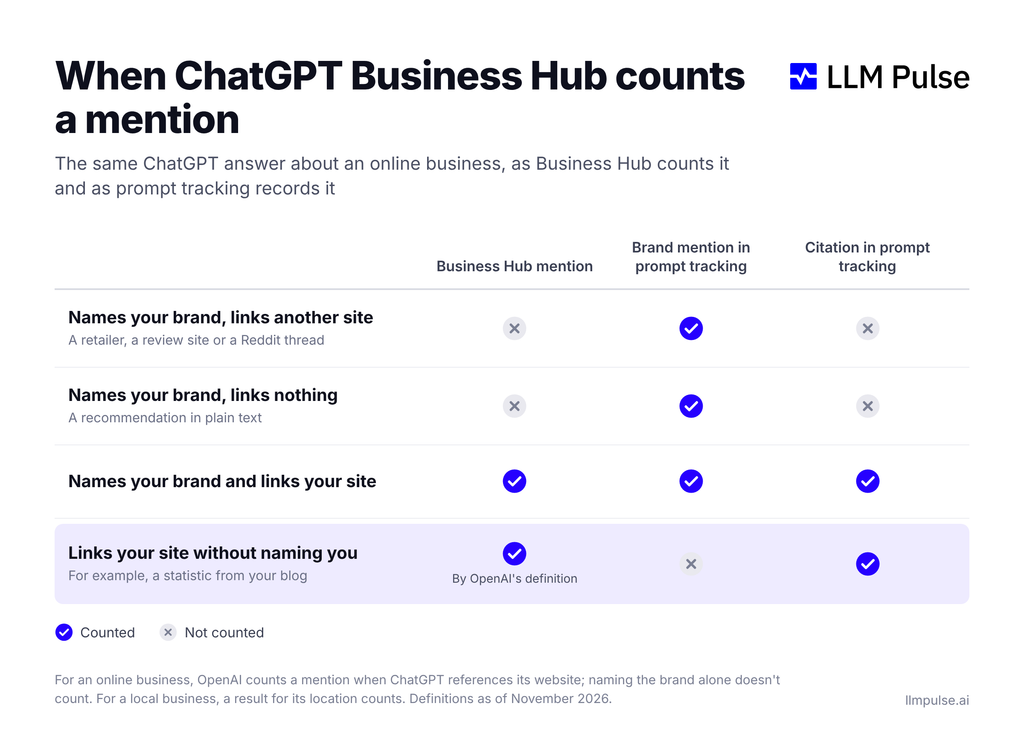
"Just naming the brand doesn't count," an OpenAI spokesperson told Digiday. For an online business, a mention in Business Hub is a reference to its website. If ChatGPT recommends your product by name and links a retailer, a review site or nothing at all, your count doesn't move.
If you haven't set up Business Hub yet, start with our guide to claiming your business in ChatGPT.
How OpenAI defines a mention
The spokesperson gave Digiday two definitions, one per type of business:
- Online businesses: a mention counts when ChatGPT references the business's website. Naming the brand alone doesn't count.
- Local businesses: a mention counts when ChatGPT shows a result for that location, even if the person never opens the listing or visits the website.
The other numbers in Insights are defined just as narrowly. Website clicks are "clicks on links from supported ChatGPT surfaces, not completed visits or purchases," the spokesperson said, and the tooltip in Business Hub repeats that clicks "don't confirm website visits or conversions." Discovery topics are themes from conversations where your website is cited.
PPC Land notes that OpenAI hasn't said whether a business that shows up three times in one conversation gets one mention or three. It also found that the announcement and the sign-up page describe discovery topics in slightly different terms.
Business Hub mentions are closer to citations
Tools that track AI answers usually separate two things. A brand mention is your name appearing in the answer. A citation is a link to a page that ChatGPT used as a source. For an online business, Business Hub's "mentions" behave like the second: they follow your domain, not your name.
Developer Flavio Copes saw the gap in his first-hand test of the launch. Logged out, from Italy, he asked ChatGPT for a good pair of wool running socks and where to buy them online. ChatGPT recommended Bridgedale and Injinji by name but linked a retailer's website instead of theirs, and Bergfreunde, a retailer that wasn't among the recommended brands, was linked four times. Going by OpenAI's definition, that answer would count as a mention for Bergfreunde and not for Bridgedale or Injinji.
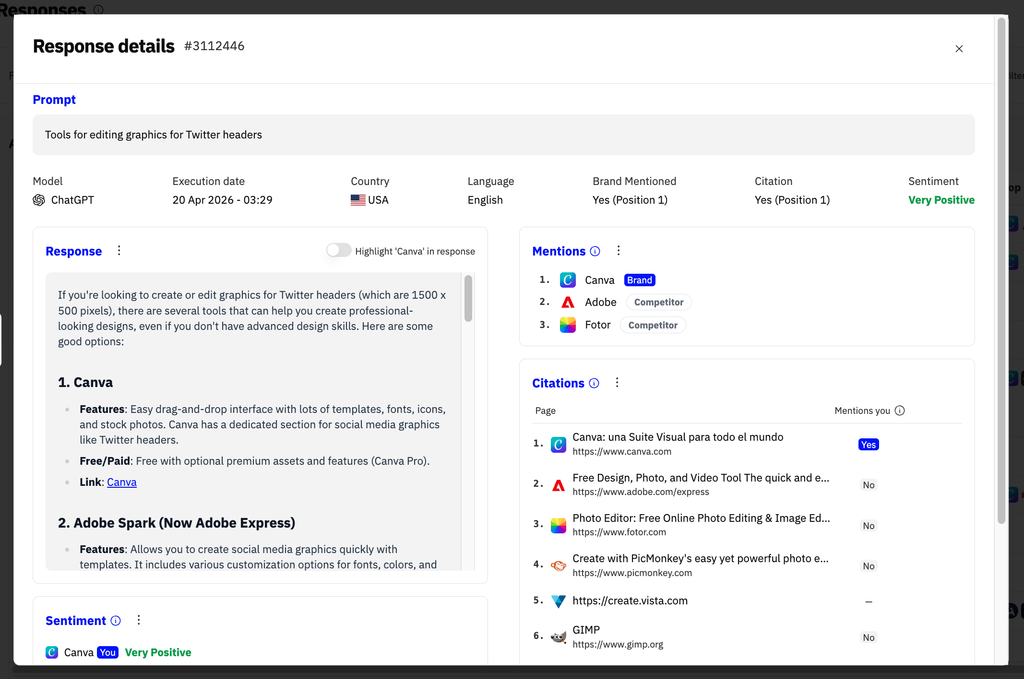
Our own tracking keeps the two apart. In this ChatGPT answer from LLM Pulse, Canva is mentioned in position 1 and its site is cited in position 1, and those are recorded as two separate facts. Business Hub would only see the second one:
Who loses out under this definition
The definition rewards whoever owns the link. That shifts the numbers in predictable ways:
- Brands sold through retailers and marketplaces. When ChatGPT recommends your product and links the store that sells it, the store collects the mention.
- Software and B2B brands named in lists. Comparison answers often name several vendors and cite review sites, publishers or forums. Every vendor named without its own link gets nothing.
- Brands with a reputation problem. A critical mention without a link is invisible in Business Hub, and those are the mentions you most need to see.
- Brands that are recommended from memory. When ChatGPT answers without searching the web, it may name you and cite nothing at all.
It also works the other way. A publisher or a company with a well-read blog can rack up mentions from answers that cite one of its articles for a statistic and never recommend it. By OpenAI's definition, those count.
Why OpenAI may have chosen it
There are reasonable arguments for counting links. A link to a verified domain is unambiguous, while matching brand names is messy: names like Notion, Gap or Apple collide with ordinary words, products go by nicknames and spellings drift. An online business is set up in Business Hub from its website, so domain references map cleanly to the account.
There's also a commercial reading. OpenAI sells ads, and the case for advertising in ChatGPT rests on ChatGPT sending people to websites. A dashboard built around references to your site and clicks to it tells that story well. We made the broader case before launch, in why ChatGPT's console won't bring keywords back: the platforms that share data tend to share the data that supports their ad business.
Either way, the number on the tile and the number in your AI visibility report measure different things.
The other limits worth knowing
Blank doesn't mean zero. Insights only appear once there are enough conversations or interactions, and low counts can be withheld for privacy. A small business may see nothing for a while.
The windows are short. People with access describe seven-day and 28-day views. If you want a trend, record the numbers yourself.
Don't benchmark against the demo. OpenAI's sample dashboard shows 15,356 mentions and 5,432 clicks in seven days, roughly one click for every three mentions. One of the first live dashboards shared publicly, reported by PPC Land, showed 690 mentions and 24 clicks over 28 days, a click rate of about 3.5%.
Clicks won't match your analytics. Business Hub records clicks on links, not visits. Your analytics records visits, and since October 9 many ChatGPT visits arrive with no referrer or UTM tag and land in Direct. Expect the two numbers to disagree.
There's no context. Insights shows no prompts, competitors, share of voice or sentiment, and no assistant other than ChatGPT.
It will tell you how often you appeared and how many clicks you got from ChatGPT. It won't tell you in which conversations, which sources were cited, who was recommended instead of you or what was said about you. Decisions get made with exactly that.
 Esteve Castells Co-founder, LLM Pulse
How to report Business Hub next to your own tracking
Treat Business Hub as a new data source with its own definitions, and label it that way in every report.
| What happened in the answer | Business Hub | Prompt tracking |
|---|---|---|
| ChatGPT names your brand | Not counted for an online business | Brand mention |
| ChatGPT links your website | Mention | Citation |
| Someone clicks your link | Website click | Visits come from your analytics |
| A competitor is recommended | Not shown | Competitor mention and share of voice |
| What the answer said about you | Not shown | Full answer and sentiment |
| Assistant covered | ChatGPT | ChatGPT and the other assistants you track |
Three habits help:
- Rename the metric internally. Call it "ChatGPT website references" in dashboards and slides. If leadership sees "mentions" in two reports with two very different numbers, they'll trust neither.
- Track named brands separately. The answers where ChatGPT names you without linking you are the ones Business Hub can't see. LLM Pulse records the entities ChatGPT names beyond the sources it cites, and our guide to tracking brand mentions in ChatGPT covers how to set up the prompts.
- Use Business Hub to confirm, and your prompt sample to explain. If your website references rise in Business Hub, your tracked answers should show where: more citations of your pages, on which topics, in place of which competitor.
What we'd like OpenAI to add
Businesses in ChatGPT is still in beta, so the definitions may change. Three changes would make it much more useful: a separate count for answers that name the business without linking it, the rule for repeat appearances in a conversation, and published thresholds, so a blank tile can be read correctly.
Until then, the tile tells you how often ChatGPT pointed to your website, which is useful. Whether ChatGPT recommends you is a different question, and you'll need the answers themselves to measure it.
Track the mentions Business Hub doesn't count
See every answer that names your brand, the pages ChatGPT cites and who it recommends instead of you, across every major AI assistant.
Frequently asked questions
Does ChatGPT Business Hub count brand mentions?
Not in the usual sense. OpenAI says naming the brand alone doesn't count. For an online business, Business Hub counts a mention when ChatGPT references the business's website, so an answer that recommends you by name without linking your site doesn't add to your count.
What counts as a mention in ChatGPT Business Hub?
For an online business, a reference to its website in a ChatGPT answer. For a local business, ChatGPT showing a result for its location, even if nobody opens the listing. OpenAI hasn't said how repeat appearances in one conversation are counted.
Is a Business Hub mention the same as a citation?
For an online business it behaves much like one, because it follows references to your domain rather than your name. AI visibility tools usually report brand mentions (your name in the answer) and citations (links to your pages) as separate metrics, and Business Hub's mention is closer to the second.
Why is my Business Hub mentions metric blank?
Insights only appear once there are enough conversations or interactions to pass a reporting threshold, and low counts can be withheld for privacy. A blank tile doesn't necessarily mean zero activity. OpenAI hasn't published the thresholds.
Are Business Hub clicks the same as website visits?
No. Business Hub counts recorded clicks on links to your website from ChatGPT, and OpenAI says they don't confirm visits or conversions. Your analytics counts visits, and many ChatGPT visits now arrive without a referrer or UTM tag, so the two numbers will differ.
Does Business Hub show competitors or share of voice?
No. Insights shows only your own aggregated mentions, profile views, clicks and discovery topics. There are no competitors, no share of voice, no sentiment, no prompts and no data from AI assistants other than ChatGPT.
How do I track the brand mentions Business Hub misses?
Run a fixed set of prompts in ChatGPT on a schedule and record every brand each answer names, separately from the pages it cites. That shows the answers where ChatGPT recommends you without linking your site, and who it recommends instead of you.






Discover your brand's visibility in AI search effortlessly
Esteve Castells
Co-Founder of LLM Pulse and AI search expert. With extensive experience working as an SEO for global brands and large enterprises, he's the subject matter expert building the product to deliver value to our users.
- ChatGPT Business Hub doesn't count your brand mentions. Here's what it counts instead
- The future of AI search data: why ChatGPT's console won't bring keywords back
- Best Tools to Track Competitors in AI Search (2026)
- How to Set Up Alerts for AI Brand Mentions
- Prompt Tracking Explained: How to Choose the Prompts You Track