



Last updated: August 17, 2026
Trakkr.ai has become hard to miss in 2026. The product is a daily AI visibility tracker that monitors how ChatGPT, Claude, Gemini, Perplexity, Grok, DeepSeek, Meta AI, and Google AI Overviews talk about your brand. Alongside the tool, Trakkr publishes a library of reviews covering most other platforms in the category, including ours. Their LLM Pulse Review 2026 calls us “a strong self-serve AI search tracker” while putting forward Trakkr’s own pricing and platform coverage as the alternative pitch.
It is a fair pitch and Trakkr earns a spot in serious shortlists. But the product is not the right fit for every team. Self-serve prompt allowances stay at 50 per brand on Growth, multi-brand support kicks in only at Scale, and the published comparison content naturally tilts in directions you would expect a vendor’s content team to tilt. This guide compares the eight strongest Trakkr alternatives in 2026, with verified pricing pulled from each vendor’s pricing page, honest feature notes, and a head-to-head at the end.
Table of Contents
Why teams look for Trakkr alternatives
Trakkr is not a bad tool. The reasons people shortlist alternatives usually come down to four friction points.
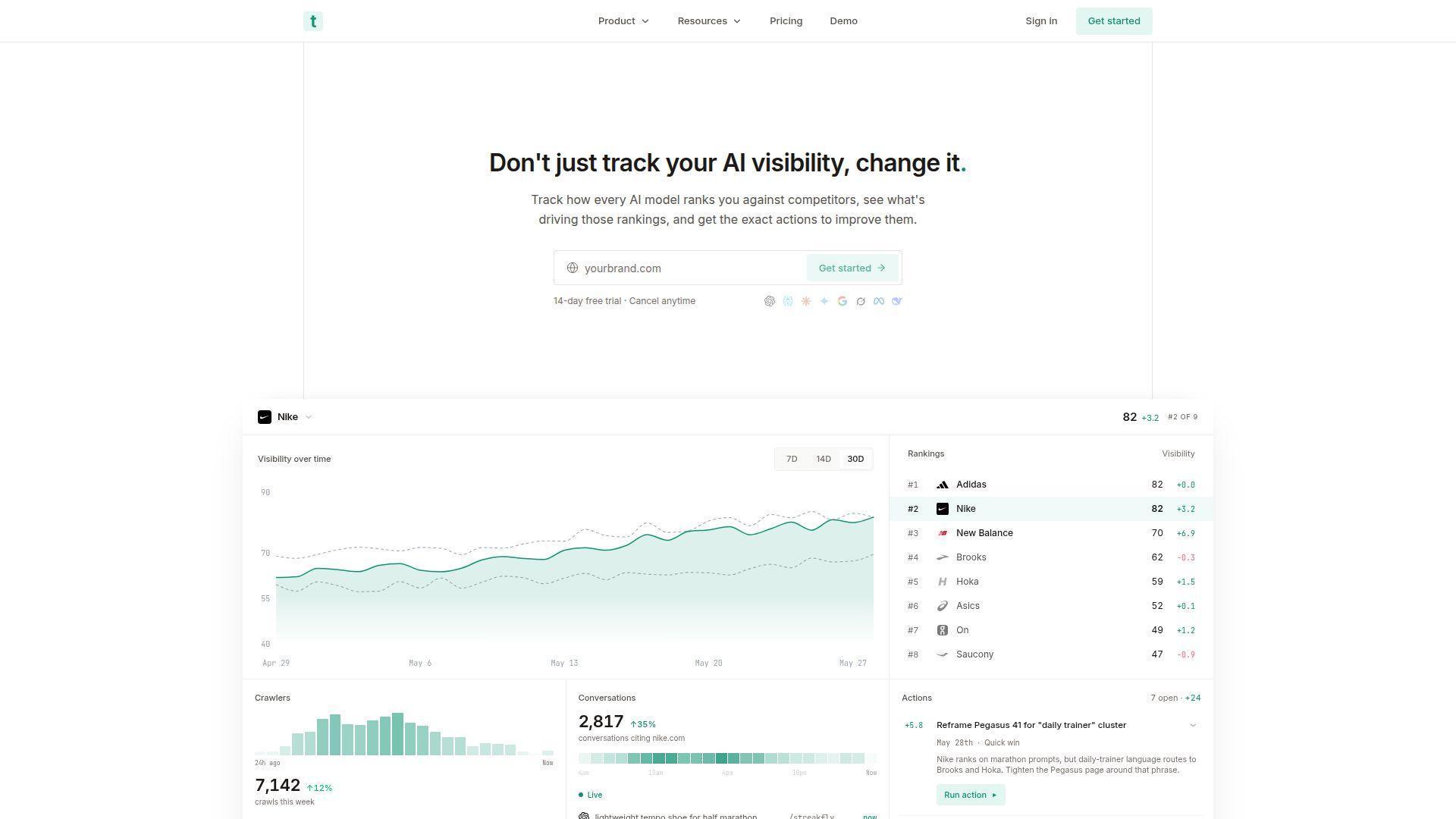
Prompt allowances stay fixed per brand. Growth tracks one brand with 50 prompts at $100/month. Scale tracks ten brands with 50 prompts per brand at $500/month, so teams should compare brand count as well as prompt count.
Multi-brand support is gated. Growth covers one brand. Scale covers ten brands and adds API access and unlimited seats. White-label is an optional $49-per-client add-on.
Marketed model coverage is broad but depth is uneven. Trakkr advertises eight AI models. Sentiment per response at the granularity many teams want is not the same as listing them on a feature table. Pressure-test in trial.
The published reviews are content marketing, not neutral analysis. Trakkr’s review pages tend to land on Trakkr-favourable conclusions, normal for vendor content but worth triangulating.
Evaluation criteria
The shortlist below is judged on the seven criteria that actually determine whether an AI visibility tool is useful day to day, rather than feature checkboxes.
- Model coverage: how many AI engines are tracked on the entry tier, and whether the ones that matter (ChatGPT, Perplexity, Gemini, Google AI Overviews, Google AI Mode) are all included without paid add-ons.
- Prompt economics: cost per prompt, cost per AI evaluation, and whether the entry plan is realistic or a marketing teaser.
- Sentiment analysis: per-response sentiment, broken down by model and locale, rather than a monthly aggregate that hides the trend.
- Citation tracking: which URLs each AI model cites when it answers, with the ability to filter by domain and surface citation gaps versus competitors.
- Competitor and share of voice: ability to benchmark named competitors and compute share of voice per prompt, per model.
- Agency and team support: unlimited seats, multi-project, white-label, API, Looker Studio connector, MCP integration.
- Honesty on the trial: free trial that actually lets you evaluate the product (credit card or not is fine, but the trial has to be representative).
Quick comparison table
AI shopping teams and product portfolios
From $79/month; 14-day trial
| Tool | Best for | Starting price | Models tracked (entry) | Notable strength |
|---|---|---|---|---|
| LLM Pulse | Best overall Trakkr alternative | €49/mo | 5 (ChatGPT, Perplexity, Gemini, AI Mode, AI Overviews) | Strong value; per-response sentiment, citations and REST API |
| Profound | Enterprise AI visibility programmes | $99/mo Starter, billed yearly | ChatGPT on Starter; 3 on Growth | Enterprise governance, prompt volumes |
| Otterly | Light entry-level tracking | $29/mo Lite | 4 (ChatGPT, AIO, Perplexity, Copilot) | Cheap pilot tier |
| Rankability | AI research and content workflows | $99/mo Core | Google and ChatGPT research on Core | Content creation, optimization, and routines |
| Siftly | 2 on Free, up to 8 on Scale | Free tier with weekly tracking; paid plans daily | ||
| Rankshift | High prompt volumes on a budget | €69/mo Starter (annual) | 8 (credit-based) | Generous credit pool |
| SE Ranking | Existing SE Ranking customers | $89/mo add-on, $99/mo standalone | 5 on AI Visibility Tracker | SEO suite + AI in one bill |
Prices verified on 20 July 2026 against each vendor’s published pricing page. Enterprise tiers are always quote-only. Confirm before purchase.
1. LLM Pulse, the top Trakkr alternative
LLM Pulse is the AI visibility platform we build, so treat the framing in this section accordingly. We have stayed honest in the rest of the guide. The reason we are first: across the evaluation criteria, LLM Pulse beats Trakkr on prompt economics, sentiment depth and multi-project support at the price point most teams actually buy at.
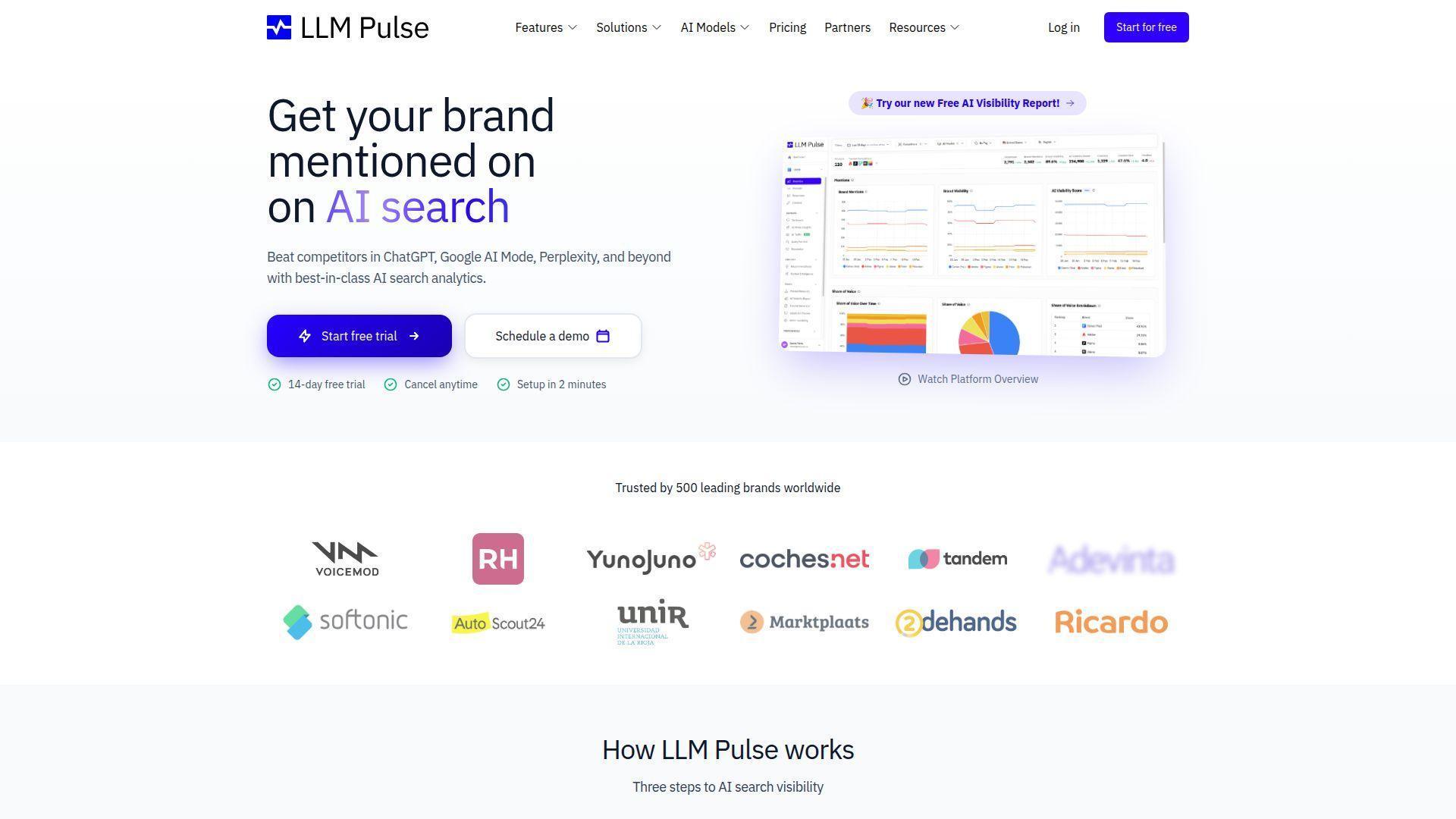
Every prompt can run weekly, daily, or monthly
Key features
- 5 standard AI engines. ChatGPT, Perplexity, Gemini, Google AI Mode and Google AI Overviews. Every paid plan can add Claude, Copilot, Grok, DeepSeek and Alexa for Shopping (formerly Amazon Rufus).
- Per-response sentiment analysis. Every individual AI response is scored. You see when sentiment turns on a specific model in a specific locale, not a monthly aggregate.
- Full citation analysis. The exact URLs each model cites are captured, with filtering by domain, competitor and prompt.
- Competitor benchmarking and share of voice per prompt, per model, per locale.
- Multi-project support. LLM Pulse tracks multiple projects, fitting agencies and groups of brands well below Trakkr’s Scale gate.
- Unlimited seats, including freelancers and clients in read-only mode, with no per-seat upcharge.
- Reporting and integrations. Looker Studio connector, REST API, CLI and webhooks, MCP integration, and custom-domain white-label portals offered through agency arrangements.
- GEO Writer and prompt research. GEO Writer turns citation and prompt data into publish-ready briefs; prompt research and query fan-out expand your tracked set.
- Web analytics integration. GA4, Plausible, Piano, PostHog, Adobe Analytics and Google Search Console connectors tie AI visibility to converting traffic from AI referrers.
- Reputation and app store tracking. Reputation monitoring plus app store tracking for mobile app visibility.
Watch-outs
If your stack depends heavily on Claude, Copilot, Grok, DeepSeek, or Alexa for Shopping, those models are paid add-ons rather than part of the five-model default set. Meta AI is listed as Talk to sales and does not support recurring tracking. We ship Agent Analytics (AI bot crawl stats via Cloudflare, Bunny CDN and log drains), alongside raw referrer data and citation logs, though some larger vendors go deeper on log-level agent analytics. If your brief requires real-time social listening or Reddit thread mining, pair LLM Pulse with a dedicated social listening tool: complete brand coverage in 2026 usually means two tools, not one.
Pricing
Starter is €49 a month for 50 prompts (around €0.98 per prompt). Growth is €99 a month for 150 prompts (around €0.66 per prompt). Scale is €299 a month for 450 prompts (still €0.66 per prompt). Scale+ is €599 a month for 1,200 prompts and Scale++ is €1,199 a month for 2,400 prompts. Enterprise is custom. LLM Pulse includes five standard models, unlimited seats, citations, competitor tracking, CSV and Excel exports, MCP, sentiment analysis, a REST API, and a Looker Studio connector. See pricing for the full breakdown.
2. Profound
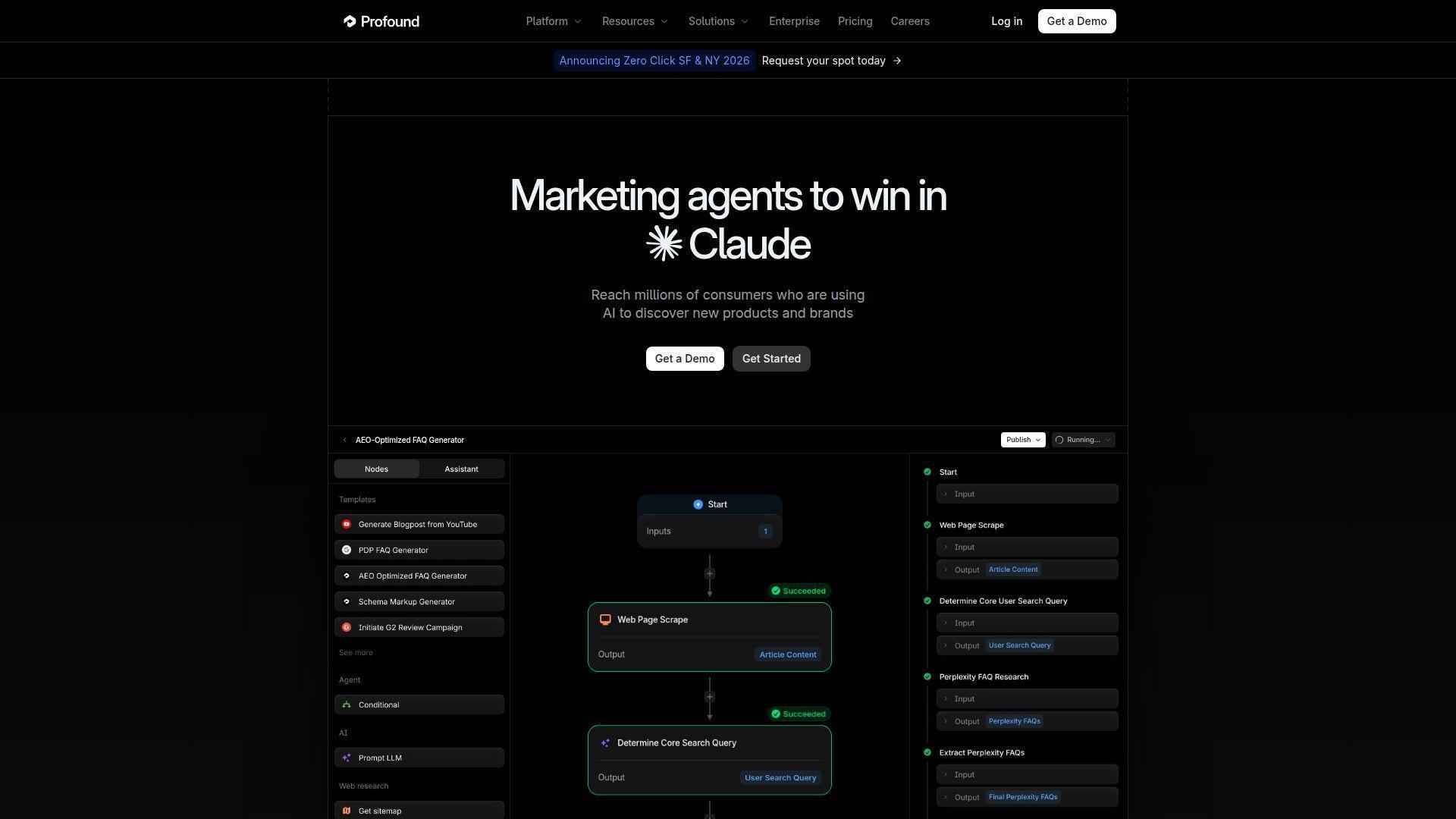
Profound is the enterprise-leaning option, but it also publishes self-serve monthly rates of $99 for Starter and $399 for Growth, both billed yearly. Enterprise adds broader coverage, governance, and dedicated support.
Key features
- Growth tracks ChatGPT, Perplexity, and Google AI Overviews, expanding to up to 9 engines on Enterprise.
- Prompt Volume Analytics on higher tiers: estimates of how often specific prompts are searched.
- Agent Analytics and a content “Agents” engine for AI-search-optimised drafts.
- ChatGPT Shopping visibility, Google Analytics integration and SOC2 governance on Enterprise.
- SSO/SAML, dedicated Slack support and a named account team on Enterprise.
Watch-outs
Starter is self-serve and Growth has a free trial path, while Enterprise remains sales-led. Growth caps prompts at 100 across three engines and three seats, with six optimized articles per month. Enterprise pricing is custom, so compare its quoted scope rather than relying on a category-wide price estimate.
Pricing
Starter is $99/month billed yearly, Growth is $399/month billed yearly, and Enterprise is custom. Starter is self-serve, Growth offers a free-trial path, and Enterprise is sales-led.
3. Otterly
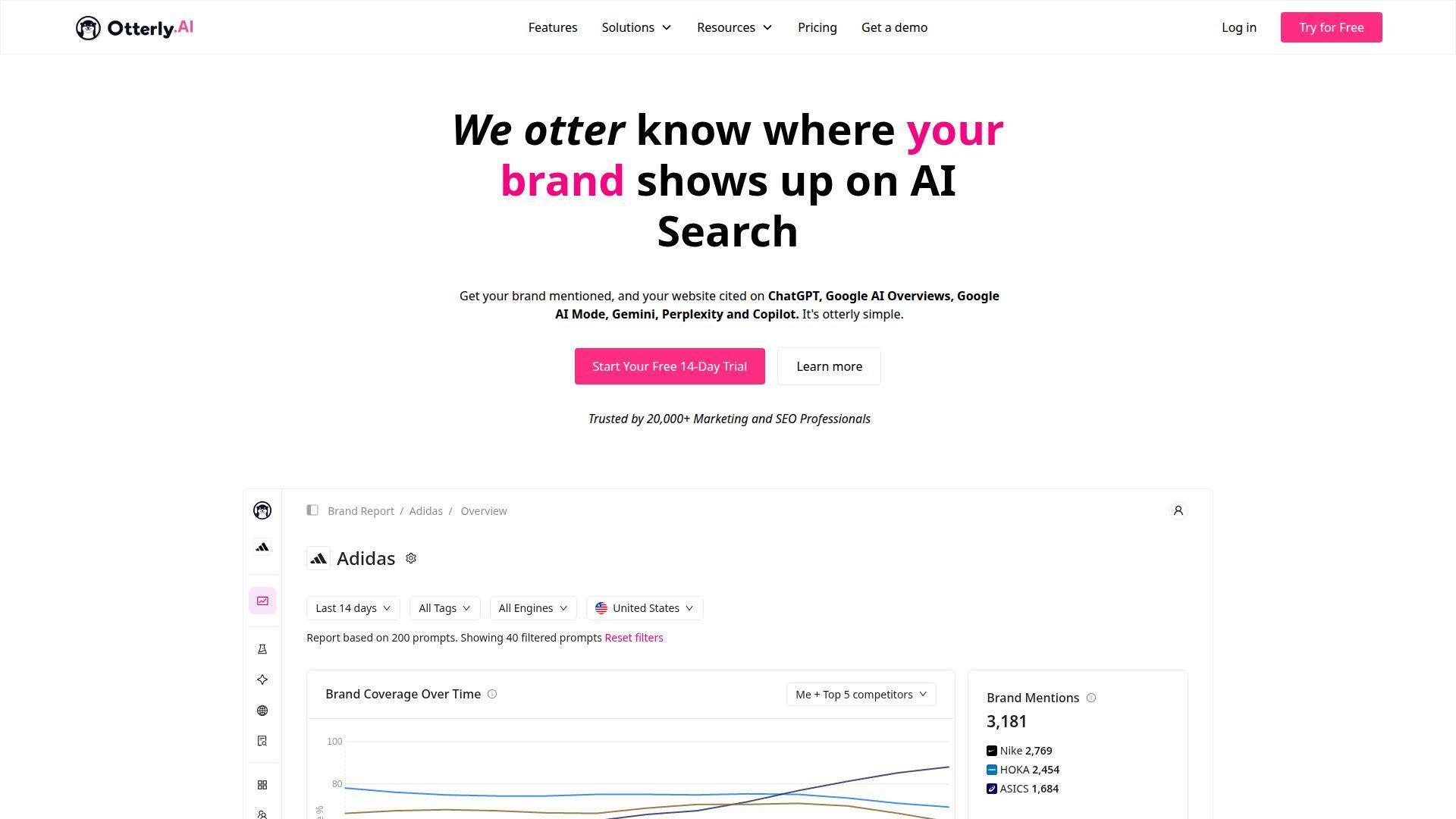
Otterly was one of the earliest movers in the AI visibility space and still wins on the entry-level pitch: a $29/mo plan with a real tracking workspace and four AI engines. For small teams or pilots, it is the cheapest legitimate way into the category.
Key features
- Tracking across ChatGPT, Google AI Overviews, Perplexity and Microsoft Copilot on every paid plan.
- GEO audits with a SWOT-style readout for tracked brand domains.
- Brand Visibility Index that aggregates a comparable score over time.
- Citation tracking surfacing cited URLs from each AI engine.
- Looker Studio connector on Standard and Premium.
- Agency partners get extra prompts and pitch workspaces.
Watch-outs
Prompt allowances are tight: 15 on Lite, 100 on Standard, 400 on Premium. Add-ons for Google AI Mode and Gemini start at $9 and climb, so the headline price is rarely the full bill. Sentiment depth and competitor analytics lag behind purpose-built reputation tools.
Pricing
Lite is $29/month for 15 prompts, Standard is $189/month for 100 prompts, and Premium is $489/month for 400 prompts. Annual billing saves 15%, and Enterprise is custom.
4. Rankability
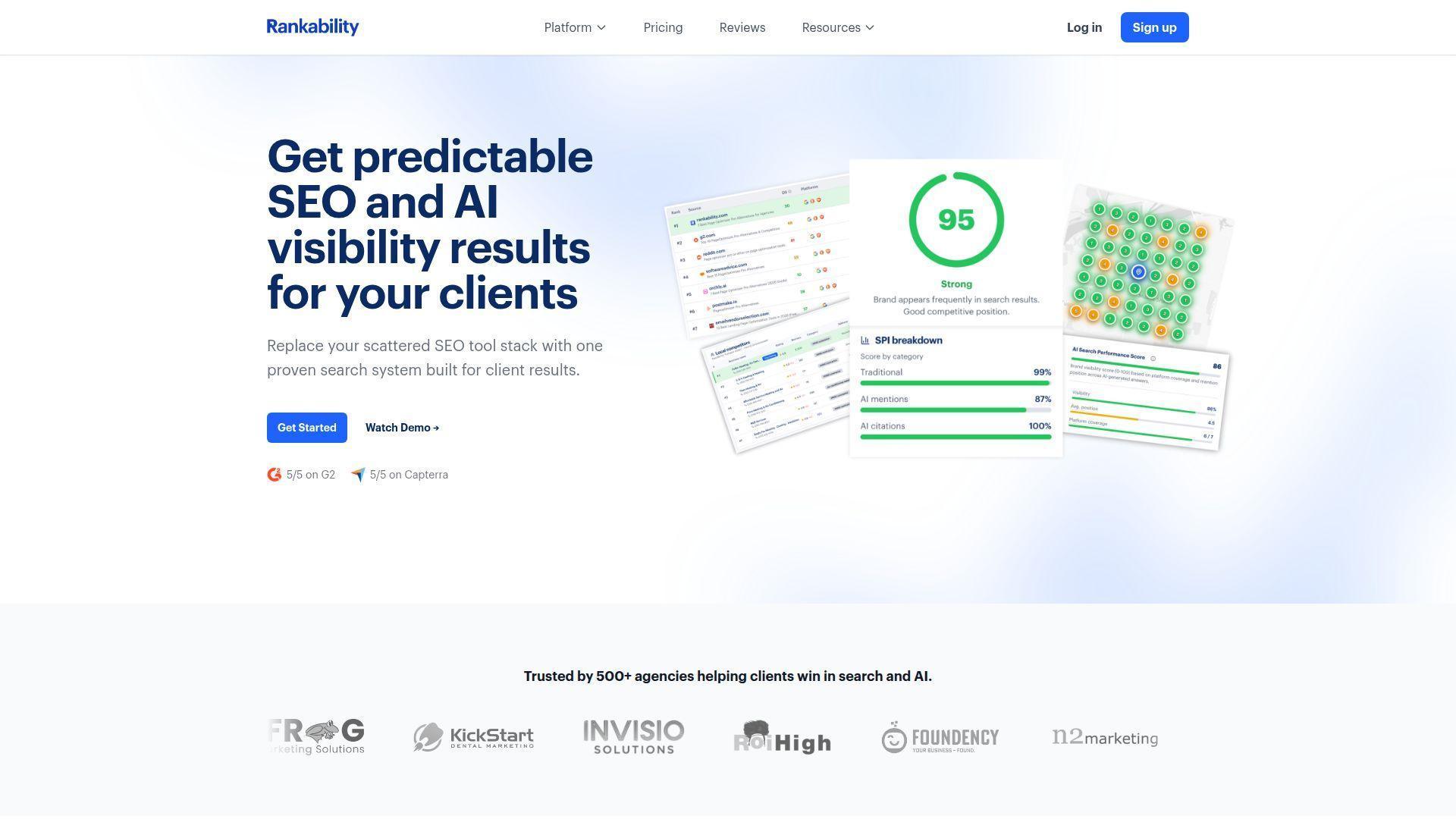
Rankability combines AI research, content creation, optimization, auditing, and automated routines in one platform. It is a practical fit for teams that want those content workflows alongside AI visibility research.
Key features
- Research across Google and ChatGPT on Core, with Claude and Perplexity added on higher plans.
- Content creation, optimization, full-document rewrites, and automated routines.
- Knowledge Base grounding, publishing, and exports.
- API and MCP access on every plan, with higher capacity on higher tiers.
- Unlimited users on every plan.
Watch-outs
Rankability is not sold by tracked prompt. Plans are limited by monthly content assets, optimizations, rewrites, active workspaces, and routines. Teams that mainly need visibility tracking should compare that output model with prompt-based tools.
Pricing
Core is $99/mo, Scale is $299/mo, and Advanced is $799/mo. Every plan includes unlimited users plus API and MCP access. Annual billing saves about 17%.
5. Siftly
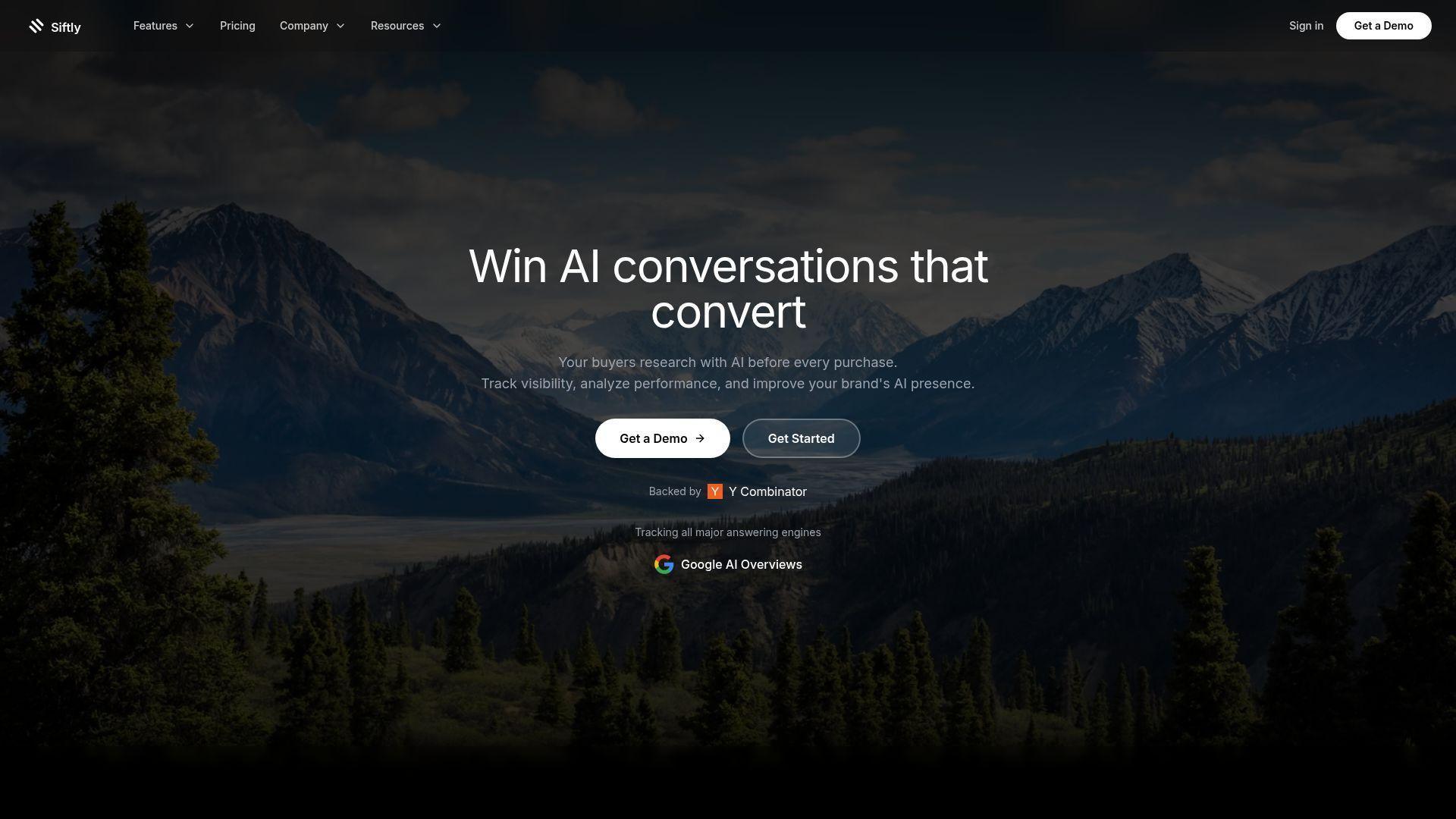
Siftly is a newer entrant focused on brand visibility. Its Free plan tracks weekly, while paid Answers plans refresh daily and add GEO content workflows.
Key features
- Coverage scales from two engines on Free to eight on Scale; Claude is Enterprise-only.
- Free tier of 100 responses/month across 10 prompts with weekly refresh.
- Citation tracking, competitor benchmarking and share of voice.
- GEO content generation with 8 to 60 blog posts per month on paid self-serve plans.
- Experimentation workflows with control and test groups.
Watch-outs
The public Answers grid lists Free, Starter, Growth, and Scale. Coverage expands from ChatGPT and Google AI Overviews on Free to eight engines on Scale, including Gemini and AI Mode.
Pricing
Free tier available. Starter is $79/month, Growth is $249/month, Scale is $599/month, and Enterprise is custom.
6. Rankshift
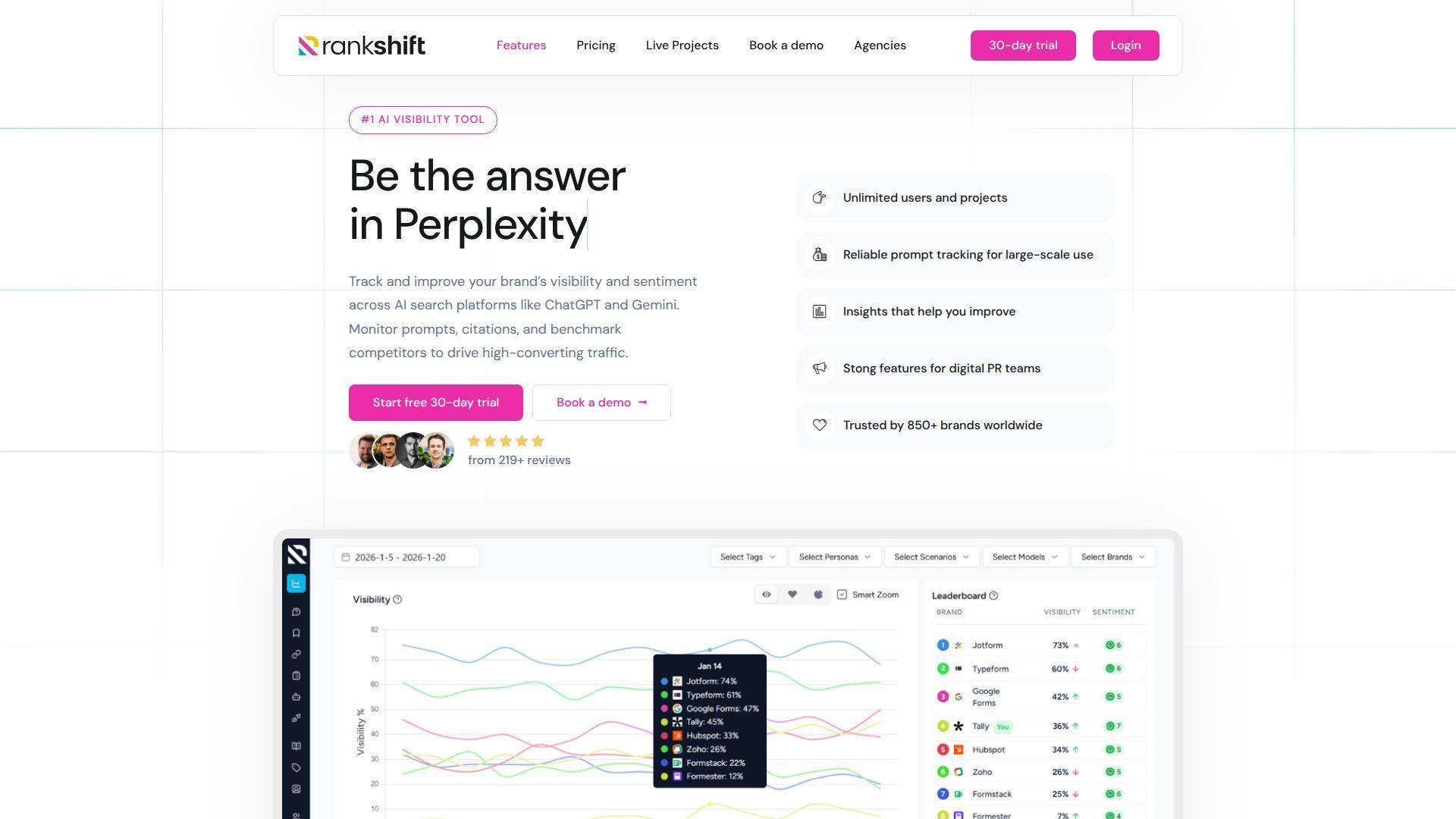
Rankshift competes on the price-per-evaluation axis. The product uses a credit-based model with generous monthly allowances, unlimited projects and unlimited seats on every plan, attractive for teams running broad keyword sets across many brands.
Key features
- Coverage across ChatGPT, Gemini, Perplexity, Claude, AI Overviews, AI Mode, Mistral and Llama.
- Credit-based system: 9,500 credits on Starter, 22,500 on Professional, 53,000 on Business.
- Unlimited projects and seats on every plan.
- Agent analytics, Looker Studio and API access included from Starter.
- Competitor benchmarking and SoV across tracked engines.
Watch-outs
Credit pricing can be hard to forecast: heavy citation analysis or competitor expansion burns credits faster than expected. Sentiment depth and reputation reporting are lighter than purpose-built tools. Reddit, social and app store workflows are out of scope.
Pricing
Starter €69/mo annual (~$82) for 9.5k credits, 150 prompts/day. Professional €159/mo annual (~$189), 22.5k credits, 350 prompts/day. Business €359/mo annual (~$425), 53k credits, 850 prompts/day. Monthly adds 10-12%. Enterprise custom.
7. SE Ranking
SE Ranking is the most familiar option for teams already using an SEO suite. The AI Visibility Tracker (SE Visible) lives both standalone and as an $89/mo add-on inside SE Ranking, so you can layer AI visibility onto an existing keyword and backlink workflow without a second vendor.
Key features
- AI Visibility Tracker covering five platforms: ChatGPT, Perplexity, Google AI Overviews, Google AI Mode, and Gemini.
- Source analysis showing cited domains in AI Overviews.
- Cached AI answer copies to review historical brand framing.
- Integration with the wider SE Ranking suite: keyword tracker, backlink, content marketing.
- Unlimited user seats on SE Visible plans.
Watch-outs
SE Visible now has a Basic standalone tier at $99/mo (200 prompts, 3 brands), putting it closer to the LLM Pulse entry price, though prompt economics still favour LLM Pulse at scale. The $89/mo add-on requires an existing SE Ranking subscription, so real cost is the base plus add-on. Sentiment per response and dedicated reputation modules are not the focus.
Pricing
$89/mo as add-on inside SE Ranking, or SE Visible standalone: Basic $99/mo (200 prompts, 3 brands), Core $189/mo (450 prompts, 5 brands), Plus $355/mo (1,000 prompts, 10 brands). Custom plans available on request. All SE Visible plans include unlimited seats.
Other alternatives worth considering
If none of the eight above is a perfect fit, three more platforms are worth a quick look. AthenaHQ has a free Essential tier and a $295 Starter plan built around credits and action workflows. Scrunch AI emphasises hallucination detection and AI accuracy monitoring for regulated industries. Brand24 is not an AI visibility tool, but pairs well with one as the social listening and PR monitoring layer if your reputation programme needs both surfaces.
Head-to-head: LLM Pulse vs Trakkr
The clearest way to compare LLM Pulse and Trakkr is to look at what each platform offers across its published plans.
| Dimension | LLM Pulse (plans from €49/mo) | Trakkr Growth ($100/mo) |
|---|---|---|
| Prompts | 50 to 2,400 on self-serve plans | 50 per brand (1 brand on Growth) |
| AI evaluations/month | Varies by cadence | ~1,400 (8 engines x daily, single brand) |
| Models included | ChatGPT, Perplexity, Gemini, AI Mode, AI Overviews | ChatGPT, Claude, Gemini, Perplexity, Grok, DeepSeek, Meta AI, Google AI Overviews |
| Sentiment per response | Yes | Yes, depth varies by engine |
| Citation analysis | Yes, per response, filterable | Yes |
| Multi-brand/projects | Multiple projects | 1 brand on Growth, 10 on Scale |
| API access | Yes | Scale plan only |
| White-label | Yes, custom-domain portal and embed | Scale plan only |
| Unlimited seats | Unlimited | Every plan |
| Looker Studio + template | Yes, with ready-made template | Not listed on public plans |
| MCP integration | Yes | Yes |
| Free trial | See current pricing | 14 days |
Trakkr wins on raw model count and offers a 14-day trial. LLM Pulse wins on multi-project support, a mature Looker Studio template and REST API, deeper sentiment integration with reputation workflows, and a lower entry price in EUR. Honest call: if you need “one brand, as many AI engines as possible, cheaply”, Trakkr is competitive. If you need “real analytics across multiple brands, with API and citation depth I can wire into BI tools and feed to clients”, LLM Pulse pulls ahead.
Cost savings analysis
Looking at total cost of ownership over a year for a typical team that needs API access across multiple brands. White-label costs are excluded because the two products package them differently:
| Tool | Plan | Monthly | Annual | Notes |
|---|---|---|---|---|
| LLM Pulse Scale | 450 prompts, API, 5 projects | €299 | €3,588 | White-label requires Enterprise or a qualifying agency arrangement |
| Trakkr Scale | 10 brands x 50 prompts, API | $500 | $6,000 | White-label costs $49 per brand as an add-on |
| Profound Growth | 100 prompts, 3 engines | $399 (~€370), billed yearly | ~€4,440 | Growth has a free trial path |
| Otterly Standard | 100 prompts, 4 engines | $189 (~€175) | ~€2,100 | Add-ons for AI Mode/Gemini |
| Rankability Core | 30 content assets, 30 optimizations, 5 active workspaces | $99 | ~€1,188 | Not sold by tracked prompt |
| Rankshift Starter | 9.5k credits, 150 prompts/day | €69 (annual) | €828 | Credit-based, sentiment lighter |
| SE Visible | 450 prompts, 5 brands | $189 (~€175) | ~€2,100 | Standalone Core tier |
For a team that needs proper API access plus multi-project support, compare Trakkr Scale ($500) with LLM Pulse Scale (€299). For teams that need only basic single-brand tracking, Otterly Lite or Trakkr Growth is cheaper. The trade is breadth and depth versus floor price.
Switching from Trakkr to LLM Pulse
If you have decided to switch, the migration is straightforward. No proprietary data format to wrestle with, and most teams are operational on LLM Pulse in a day.
- Export your Trakkr prompts. CSV export of tracked prompts plus the brand/competitor configuration is enough.
- Choose an LLM Pulse plan so you can validate the platform using your real prompts.
- Recreate the prompts. Paste them into LLM Pulse. The platform runs them across the five default models. If Claude or Grok are critical, add them as paid models or pair LLM Pulse with a complementary tool.
- Add competitors, mentions and locales. Citations, share of voice and sentiment analysis start populating from the first execution.
- Hook up integrations. Looker Studio for reports, REST API for warehouses, GA4 / Plausible / Piano for referrer attribution, and MCP integration for Claude Desktop or other MCP clients.
- Run both tools in parallel for two weeks. Differences show up in model selection, because Trakkr includes Claude and Grok while LLM Pulse offers them as paid add-ons, and in sentiment depth, where LLM Pulse goes per response. Decide based on what you actually use.
- Generate your first free AI Visibility Report. White-label and Looker templates make the first delivery painless.
Summary
Trakkr.ai is a real product with a genuine place in the market, especially for teams that want a cheap entry plan tracking one brand across eight AI engines. Where it falls short: multi-project work, API access on entry tiers, and the price gap between Growth and Scale. For most marketing teams and agencies in 2026, LLM Pulse is the strongest alternative on the price-to-feature trade, with €49 a month buying five-model tracking, citations, share of voice, MCP, and unlimited seats.
Profound is the right call if you have an enterprise budget. Otterly is the cheapest legitimate entry. Rankability suits agencies that want SEO and AI search in one bill. Siftly is worth a look if you want a free tier. Rankshift is the budget pick for high prompt volumes. SE Ranking fits existing customers of theirs.
FAQ
Is Trakkr.ai worth the money?
Trakkr is reasonable value for teams tracking one brand across eight AI engines on its $100 Growth plan. Multi-brand support and API access require the $500 Scale plan, while white-label costs an additional $49 per brand. At that price, compare it with LLM Pulse Scale (€299).
Is LLM Pulse a real alternative to Trakkr?
Yes. Both track AI visibility across the major engines, run prompts on a schedule and capture citations and sentiment. Main differences: LLM Pulse includes multi-project support and REST API access; Trakkr includes Claude and Grok on every plan, while LLM Pulse offers them as paid add-ons on every paid plan. LLM Pulse also has a more mature Looker Studio template and reputation module.
How does Trakkr compare to Profound?
Trakkr is self-serve at $100 for Growth, while Profound publishes monthly rates of $99 for Starter and $399 for Growth, both billed yearly, before custom Enterprise. Profound’s deeper enterprise governance and content workflows are the main reasons buyers pick it. If you do not need those, compare the self-serve plans on model and prompt limits.
What is the cheapest AI visibility tool that actually works?
Otterly Lite at $29/mo is the cheapest legitimate tracking plan: 15 prompts across four AI engines. Siftly has a free tier. For real analytics work, LLM Pulse Starter (€49/mo, 50 prompts, 5 engines) tends to be the lowest tier where the product is meaningfully usable for a team.
Can I track Claude or Grok without Enterprise pricing?
Trakkr and Rankshift include Claude and Grok on entry-level plans. LLM Pulse offers Claude, Grok, Copilot and DeepSeek as paid add-ons on every paid plan. Meta AI is Talk to sales and does not support recurring tracking. Profound’s wider model access remains part of its Enterprise offering. The right answer depends on which model your buyers actually use.
Does Trakkr include sentiment analysis?
Trakkr captures perception analysis and citation data alongside visibility scores. Sentiment depth per response, broken down by model and locale, is less developed than in dedicated reputation tools. If your reputation programme leans heavily on sentiment trend lines, ask Trakkr’s team to walk you through their workflow before signing.
What should agencies running multiple brands choose?
If you need 5+ client brands with white-label dashboards, API access, multi-project support, unlimited seats and a Looker Studio template, LLM Pulse is built around those requirements. Rankability combines AI research with content workflows and includes unlimited users, API and MCP access, but its current public pricing does not use prompt-based visibility allowances. Trakkr Scale supports agencies but at $500/month lands above LLM Pulse Scale, before its $49-per-brand white-label add-on.