



Last updated: October 5, 2026
SEOTesting has a clear job. It connects to Google Search Console and GA4, keeps your search data past Google’s 16-month window, and wraps it in a structure for running experiments: time-based tests against a forecast, split tests with a control group, annotations, content groups, cannibalization checks, and reports you can hand to a client.
Table of Contents
Teams look for alternatives for two different reasons, and they lead to two different shortlists. The first is price and scope: at $50 per month for a single website, an agency with fifteen clients is looking at the $375 plan, and several tools now do GSC reporting and testing for unlimited properties at a fraction of that. The second reason is newer. SEOTesting’s data comes from Search Console and GA4, so an experiment can only be scored on Google clicks and sessions. When your test is about whether ChatGPT starts recommending the page, that measurement does not exist in either source.
Here are six alternatives, with pricing checked against each vendor’s live pages in August 2026.
Why look for SEOTesting alternatives?
None of these are quality complaints. SEOTesting is well built and its case studies are real. The reasons to look elsewhere are structural.
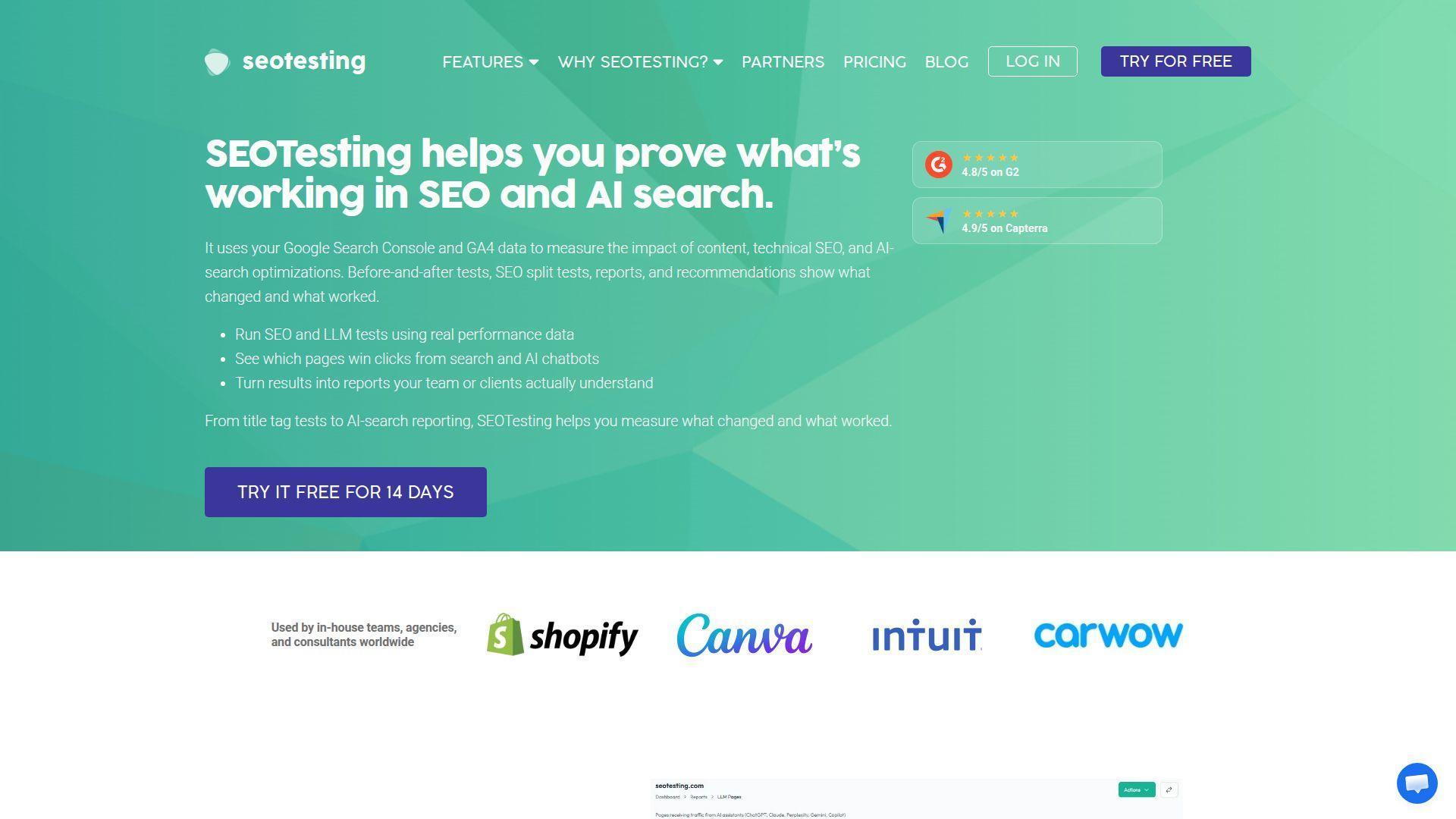
- Pricing is per site, and the jumps are steep. $50 buys one website. Five costs $125, twenty costs $375. Competing GSC layers charge $39 to $59 for unlimited connected properties, which changes the math completely for agencies and for anyone running a portfolio.
- No published annual discount. Plans run month to month and the pricing FAQ asks you to email for annual terms, so you cannot compare a yearly commitment on paper against tools that publish a 17% to 20% annual saving.
- Your data has a deadline if you stop. After the 14-day trial ends, site data is deleted seven days later without a subscription. The warehoused history that makes the tool valuable is not yours to keep on the way out.
- Answer visibility remains outside its data sources. SEOTesting can show Bing data alongside Google, but it does not report what an AI assistant said about you.
- Its LLM tests measure clicks, not answers. SEOTesting’s LLM reporting identifies pages that already receive referral visits from ChatGPT, Gemini, Claude and Perplexity, and its LLM tests check whether those visits rise after a change. That is genuinely useful, and it is a different question from whether the assistant recommends you. An answer that names your brand and never sends a click leaves no trace in GA4 or GSC, so a test scored on referral sessions scores nothing.
- Split tests are inferred, not served. SEOTesting compares test and control page groups using GSC data. It does not sit in your infrastructure and serve variants, which is what a high-traffic site needs to isolate the effect of a template change.
Quick comparison table
| Tool | Entry price | What it measures | Sites on entry plan | Free trial |
|---|---|---|---|---|
| LLM Pulse | €49/mo | AI answer visibility, citations, AI traffic | 1 project | 14 days on eligible plans |
| SEOTesting | $50/mo | GSC and GA4 performance, SEO tests | 1 | 14 days, no card |
| SEO Gets | $0 free, $39/mo Core | GSC and GA4 performance | Unlimited | Free tier plus paid trials |
| SEOTalos | $29/mo | GSC portfolio reporting, SEO A/B tests | 10 properties | 7 days |
| SEO Stack | $19.99/mo | GSC warehousing, keyword and AI tools | 1 property | 30 days |
| SearchPilot | Custom | Served SEO and LLM A/B tests | Enterprise scope | Demo only |
| SplitSignal | Custom | SEO split tests | Enterprise scope | Demo only |
| Search Console and Looker Studio | Free | GSC performance, 16 months | Unlimited | Free |
1. LLM Pulse
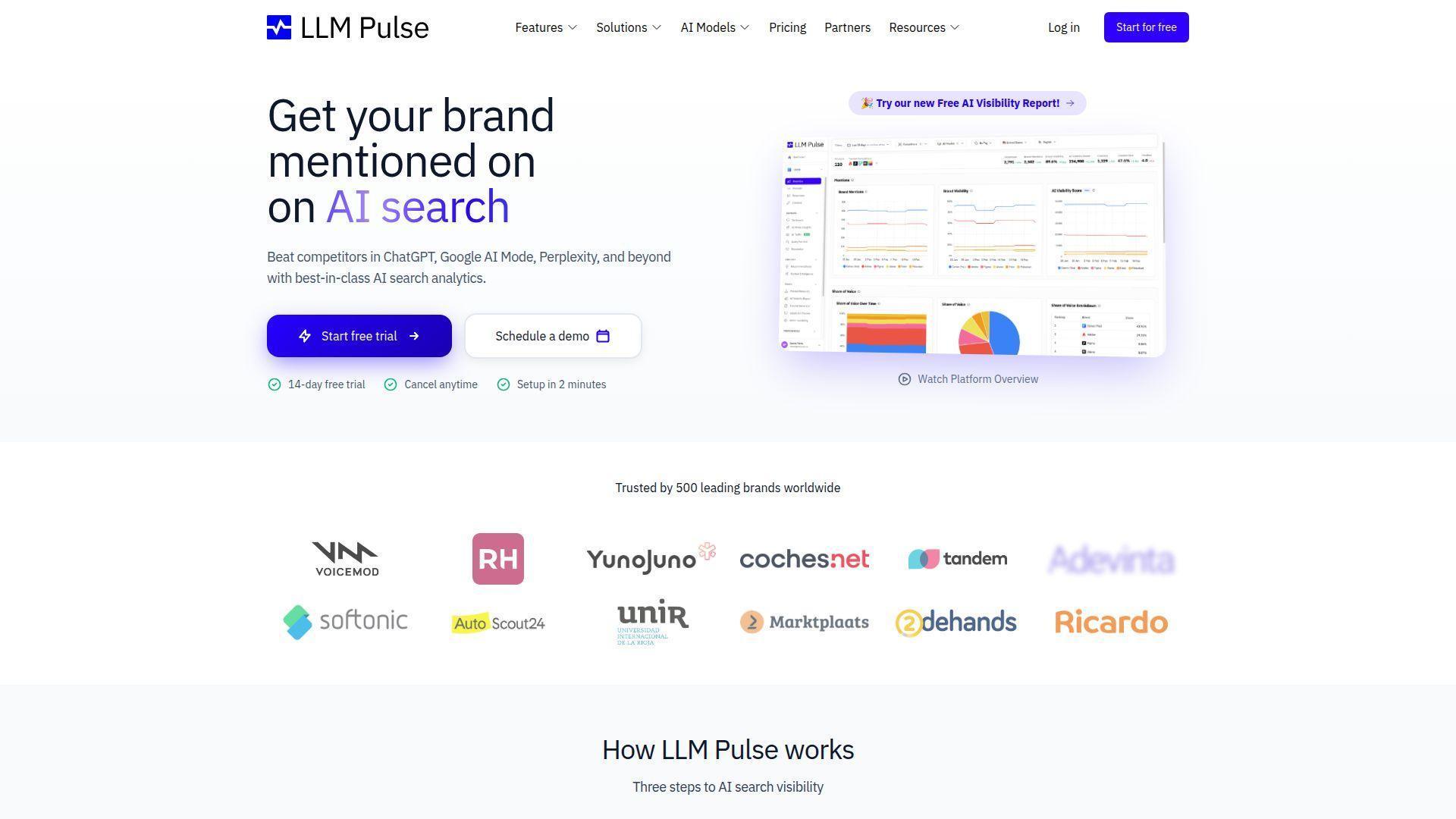
LLM Pulse is an all-in-one AI search and GEO platform, and it earns the top spot here for a specific reason rather than a general one. It is the only tool on this list that scores an experiment on what the AI answer itself said.
The mechanics will feel familiar to a SEOTesting user. You build URL groups from the pages you plan to change, set a change date, and run either a time-based test on one group or a split test against a control group of similar pages you leave alone. Results come back broken down by AI model, by prompt, by the sources the models cited, and by the AI referral traffic those pages received, with your annotations laid over the timeline and a written analysis of what moved.
The difference is the metric. SEOTesting asks whether Google clicks went up. LLM Pulse asks whether ChatGPT, Perplexity, Gemini, Google AI Mode and Google AI Overviews started mentioning you, where you ranked in the answer, and which sources they cited instead of you when they did not.
Key features
- GEO Testing. Before-and-after and control-group experiments on URL groups, scored on AI visibility instead of organic clicks. Details on the GEO Testing feature page.
- Five standard models on every prompt. ChatGPT, Perplexity, Gemini, Google AI Mode and Google AI Overviews are included by default, with no per-engine metering. Claude, Copilot, Grok, DeepSeek, Naver AI Briefing, Baidu AI and Meta AI are available as self-serve paid add-ons. Alexa for Shopping is available as a self-serve paid add-on. Further models are available through Talk to sales.
- Citations and share of voice. Which URLs and domains the models cite when they answer your category prompts, how often competitors appear next to you, and sentiment analysis of how the answers describe your brand.
- Google Search Console integration. Connect your property to seed prompt generation from the queries you already rank for, and to feed the AI traffic dashboard. The two data sets sit in one tool rather than two.
- AI traffic and Agent Analytics. Human referral sessions from AI assistants via GA4, Plausible, PostHog, Piano or Adobe, and separately the AI crawler and bot hits in your own server or CDN logs, which is the part no analytics tool sees.
- Recommendations and GEO Writer. The improvement layer: prioritized fixes and content briefs tied to the prompts where competitors are winning, so a losing test has an obvious next move.
- Built for agencies. Unlimited team members, granular permission roles, white-label portals on a custom domain, CSV and Excel exports, a REST API, a Looker Studio connector, webhooks and an MCP server.
Watch-outs
- It does not replace SEOTesting’s GSC reporting. LLM Pulse reads Search Console data, but content decay reports, cannibalization checks and CTR opportunity analysis are not what it is for. If those reports are why you pay for SEOTesting, keep a GSC layer.
- No classic rank tracking. Google position tracking is not part of the product.
- AI answers vary between runs. A single cycle is noise. Test windows need several cycles before a result means anything, which is true of every tool in this category.
Pricing
Starter is €49/month for 50 prompts, Growth €99 for 150, Scale €299 for 450, Scale+ €599 for 1,200 and Scale++ €1,199 for 2,400, each tracked across all five included models. Enterprise is custom. Weekly tracking is the default, with daily and monthly available. Eligible new customers can start a 14-day trial on the weekly Starter, Growth and Scale plans.
2. SEO Gets
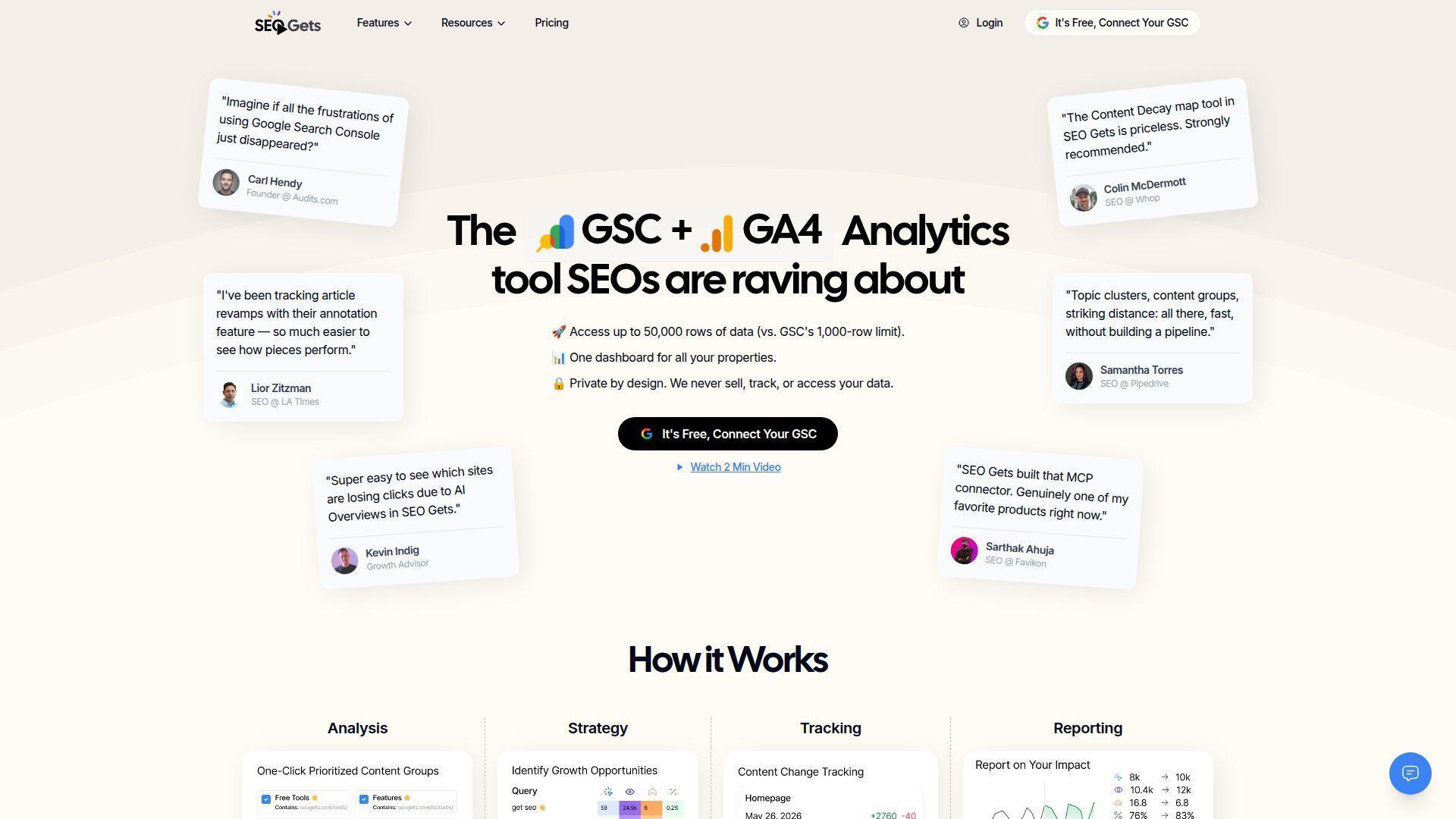
The closest like-for-like swap if per-site pricing is what pushed you out. SEO Gets is a Search Console and GA4 reporting layer with a genuinely usable free tier, and its paid plans connect unlimited sites and unlimited team members rather than charging per property.
Key features
- Unlimited connected sites and unlimited users on every tier, including free.
- Growth and content decay tabs, master dashboard across properties, GA4 alongside GSC.
- Pro extends history to five years, and adds content groups, opportunity reports, portfolio tagging, index reporting, scheduled reports, live client portals and SEO testing.
- Chrome extension and AI credits included on the lower tiers.
Watch-outs
- The testing framework is lighter than SEOTesting’s. If structured experiments are the whole reason you subscribe, check it covers your test types before switching.
- Free and Core keep the standard 16 months of history. The long warehouse is a Pro feature.
Pricing
Free at $0, Core at $39/month and Pro at $49/month. Unlimited sites and users throughout.
3. SEOTalos
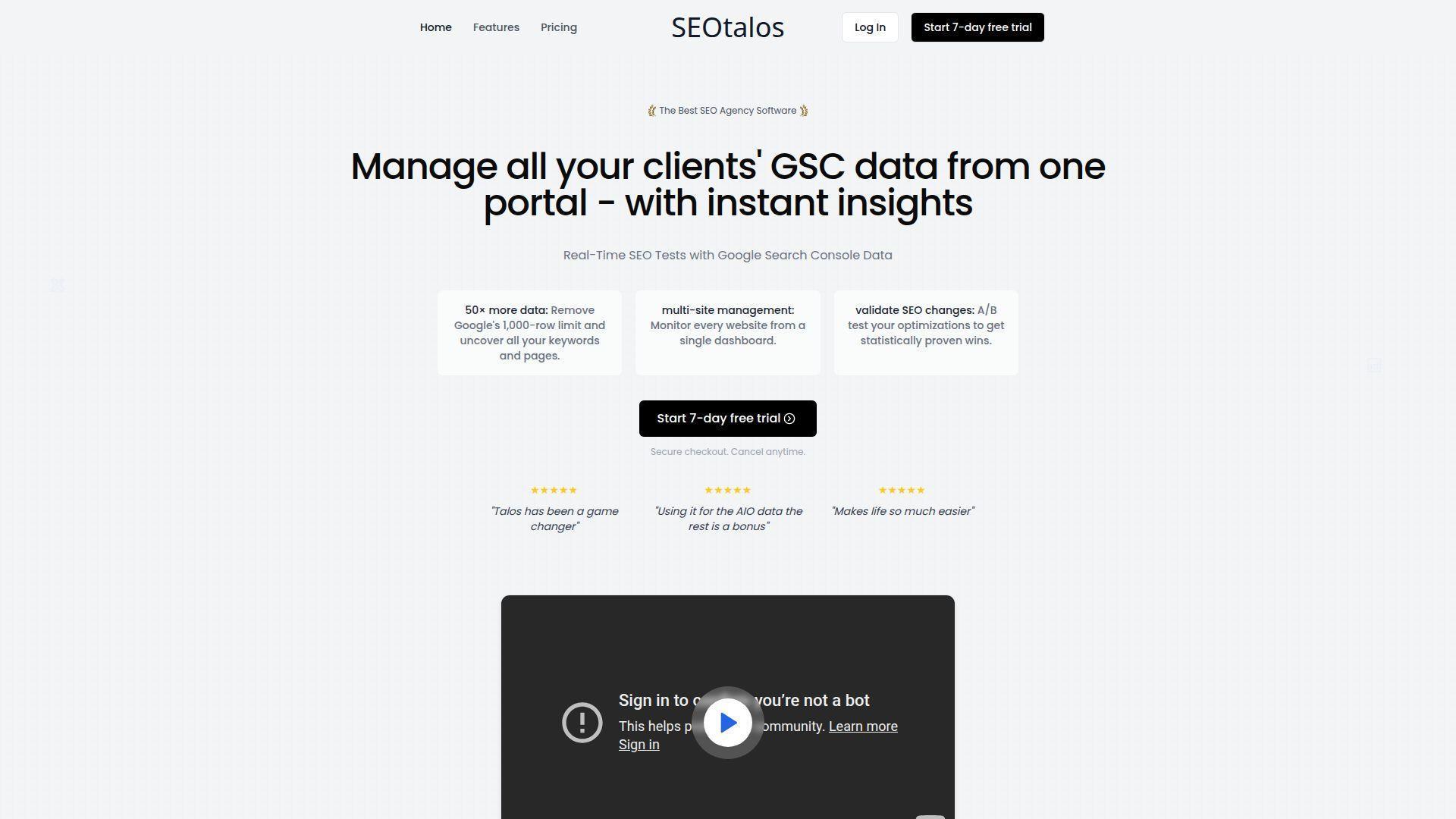
A GSC portfolio tool built around the same premise as SEOTesting, at a different price shape: manage every property from one dashboard with tagging, team access and annotations, keep history past Google’s 16-month cut-off, and run experiments on top.
Key features
- Portfolio view across properties, with tags, annotations and shared team access.
- Long-term history beyond the GSC window for seasonality and baseline comparisons.
- SEO A/B testing on the Pro tier, with statistical validation across multiple sites from one dashboard.
- Keyword volume and CPC overlays on GSC queries, plus AI credits on Pro.
Watch-outs
- Testing sits on Pro, so the $29 Starter is a reporting tool rather than a SEOTesting replacement.
- It is a younger product than SEOTesting, with a smaller published case-study record.
Pricing
Starter $29/month for 10 properties and 2 seats, Pro $59/month for unlimited properties and seats with A/B testing. Yearly billing saves 20%, and there is a 7-day trial with a no-questions refund.
4. SEO Stack
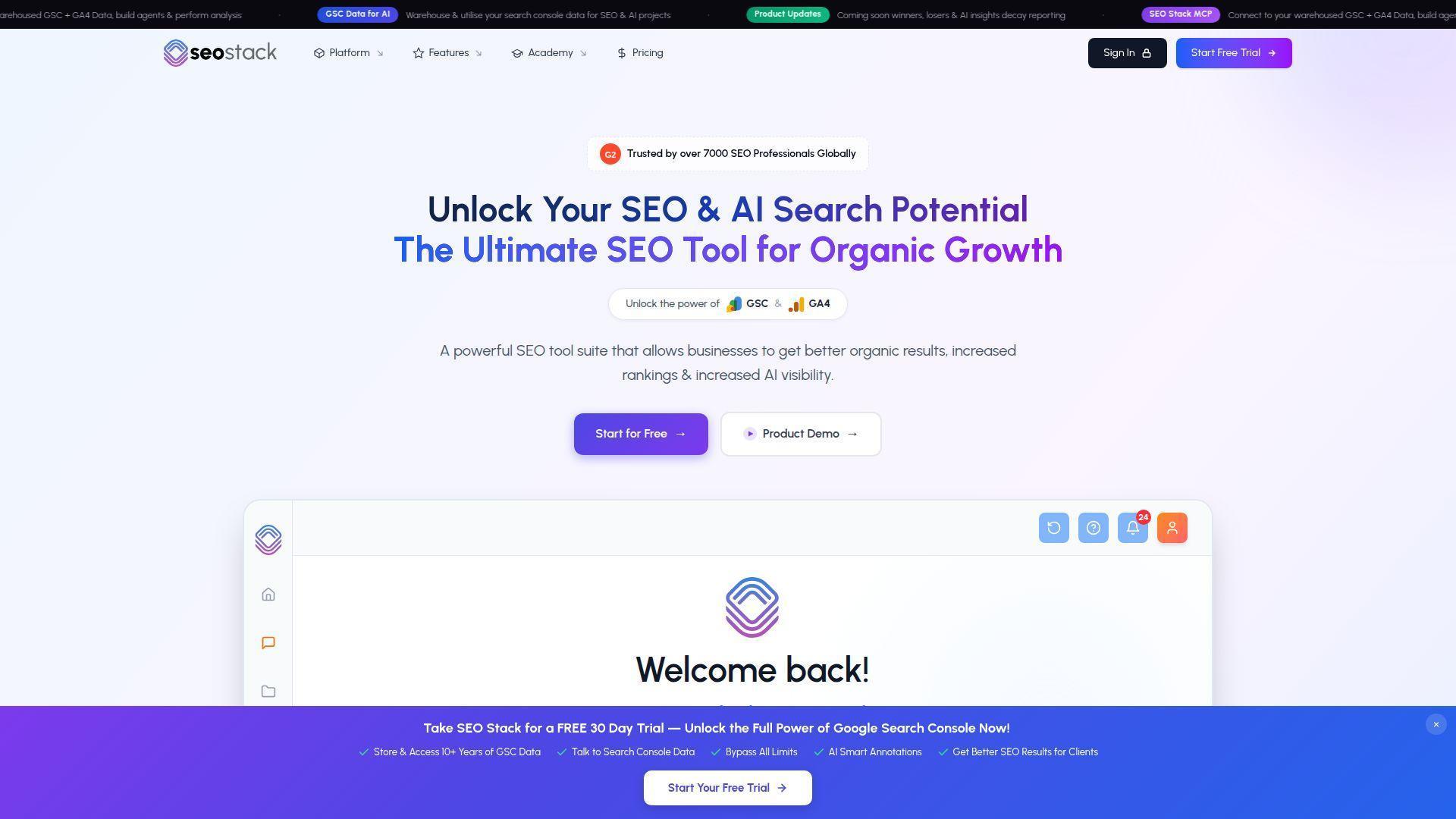
The pick when the thing you actually want is your Search Console data kept forever and queryable. SEO Stack is a GSC warehouse first, with keyword research, click forecasting and AI content tooling layered on.
Key features
- Data warehousing from 16 months on the entry plan up to 120 months on Agency, which is the longest retention in this comparison.
- Keyword discovery, intent analysis, custom filters and query counting on top of GSC.
- AI annotations, an AI content auditor and NLP content briefs, metered in tokens per plan.
- Client and team seats from 1 up to 15 depending on tier.
Watch-outs
- Its focus is analysis and warehousing, not the structured before-and-after test framework SEOTesting is built around.
- Seats are capped per plan, so a large agency lands on a higher tier than the per-site count alone suggests.
Pricing
Single Site $19.99/month, Lite $69.99, Basic $139.99, Pro $279.99 and Agency $489.99, with a 30-day trial and roughly 17% off annual billing.
5. SearchPilot
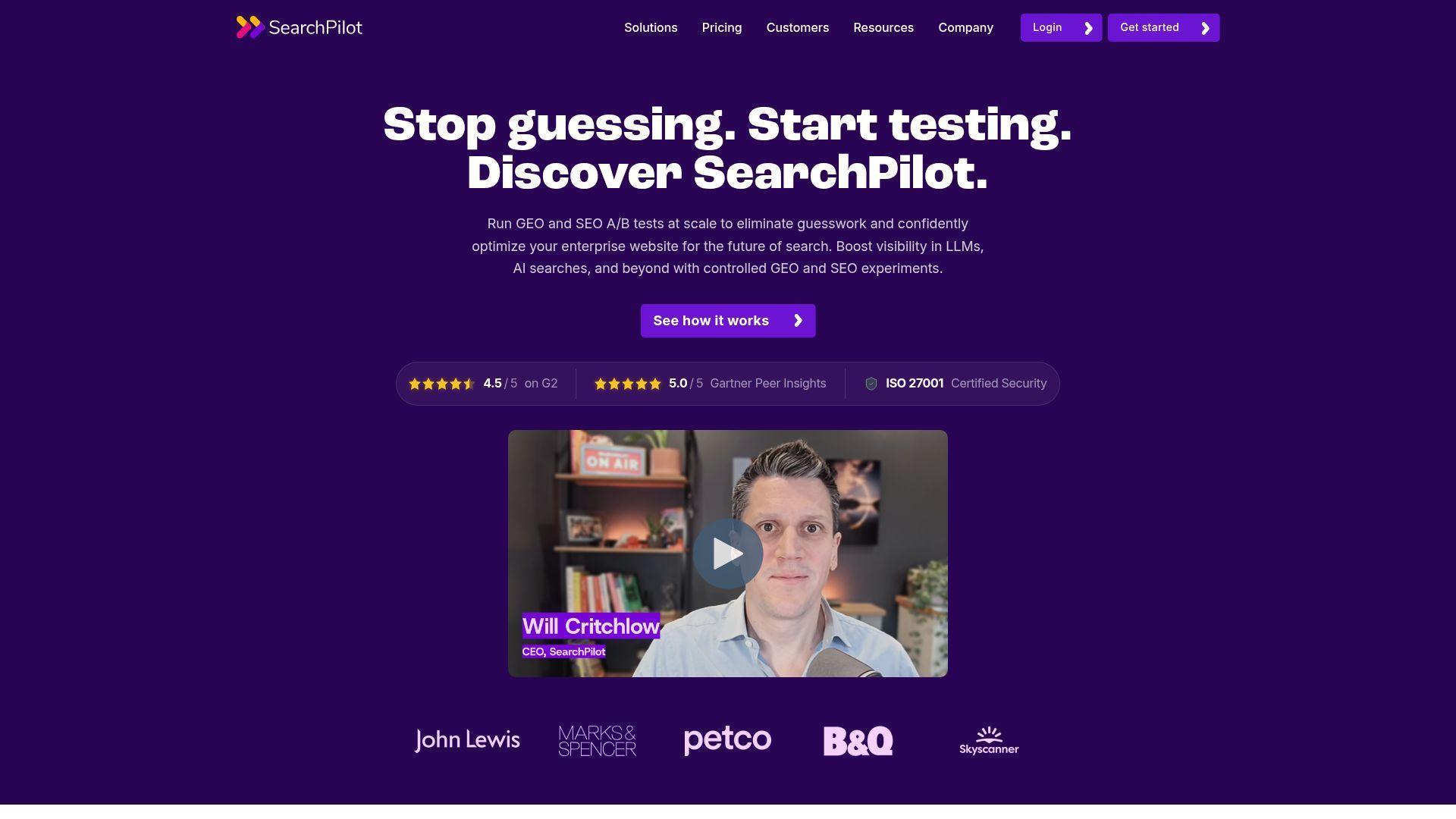
A different class of product. Where SEOTesting infers the effect of a change from Search Console data, SearchPilot sits in your delivery path and actually serves the variants, then measures the difference.
Key features
- Page-split testing: statistically similar buckets of control and variant pages, with the variant served rather than simulated.
- A proprietary neural network model that accounts for seasonality, competitor movement and algorithm updates when scoring a test.
- Multiple KPIs in one test, including organic traffic and LLM referrals side by side.
- A readiness analysis that tells you whether a site section has enough pages and traffic to reach confidence at all.
Watch-outs
- It needs scale. Page-split testing only reaches significance on sites with large template-driven sections and heavy traffic.
- Implementation is an engineering project, not a two-click GSC connection.
- No public pricing, and it is far above SEOTesting’s bracket.
Pricing
Not published. Demo and sales process.
6. Search Console with Looker Studio or BigQuery
The free baseline, and the honest answer for a single site with a patient analyst. Search Console connects natively to Looker Studio, and its bulk export writes daily performance data to BigQuery, which removes the 16-month limit that most paid GSC tools charge to solve.
Key features
- Free Looker Studio connector for dashboards and client-facing reports.
- BigQuery bulk export for unlimited history and SQL access to raw query and page data.
- Full control over how a test is defined and scored.
Watch-outs
- BigQuery storage and queries are billed by Google, so “free” applies to the connector, not the warehouse.
- You build the test framework, the forecasting, the annotations and the cannibalization logic yourself. That is exactly what the paid tools sell.
- Looker Studio dashboards on large GSC data sets get slow.
Pricing
Free, plus whatever BigQuery costs at your data volume.
Other alternatives worth considering
- Semrush. The full suite rather than a testing tool: SEO at $139/month, Starter $199, Pro+ $299 and Advanced $549, with annual billing saving up to 17%. Position tracking and site audits replace part of what a GSC layer gives you, and the current SEO and AI Search plans include AI visibility prompt tracking.
- Ahrefs. Starter €27/month, Lite €119, Standard €229, Advanced €419, Enterprise €1,394 with an annual commitment. Its Brand Radar AI visibility product starts at €179/month on top. Strong for competitive research, not an experiment framework.
- Analytics and CRO platforms. Tools like VWO can A/B test titles and on-page elements, but they split by user rather than by page, which is the wrong shape for measuring a search engine’s response.
For the wider AI side of this category, we keep a running roundup of the best AI visibility tools.
How to choose
- You left because of per-site pricing. SEO Gets or SEOTalos. Both connect unlimited or near-unlimited properties for less than SEOTesting’s single-site plan, and both keep history past 16 months on their paid tiers.
- You want the longest possible data history. SEO Stack on a higher tier, or BigQuery bulk export if you have someone to run it.
- You run a large template-driven site and need real proof. SearchPilot or SplitSignal. Inference from GSC is not the same as serving a variant, and at enterprise traffic the difference decides roadmap arguments.
- Your tests are about AI answers, not Google clicks. LLM Pulse. This is the gap in every other tool here, including SEOTesting’s own LLM tests, which score referral sessions rather than answer content.
- You are an agency reporting to clients. Weigh seats and white label before features. SEOTesting and SEO Gets include unlimited users, SEO Stack caps them per plan, and LLM Pulse includes unlimited team members with white-label portals.
- You need both sides. Most teams do. A GSC layer plus an AI visibility platform costs less than the enterprise testing tools and covers both halves of search. Our breakdown of AEO, GEO and SEO explains where the two disciplines actually diverge.
Cost comparison
The number that matters for most SEOTesting switchers is cost per connected property, because that is where the per-site model bites.
| Tool | Plan | Monthly price | Sites included | Users |
|---|---|---|---|---|
| SEOTesting | Single Site | $50 | 1 | Unlimited |
| SEOTesting | Medium | $125 | 5 | Unlimited |
| SEOTesting | Large | $375 | 20 | Unlimited |
| SEO Gets | Core | $39 | Unlimited | Unlimited |
| SEO Gets | Pro | $49 | Unlimited | Unlimited |
| SEOTalos | Pro | $59 | Unlimited | Unlimited |
| SEO Stack | Basic | $139.99 | 10 | 5 |
| LLM Pulse | Starter | €49 | 1 project, 50 prompts | Unlimited |
| LLM Pulse | Scale | €299 | 5 projects, 450 prompts | Unlimited |
An agency on SEOTesting’s Large plan pays $375/month for twenty properties. SEOTalos Pro covers unlimited properties at $59 and SEO Gets Pro at $49, which frees most of that budget for the measurement layer neither of them has.
Pairing LLM Pulse with your SEO testing setup
LLM Pulse is not a drop-in swap for SEOTesting, and pretending otherwise would waste your time. It answers a question your GSC tool structurally cannot. Most teams that adopt it keep a cheap GSC layer and add AI measurement on top.
- Keep a Search Console layer for the Google half. If per-site pricing was the problem, move that half to SEO Gets or SEOTalos first. The saving usually covers the AI tool.
- Turn your test hypotheses into prompts. A test on “best running shoes for flat feet” pages becomes the buyer questions a shopper actually types into ChatGPT, not the keyword you targeted in Google.
- Connect Search Console. It seeds prompt generation from queries you already rank for and powers the AI traffic view, so the two data sets sit side by side.
- Build URL groups before you change anything. Set the test group and, where you have comparable pages, a control group you leave untouched. Baseline first, then ship the change and set the change date.
- Let several cycles run. AI answers move between runs. Read direction over weeks, not a single snapshot, exactly as you would refuse to call a Google test after three days.
- Work the losing tests. When visibility does not move, the citations view shows which sources the models used instead, and recommendations turn that into the next change. Our guide to GEO covers the optimization side in depth.
Summary
SEOTesting is a good tool with a pricing model that punishes portfolios and a data source that stops at Google’s edge. If cost per site is your problem, SEO Gets at $39 and SEOTalos at $29 do most of the same reporting for unlimited properties, and SEO Stack goes furthest on history. If you need real experimental proof on a large site, SearchPilot and SplitSignal serve variants instead of inferring, at enterprise prices.
If your problem is that your tests keep coming back inconclusive because the traffic moved to AI answers that never produced a click, none of those tools measure it. That is what LLM Pulse does, from €49/month across five AI models, with the same before-and-after and control-group structure you already use. For the broader category, our roundup of the best GEO tools has the full list.
FAQ
How much does SEOTesting cost?
As of August 2026, SEOTesting is $50/month for one website, $125/month for five, and $375/month for twenty, with Enterprise pricing on request. Every plan includes unlimited users and a monthly allocation of InternalLinking.com credits. Plans run month to month, and annual terms are arranged by email rather than published.
Does SEOTesting have a free trial?
Yes, 14 days, fully functional, with up to 30 sites and no credit card required. If you do not subscribe, your site data is deleted seven days after the trial ends.
What is the cheapest SEOTesting alternative?
SEO Gets has a free tier and a $39/month Core plan, both with unlimited connected sites and unlimited users. SEOTalos starts at $29/month for 10 properties, and SEO Stack at $19.99/month for a single site. For a free option, Search Console plus Looker Studio costs nothing but leaves you building the reporting yourself.
What is the best alternative for actual SEO split testing?
SearchPilot, if you have the traffic for it. It serves control and variant pages rather than inferring the difference from Search Console, and models seasonality and algorithm updates when scoring the result. SplitSignal solves the same problem inside Semrush’s enterprise offering. Both are sales-led with no public pricing.
Can SEOTesting measure AI search visibility?
Partially. Its LLM traffic reports show which pages receive referral clicks from ChatGPT, Gemini, Claude and Perplexity, and its LLM tests check whether those clicks increase after a change. What it cannot show is whether the assistants mention or cite you in answers that never send a click, because that data does not exist in Search Console or GA4. Measuring it requires querying the models directly, which is what an AI visibility platform does.
Do I need both a GSC tool and an AI visibility tool?
If organic search still drives meaningful revenue, yes. They measure different channels and neither substitutes for the other. A common setup is a low-cost GSC layer for Google reporting plus a dedicated AI platform for the answer engines.
How do you run an A/B test on AI visibility?
The structure mirrors a classic SEO test. Group the URLs you plan to change, optionally pair them with a control group of similar pages you leave alone, record the change date, then track whether the models start mentioning and citing the test group more often than the control across the following cycles. The difference is the metric: mentions, answer position and citations rather than clicks and impressions.
Will my Search Console history transfer if I switch tools?
Only the last 16 months, because that is all Google’s API exposes. Any warehoused history above that limit belongs to the tool that stored it, so a new tool starts its own long-term record from the day you connect. If you plan to move, connect the new tool early and let the two overlap.