



Last updated: September 28, 2026
If you are reading this, you already know the search box is not the only game in town. A real user question in 2026 is just as likely to land in ChatGPT, Perplexity, or a Google AI Overview as on a blue-link results page. The job of an answer engine optimization tool is to make sure your brand is the answer being read aloud, quoted in a generated reply, or cited as the source.
Table of Contents
This post compares the best AEO tools in 2026: what each one actually does, who it fits, what it costs, and where it falls short. We focus on AEO specifically (the practice of being extracted as a direct answer) rather than generic AI visibility or traditional SEO. LLM Pulse comes first because it is the platform we build, but we have stayed honest about where competitors do something genuinely useful.
Why AEO matters in 2026
Answer engines do not show ten blue links. They show one answer. In 2026, that one answer can come from a Google AI Overview, an AI Mode response, a Perplexity quick reply, a ChatGPT search citation, or a Gemini-generated summary. If your brand is not the source feeding that single answer, you are functionally invisible for that query.
The numbers tell the story. Google AI Overviews now trigger on a majority of informational queries in English markets, and click-through on the underlying blue links drops by a meaningful margin when an AI Overview is present. Perplexity and ChatGPT route an increasing share of high-intent commercial research before any traditional search ever happens. If a buyer asks “what is the best CRM for a 10-person sales team” and your brand is not in the generated answer, you do not get to compete in that buying moment.
AEO tools exist to close that gap. They simulate the questions your buyers are asking, run those questions through real answer engines, and tell you whether you are being cited, quoted, or quietly skipped. The good ones do this every week, across multiple engines, and tie the results back to actions you can take on your content.
AEO is not the same as classic SEO. Featured snippet optimization, which used to be the closest analog, gets you closer but does not cover generative answers built from multiple sources. It is largely the same discipline as generative engine optimization (GEO): the two are two names for optimizing to appear in AI answers, differing at most in emphasis. AEO tends to stress being the answer specifically.
How answer engine optimization tracking works
Every credible AEO tool follows roughly the same five-step loop. The differences are in cadence, coverage, and how the data lands in your hands.
- Prompt selection. You define the questions a buyer would ask: product comparisons, “best X for Y” queries, branded queries, “is X worth it” queries, location and intent variations. Strong tools help you generate these from your seed keywords, your competitors, and your own GA4 or GSC data.
- Multi-engine query. The tool runs every prompt against the answer engines you care about. In 2026, that means at minimum ChatGPT, Perplexity, Gemini, Google AI Mode, and Google AI Overviews. Bonus engines: Claude, Microsoft Copilot, Grok, DeepSeek, Meta AI.
- Answer extraction. The raw model output is parsed for brand mentions, the position your brand appears in (first, second, buried), and whether your brand was quoted directly or paraphrased. Good tools also analyze sentiment.
- Citation parsing. The tool extracts every URL the engine cited. This is where you learn which of your pages (or which competitor pages, or which third-party sources like Reddit or G2) are actually feeding the answer.
- Longitudinal tracking. All of the above runs on a cadence, weekly is the sweet spot, so you can see whether your AEO position is improving or eroding over time. This is the bit cheap tools skip.
If a tool does not do all five of these, it is not really an AEO platform. It is a one-shot prompt tester, which is useful for spot-checks but useless for measuring whether your AEO investments are working.
Quick comparison: top 12 AEO tools
| Platform | Best for | Starting price | AI surfaces covered | Key differentiator |
|---|---|---|---|---|
| LLM Pulse | Best overall AEO measurement for SMBs, agencies, and enterprise | €49/month | ChatGPT, Perplexity, Gemini, Google AI Mode, Google AI Overviews; self-serve paid add-ons: Claude, Copilot, Grok, DeepSeek, Naver AI Briefing, Baidu AI and Meta AI; Talk to sales: Alexa for Shopping and further models | Weekly tracking across 5 default engines, with citations and share of voice, sentiment analysis, Google Search Console integration, a Looker Studio connector, and agency white-label |
| Athena HQ | AEO-focused content optimization | From around $295/month | ChatGPT, Perplexity, Google AI | Content briefs tuned for answer extraction |
| Scrunch AI | AI visibility, page audits, and agent traffic | From $250/month billed annually | Seven AI platforms on public plans | Agent Experience Platform and crawler analytics |
| Profound | Free Trial and custom Enterprise packages | Free Trial; Enterprise custom | Three engines in Trial; up to nine on Enterprise | Enterprise reporting, integrations, and agents |
| Otterly.ai | AI Overview and answer monitoring | From around $29/month | AI Overviews, ChatGPT, Perplexity | Entry-level AI Overview tracking |
| Surfer SEO | Content optimization with AEO features | From around $89/month | Indirect (content scoring) | Content scoring for answer-ready writing |
| Frase | Answer-engine content briefs and FAQ extraction | From around $45/month | Indirect (SERP and content) | Question and answer mining at scale |
| Semrush | AI visibility inside SEO + AI Search plans | SEO from $139 monthly; Starter from $199 monthly | ChatGPT, Google AI, Gemini, Perplexity | Starter tracks 50 prompts daily |
| Conductor | Enterprise content and AEO | Custom (enterprise) | AI Overviews, ChatGPT | Enterprise content workflow plus AEO layer |
| BrightEdge | Enterprise AI search platform | Custom (enterprise) | AI Overviews, ChatGPT, Perplexity | Enterprise SEO heritage extended into AEO |
| WRITER | Content generation tuned for AEO | Starter trial; Enterprise by quote | Indirect (generation only) | Generative content workflows for large teams |
1. LLM Pulse, best overall for AEO measurement across 5 AI engines
Why it stands out
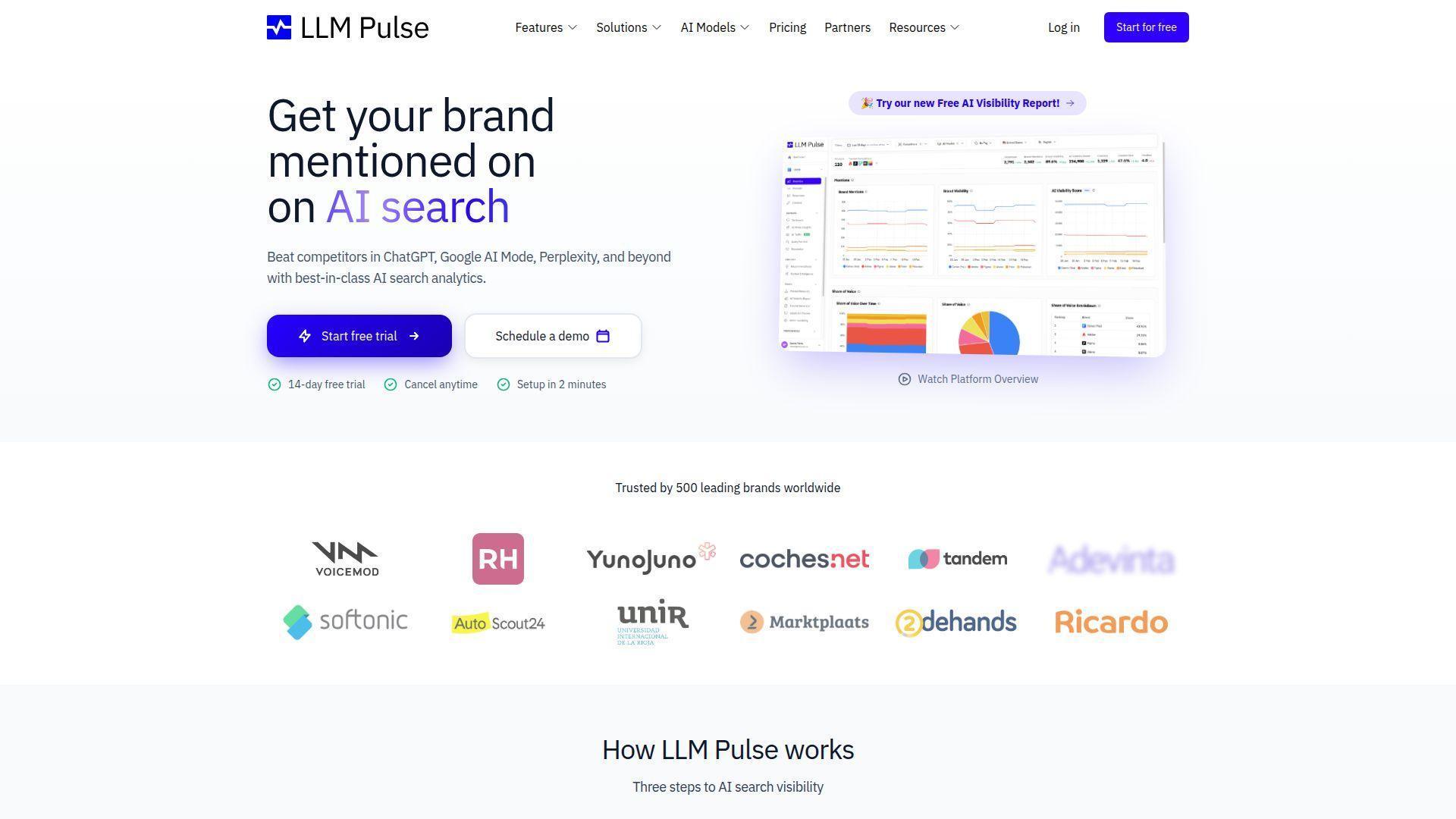
LLM Pulse is built to answer a specific question: when a real buyer asks an AI engine the questions that matter to your business, are you the answer or is your competitor? Every prompt you add runs across ChatGPT, Perplexity, Gemini, Google AI Mode, and Google AI Overviews by default, with no extra configuration. That is the AEO loop done end to end on a single platform.
Three things make it the strongest AEO measurement tool on this list. First, default coverage of the five surfaces that drive answer-engine traffic in 2026, with seven self-serve paid add-ons and further models available through Talk to sales. Second, the depth of the data behind each mention: sentiment, brand position, citation source, share of voice against named competitors, and longitudinal trends over weeks and months. Third, the platform includes unlimited seats, multi-project management, CSV and Excel exports, and MCP, a REST API and Looker Studio connector, and agency white-label through a separate agency arrangement.
Key features
- Weekly prompt execution across ChatGPT, Perplexity, Gemini, Google AI Mode, and Google AI Overviews (5 standard surfaces).
- Self-serve paid add-on engines: Claude, Copilot, Grok, DeepSeek, Naver AI Briefing, Baidu AI and Meta AI. Alexa for Shopping and further models are available through Talk to sales.
- Brand sentiment analysis (positive, neutral, negative).
- Citation tracking: every URL the AI engine cites, mapped to your pages and your competitors’ pages.
- Share of voice against named competitors, with breakdowns by engine, prompt cluster, and time period.
- AI Models Comparison view: see why one engine quotes you and another skips you.
- GEO Writer and Query Fan-out: research related searches and subtopics that retrieval systems may use to answer a prompt.
- Prompt Research: generate AEO-relevant prompts from seed keywords, competitors, and your own data.
- Chrome Extension (Query Detector) to capture web-search queries exposed inside ChatGPT conversations.
- Google Search Console and web-analytics integrations (GA4, Plausible, Piano, PostHog, Adobe Analytics) to tie AEO visibility back to search and referral traffic.
- App Store tracking and Reputation monitoring for product and brand teams.
- Unlimited seats with granular permission roles, multi-project management, CSV and Excel exports, with agency white-label spanning a custom-domain portal and embeddable iframe dashboards.
- MCP, plus a Looker Studio connector, REST API, CLI, and webhooks (Zapier, Make, n8n).
Watch-outs
If you only care about featured snippets on classic Google and have zero interest in ChatGPT or Perplexity, LLM Pulse will give you more than you need. It is also opinionated about how prompts should be structured, so if you want a raw playground rather than a measurement system, a one-shot prompt tester might suit you better.
Pricing
€49/month (50 prompts) on Starter. Growth €99/month (150 prompts). Scale €299/month (450 prompts). Scale+ €599/month (1,200 prompts). Scale++ €1,199/month (2,400 prompts). Enterprise custom. See LLM Pulse pricing or book a demo.
2. Athena HQ, strong AEO-focused content optimization
Why it stands out
Athena HQ leans hard into the content side of AEO. Instead of just telling you whether you appear in AI answers, it gives you concrete editing guidance for how to restructure pages so they get extracted as the answer. The output reads like a writing brief tuned for ChatGPT and Perplexity rather than for ten-blue-link SEO.
Key features
- AEO content briefs that flag structural fixes (clear headings, definition boxes, parallel lists).
- Tracking of brand visibility in ChatGPT, Perplexity, and Google AI surfaces.
- Suggestions for FAQ blocks and short-form answer sections.
Watch-outs
The measurement side is solid but narrower than LLM Pulse, and weekly cadence on lower tiers can be limited. Enterprise pricing climbs quickly once you add seats and projects.
Pricing
Essential is free with 300 credits. Starter is $295/month with 3,600 credits, and Enterprise pricing is available by quote.
3. Scrunch AI, explicit AEO/GEO platform positioning
Why it stands out
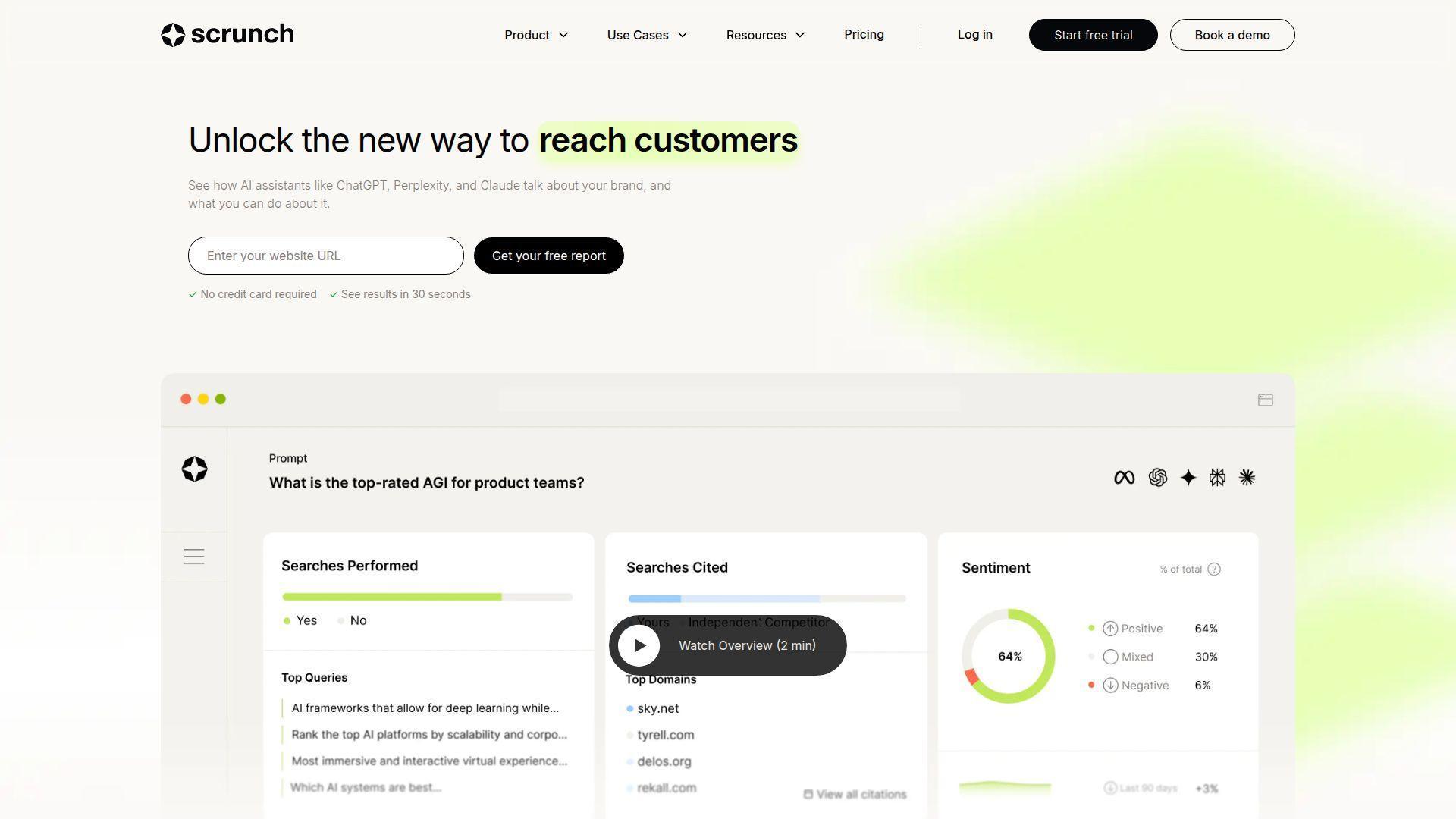
Scrunch AI markets itself directly as an AEO and GEO platform. The product is built around the framing that AI answers, not blue links, are the real visibility surface. That clarity of positioning is reflected in the dashboards: you see answer-engine coverage front and center, not as a side panel inside a generic SEO suite.
Key features
- Tracking across seven AI platforms on Starter and Growth.
- Competitive share of voice by engine.
- Prompt management with clustering by intent.
Watch-outs
Starter and Growth cover seven AI platforms. Enterprise adds custom scale, security, and API access.
Pricing
Starter costs $250 per month billed annually or $300 month to month for 350 custom prompts and three users. Growth costs $417 per month billed annually or $500 month to month for 700 prompts and five users. A 7-day trial is available.
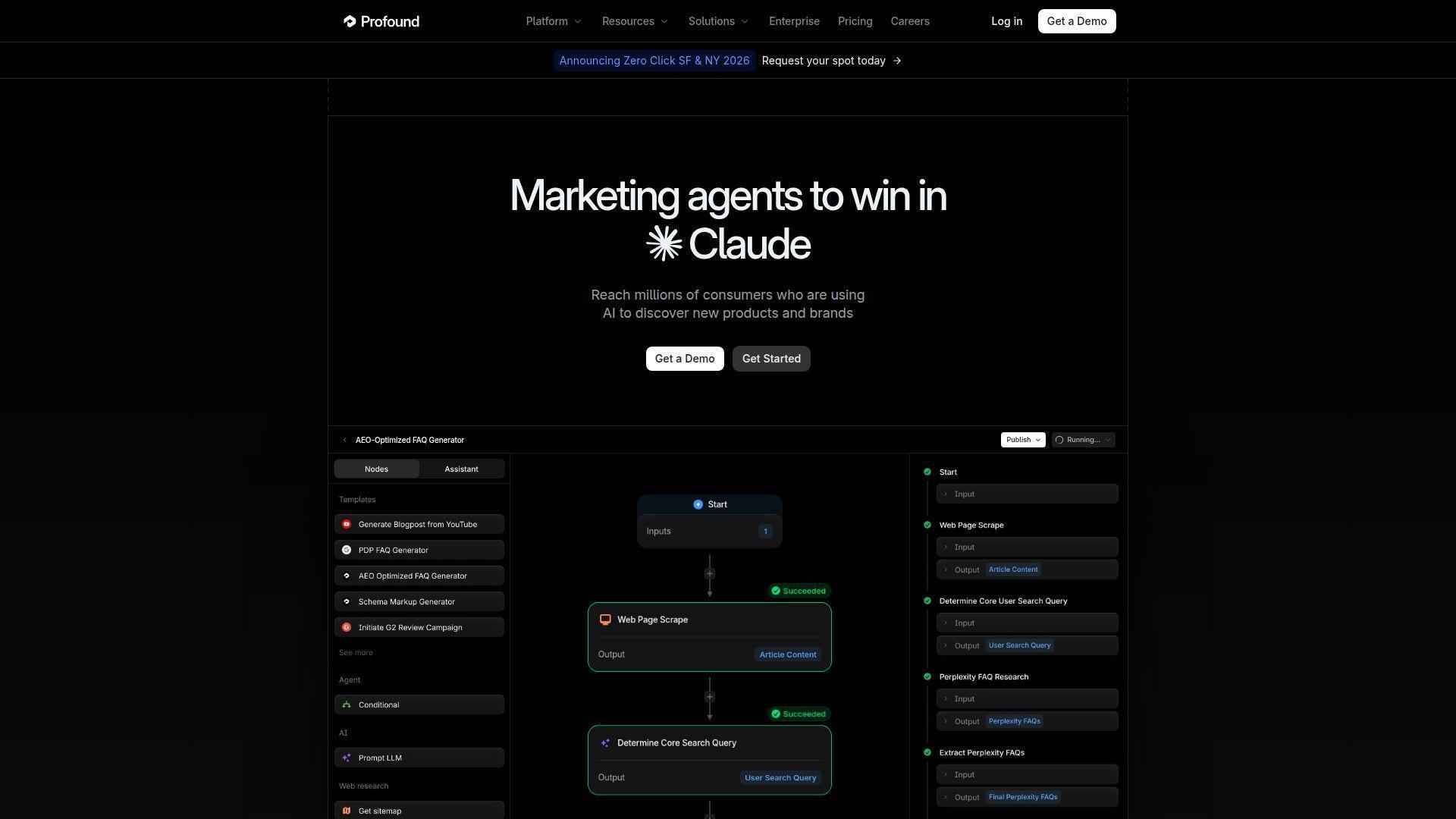
4. Profound, enterprise AEO/GEO platform
Why it stands out
For brand accounts, Profound offers a free Trial and custom Enterprise packages for teams that need a managed answer-engine program. The reporting layer, integrations, and agent workflows are designed for larger organizations.
Key features
- Enterprise-grade reporting and BI integrations.
- Tracking across ChatGPT, Perplexity, Gemini, and Copilot.
- Workflows for managed services and content teams.
Watch-outs
The Trial runs 50 unique prompts daily for seven days across ChatGPT, Gemini, and Google AI Overviews. For brand accounts, ongoing tracking and broader engine coverage require Enterprise.
Pricing
The Trial is free. Enterprise pricing is custom, with tailored prompt tracking across up to nine answer engines.
5. Otterly.ai, AI Overview and answer monitoring
Why it stands out
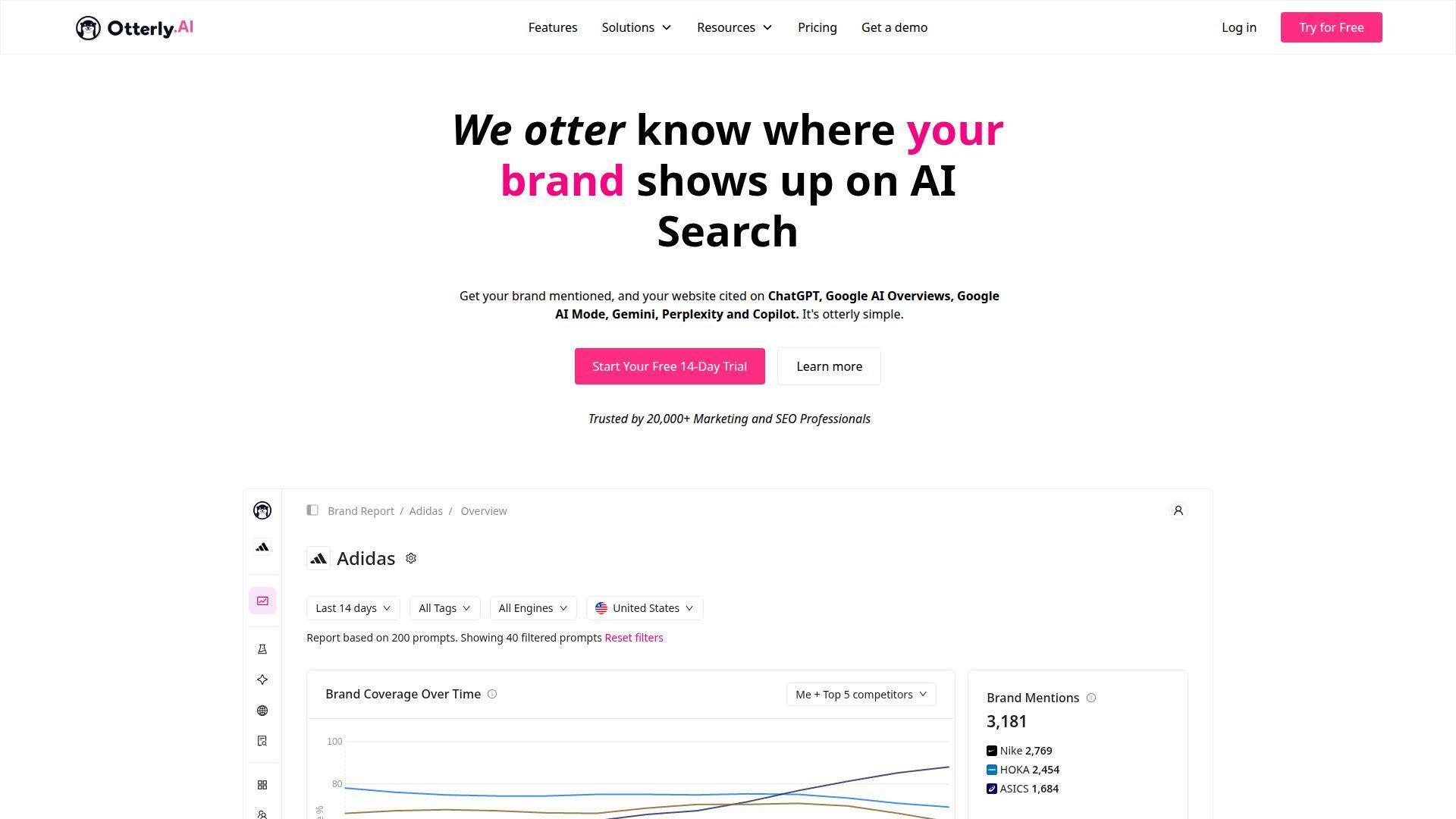
Otterly.ai is a popular entry point for teams that want to start monitoring Google AI Overviews and a couple of LLM engines without a big commitment. The product is simple, fast to set up, and the AI Overview tracking specifically is decent.
Key features
- AI Overview tracking on Google.
- Brand mention tracking in ChatGPT and Perplexity.
- Email alerts for visibility changes.
Watch-outs
The base plans cover Google AI Overviews, ChatGPT, Perplexity, and Copilot; AI Mode and Gemini are sold as add-ons. Check the engine mix and prompt allowance before choosing a tier.
Pricing
From around $29/month for a starter plan.
6. Surfer SEO, content optimization with AEO features
Why it stands out
Surfer SEO comes from the content optimization world and has extended its scoring engine with AEO-flavored signals: structuring content as direct answers, adding FAQ blocks, tightening definition paragraphs. If you already use Surfer for traditional SEO writing, the AEO add-ons sit naturally inside that workflow.
Key features
- Content scoring tuned for answer-ready structure.
- Keyword and topic research grounded in SERP analysis.
- AI writing assistant tied to the score.
Watch-outs
It is a content optimization tool first, not a measurement platform. You do not actually see whether your brand is appearing in ChatGPT or Perplexity answers, only whether your content is structured in an AEO-friendly way. Pair it with a measurement tool like LLM Pulse.
Pricing
From around $89/month, with team and business tiers available.
7. Frase, answer-engine content briefs and FAQ extraction
Why it stands out
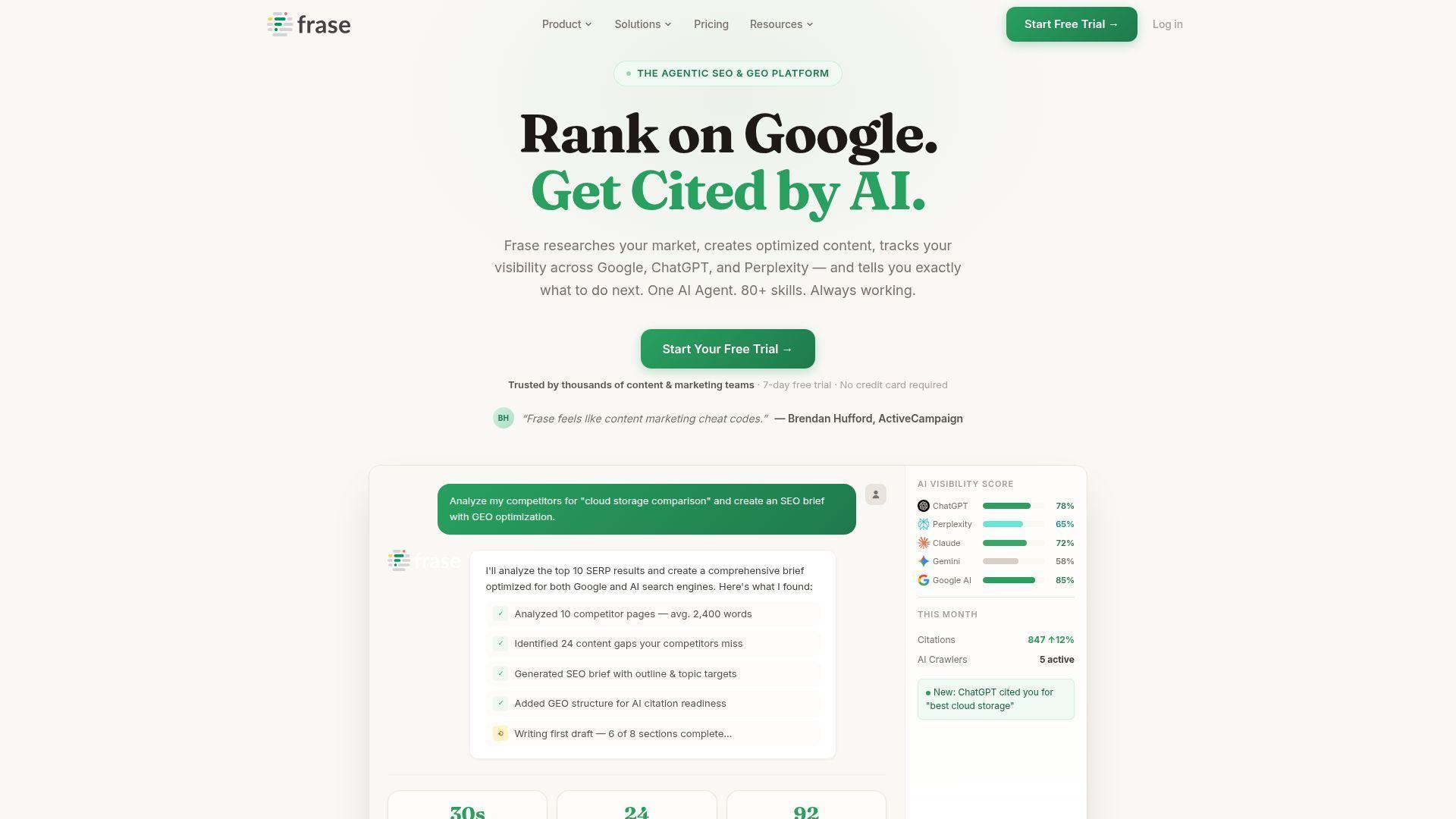
Frase is a long-standing player in question and answer mining. Its strength is taking a topic and surfacing the dozens of related questions real users ask, then helping you build briefs and FAQ blocks that feed directly into AEO. For teams writing volume content where each article needs to answer a cluster of questions, Frase is genuinely useful.
Key features
- Question mining from SERPs and “People Also Ask”.
- Content briefs with FAQ scaffolding.
- AI writing tools built around the brief.
Watch-outs
Like Surfer, it focuses on the content production side of AEO rather than measurement. You still need a separate tool to know whether the resulting pages get extracted as answers.
Pricing
From around $45/month, with team plans available.
8. Semrush, AEO add-on
Why it stands out
Semrush includes AI visibility in its SEO + AI Search plans. It monitors ChatGPT, Google AI surfaces, Gemini, and Perplexity alongside its keyword and competitor workflows.
Key features
- AI Overview tracking on Google.
- ChatGPT visibility monitoring.
- Integration with the rest of the Semrush keyword and competitor data.
Watch-outs
AI visibility is bundled with the broader SEO product, so teams should compare the full plan scope with a dedicated tracker.
Pricing
SEO costs $139 monthly or $117.33 per month billed annually. Starter costs $199 monthly or $165.17 per month billed annually and tracks 50 prompts daily.
9. Conductor, enterprise content plus AEO
Why it stands out
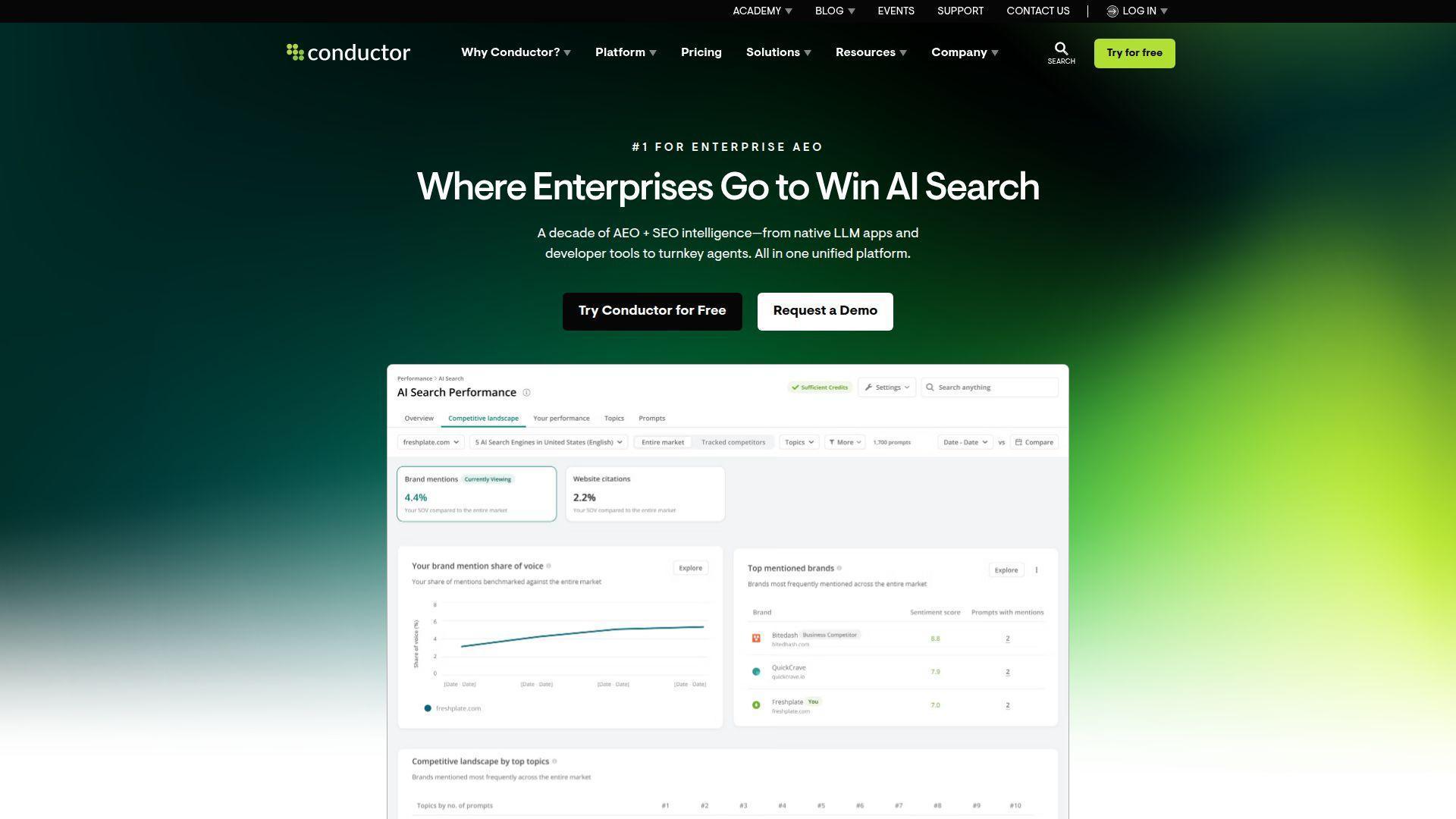
Conductor is an enterprise content workflow platform that has added AEO and AI Overview tracking on top of its existing SEO heritage. The pitch is end-to-end: research, brief, write, publish, measure, with answer-engine visibility woven into the same dashboards your content team already lives in.
Key features
- AI Overview and ChatGPT visibility tracking.
- Enterprise content workflow with editorial roles and approvals.
- BI and CMS integrations.
Watch-outs
Enterprise-only pricing and lengthy onboarding put it out of reach for SMBs and most agencies. AEO depth is decent but not the core of the platform.
Pricing
Custom enterprise pricing.
10. BrightEdge, enterprise AI search platform
Why it stands out
BrightEdge is one of the longest-running enterprise SEO platforms and has rebranded a meaningful chunk of its surface area around AI search. For very large brands that already use BrightEdge for organic search, the AI search modules give you a continuity story across blue links and AI answers.
Key features
- AI Overview tracking at scale.
- Integration with the broader BrightEdge content and reporting suite.
- Enterprise dashboards and reporting.
Watch-outs
Enterprise pricing, long contracts, and a learning curve that is hard to justify if you do not already live in BrightEdge. Pure AEO platforms deliver more focused tooling at a fraction of the cost.
Pricing
Custom enterprise pricing, typically annual.
11. WRITER, content generation tuned for AEO
Why it stands out
WRITER is a generative content platform built for large in-house content teams. Its AEO angle is on the production side: generate content that is structured for answer extraction, with brand voice guardrails and approval workflows baked in. For enterprise marketing teams producing high volumes, that workflow value is real.
Key features
- Branded generative writing with style and voice controls.
- Templates for FAQ blocks, definition paragraphs, and answer-ready sections.
- Enterprise governance and approval workflows.
Watch-outs
It does not measure AEO performance. You generate the content, then you still need a separate AEO measurement tool (LLM Pulse, for example) to find out whether the engines pick it up.
Pricing
WRITER currently offers a Starter trial and custom Enterprise plans; the older $18-per-user price is no longer the published plan structure.
Other AEO tools worth mentioning
A handful of smaller and newer players are worth keeping on your radar as the AEO category matures. AlsoAsked is a focused question-mining tool that pairs well with any of the measurement platforms above. AnswerThePublic remains useful for harvesting the long tail of “people also ask” style questions. RankWise (tryrankwise.com) is a newer entrant focused on AI ranking. NeuronWriter and MarketMuse both extend their topical optimization heritage into AEO-flavored briefs. None of these replaces a real measurement platform, but they can sit usefully alongside one.
How to choose the right AEO tool for your team
The “right” AEO tool depends less on feature lists and more on the size and shape of your team. Three lenses help.
SMB and in-house marketing teams. You need a single platform that covers the five major surfaces (ChatGPT, Perplexity, Gemini, AI Mode, AI Overviews), gives you tracking, and does not require a six-figure annual contract to access citations or sentiment. Default recommendation: LLM Pulse on Starter (€49/month, 50 prompts) or Growth (€99/month, 150 prompts).
Agencies. Your tool needs to scale across many clients without forcing per-seat fees that bleed your margin. Look for white-label, unlimited seats, multi-project management, a Looker Studio template (so you can ship branded reports without building dashboards from scratch), and CSV/Excel exports. LLM Pulse is the clearest fit; our GEO agency guide goes deep on agency workflows. Profound, Conductor, and BrightEdge can work for very large managed-services shops, but the pricing usually kills the unit economics on smaller clients.
Enterprise. If you have ten stakeholders, legal review and BI integration requirements, you have two real shortlists: LLM Pulse Enterprise, with custom SLAs and the same optional paid model add-ons, or the heavyweight enterprise suites (Conductor, BrightEdge, Profound). The choice usually comes down to existing vendor relationships and how much of the platform you actually use.
Three more decision factors that get underweighted: cadence (weekly is the floor, anything less and you are flying blind), integration (does the tool plug into GA4, Looker Studio, and your data warehouse via API?), and citation depth (without per-URL citation parsing, you cannot do source-level optimization).
Common AEO tool mistakes
Even with a strong tool, teams trip themselves up. The patterns we see most often:
- One-shot prompt testing. Running a prompt once in ChatGPT and concluding “we are visible” is not measurement. AI answers are non-deterministic. You need weekly cadence and statistical aggregation, not single screenshots.
- Tracking too few prompts. Ten prompts will not give you a stable AEO signal. Most categories need 50 to 150 to cover the buyer-journey question space.
- Only tracking ChatGPT. Each engine has a different answer style, citation pattern, and bias. Google AI Overviews, AI Mode, and Perplexity behave nothing like ChatGPT, and your brand might be invisible on one while dominant on another.
- Ignoring citations. Mentions tell you whether you are named. Citations tell you which page on your domain (or which Reddit thread, or which competitor URL) is feeding the answer. Citations are where AEO optimization actually starts.
- Skipping sentiment. Being mentioned in a negative answer (“X is unreliable, avoid it”) is worse than not being mentioned at all. If your tool does not surface sentiment, you cannot triage that.
- No reporting layer. Marketing leadership does not log into a tool dashboard. If you cannot produce a Looker Studio or BI report from your AEO tool, the data dies inside the tool.
- Confusing AEO with classic SEO. Featured snippet wins are a leading indicator for AEO, but they do not guarantee inclusion in generative answers. AI search optimization is a related but distinct discipline.
Summary
AEO is no longer a side project. In 2026, being the answer in ChatGPT, Perplexity, Gemini, Google AI Mode, and Google AI Overviews is at least as commercially important as ranking on the first page of classic Google. The 12 tools in this guide each address a piece of that problem, from content generation through citation analysis to enterprise reporting.
If you want one platform that covers measurement end to end (the five major surfaces, citations, sentiment, share of voice, agency and enterprise scaffolding) without paying enterprise-only prices, LLM Pulse is the clearest pick.
If your team already lives inside a specific vendor ecosystem (Semrush, Conductor, BrightEdge), there is value in the integrated AEO modules, with the caveat that they are usually narrower and more expensive than a focused platform. And if your need is upstream of measurement (briefs, drafts, FAQ generation), pair a content tool like Surfer, Frase, or WRITER with a real measurement layer rather than relying on either side alone.
FAQ
What is AEO?
AEO stands for answer engine optimization. It is the practice of structuring and promoting your content so that it gets extracted as the direct answer in AI-generated responses (Google AI Overviews, AI Mode, ChatGPT, Perplexity, Gemini) and voice-style answers. AEO sits next to classic SEO but optimizes for being lifted as the answer rather than being one of ten blue links.
Is AEO the same as featured snippet optimization?
Featured snippet optimization is a subset of AEO, and historically it was the closest analog. The difference is that featured snippets pull a single source, while modern answer engines (ChatGPT, Perplexity, Gemini, AI Overviews) generate answers from multiple sources at once. AEO covers both: traditional featured snippets and multi-source generative answers.
How do AEO and GEO relate?
AEO and GEO (generative engine optimization) are two names for the same discipline: optimizing so your brand shows up in AI-generated answers. Any difference is one of emphasis, with AEO leaning on being the answer and GEO leaning on being cited or mentioned anywhere in a response, not a difference of goal or scope. In 2026 most serious programs treat them as one discipline measured with one tool. Our GEO vs SEO playbook walks through the differences in depth.
Do I need an AEO tool or is SEO enough?
You need both. Classic SEO still drives the blue-link traffic that has not migrated to AI answers, and AEO captures the answer-engine traffic that has. The two share fundamentals (content quality, structure, authority) but require different measurement. An SEO tool will not tell you whether you appear in ChatGPT or Perplexity, and an AEO tool will not show you which keywords rank on page two of Google.
Are free AEO tools any good?
Free tools and one-shot prompt testers are useful for spot-checking individual queries (typing “what is X” into ChatGPT and seeing what comes back). They are not useful for measurement. AI answers are non-deterministic, so a single test is a screenshot, not a signal. Any real AEO program needs a paid tool with weekly cadence, multi-engine coverage, and citation tracking. The cost (€49/month entry on LLM Pulse, for example) is trivial compared to the content investment it protects.
How often should I run AEO checks?
AI answers drift over time as models update, citations rotate, and new content gets indexed. Daily tracking is useful during launches or active reputation work, while weekly tracking can suit steadier trend analysis.
Which AI engines should I track for AEO?
The five that matter most in 2026: ChatGPT, Perplexity, Gemini, Google AI Mode, and Google AI Overviews. These are the surfaces that route real buyer traffic. Claude, Copilot, Grok, DeepSeek and Alexa for Shopping are worth tracking once you have the basics covered, particularly in regulated industries and developer-heavy categories. LLM Pulse covers the first five as standard and offers the rest as paid add-ons.
How long does it take to see AEO results?
There is no reliable fixed timeline. Inclusion depends on the engine, crawl and retrieval timing, the query, competing sources, and the strength of the page. Track on a stable cadence so you can distinguish a repeatable change from a one-off answer. Our guide to ranking in ChatGPT covers the playbook in detail, and the same principles apply across Perplexity and Gemini.