US Data Center Moratoriums and Blocked Projects, Tracked (2026)

By Esteve Castells





Table of contents
- Why people oppose data centers, and what supporters say
- Data center moratoriums in the US: the 2026 tracker
- Blocked, denied and withdrawn data center projects
- By the numbers
- Timeline, 2023 to 2026
- State by state: where the fights are
- Public opposition to AI data centers: polls and elections
- Senate blocks the data center bill: the federal fight
- How projects actually get stopped
- What this means for your AI visibility
- Summary
- Frequently asked questions
Alongside the AI data centers going up across the US, a growing number have been paused, banned or voted down by counties, cities and townships since 2024. One inventory of local moratoriums grew from 222 records in April 2026 to 1,329 in November, most of them covering data centers. In 2026 the fight reached statehouses, the U.S. Senate and the midterms. This post tracks that opposition; for the projects that went ahead, see our map of AI data centers under construction in the US.
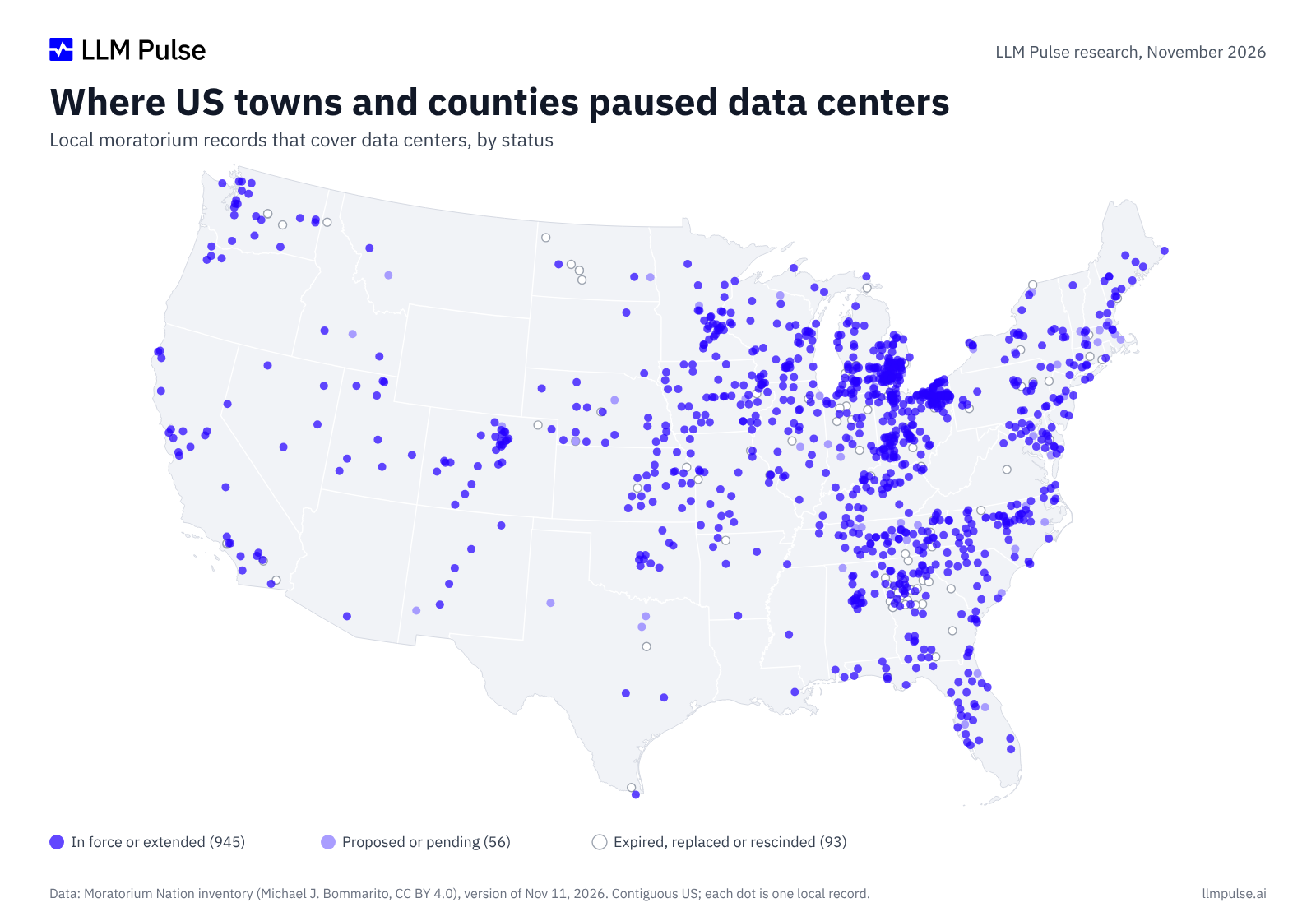
The headline numbers, as of November 2026: Data Center Watch, part of the AI intelligence firm 10a Labs, counted at least $156 billion of projects blocked or delayed by local opposition in 2025, then at least 75 projects worth about $130 billion in the first quarter of 2026 alone and 45 more worth about $68 billion in the second. The Moratorium Nation dataset lists 1,101 local moratorium records that cover data centers in 47 states, 946 of them listed as active or extended. New York became the first state to pause large data centers on July 14, 2026, Texas froze grid approvals on August 3, and on November 3 voters sided with restrictions in 40 of 41 local data center ballot measures. Gallup found that 71% of Americans oppose an AI data center in their area.
Why people oppose data centers, and what supporters say
Power bills are a common complaint. Pew found that the share of Americans who say data centers are mostly bad for home energy costs rose from 38% in January 2026 to 50% in August. Pennsylvania Gov. Josh Shapiro's August 2026 executive order cites the PJM market monitor's finding that data centers accounted for $29.4 billion, or 46%, of capacity charges across PJM's last four auctions.
Water comes up about as often: in Gallup's open-ended follow-up, 18% of opponents named water and 18% named energy. Tucson's council turned down Project Blue after city findings said it would need more water than four golf courses. In Lackawanna County, Pennsylvania, where a June 2026 tally by Resilience.org counted eight of 13 proposed data centers rejected or withdrawn, one proposed campus could draw up to 3.3 million gallons a day from Lake Scranton.
Then there is noise and on-site power. Peculiar, Missouri, residents fought Diode Ventures over noise, visual impact and property values, and Brighton, Colorado, residents cited backup generators and air quality. In Memphis, the Southern Environmental Law Center said xAI ran gas turbines for its Colossus supercomputer without permits before Shelby County permitted 15 of them in July 2025, and the NAACP sued over xAI's turbine plant in Southaven, Mississippi, in April 2026.
Tax breaks draw fire from Republicans as well as Democrats. In Virginia's 2026 session, 21 Democrats and seven Republicans in the state Senate voted to end a data center sales tax exemption projected at about $1.6 billion a year; Gov. Abigail Spanberger opposed ending it, and the June budget kept the exemption and added a tax of $0.011 per kilowatt-hour on data center electricity. Maine Gov. Janet Mills vetoed the state's moratorium but signed a law barring data centers from state business tax incentives, and Texas Gov.-elect Gina Hinojosa campaigned on ending data center tax subsidies.
Secrecy is another constant. St. Charles officials had signed nondisclosure agreements for Project Cumulus, and the mayor blamed its collapse on a lack of transparency and public trust. In Wood County, Ohio, NDAs kept Meta's name off its "Project Accordion" campus even after construction began. Pennsylvania's order now bars state agencies from signing data center NDAs, and Hinojosa promised to stop data center companies from using them in Texas.
Many of the sites are farmland. Google's Indianapolis plan would have rezoned 468 acres, and the Stargate campus in Saline Township, Michigan, started as a request to rezone 575 acres of farmland (covered in our Stargate site map).
Supporters have numbers too. In Gallup's follow-up, 55% of data center supporters cited jobs and 13% cited tax revenue. Beale promised Tucson 3,000 construction jobs and 180 permanent ones, Tract offered Hanover County $15 million for a water pump station and tank plus $6 million for land conservation and parks, and NorthPoint offered Hazle Township, Pennsylvania, a $165 million community package. Maine's governor said a moratorium was appropriate but vetoed the bill because it had no exemption for a project in the town of Jay that she said had strong local support. The Data Center Coalition says a national moratorium would eliminate jobs and drain local tax revenue, and President Trump wrote on August 31, 2026 that the only reason communities would not want data centers "is if they want to end up being backwards and poor."
Data center moratoriums in the US: the 2026 tracker
With more than a thousand local actions on record, the table lists the statewide measures and the local ones that set a precedent or cover a large market. Status is as of November 15, 2026.
| Jurisdiction | State | Type | Enacted | Length/expiry | Status | Source note |
|---|---|---|---|---|---|---|
| New York, Executive Order 62 | NY | Pause on state environmental permits for new data centers of 50 MW or more | July 14, 2026 | Up to one year, until a statewide impact study is done | In force | Utility Dive |
| New York, S10642/A11560 | NY | 12-month pause on state permits for data centers of 20 MW or more | Passed legislature June 4, 2026 | 12 months if signed | Not signed; no delivery to governor recorded | NY Senate |
| Texas, governor's directive | TX | Pause on grid-connection approvals pending a PUCT and ERCOT audit, later extended to state environmental permits | Aug 3, 2026 | Until the audit is done | In force | Texas Tribune |
| Maine, LD 307 | ME | Statewide ban on new data centers over 20 MW | Passed April 15, 2026 | Until November 2027 (proposed) | Vetoed April 24; override failed April 29 | WMTW |
| St. Charles (city) | MO | One-year moratorium, then permanent ban | Aug 22, 2025; ban May 2026 | Permanent | In force | KCUR, St. Louis Public Radio |
| St. Charles County | MO | Moratorium on projects over 100,000 sq ft or 5 MW | July 13, 2026 | Six months | In force | St. Louis Public Radio |
| Prince George's County | MD | Executive permit hold, then council pause on approvals | Sept 2025; council July 7, 2026 | Up to two years or until legislation | In force | The Banner |
| Indianapolis (Marion County) | IN | Pause on new approvals | Aug 19, 2026 (commission vote, 6-0) | Through 2027 | In force; three approved projects exempt | WFYI |
| Marshall County | IN | Permanent ban, replacing a one-year moratorium | April 2026 | Permanent | In force | Giant FM |
| Seven Wood County townships | OH | Township moratoriums | Adopted by March 13, 2026 | Lake Township: one year | Adopted; terms vary | BG Independent News |
| Lordstown | OH | Ban, converted to a 180-day moratorium | Nov 2025; extension in effect July 5, 2026 | To January 2027 | Upheld by Ohio Supreme Court Oct 20, 2026 | WKBN |
| Troup County | GA | Moratorium prompted by the $9.7B "Project West" | Sept 16, 2025 | 90 days, extended | Zoning rules up for final vote May 2026; Moratorium Nation lists the pause as lifted | FOX 5 Atlanta, county agenda |
| Coweta County | GA | Moratorium on new data center proposals | May 6, 2025 | 180 days | Ended; county rezoned Project Sail in April 2026 | WSB-TV |
| Loudoun County | VA | Proposed pause on board votes on legislative data center and substation applications | Advanced Sept 15, 2026 (7-1-1) | Up to 12 months | Pending; final resolution deferred to Nov 17 | Loudoun County |
| Pima County | AZ | Pause on new data center projects in unincorporated areas | Sept 22, 2026 (3-2) | 120 days | In force; Project Blue not covered | KJZZ |
| Denver | CO | Pause on permits and site plans for data centers | May 18, 2026 (unanimous) | One year | In force; CoreSite DE3, already under construction, not affected | Colorado Politics |
| Brighton | CO | Moratorium | Oct 6, 2026 | One year | Advanced by council | CBS Colorado |
| Seattle | WA | One-year moratorium on data center development | June 2026 | One year | In force | Route Fifty |
| Blaine | WA | Moratorium on data centers and battery storage | Oct 26, 2026 (6-0) | Up to one year | In force | Cascadia Daily News |
| Clackamas County | OR | Moratorium in unincorporated areas | Oct 22, 2026 | 120 days | In force | Clackamas County |
| Monterey Park | CA | Citywide ban by ballot measure | June 2, 2026 | Permanent | Approved with about 90% of the vote | Route Fifty |
Blocked, denied and withdrawn data center projects
"Blocked" here means a vote, a court ruling or a withdrawal stopped the project at that site. Some came back elsewhere, which the table notes.
| Project | Developer/tenant | Location | Size/investment | What happened | Date |
|---|---|---|---|---|---|
| PW Digital Gateway | QTS (Blackstone), Compass Datacenters | Prince William County, VA | About 2,100 acres, 22M+ sq ft, up to 37 buildings | Rezoning voided over defective public notice and upheld on appeal March 31, 2026; county and Compass stopped defending it; QTS terminated the project | Aug 2025 to July 2, 2026 |
| Project Blue | Beale Infrastructure (local reports tied it to Amazon; AWS said it had no commitments) | Tucson, AZ | 290 acres | City council voted unanimously to stop work on annexation and a development agreement; Pima County sold Beale the land in December 2025 and site work began in 2026 | Aug 6, 2025 |
| Project Flo | Google (Deep Meadows LLC) | Franklin Township, Indianapolis, IN | 468 acres, about $1B | Rezoning petition withdrawn just before the council vote | Sept 22, 2025 |
| Caledonia campus | Microsoft | Caledonia, WI | 244 acres | Dropped "based on the community feedback" a week after plan commission approval; Microsoft seeking another site | Oct 8, 2025 |
| City land sale | Priority Power | College Station, TX | City-owned land | Council unanimously refused to sell | Sept 2025 |
| Project Cumulus | CRG, for an undisclosed Fortune 100 tenant | St. Charles, MO | 440 acres | Application withdrawn; city passed a moratorium, then a ban | Aug 2025 |
| Harper Road Technology Park | Diode Ventures | Peculiar, MO | $1.5B | City removed data centers from its zoning code | Oct 2024 |
| Tract campus | Tract | Goodyear and Buckeye, AZ | $14B | Withdrawn after rezoning pushback | May 2024 |
| Chesterton campus | Provident Realty Advisors | Chesterton, IN | $1.3B | Withdrawn | June 2024 |
| Howell Township campus | Undisclosed (reportedly Meta) | Howell Township, MI | About 1,000 acres of farmland | Township planning commission recommended against it; rezoning request withdrawn | Sept-Dec 2025 |
| Menomonie campus | Balloonist LLC | Menomonie, WI | $1.6B | Mayor sidelined the plan | Sept 2025 |
| San Marcos rezoning | Highlander SM One | San Marcos, TX | About 200 acres; valued at $1.5B | Council reversed a January approval and rejected it 5-2 | Feb 18, 2026 |
| Pacific rezoning | Beltline Energy | Pacific, MO | $16B | City rezoning request withdrawn; Franklin County approved a rezoning for the project south of Pacific on Sept 15, 2026 | Feb-Sept 2026 |
| New Hill Digital Campus | Natelli Investments | Apex, NC | 250-300 MW (reports differ) | Annexation and rezoning applications withdrawn; town adopted a 12-month moratorium April 14 | March 2026 |
| Project Scott | Archbald I LLC (same address as Provident Data Centers) | Archbald, PA | 18 buildings on 400+ acres | Denied 5-0 to avoid a "deemed approval"; developer filed a land-use appeal April 24 | March 27, 2026 |
| Okee-One | Indian River State College (lead) | Okeechobee County, FL | 205 acres, 9-10 MW | County removed the land designation it needed; state funding pulled | April 2026 |
| Project Hazelnut | NorthPoint Development | Hazle Township, PA | $165M community package offered (June 2026) | Rejected by the township; a county court ruled against NorthPoint in May 2026 and NorthPoint appealed | Nov 2025 |
| Mountain Road Technology Park | Tract | Hanover County, VA | 430 acres, 900 MW | Rezoning denied 4-3 | May 27, 2026 |
| Lordstown campus | Bristolville 25 Developer | Lordstown, OH | Four buildings; $3.6B proposed | Ohio Supreme Court let the village's moratorium stop the review | Oct 20, 2026 |
| Silo (Willard Property) | Not named | Brighton, CO | 8 buildings, 2.5M sq ft, 155 acres | Application withdrawn as the moratorium advanced | Oct 6, 2026 |
The three 2024 entries come from Data Center Watch's first report.
By the numbers
- $156 billion: projects with disclosed values blocked or delayed in 2025, per Data Center Watch's Q3-Q4 2025 report. Its first report, covering May 2024 to March 2025, counted $64 billion.
- 75 projects and $130 billion: blocked or delayed in Q1 2026, the largest quarter on record (Q1 2026 report). Q2 2026 added 45 projects worth about $68 billion. Added together, the first half of 2026 comes to at least 120 projects and about $198 billion. Treat that as an estimate, since Data Center Watch counts delays as well as cancellations.
- 843: active local opposition groups in Q2 2026, across 49 states, up from 142 groups in 24 states in the first report.
- 1,101: local moratorium records covering data centers in the Moratorium Nation inventory (updated November 11, 2026), including proposals and lapsed ones. 934 are dated 2026 and 68 are dated 2025. Ohio leads with 159, then Michigan (134), Georgia (71) and North Carolina (66). A separate tracker by Electric Choice counted 583 active restrictions in 46 states on November 4.
- 300+: state data center bills filed in the first six weeks of 2026, with statewide moratorium bills in 14 states.
- 40 of 41: local ballot measures on November 3, 2026 where voters favored limits, per Ballotpedia.
- 474 GW: large-load requests in ERCOT's interconnection queue when Texas paused approvals, more than five times the grid's record peak.
Timeline, 2023 to 2026
- 2023: Cascade Locks, Oregon, recalls two port officials over a data center deal, and the new board cancels it in July.
- 2024: Tract withdraws a $14 billion Arizona plan (May) and Culpeper County's planning commission denies a $12 billion campus (June 12).
- 2025: Data Center Watch counts $98 billion blocked or delayed in Q2 alone. The Senate strips a federal moratorium on state AI laws 99-1 (July 1), Tucson ends Project Blue talks (August 6), a judge voids the Digital Gateway rezoning (August), Google withdraws in Indianapolis (September 22), Microsoft leaves Caledonia (October 8) and Georgia voters oust two utility commissioners (November 4).
- 2026: Archbald denies Project Scott (March 27) and Maine's statewide moratorium dies (April 29). New York's legislature passes a moratorium (June 4), QTS abandons the Digital Gateway (July 2) and Hochul signs Executive Order 62 (July 14). Texas pauses grid approvals (August 3), the Senate blocks the Ratepayer Protection Act (September 30), Ohio's Supreme Court backs Lordstown (October 20) and voters weigh in on November 3.
State by state: where the fights are
New York data center moratorium
Executive Order 62 pauses state environmental permits for data centers of 50 MW or more until the state finishes a generic environmental impact statement, for up to a year; projects that need only local permits are not covered. The legislature's bill would set a 12-month pause at 20 MW and require renewable power, but as of mid-November the Senate's record shows no delivery to the governor. NYISO's large-load queue had grown to about 12 GW, according to a law firm analysis cited by Utility Dive.
Texas data center moratorium
Texas's pause came from a governor's letter, not a law. Abbott's August 3 letter told the PUCT and ERCOT to audit every data center in the interconnection queue and deny connection to any that fail. The pause later reached TCEQ permits, and TCEQ shut its online filing system in October after advocates said some permits slipped through. Hinojosa, who takes office January 19, 2027, has promised a ban on all data center approvals until the legislature passes protections.
Northwest Ohio data center moratoriums, township by township
Wood County's planning commission told residents in January 2026 that Ohio law does not let counties impose land-use moratoriums, so northwest Ohio pauses go township by township. Seven of Wood County's 19 townships had one by March 13. Statewide, Ohio voters approved three full bans and eight partial bans on November 3, and Grove City now requires a public vote for large data centers.
Virginia and Maryland
Virginia has more operating data centers than any state. In 2026 Hanover County denied Tract's 900 MW park (May), and Loudoun County, whose attorney said a moratorium would not be legal, moved toward a 12-month pause on votes on new legislative applications (September). Amazon has faced long-running fights in Warrenton and King George County. In Maryland, The Banner reported in July 2026 that Montgomery and Frederick counties had issued six-month moratoriums and Washington County a yearlong one, alongside Prince George's pause.
Indiana, Michigan and Wisconsin
Indiana University researchers counted at least 17 Indiana counties with temporary moratoriums and two, Marshall and Cass, with bans as of July 2026. Michigan's best-known fight was in Saline Township, which denied the Stargate campus 4-1 in September 2025 and settled when the developer sued; Howell Township adopted a moratorium in November 2025, weeks before a rezoning request reportedly tied to Meta was withdrawn. Microsoft left Caledonia while its Mount Pleasant campus kept growing (more in our big tech AI data center map), and Port Washington voters now get a say on large tax-increment districts.
Georgia, Missouri, Pennsylvania and Arizona
Georgia had more data center moratorium records dated 2025 than any other state in the Moratorium Nation dataset, and some counties then wrote rules and resumed approvals, including Coweta with its 829-acre Project Sail (see our record of data center approvals). St. Charles, Missouri, went furthest with an outright ban. In Pennsylvania, Shapiro chose rules instead of a moratorium: Executive Order 2026-05 removes data centers from the state's permit fast track and makes developers who skip his standards win local approval first. Pima County adopted a 120-day moratorium in September.
Public opposition to AI data centers: polls and elections
Opinion turned fast. Heatmap's poll had local support and opposition about even in September 2025 (43% to 42%); by May 2026, 71% opposed a data center near them. Gallup's March 2026 survey also found 71% opposed, 48% strongly, with opposition highest in the Midwest (76%) and South (75%) and no meaningful difference between urban and rural areas. Pew's July-August survey found 60% uncomfortable with a new data center nearby, including 54% of Republicans and 68% of Democrats. In Pew's fall survey, 58% said they dislike political leaders who support building data centers locally.
Voters have acted on it too. On November 4, 2025, Georgia Democrats Alicia Johnson and Peter Hubbard ousted two Republican utility commissioners with about 63% each after campaigning on energy costs. On November 3, 2026, several winners had campaigned against data centers: Hinojosa defeated Abbott in Texas after pledging a moratorium, Sherrod Brown beat Sen. Jon Husted in Ohio and told supporters "I do not work for data centers," and in South Carolina Annie Andrews flipped a Senate seat after branding her opponent, Sen. Darline Graham, "data center Darline," CNBC reported. Based on preliminary results, Data Center Watch counted 61 of the 393 congressional winners it classified, and 12 of 34 governors, as backing a ban or moratorium.
Senate blocks the data center bill: the federal fight
Congress has not passed a data center law.
- July 1, 2025: the Senate voted 99-1 to strip a 10-year moratorium on state AI laws from the reconciliation bill.
- December 11, 2025: Executive Order 14365 created a Justice Department task force to challenge state AI laws, but its legislative section says the administration will not propose preempting state laws on "AI compute and data center infrastructure," apart from general permitting reforms.
- March 25, 2026: Sen. Bernie Sanders and Rep. Alexandria Ocasio-Cortez introduced the AI Data Center Moratorium Act to pause new data centers until national safeguards exist. Sen. John Fetterman and the Data Center Coalition opposed it.
- September 2026: the House passed the Ratepayer Protection Act (H.R. 9340) 417-3. It would have directed state utility regulators to consider making large data centers pay for their own grid costs. On September 30 the Senate failed to advance it, 57-43, short of the 60 votes needed, with all but four Democrats opposed. Chuck Schumer called it toothless because it was optional for states.
- After November 3: Sanders posted "National data center moratorium now," and Rep. Yassamin Ansari called a pause on AI development a first-day priority for the incoming House Democratic majority.
How projects actually get stopped
The most common ending in the tables is a withdrawal shortly before a vote, as with Google in Indianapolis, CRG in St. Charles and the Howell Township developer in Michigan. Several of the largest projects fell on procedure: a defective public notice in Prince William County, a deemed-approval deadline in Archbald, a moratorium that beat a site plan in Lordstown.
A withdrawal is often a relocation. Microsoft says it will stay in southeast Wisconsin, Beale went ahead with Project Blue on county land after Tucson declined to annex it, Tract announced another Buckeye-area project three months after its 2024 exit, and Beltline Energy moved its Pacific project into unincorporated Franklin County, which approved it. Developers also sue: Saline Township settled weeks after its denial, and the $16 billion Stargate campus went ahead. Coweta approved Project Sail after writing its own rules.
What this means for your AI visibility
Residents, county officials, journalists, investors and job seekers now research a project by asking ChatGPT, Google AI Mode or Perplexity: "Is there a data center moratorium in my county?", "Did Google cancel the Indianapolis data center?", "Why did Archbald reject Project Scott?" The answer, the sources it cites (a local paper, an opposition group's site, a developer's press release, a utility filing) and its tone shape what people believe before the hearing starts. Statuses in this post changed month to month, so an AI answer that still calls Project Blue dead, or the Digital Gateway approved, misleads the people about to vote or testify.
For developers, utilities, economic development agencies and the companies behind these campuses, that is a reputation question you can measure. LLM Pulse tracks brand mentions, the sources and URLs cited, share of voice and sentiment across ChatGPT, Perplexity, Gemini, Google AI Mode and Google AI Overviews, with daily, weekly or monthly tracking. Other models, including Claude, Copilot, Grok and Meta AI, are paid add-ons. You can see whether answers about your project cite the county minutes, the opposition group or your own fact sheet, and whether that changes after a vote.
See what AI answers say about your projects
Track the sources and sentiment ChatGPT, Perplexity, Gemini and Google AI Mode use when people ask about your company and its sites.
Summary
Opposition to US data centers grew from scattered zoning fights in 2023 into a national political issue by 2026. Data Center Watch counts at least $156 billion of projects blocked or delayed in 2025 and, by our sum of its quarterly reports, about $198 billion more in the first half of 2026, more than a thousand local moratorium records cover data centers, New York and Texas have paused approvals statewide, and voters backed restrictions in 40 of 41 local measures on November 3. Congress has passed nothing. Projects still get built, often after a pause, a lawsuit or a move to the next county, so the status of any single site can change within weeks.
Frequently asked questions
What is a data center moratorium?
A data center moratorium is a temporary pause on accepting, reviewing or approving data center applications, usually for six to 12 months while a county, city or state writes zoning or permitting rules. Some communities later replace the pause with a permanent ban, as St. Charles, Missouri, and Marshall County, Indiana, did in 2026. Others lift it once rules are in place and resume approvals.
Which US states have a statewide data center moratorium?
As of November 2026, New York is the only state with a formal statewide pause: Executive Order 62, signed July 14, 2026, halts state environmental permits for new data centers of 50 MW or more for up to a year. Texas has paused grid-connection approvals for data centers while regulators audit the interconnection queue. Maine's legislature passed a ban on data centers over 20 MW through November 2027, but the governor vetoed it, and a stricter New York bill passed in June 2026 has not been signed.
Is there a data center moratorium in Texas?
There is a pause, ordered by the governor rather than passed into law. On August 3, 2026, Gov. Greg Abbott ordered the Public Utility Commission and ERCOT to audit every data center seeking a grid connection and deny those that fail, which froze approvals, and the pause later reached state environmental permits. Governor-elect Gina Hinojosa, who takes office January 19, 2027, has promised a full moratorium on approvals until the legislature passes protections.
Why do people protest data centers?
The most common reasons are higher electricity bills, water use, noise, backup generators and gas turbines, tax breaks, secrecy around nondisclosure agreements and code-named projects, and the loss of farmland. Polls show broad local opposition: Gallup found 71% of Americans oppose an AI data center in their area. Supporters point to construction jobs, permanent jobs and local tax revenue.
How many data center projects have been blocked in the US?
Data Center Watch counted at least $156 billion of projects blocked or delayed in 2025, then at least 75 projects worth about $130 billion in the first quarter of 2026 and 45 worth about $68 billion in the second. Its counts include delays as well as cancellations, and some blocked projects later move to another site. Large examples include the PW Digital Gateway in Virginia and Google's Franklin Township plan in Indianapolis.
What data center bill did the Senate block?
On September 30, 2026, the US Senate failed to advance the Ratepayer Protection Act (H.R. 9340) by 57 to 43, short of the 60 votes needed. The House had passed it 417 to 3. The bill would have directed state utility regulators to consider making large data centers pay for their own grid costs, and most Senate Democrats opposed it as too weak because it was optional for states.
Did voters reject data centers in the 2026 midterms?
In local ballot measures, yes: Ballotpedia counted 41 data center measures on November 3, 2026, and voters favored limits in 40 of them. Several winning candidates also campaigned on data centers, including Gina Hinojosa in the Texas governor's race and Sherrod Brown in Ohio's Senate race.
Do these fights affect what AI assistants say about a project?
They can. People increasingly ask ChatGPT, Perplexity or Google AI Mode whether a data center is approved, who is building it and how much water it uses, and the answer depends on which sources the assistant cites and how current they are. Developers and companies can monitor those answers, the cited sources and their sentiment to see how a project is being described.






Discover your brand's visibility in AI search effortlessly
Esteve Castells
Co-Founder of LLM Pulse and AI search expert. With extensive experience working as an SEO for global brands and large enterprises, he's the subject matter expert building the product to deliver value to our users.
- US Data Center Moratoriums and Blocked Projects, Tracked (2026)
- Big Tech AI Data Centers: Every US Campus From Meta, Microsoft, Amazon, Google, xAI and Anthropic
- Every AI Data Center Under Construction in the US, Mapped (2026)
- ChatGPT Business Hub doesn't count your brand mentions. Here's what it counts instead
- The future of AI search data: why ChatGPT's console won't bring keywords back