




Last updated: August 3, 2026
AI assistants are changing how people discover things
Search is changing. More and more people now ask questions directly to AI assistants like ChatGPT, Gemini, Perplexity, or Google AI Mode instead of browsing dozens of websites. Instead of scanning many search results, users often receive a single synthesized answer that summarizes information from across the web. The assistant reads content from multiple pages, extracts relevant details, and combines them into a response that feels immediate and complete.
Table of Contents

This shift is creating a new discovery layer. In this environment, visibility no longer depends only on ranking pages in traditional search engines. It also depends on whether AI assistants include your brand when generating answers. Many people are referring to this new shift as AI Search, AI Visibility, or Generative Engine Optimization (GEO), and understanding how these systems build responses is becoming increasingly important.
AI answers are built from sources
Search-backed AI responses can draw on web pages. Many answers display some of those pages as citations, but visible citations do not reveal every source or step involved in generation. These pages can include social media, blog posts, comparison articles, product documentation, tutorials, industry guides, and many other forms of content. Together they form the informational foundation that the AI assistant uses to build its response.
Sometimes these pages appear explicitly as citations or references that users can open. Other source use may not be visible to the user. A citation can show that a page was referenced alongside a brand mention, but it does not prove that the page caused the mention or determined the final wording.
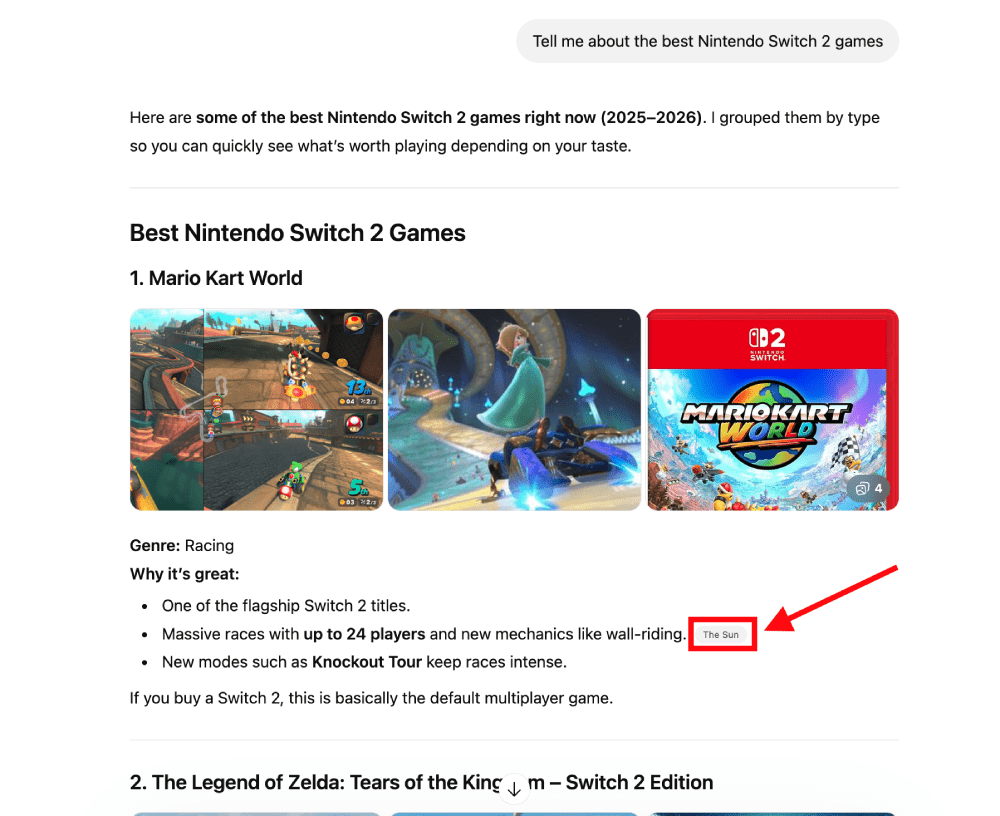
Note: LLMs can drive clicks, traffic, and even app downloads (something you can observe in tools like Google Analytics or App Store Connect), but they are not designed to optimize for that. In practice, the real impact of AI visibility often appears later through brand searches on Google, the App Store, TikTok, or other discovery platforms. As a result, attribution becomes even more complex.
Visibility in AI starts with visibility in sources
This dynamic introduces an important difference between traditional SEO and AI Search. In classic search, the primary goal is to rank your own page as high as possible. In AI-driven discovery, another layer appears because your brand also needs to exist inside the content that AI assistants rely on to construct their answers.
Consider prompts such as “best project management tools,” “top AI visibility platforms,” or “best marketing analytics tools.” When answering these types of questions, AI systems often rely on existing content such as comparison articles, software roundups, expert recommendations, and detailed industry guides. Appearing in relevant, well-supported pages can make your brand available to search-backed systems, but no individual citation guarantees inclusion in an answer.
For this reason, understanding which pages AI systems use as sources becomes essential for brands that want to improve their visibility in AI-driven search.
And, as it has always been, in the end it all comes down to building a brand.
Citations can also generate traffic
Another important aspect of sources is that many AI assistants now display them directly in their answers. In some platforms they appear as references, while in others they are shown as clickable citations that allow users to explore the underlying content.
When your website appears among those sources, several benefits emerge simultaneously. Your domain becomes visible alongside the answer, which can support awareness when users review the cited sources. Users also see your domain while reading the response, which increases brand visibility even if they do not click immediately. In many cases, users can open those citations to learn more, which means that sources can also generate direct traffic from AI answers to your website.
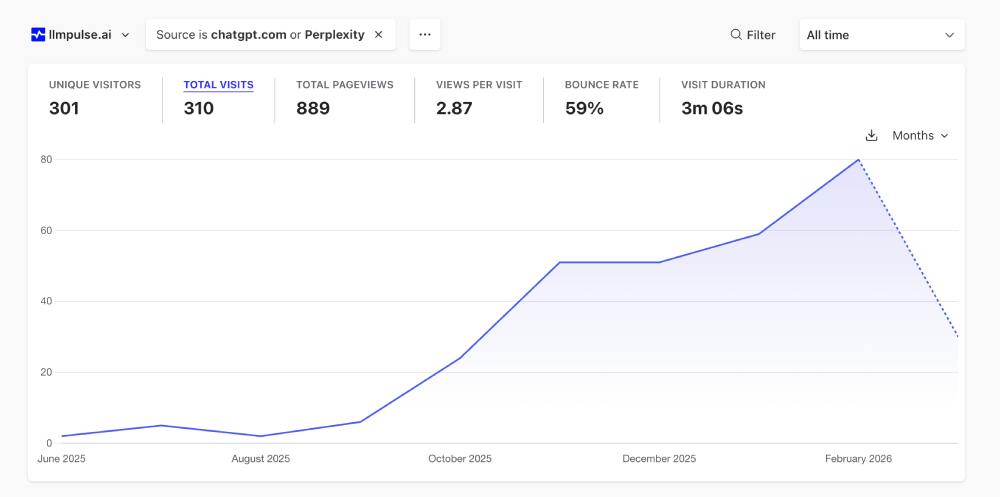
This dynamic means that companies are no longer competing only for search rankings. They are also competing to become trusted sources used by AI systems when answering questions.
You can check this manually (but it doesn’t scale)
If you want to explore how your brand appears in AI answers, you can start by testing prompts directly on different LLMs. For example, you might open ChatGPT or Gemini and ask questions such as “What are the best project management tools?” or “Which SEO platforms should I use?” After reading the response, you can check whether your brand appears in the answer or whether certain websites are referenced.
You can repeat the same experiment on platforms such as Perplexity or by triggering Google AI Overviews with relevant search queries. Testing multiple prompts and industries can help you understand which brands and sources appear most frequently. This approach is useful for gaining an initial understanding of how AI assistants construct answers.
However, manual exploration quickly becomes difficult to scale. As the number of prompts grows and responses vary across models, languages, and locations, tracking everything consistently becomes extremely time-consuming.
Automated tracking with LLM Pulse
Because manual tracking does not scale well, many teams use specialized platforms to monitor how brands and websites appear in AI responses. Tools such as LLM Pulse automate the process by running prompts across multiple AI models (ChatGPT, Gemini, Google AI Mode, Google AI Overviews and Perplexity) and collecting the answers systematically:
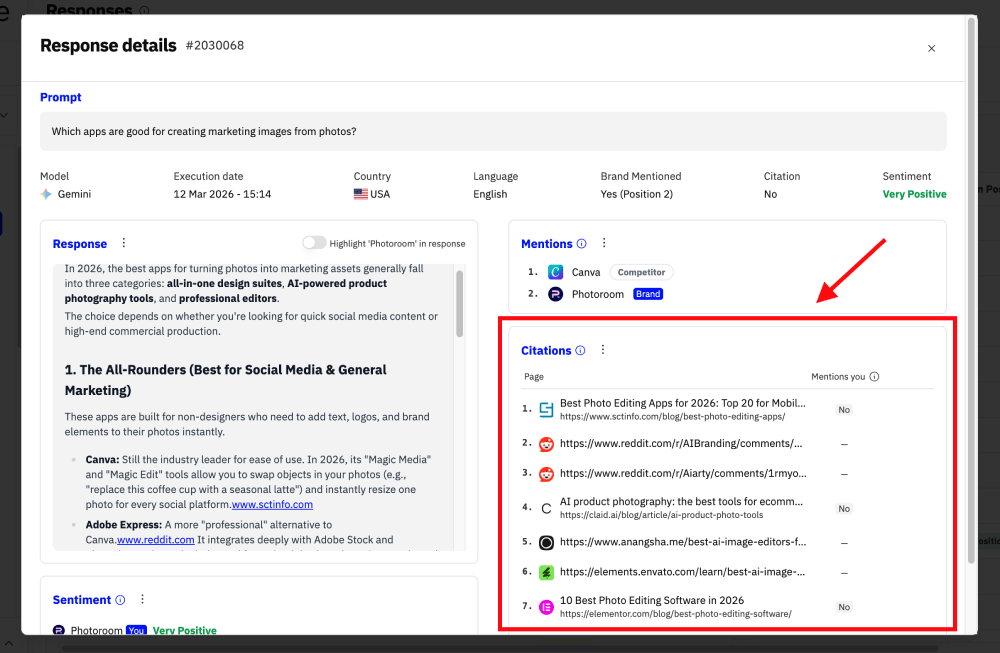
The process typically starts with creating a project for your brand, including your domain name and industry context. From there, you define prompts that reflect how users might search for tools, services, or companies in your market. The platform runs those prompts regularly across different LLMs and gathers the generated responses automatically.
Each response can then be analyzed to identify which websites are used as sources. Instead of reviewing hundreds of answers manually, teams can immediately see which domains AI assistants cite most often, which sources dominate specific prompts, and whether their own site appears among them.
LLM Pulse layers several related features on top of raw citation data: a Citation Sources Analysis view across your entire prompt set, a URL Report that connects citations back to the specific pages being referenced, GEO Testing so you can measure whether a content change actually moves which sources get cited, and Reputation monitoring to track how the tone around your brand drifts over time, not just whether you appear. MCP, REST API, Looker Studio, and CLI access are available.
From individual responses to visibility metrics
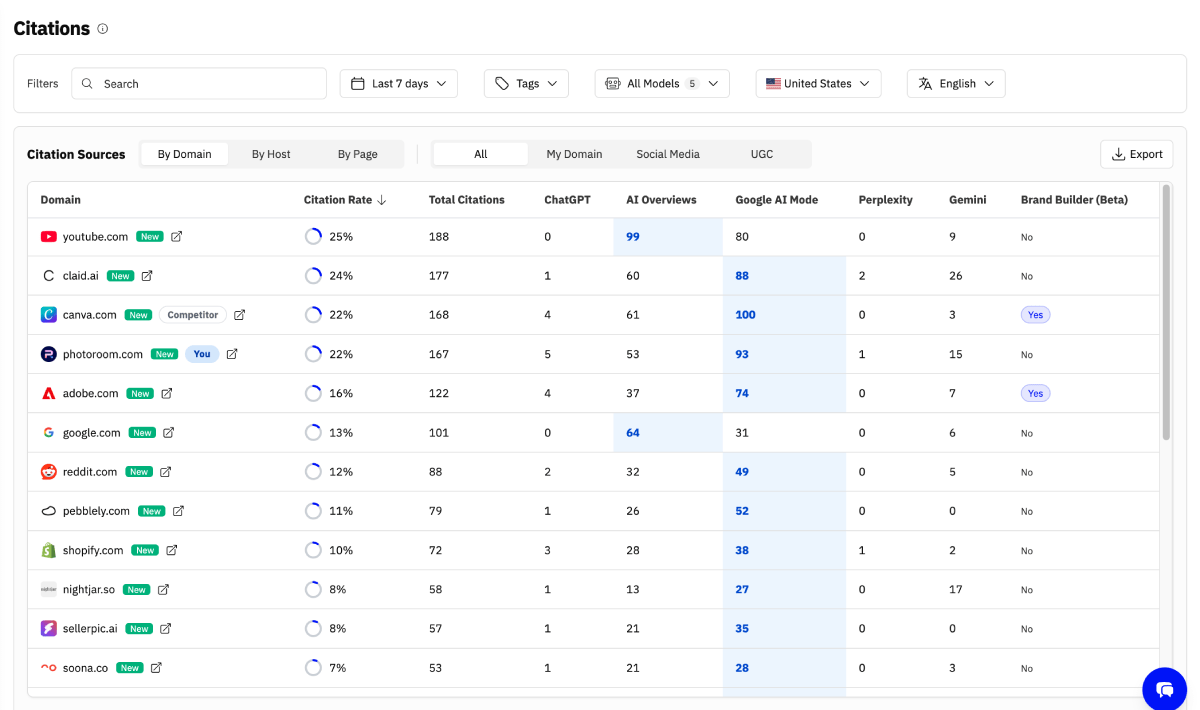
When enough responses are collected, citation data can be aggregated into meaningful visibility metrics. These insights help teams understand how often their website appears as a source, which competitors dominate certain prompts, and how their presence evolves over time:
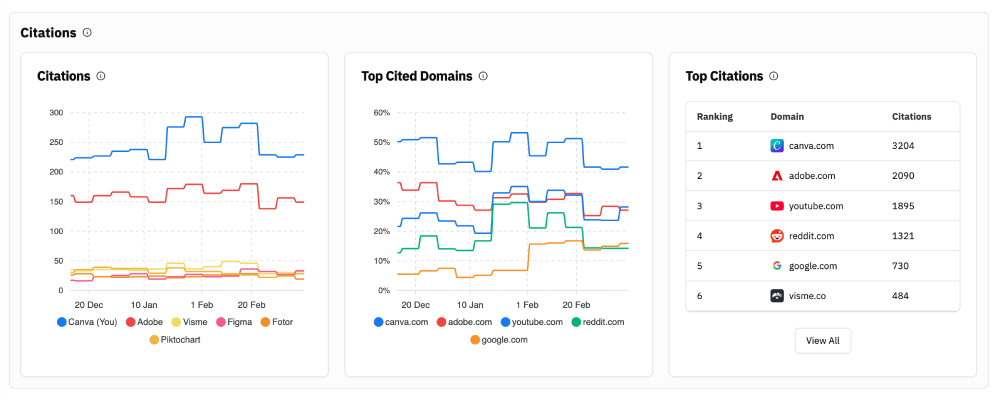
The data also allows companies to identify which prompts generate visibility and which types of content tend to appear most frequently in AI answers. By examining individual responses in detail, teams can see exactly which sources were used and how brands are positioned within those answers. This helps move beyond isolated examples and understand how LLMs actually represent an entire market.
Why monitoring sources matters
AI assistants are becoming a major interface for discovering information, products, and services. If the sources used by those systems consistently mention your competitors while ignoring your brand, their perspective will shape the answers that users see.
Monitoring citations helps companies understand whether their content participates in the information layer that AI assistants rely on. It reveals which websites influence AI responses, which competitors appear most often, and where new visibility opportunities exist. Instead of relying on occasional manual checks, automated monitoring provides a structured and scalable way to understand how AI assistants represent your brand and your industry.
FAQ
Why should brands track citations in AI assistants?
Citations reveal which websites are referenced in an AI response. They can place your domain in front of users, but they do not prove that the cited page caused a brand mention.
Do AI assistants really rely on web sources?
Search-enabled assistants can retrieve web pages and cite them in their answers. Models can also answer from training data or other context, so not every response has a visible web source.
Why do sources influence brand mentions?
A page that mentions your brand can provide relevant context to a search-backed system. The displayed citations alone cannot establish whether that page caused the final brand mention.
Can citations in AI answers be tracked automatically?
Yes. Platforms like LLM Pulse analyze AI-generated responses across multiple models and identify which websites appear as sources, how frequently they are cited, and how brand visibility evolves over time.
How does citation tracking relate to GEO or AI Search?
Monitoring sources helps companies understand whether their content is part of the information layer AI assistants rely on to generate answers. This insight can inform content strategies and strengthen visibility in AI search.
Why do citations matter in AI search?
When an AI answer cites your website, users can click through to your pages. Citation tracking reveals which of your pages AI models trust, which competitors get cited instead, and what content gaps you need to fill. LLM Pulse’s GEO Writer goes further by recommending specific improvements to increase your citation rate.
How do I find out which sources AI models use?
LLM Pulse tracks every citation across ChatGPT, Perplexity, Gemini, and Google AI. You can see which URLs are cited for each prompt, how citation patterns differ across models, and which sources appear most frequently in your industry. This data helps identify pages and topics worth reviewing, though citation presence does not reveal the model’s full generation process.