How to Advertise on ChatGPT: A Practical Guide to ChatGPT Advertising (2026)

By Daniel Peris




Table of contents
- ChatGPT advertising in 2026: where ads run and who sees them
- How to buy ChatGPT ads: self-serve, sales team or partners
- What ChatGPT ads look like
- How ChatGPT ad targeting works
- ChatGPT ad policies: what you can and cannot advertise
- What ChatGPT ads cost
- How to advertise on ChatGPT, step by step
- How to measure ChatGPT ads
- Organic vs paid in ChatGPT: ads do not buy mentions
- Track ChatGPT ads on your own prompts with LLM Pulse
- Frequently asked questions
ChatGPT advertising is a self-serve channel now. A business based in one of the 89 countries where OpenAI sells ads can open an account, build a campaign in Ads Manager and pay per impression or per click, or let the system bid toward a target cost per conversion. On October 21, 2026, OpenAI said that more than 100,000 advertisers had run campaigns in the eight months since launch.
This guide is for marketers deciding whether to put budget behind it: who can buy and who sees the ads, the formats, how targeting and bidding work, what it costs, which categories are restricted, how to launch a first campaign and how to measure it. A ChatGPT ad runs below the answer and changes nothing in what the answer says about your brand, so the last sections cover the organic side too.
I would spend more time on context hints than on any other part of the setup. They look like a keyword field, but OpenAI uses them to judge who an offer is for and when it helps, so 'CRM' tells the system far less than 'CRM for a ten-person agency still running on spreadsheets'. Before writing a headline, I would also look at the ads already running in your category and country: the format is young, and real placements teach more than any spec sheet.
 Daniel Peris Co-founder, LLM Pulse
ChatGPT advertising in 2026: where ads run and who sees them
OpenAI began testing ads in the US on February 9, 2026, and has opened ChatGPT Ads market by market since. Its Ads Manager availability page lists all 89 countries: the US, Canada, the UK, Australia and New Zealand, every EU member state plus Iceland, Liechtenstein, Norway and Switzerland, most of Latin America, and markets such as India, Japan, South Korea, Indonesia, Turkey, Saudi Arabia and the United Arab Emirates.
Who sees the ads, according to OpenAI's Ads in ChatGPT help article:
- Users on the Free and Go plans. Plus, Pro, Business, Enterprise and Edu accounts never have ads.
- Logged-out visitors, who only get ads suitable for all audiences.
- Nobody identified as under 18, from their stated age or OpenAI's age prediction.
- Nobody in a Temporary Chat, and no Free user who has switched to the ads-free mode, which removes ads in exchange for lower message limits.
For B2B budgets, this means a buyer who uses ChatGPT only through a company Business or Enterprise seat will not see your ad there. The channel suits offers that people research on Free and Go accounts.
Being on the list also tells you little about how full a market is. Our ad coverage report measures, country by country, the share of ChatGPT answers that carry at least one ad. In the 7-day window ending November 22, 2026, the ten highest markets ran from 67.32% (the Netherlands) to 92.41% (the United Arab Emirates), with Turkey, Japan, Indonesia, New Zealand, Australia, Saudi Arabia, Germany and India in between. The rates come from questions brands track in LLM Pulse, not from a random sample of everyday ChatGPT use.
How to buy ChatGPT ads: self-serve, sales team or partners
The main route is self-serve. OpenAI started rolling out a beta of Ads Manager on May 5, 2026, together with cost-per-click bidding and conversion measurement. The legal entity that advertises and pays must be based in a listed country, and opening an account does not by itself give access to self-serve buying. Some new accounts can advertise only in their home country at first, and OpenAI may open other countries as the account builds a history.
Larger advertisers with more complex needs can ask OpenAI's ads team for sales support. In the 31 European markets, the ads team and partners were the only way in until self-serve opened there on August 31, 2026.
You can also buy through partners. OpenAI names Dentsu, Omnicom, Publicis and WPP among its agency partners, and Adobe, Criteo, Kargo, Pacvue and StackAdapt among its technology partners. Since September 16, 2026, businesses can also create and track ChatGPT ads from HubSpot, and US Shopify merchants from a ChatGPT Ads app in the Shopify App Store.
What ChatGPT ads look like
OpenAI describes one ad unit, labeled as an ad and shown below a ChatGPT response, separate from the answer itself. For standard campaigns, Ads Manager offers two formats:
- A single-image ad: one image, a headline, a description and one destination URL.
- A multi-image ad: four to six square images that all link to the same URL, with "Learn more" as the only call to action. It has been an open beta since October 26, 2026.
Retailers have a third option. Product feed campaigns turn an uploaded catalog into product ads with images, titles, star ratings, prices and sale prices. During the beta, feed products appear only in ads, never in organic ChatGPT conversations.
Two more formats are in US tests. Sponsored Agents let a user who clicks an ad open a labeled conversation with an agent the advertiser sponsors, kept apart from ChatGPT's own answers; OpenAI is testing them with select advertisers. A US test of visual ads shown while ChatGPT generates an image, with an initial group of advertisers, was announced on October 5, 2026.
On the creative side, you can opt into AI text customization, which adapts your headlines and descriptions to the conversation and translates them into the user's language. Ads Manager can also prefill draft ads from your website's metadata.
How ChatGPT ad targeting works
There are no keywords to bid on. OpenAI matches ads using the context and intent of the current conversation, the ad's title, copy and landing page, and the context hints and targeting choices you set. When a user has ads personalization switched on, memories and recent chats can count as well. Advertisers never see the conversations.
Context hints live at the ad group level. OpenAI's ad group guide says they "inform relevance" but "are not exact-match keywords or targeting rules, and they do not guarantee delivery for particular conversations or audiences." Its own example: "cushioned everyday running shoes for beginners training for their first 5K" gives the system more to work with than "running shoes". Use separate ad groups when two offers need different messages or landing pages.
The hard controls sit at campaign level:
- Countries: list every market you want. As OpenAI notes, excluding other countries alone does not limit delivery to the US.
- Platforms: Android app, Android web, desktop web, iOS app and iOS web.
- Locations inside a country, such as states, cities, markets and postal codes where available (product feed campaigns take countries only).
- Start and end dates.
- Custom audiences to include (at least 25,000 matched users) or exclude.
In the European Economic Area and Switzerland, personalized ads are not available yet, and OpenAI advises against custom audiences in campaigns that target them. Matching there relies on the conversation and basic context such as general location and language.
Ads are not limited to shopping questions either. In our study of 36,153 US ChatGPT answers collected between July 25 and August 4, 2026, informational questions drew an ad 69.5% of the time, close to the 74.6% for commercial ones. Write hints for the problem your buyer is learning about as well as the moment they compare vendors.
OpenAI's guides describe no negative keywords and no way to exclude conversations. The company keeps ads away from sensitive conversations on its own, and in October it announced brand suitability pilots with DoubleVerify and Integral Ad Science.
ChatGPT ad policies: what you can and cannot advertise
OpenAI reviews the title, copy, image and landing page of every ad against its ad policies, last updated on November 20, 2026. In the early phases it focuses on consumer goods, local services, travel and entertainment, and digital products and education. B2B software is already well represented: in our US study window, 50 of the 100 biggest advertisers sold B2B software or services.
Not allowed today:
- Adult content and dating apps
- Alcohol over 0.5% ABV, tobacco and vaping
- Gambling (a casino hotel stay may be allowed when gambling is not the focus)
- Political and issue ads, and ads from government bodies
- Recreational drugs
- Unsupported wellness claims, such as diet pills and detox programs
- Credit repair, debt settlement and alternative investments
- Individual job listings and individual housing rentals or sales
In the US, healthcare and financial services ads are open to approved advertisers in listed categories, case by case, and may require proof of licensure, and legal services ads are allowed for licensed professionals. Outside the US, healthcare ads are generally prohibited, financial services ads need OpenAI's approval and legal services ads are not allowed.
For landing pages, the ad must match its destination end to end, deceptive redirects are banned, ads cannot link straight to a messaging chat, and a lead generation advertiser must say that a third party provides the service before collecting personal data. The page must also let OpenAI's crawlers in: the ad creation guide says landing pages must not block OAI-AdsBot or OAI-SearchBot.
What ChatGPT ads cost
OpenAI publishes no rate card. An auction decides which eligible ads show, and the winning bid sets the price.
| Item | What is public |
|---|---|
| Objectives and billing | Views, billed per 1,000 impressions (CPM); clicks, billed per click (CPC); or conversions, billed per click or per 1,000 impressions. You never pay per conversion. |
| Bidding | Intelligent bidding (formerly Maximize Results) adjusts bids within your budget. Since November 9, 2026, new campaigns can set a Target CPA or Target CPC, an average cost goal, not a cap. Max Bid and Max CPC retire on January 1, 2027. |
| Minimum daily budget | Set per billing currency, for example 25 USD, 15 EUR, 15 GBP, 25 AUD or 2,500 JPY. |
| Pacing | A daily budget is a 7-day average: a single day can spend up to twice the amount, a week up to seven times. |
| Pilot pricing | The February 2026 pilot launched at a reported $60 CPM. By April, Digiday reported CPMs as low as $25 and a minimum spend down from $250,000 to $50,000. |
Sources for the first four rows: OpenAI's guides to creating campaigns and to bidding and pricing.
Set targets from your own numbers. OpenAI's example: $400 of spend and 10 attributed purchases is a $40 CPA, and a $20 Target CPA will not make purchases cost half as much. A target below recent performance can restrict delivery and leave budget unspent. Treat any CPC or CPM range you read on a blog as one account in one category at one moment.
How to advertise on ChatGPT, step by step
- Check eligibility. Confirm that the country where your business is registered and billed appears on OpenAI's availability list, that the markets you want to reach are live and that your category is allowed under the ad policies.
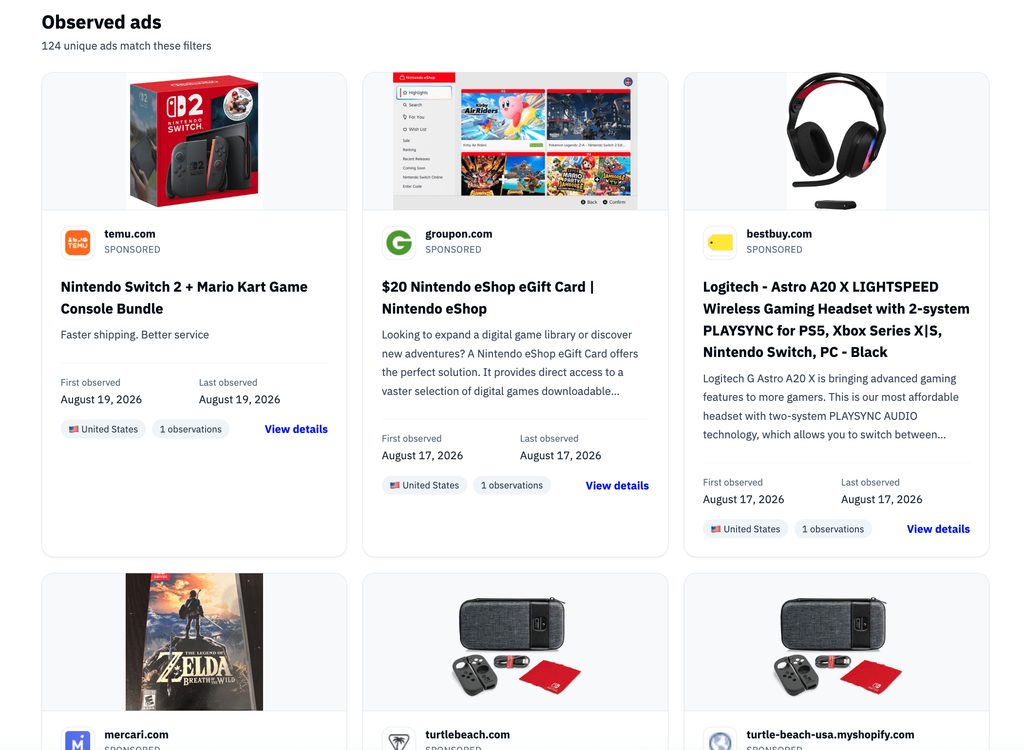
- Study your category first. See who already advertises on the questions your buyers ask, in the countries you plan to target. Our ChatGPT Ads Library shows observed ads by advertiser, country, message and date. Anyone can browse a sample, and a free account adds search, filters and the ad creatives.
- Create the account. Sign up at ads.openai.com and complete verification and billing. Ads start delivering only after they pass review.
- Install measurement before launch. Add the OpenAI Pixel, the Conversions API or both, and check that real events reach the data source. Put your own UTM parameters on every destination URL, with a paid medium such as
utm_medium=cpc, so the visits are easy to separate in analytics. - Plan ad groups by need. One product, service or buyer problem per ad group, each with its own context hints. "Project management for agencies" and "project management for construction firms" deserve separate groups.
- Write several ads per group. A headline that says what the product does, a description that adds a new fact and a landing page that answers the same question. OpenAI recommends several title and description variations per offering, each from a different angle.
- Choose the objective and budget. You cannot switch a campaign to a different objective later, so choose between views, clicks and conversions with care. Intelligent bidding is the simplest start; once you have a few weeks of cost data, set a Target CPC or Target CPA from it. Budget well above the daily minimum so the campaign gathers enough data to learn from.
- Review weekly. Compare ad groups, break results down by platform and country with the Segment menu, move budget to what converts and rewrite ads that get impressions without clicks.
How to measure ChatGPT ads
Measure in three layers, because Ads Manager shows you only one of them.
Inside Ads Manager. Impressions, clicks, spend and the conversions your Pixel or Conversions API report. If you send the same conversion through both, give it the same event ID so OpenAI counts it once. Reported totals can include modeled conversions, and reports show campaign results, never individual users. OpenAI's measurement partner integrations connect tools such as Hightouch and LiveRamp for conversion data, and mobile measurement partners including Adjust, AppsFlyer, Branch and Kochava for apps.
In your own analytics. Do not rely on ChatGPT to label your traffic. From October 9 to mid-October 2026, many organic ChatGPT visits arrived with neither utm_source=chatgpt.com nor a referrer and landed in Direct before the tag came back. The UTMs you put on ad URLs are the labels you control: they keep paid clicks identifiable, and the paid medium keeps them apart from organic AI traffic, so you can compare the two on conversion rate.
Across the market. Ads Manager says nothing about competitors, and OpenAI publishes no ad archive. To see who else buys your category, how their message changes and which countries they enter, you need observed data. In the 7 days to November 23, 2026, the ChatGPT Ads Library captured more than 160,000 ad placements from over 9,500 advertisers in 61 countries. It is independent observed data, so an advertiser missing from it may still be buying.
Organic vs paid in ChatGPT: ads do not buy mentions
OpenAI says ads do not influence ChatGPT's answers and run on systems separate from the chat model. Our data is consistent with that: in the US sample, only 2.8% of ads pointed at a domain the same answer also cited as a source, and across the study's full sample, 73% of advertisers never appeared as a source in any answer.
So the two channels do different jobs:
| Paid (ChatGPT Ads) | Organic (the answer itself) | |
|---|---|---|
| What you get | A labeled ad below the answer | A mention, recommendation or citation inside it |
| Who sees it | Free and Go users and logged-out visitors in live markets | Every user, on every plan |
| How you get it | Budget, bids and context hints | Content, sources and a reputation the model trusts |
| How fast | Days | Weeks to months |
| What it tells the reader | You paid to be there | The model chose you |
The strongest position is both: the answer recommends you, and the ad below it is yours. In our data, when a question named a tracked brand and the answer carried an ad, the ad came from that brand only 1.7% of the time and from a tracked direct competitor 5.1% of the time. If the organic side is where you are weak, start with our guide on how to get cited by ChatGPT.
Track ChatGPT ads on your own prompts with LLM Pulse
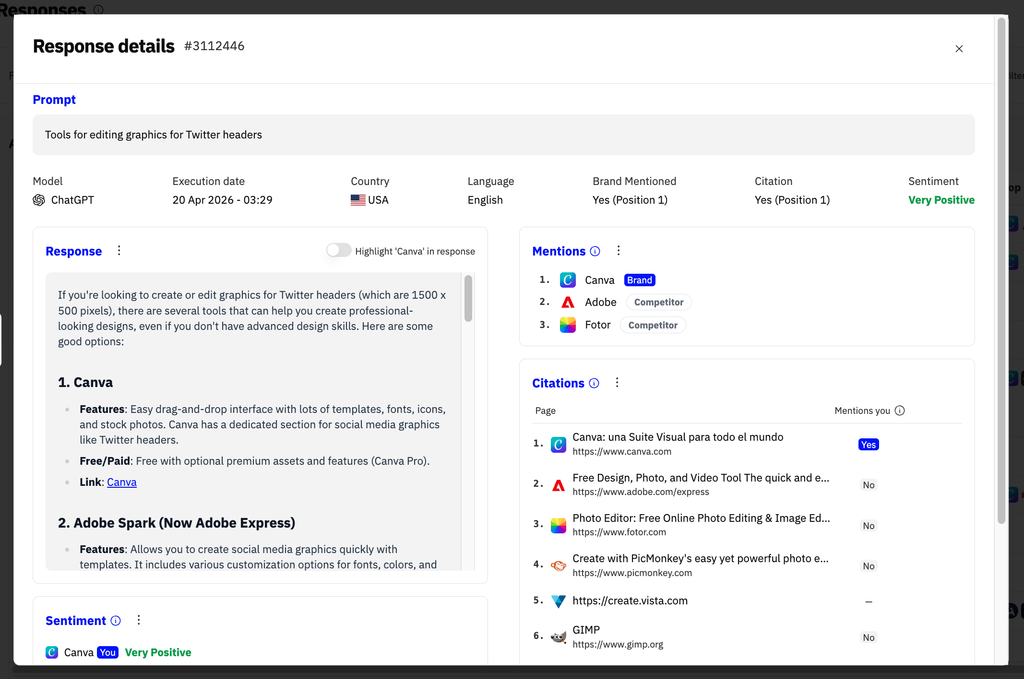
LLM Pulse tracks how ChatGPT, Perplexity, Gemini, Google AI Mode and Google AI Overviews answer the questions your buyers ask. When a ChatGPT answer it collects carries sponsored ads, ChatGPT Ads tracking stores each ad's headline, description, link and position, resolves click-tracker links to the real advertiser and matches the ads to your domain and your tracked competitors.
That gives you the view Ads Manager cannot:
- An advertiser leaderboard for your prompts, with placements, prompts covered and average and best position per domain.
- The prompts where a tracked competitor advertised and you did not.
- Your share of the sponsored space next to your organic mentions, on the same prompts.
- Ad volume, new advertisers and your own share per tracking period, so you can see when a category starts to fill up.
- The full answer around every ad, so you can read what the model said and what was sold next to it.
You do not need an ad account or a tracking tag, and the advertiser and response tables export to CSV or XLSX for paid media and agency reporting.
See who advertises on your ChatGPT prompts
Track ChatGPT's sponsored ads next to your organic mentions in ChatGPT and the other major AI engines.
Frequently asked questions
If your business is registered and billed in one of the 89 countries on OpenAI's Ads Manager availability list, sign up at ads.openai.com, complete verification and billing, install the OpenAI Pixel or Conversions API, create a campaign with ad groups and context hints, write your ads and set a daily budget. Ads run once they pass review. Larger advertisers can also work with OpenAI's ads team, agency partners or technology partners.
OpenAI publishes no rate card. Prices come from an auction, and campaigns are billed per 1,000 impressions or per click, never per conversion. The minimum daily budget depends on the billing currency, for example 25 USD, 15 EUR or 15 GBP. The February 2026 pilot launched at a reported $60 CPM, and Digiday reported CPMs as low as $25 by April 2026.
No. Ads are matched to the context of the conversation. Each ad group carries context hints, which OpenAI says inform relevance but are not exact-match keywords or targeting rules. Campaign settings control countries, platforms, locations within a country, dates and custom audiences.
Users on the Free and Go plans and logged-out visitors in the 89 countries where ads are live. Plus, Pro, Business, Enterprise and Edu accounts have no ads, and OpenAI shows none to users identified as under 18, in Temporary Chats or near sensitive topics such as health, mental health and politics.
OpenAI's ad policies disallow adult content and dating apps, alcohol and tobacco, gambling, political and government ads, recreational drugs, unsupported wellness claims, credit repair and debt settlement, and individual job or housing listings. Healthcare and financial services ads need OpenAI's approval and are mostly limited to the US, and legal services ads are open only to licensed US professionals.
No. OpenAI says ads do not influence answers. In LLM Pulse's study of 36,153 US answers collected between July 25 and August 4, 2026, only 2.8% of ads pointed at a domain the same answer cited, and across the study's full sample, 73% of advertisers never appeared as a source.
Use Ads Manager for impressions, clicks, spend and the conversions your OpenAI Pixel or Conversions API report. Add your own UTM parameters with a paid medium to every ad URL so paid visits stay separate in your analytics, and watch competitor ads in your category with an ad library or ad tracking.
OpenAI publishes no ad archive. The LLM Pulse ChatGPT Ads Library shows observed ads by advertiser, country, message and date, and LLM Pulse's ChatGPT Ads tracking shows which advertisers appear on your own tracked prompts.






Discover your brand's visibility in AI search effortlessly
Daniel Peris
Daniel Peris is a serial entrepreneur and one of the Co-Founders of LLM Pulse. With a strong background in SEO and ASO, he has spent over 15 years building and scaling digital businesses. He brings extensive experience in SaaS, both in product and growth, focusing on refining the product and executing growth strategies.
- How to Advertise on ChatGPT: A Practical Guide to ChatGPT Advertising (2026)
- Every Major US Data Center Approval, State by State (2019-2026)
- OpenAI Stargate Data Centers: Every US Site, Mapped (2026)
- ChatGPT Business Hub explained: how to claim your business and what Insights shows
- What Score Does AI Give Zelda: Ocarina of Time? We Asked 4 AIs in 10 Countries