



Last updated: October 5, 2026
Increasingly, users turn to ChatGPT, Perplexity, or Google’s AI products for answers rather than traditional search, reshaping how brands and products / services are discovered and assessed.
Table of Contents
If a brand is mentioned inside an AI-generated answer, it can shape perception, trust and even sales. If it is ignored, that invisibility matters just as much.
That is why measuring brand mentions, sentiment, citations and share of voice in large language models is becoming essential. It is how companies can see where they stand in this new layer of discovery and how they compare with competitors.
In this new environment, brands need reliable tools to measure, monitor and optimize their visibility inside LLMs. Understanding how they appear across AI systems helps identify opportunities, detect risks and guide content and reputation strategies. Choosing the right tracker is key to building and maintaining visibility in this new kind of search.
The following points explain what to consider before deciding which AI Search Visibility tracker best fits your needs.
1. Functionality
A visibility tracker should do much more than count how many times your brand appears. The goal is to understand context: how, when and why you show up inside AI-generated results.
What really matters:
- Mentions: every time your brand or competitors appear in an AI answer.
- Sentiment: whether those mentions are positive, neutral or negative.
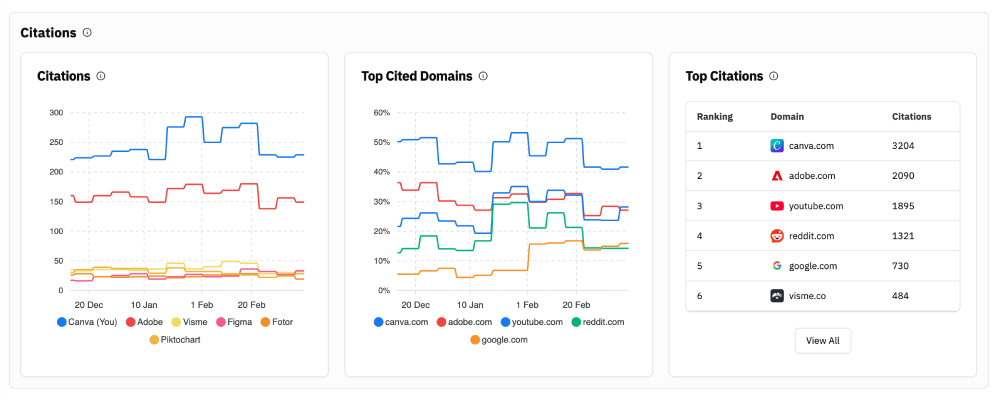
- Citations: which domains are being linked or referenced by AI engines.
- Share of Voice: how your brand’s exposure compares to others across similar prompts.
- Evolution over time: how visibility and sentiment change week by week.
LLM Pulse provides mentions, citations, share of voice, and sentiment in one platform.
Understanding which sources are cited by AI systems is essential, since these citations shape how answers are formed and which brands are perceived as trustworthy or authoritative.
You can filter results by model, country, language, topic / tag or competitor to get a clear view of your presence in AI search. CSV and Excel exports, GEO Writer, Models Comparison, MCP, tags, sentiment, app tracking, Web Analytics, ChatGPT Shopping, GEO Testing, Reputation monitoring, API, Looker Studio, and CLI access are available. The Query Detector Chrome extension captures web-search queries exposed in ChatGPT responses. White-label access uses an agency arrangement.
2. Data coverage
The value of any visibility tracker depends largely on the platforms it monitors. A good tool should not limit itself to a single AI model but instead provide a complete view of how your brand appears across different ecosystems.
LLM Pulse monitors Gemini, ChatGPT, Perplexity, Google AI Mode and Google AI Overviews. These five environments represent the core of modern AI Search, where millions of daily interactions shape brand awareness. Paid accounts can add Claude, Copilot, Grok, DeepSeek, Naver AI Briefing, Baidu AI and Meta AI themselves. Alexa for Shopping is available as a self-serve paid add-on. Further models are available through Talk to sales.
At DevDay 2026, OpenAI said developers could launch native experiences on ChatGPT’s shared surface for its collective 1.2 billion weekly users. Perplexity is growing fast as a conversational search engine, and Google’s AI layers are already blending generative results into traditional search.
LLM Pulse supports daily, weekly, and monthly tracking across these engines.
3. Technology
The quality of an AI visibility monitoring platform depends on how it collects and interprets data. Many tools rely on surface-level extraction or keyword matching, which often misses the real context of how brands appear inside AI-generated answers.
LLM Pulse takes a deeper and more accurate approach. It runs tens of thousands of real prompts across multiple AI engines and analyzes the full text of each response to detect and track brand mentions, sentiment and citations. This ensures that visibility data reflects what users actually see when interacting with models like ChatGPT, Perplexity or Google AI Mode.
The platform is scalable and built to handle an increasing number of prompts, engines and brands without losing precision or speed. All results are processed, structured and updated regularly, so the data always reflects the current state of AI search. As new models and generative search layers appear, LLM Pulse adds them quickly to maintain complete coverage and an up-to-date view of how each brand is represented across AI systems.
4. Support that listens, learns and improves
When adopting a new analytics platform, good support can make a BIG difference. Tracking visibility in AI search is still new for most companies, so having a responsive and accessible team behind the product is essential.
LLM Pulse offers support by email and through its contact form, with a typical response time of one business day. The platform also includes clear onboarding materials, a detailed Help Center and regular product updates with examples and use cases.
Client feedback has a direct impact on the evolution of the product. Many of the new features and improvements are the result of suggestions and ideas from active users. This close relationship between the team and the community helps ensure that LLM Pulse keeps evolving in the right direction and remains focused on solving real visibility challenges.
5. Pricing
Pricing in this field can be confusing. Some tools target large corporations with long contracts, while others are built for agile teams.
LLM Pulse publishes its self-serve prices. Plans differ in prompt and project limits, tracking cadence, and features. Agencies can manage multiple clients from one account within their project allowance.
For a deeper dive into how LLM Pulse stacks up in terms of cost-efficiency compared to other tools, check out this detailed article.
6. The team
The people behind a tool matter more than it seems. AI visibility evolves quickly, and what you choose today needs to adapt as the market changes.

LLM Pulse was created by a team with extensive experience in SEO, SaaS, app marketing and data analytics. For more than a decade they have built and grown SEO tools and platforms used by thousands of companies worldwide.
The company is fully bootstrapped, profitable, and releases new features every week. Its founders stay close to the clients, evolving the product in sync with the industry and the needs of each brand.
Final thoughts
Understanding how your brand appears inside AI answers is no longer optional. It is the natural next step after SEO and it is already happening.
Before choosing an LLM visibility tracker, look at what it can measure, which models it covers, how the data is processed, and who is behind it. And of course, always choose the one that best fits your needs.
LLM Pulse brings all of that together in one platform, helping brands see where they stand, how they are perceived and what drives visibility in AI search.
👉 See current pricing or schedule a demo
FAQ
What is AI Search Visibility and why is it becoming essential for brands?
AI Search Visibility refers to how often and how positively your brand appears inside AI-generated answers. As users shift part of their search behaviour to LLMs, this visibility directly influences awareness, recommendations and decision making.
Why should a visibility tracker analyze full AI answers instead of simple keyword mentions?
Because LLM answers rely on context. A tracker must read full outputs to understand sentiment, citations, depth of mention and whether your brand is positioned as a recommended option or merely referenced.
How important is engine coverage when choosing a visibility tracker?
It is key. Each AI engine has different behaviours, prompt routing and citation patterns. To understand your real footprint, you need a tracker that monitors ChatGPT, Perplexity, Google AI Mode and other fast-growing models.
Why does tracking cadence matter in AI visibility?
AI results change quickly. Some brands need weekly snapshots for strategic monitoring. Others prefer daily runs for competitive categories. The right cadence depends on your market, your team and your decision cycles.
What factors help determine which visibility tracker is the best fit for a company?
You should evaluate coverage, cadence, accuracy, pricing model, data transparency and the execution quality of the vendor. The best tool is the one that matches your prompt volume, your growth stage and your need for auditability.
What’s the most important feature in an AI visibility tracker?
Multi-model coverage. Your brand appears differently in ChatGPT vs Gemini vs Perplexity, each with its own biases, source preferences, and update cadence. A tracker that only covers one or two models gives you an incomplete picture. Look for platforms that include at least ChatGPT, Perplexity, Gemini, and Google AI.
How much should an AI visibility tracker cost?
Quality AI visibility tracking starts around €49-99/month for most teams. Be wary of tools that charge per AI model or per seat, since costs escalate quickly. LLM Pulse includes 5 standard AI models and unlimited seats, making costs predictable as your team and coverage grow.