



Last updated: August 30, 2026
When a user asks ChatGPT “is brand X trustworthy?” or “what is the best real estate portal in Spain?”, the answer is not random. It comes from everything the model has absorbed about your brand: news coverage, reviews, forum threads, your own content and your competitors’ content. In other words, AI models hold an opinion about your brand, and they repeat it at scale, in millions of conversations you never see.
Table of Contents
Most teams have no idea what that opinion is. This post explains how AI brand reputation analysis works, what it measures, and how you can track and improve it with LLM Pulse’s Reputation feature.
What is AI brand reputation?
AI brand reputation is the perception that large language models have of your brand across qualities like trust, innovation, product quality, ethics and leadership. It is the AI-era equivalent of brand perception studies, with one important difference: instead of surveying a panel of consumers, you query the AI models themselves.
This matters because AI answers are now a primary discovery and evaluation channel. Buyers ask AI assistants to compare vendors, recommend products and summarize what a company is known for. If ChatGPT consistently describes a competitor as “the market leader” and your brand as “a smaller alternative”, that framing shapes thousands of buying decisions before anyone reaches your website.
AI brand reputation analysis complements classic AI visibility tracking. Visibility tells you how often you appear in AI answers. Reputation tells you how AI models talk about you when you do appear, and how that compares to every competitor in your space.
How LLM Pulse measures AI brand reputation
LLM Pulse’s Reputation feature runs a structured evaluation of your brand and your competitors directly against the AI models. Here is the methodology in plain terms:
- Multiple AI models, queried independently. Each report can run across up to six models (ChatGPT, Perplexity, Gemini, DeepSeek, Grok, and Claude). Every model scores all brands on its own, with no knowledge of what the other models said.
- 7 reputation dimensions, ~27 attributes. Each brand is scored 0-100 on every attribute, with written reasoning for each score.
- Brand vs competitors, always. The analysis is comparative by design. A score of 75 only means something when you can see that your closest competitor scored 82.
- Monthly cadence. A new report is generated automatically on the 1st of every month, so you build a longitudinal record of how AI perception evolves.
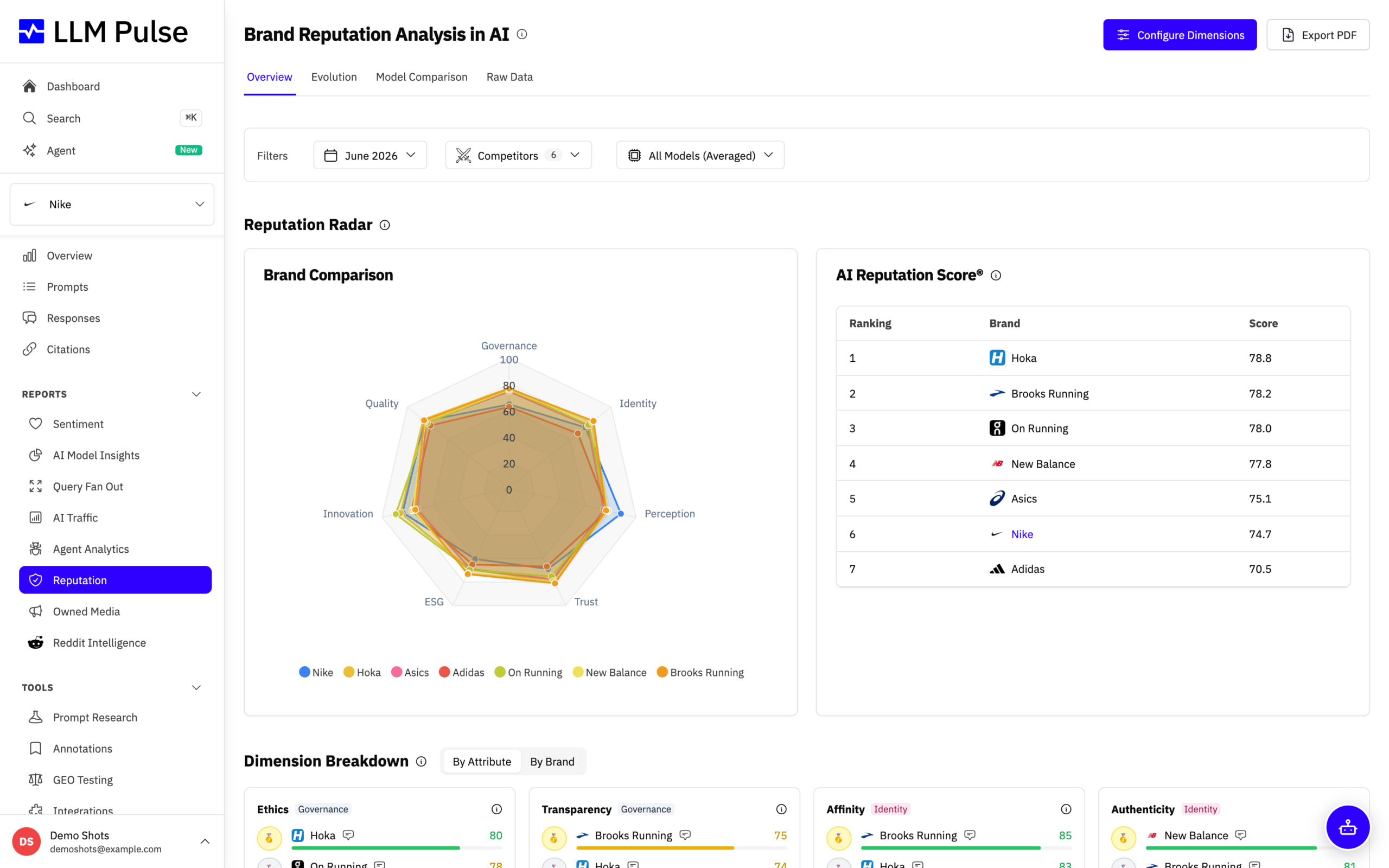
The result is an AI Reputation Score for every brand, a ranking, and a radar chart that shows the shape of each brand’s reputation at a glance. In the example below, seven running shoe brands are scored on the same scale by the same models, and the gap between first (78.8) and last (70.5) tells you exactly how contested the category is:
The 7 dimensions of AI brand reputation
Reputation is not one number. LLM Pulse breaks it into seven dimensions, each made of specific attributes:
- General Perception: reputation, solvency, solidity, influence, leadership and prestige.
- Innovation and Adaptability: innovation, adaptability and differentiation.
- Identity and Values: brand affinity and authenticity.
- Relationships and Trust: trust and accessibility.
- Social Responsibility and Sustainability: social responsibility, community impact and environmental sustainability.
- Product and Service Quality: product quality and service quality.
- Governance: ethics and transparency.
On top of the default framework, you can disable dimensions that are not relevant to your industry and add up to three custom dimensions with your own attributes, for example a “News” dimension that scores media coverage and freshness for brands where press presence drives perception.
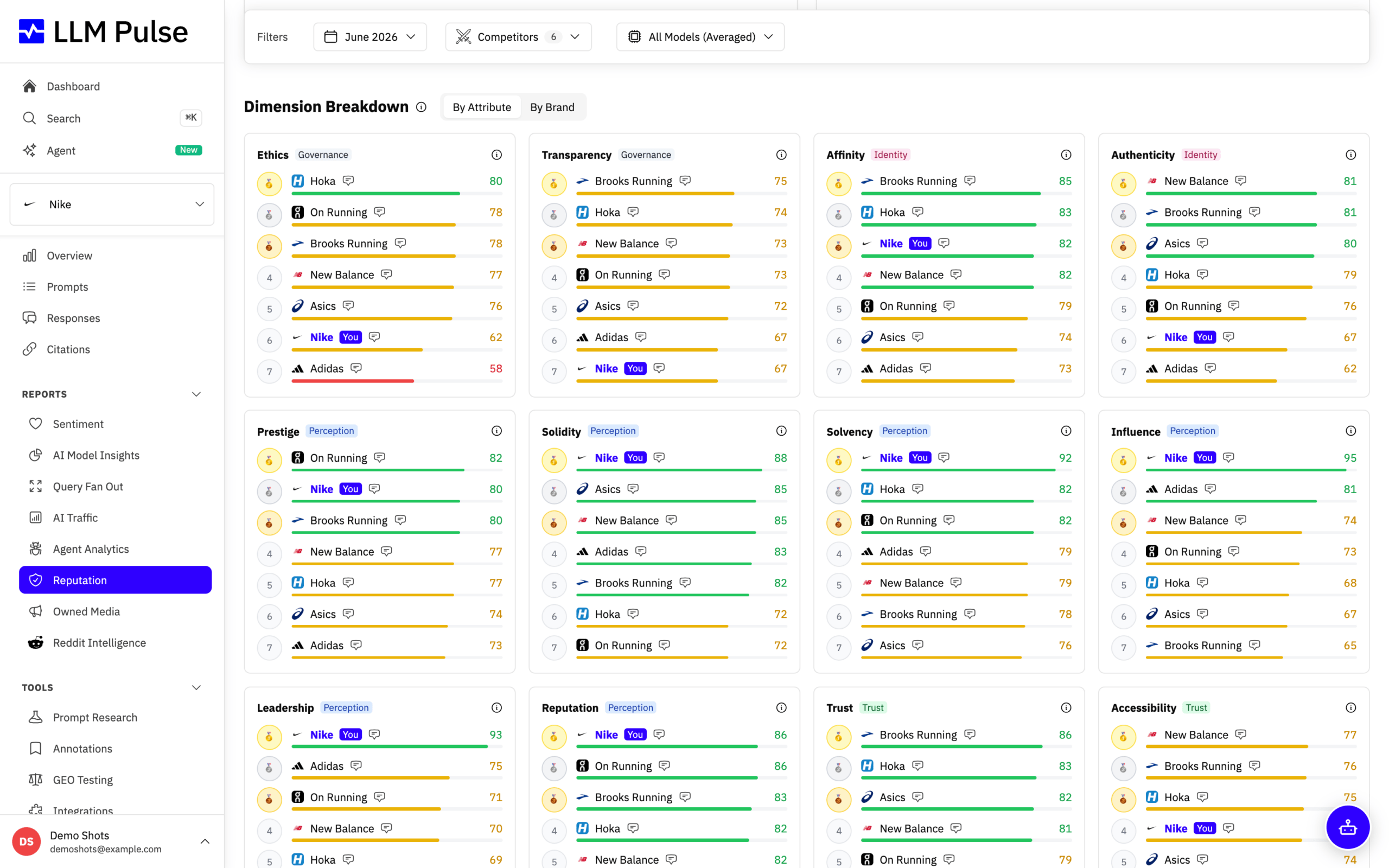
Each attribute gets its own ranking card, so the overall score never hides the detail. In the running shoes example, the brand that ranks sixth overall still leads the category on solidity, solvency and leadership, which is exactly the kind of nuance an average would bury:
Scores follow a simple scale: 80-100 is excellent, 60-79 good, 40-59 average, and anything below 40 signals a real perception problem. Because every attribute score comes with the model’s written reasoning, you never have to guess why a number is low.
Track how AI perception evolves month over month
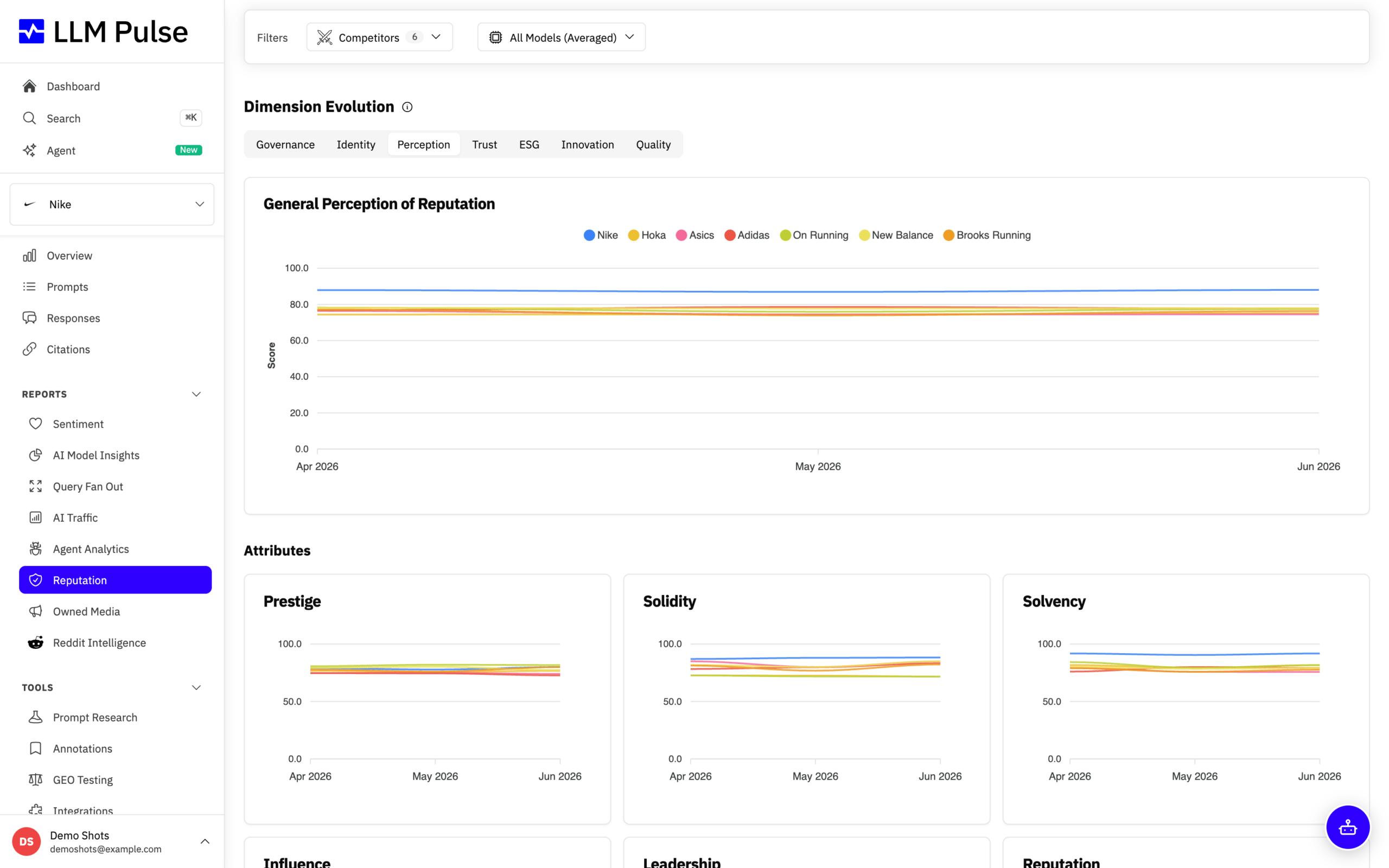
A single snapshot is useful. A trend line is strategy. Because reports run automatically every month, the Evolution tab turns your reputation data into time series per dimension and per attribute, for your brand and every competitor.
This is where reputation work becomes measurable. Launched a PR push or a sustainability report two months ago? Check whether your ESG and News scores actually moved. Watching a competitor’s trust score climb? That is an early warning that their narrative is landing with the models, and it will eventually land with users too.
Different AI models see your brand differently
One of the most consistent findings across our customers: AI models do not agree about brands. ChatGPT might highlight your B2B tools and international expansion, while Perplexity, which leans heavily on fresh web sources, emphasizes recent pricing complaints, and Gemini focuses on your financial solidity.
The Model Comparison tab puts each model’s strengths, opportunities and key differentiators side by side:
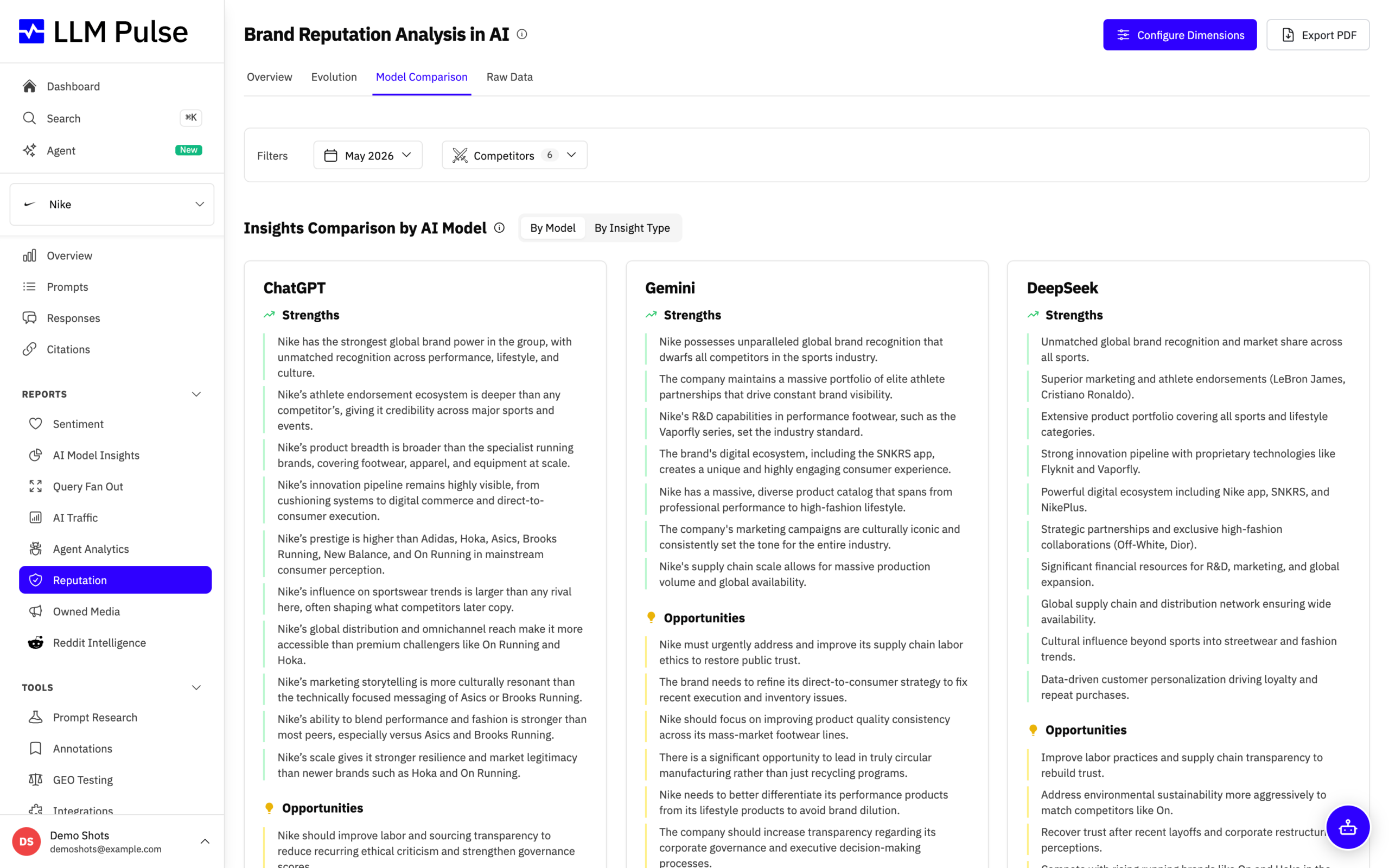
This matters for prioritization. If your reputation gap only exists on one model, you can usually trace it to the sources that model favors and fix the narrative there. If all models in the report agree on a weakness, the problem is not an AI quirk: it is your actual market narrative.
Drill down to the raw data
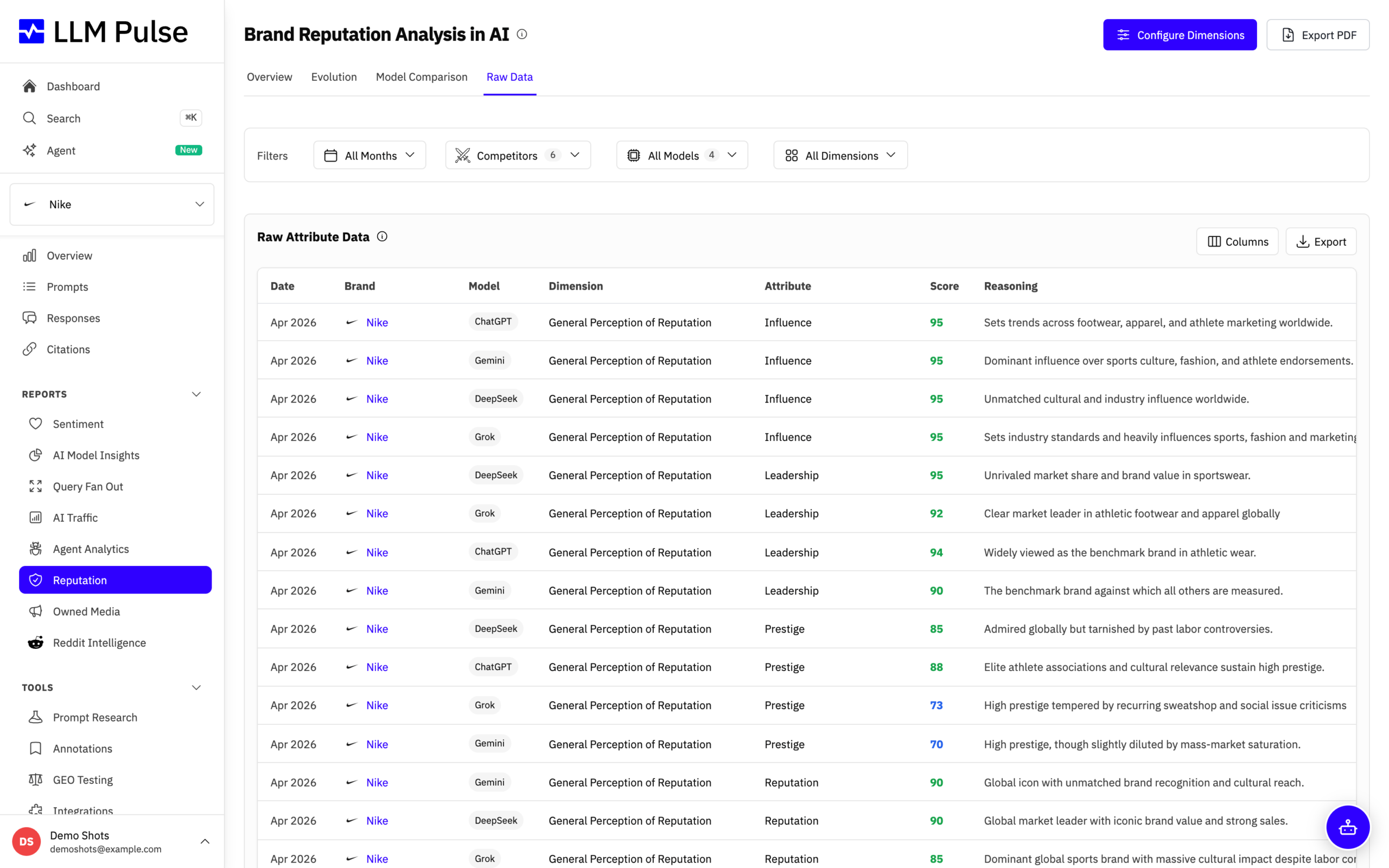
For analysts and agencies, the Raw Data tab exposes every single data point: date, brand, model, dimension, attribute, score and the model’s reasoning, all filterable and exportable to CSV or Excel. Nothing is a black box; you can audit exactly why your brand scored 71 on trust in March and 78 in June.
Agencies running reputation programs for clients can also export the full report as a branded PDF, and opt in to a monthly report email so stakeholders get the update without logging in.
How to improve your brand’s AI reputation
Measurement is step one. Here is the playbook we see working:
- Fix the weakest attributes first. The attribute rankings tell you exactly where you lose to competitors. A weak “transparency” score is an invitation to publish pricing, leadership and policy pages that models can cite.
- Read the reasoning, not just the score. The models explain their scores. If Perplexity says your service quality reputation is dragged down by review-site complaints, you know which channel to work on.
- Close the narrative gap per model. Each model favors different sources. Match your content and PR efforts to the sources behind the model where you underperform.
- Feed the models substance. Sustainability reports, case studies, third-party coverage and structured company information all become training and retrieval material that shapes future scores.
- Re-measure monthly. Reputation moves slowly. The monthly cadence is designed to show real trends instead of day-to-day noise. Expect small score fluctuations between runs; what matters is the direction over quarters.
Because LLM Pulse is an all-in-one AI search platform, reputation data does not live in a silo. It feeds the Recommendations engine alongside your visibility, citation and sentiment data, so reputation gaps turn into concrete action items in the same workflow you already use for GEO.
Getting started
The Reputation feature is available under Reports in the sidebar. Setup takes one click: generate your first report, and from then on a new one runs automatically on the 1st of every month for your brand and all configured competitors. You can customize dimensions per project, export PDFs, and receive the monthly summary by email.
If you want to see how AI models talk about your brand, LLM Pulse combines reputation reports with AI visibility tracking, sentiment analysis and citation monitoring.
Frequently asked questions
What is an AI Reputation Score?
It is a 0-100 score that summarizes how AI models perceive a brand. LLM Pulse computes it by asking up to six AI models to score the brand on roughly 27 attributes across 7 dimensions, averaging attributes into dimension scores and dimensions into the overall score.
Which AI models are included in reputation reports?
Reports can run across ChatGPT, Perplexity, Gemini, DeepSeek, Grok, and Claude. Each model is queried independently, and you can view results per model or averaged across all models.
How is this different from sentiment analysis?
Sentiment analysis classifies the tone of individual brand mentions in real AI answers to your tracked prompts. Reputation analysis is a structured, comparative evaluation: it asks the models directly to score defined attributes for your brand and competitors. Sentiment tells you how conversations sound today; reputation tells you what the models believe about you. LLM Pulse includes both.
How often are reputation reports updated?
A new report is generated automatically on the 1st of every month, one per project. Competitors added mid-month are included in the next monthly run.
Why do scores change slightly between months?
AI models produce slightly different outputs on every run, so small month-over-month variations are expected. Focus on sustained trends across several months rather than single-point changes.
Can I customize the reputation dimensions?
Yes. You can enable or disable the default dimensions per project and add up to three custom dimensions with your own attributes, for example a “News” dimension that scores media coverage and freshness.
Can I export the data?
Yes. The full report exports as a PDF, and the raw attribute data exports to CSV or Excel. There is also an optional monthly email with the report summary.
Does LLM Pulse include a Reputation feature?
Yes. Reputation works alongside prompt tracking across the five default visibility models, mentions, citations, competitive share of voice, and sentiment analysis.