




Last updated: August 10, 2026
Perplexity is an answer engine that typically retrieves current web sources and writes a synthesized answer with numbered citations. If you are not one of those cited sources, you are effectively invisible, no matter how well you rank in traditional search.
Table of Contents

Getting cited in Perplexity is a distinct discipline from classic SEO, and it overlaps with what people now call GEO (generative engine optimization) or AI search optimization. This guide explains, briefly, how Perplexity chooses its sources, then walks through the concrete strategies that actually move the needle, the mistakes that keep good pages out of answers, and how to measure your Perplexity visibility over time.
If you want the full mechanics behind the pipeline, read our companion explainer on how Perplexity works. This post is the action guide.
How Perplexity picks its sources (the short version)
Perplexity uses retrieval-augmented generation (RAG). For each query it fetches a set of live web pages, ranks them, and passes the strongest few to a language model that writes the answer and attributes claims back to those pages. Of the pages it retrieves, typically only three to six end up cited.
Perplexity does not publish its ranking weights. The following are observed patterns and practical content qualities, not confirmed ranking factors:
- Relevance: how directly the page answers the specific question, not just the broad topic.
- Extractability: whether Perplexity can cleanly lift a factual statement and attribute it. A page can rank well in Google and never get cited here if its facts are buried, vague, or hard to quote.
- Freshness: Perplexity has a stronger recency bias than most AI tools. Recently updated pages routinely outrank older, higher-authority ones for fast-moving topics.
- Authority and trust: established domains with named authors and editorial accountability are treated as more reliable.
- Structure: clear headings, direct answers, tables, and lists make a page easier to parse and cite.
The practical approach is to make facts easy to find, quote, and verify. Perplexity has not stated that extraction quality is its primary ranking objective.
How to rank in Perplexity: 8 strategies
1. Make sure PerplexityBot (and Perplexity-User) can reach you
None of the following matters if Perplexity cannot crawl your site. Perplexity operates two user agents, documented in its official crawler docs:
- PerplexityBot is the indexing crawler that discovers and surfaces pages for cited answers. It respects robots.txt.
- Perplexity-User is the user-initiated fetch that visits a page when someone’s question requires it in real time. Because it acts on behalf of a person, it generally does not follow robots.txt rules.
To explicitly allow the indexing crawler, add this to your robots.txt:
- User-agent: PerplexityBot
- Allow: /
Then check that your firewall, CDN, or bot-management rules are not silently blocking it. Many sites accidentally block AI crawlers at the WAF layer even when robots.txt allows them. Perplexity publishes its verified IP ranges (linked from its crawler documentation) so you can whitelist by user agent plus IP. Changes can take up to 24 hours to take effect. For the full picture across every AI crawler, see our guide on controlling AI bot access to your website.
2. Write answer-first, extractable content
Lead with the answer, then explain. Perplexity rewards pages that state a clear, self-contained fact near the top of a section rather than burying it after three paragraphs of preamble. Practical rules:
- Put a direct, one to two sentence answer immediately under each heading.
- Phrase key facts as standalone statements that make sense out of context (Perplexity quotes them in isolation).
- Keep the evidence next to the claim: dates, numbers, and named sources in the same paragraph.
- Use one clear topic per page. Single-focus pages get extracted more reliably than sprawling catch-all articles.
Format matches intent, so write in the shape of the answer: use tables for comparisons, numbered steps for how-to content, and short lists for “types of” or “options” queries. This is the same extractability discipline that wins in ChatGPT and AI Overviews, covered in our sibling guides on how to rank in ChatGPT and how to rank in Google AI Overviews.
3. Keep content fresh
Freshness is one of Perplexity’s strongest and most distinctive signals. For time-sensitive queries it will favor a page updated last week over an authoritative page that has not moved in a year. To use this:
- Genuinely update your cornerstone pages on a regular cadence, not just the visible date. Refresh figures, add recent developments, and prune anything stale.
- Show a real “last updated” date and, where relevant, cite current-year data.
- Prioritize your highest-value comparison and “best of” pages, which decay fastest.
Cosmetic date changes without substantive edits are a short-term trick and a long-term risk. Update the substance, and the date follows honestly.
4. Earn authoritative third-party citations and mentions
Perplexity leans heavily on independent validation. Your own site claiming you are “the best” carries little weight. Being named favorably on sites the model already trusts carries a lot. Multiple 2026 studies found that the large majority of citations for commercial and B2B queries come from third-party sources rather than the brand’s own domain.
That makes off-site presence a core ranking lever, not an afterthought:
- Earn coverage and mentions in reputable industry publications.
- Get listed and reviewed on relevant review platforms and category directories (for example G2, Trustpilot, Clutch, or the leading site in your niche).
- Pursue mentions in analyst roundups, “best of” lists, and comparison articles that Perplexity is likely to retrieve.
Think of it as building the consensus Perplexity reads back to users, not just optimizing a single page.
5. Build presence on the sources Perplexity cites most
Perplexity’s citations are a long tail, but a familiar set of high-authority domains recurs across studies: Reddit, Wikipedia, YouTube, LinkedIn, and major industry publications and review sites. Reddit in particular is consistently one of the most-cited domains on Perplexity, reportedly accounting for around a quarter of its citations in some 2026 analyses, and far higher in certain product and software categories.
Concrete moves:
- Participate genuinely in relevant subreddits and communities where your category is discussed. Helpful, non-spammy contributions can become the exact threads Perplexity surfaces.
- Make sure your brand has an accurate, well-sourced Wikipedia presence if it meets notability guidelines (do not fabricate or self-edit against the rules).
- Publish and optimize YouTube content for how-to and review queries.
- Keep your LinkedIn and other high-authority profiles current and factual.
Publishing your own pages is only part of it. You are also seeding the wider web that Perplexity draws from.
6. Target question and comparison queries
Perplexity usage skews toward research and evaluation: “best tools for X”, “A vs B”, “alternatives to Y”, “is X worth it”. Comparison and list content is disproportionately cited because it maps cleanly onto how Perplexity extracts answers. One 2026 analysis attributed roughly a third of AI citations to listicle and comparison formats.
- Build pages that directly answer evaluative queries, with honest comparison tables and clear criteria.
- Mirror the phrasing real users type: include the “best”, “vs”, and “alternatives” framings your buyers actually search.
- Answer the specific sub-questions around your category (pricing, use cases, pros and cons) as their own extractable sections.
7. Add structured data
Use valid structured data when it accurately describes the page and supports established search features. Perplexity has not published schema markup as a citation ranking factor, so do not add unsupported types solely to influence AI answers. Clear visible content and crawlability matter more than speculative markup tactics.
8. Strengthen your entity and topical authority
Perplexity favors domains that repeatedly show up as relevant across a topic. Cover your subject area in depth rather than publishing one-off posts, interlink related pages, and keep your brand’s core facts (what you do, who you serve, key numbers) consistent everywhere they appear. Consistent, well-connected coverage signals that your domain is a dependable authority on the topic, which raises your odds across many related prompts at once. For more on where these systems source their information, see where ChatGPT gets its data.
Common mistakes that keep you out of Perplexity
- Blocking the indexing crawler by accident. Restricting PerplexityBot can keep pages out of its index, although Perplexity-User may still fetch a page for a user request. Audit robots.txt and WAF rules deliberately.
- Burying the answer. Long intros, vague claims, and facts scattered mid-paragraph are hard to extract. Lead with the answer.
- Optimizing only your own site. If most citations in your category come from third parties, an all-on-domain strategy caps your ceiling. Invest in off-site presence.
- Letting flagship pages go stale. Recency matters more here than in classic SEO. A page untouched for a year loses ground to fresher competitors.
- Chasing volume over clarity. Thin, keyword-stuffed pages do not extract cleanly. One strong, single-topic page beats five shallow ones.
- Ignoring Reddit and review sites. These are where a large share of Perplexity’s trust comes from in many categories. Being absent there is a real gap.
- Faking freshness. Changing a date without changing the content is a fragile tactic that erodes trust over time.
How to track your Perplexity visibility
You cannot improve what you cannot see. Perplexity answers vary by user, phrasing, and day, so spot-checking a few queries by hand is not a measurement strategy, it is guessing. You need consistent, repeated tracking of the prompts that matter to your business, which is where the best Perplexity trackers earn their keep.
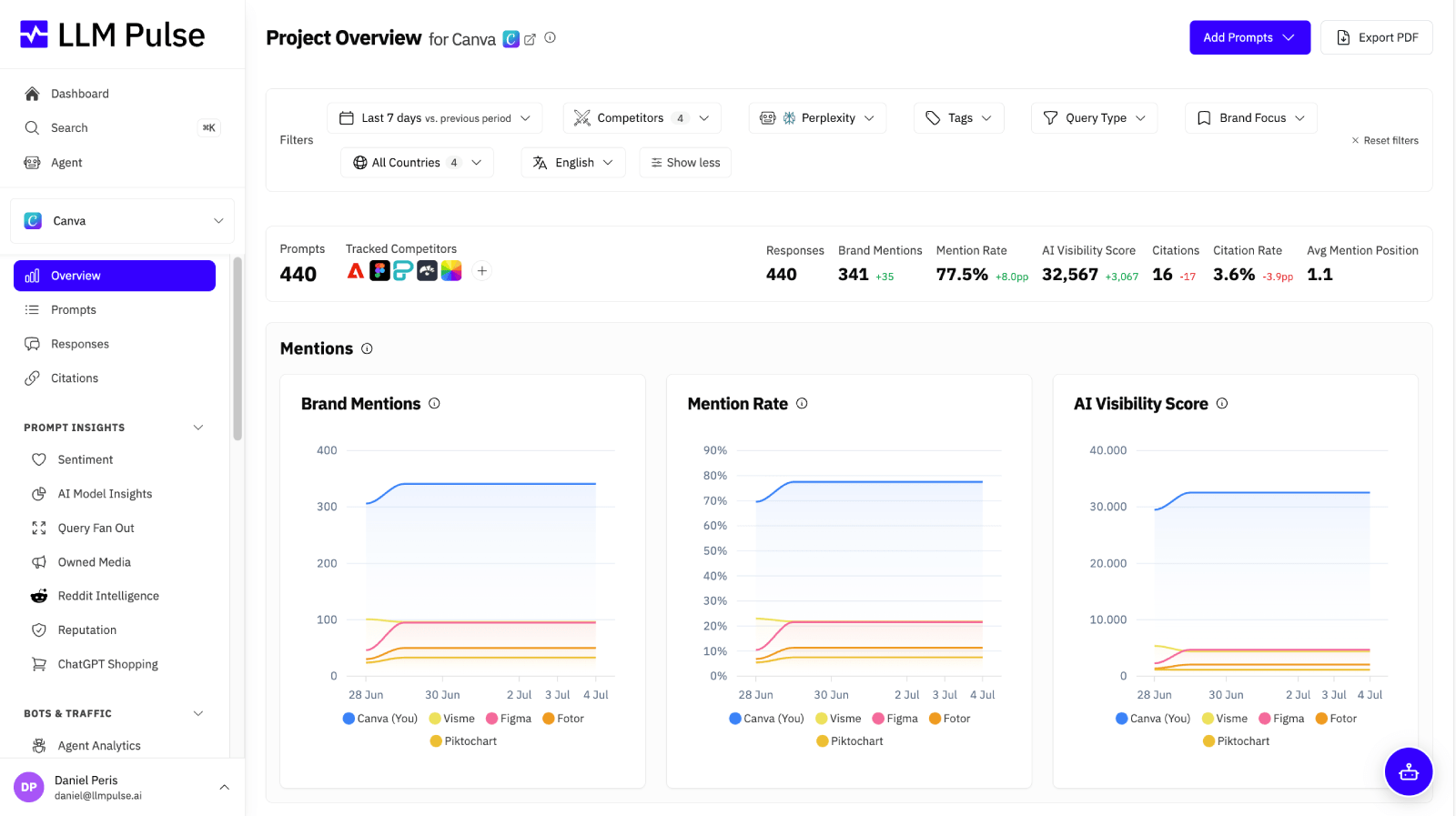
This is exactly what LLM Pulse is built for. It runs your important prompts across the major AI engines, including Perplexity, and tracks the GEO metrics that actually matter:
- Mentions: when and how your brand is named in the answer, including its sentiment.
- Citations: which sources Perplexity cites for your target questions, so you can see whether it is your page, a competitor, Reddit, or a review site earning the reference.
- Share of voice: how often you appear versus competitors for the same prompts, tracked over time.
- And much more.
That turns “are we in Perplexity?” into a metric you can watch over time. The visible citations show which off-site pages Perplexity presents with answers about your category, without proving that one placement caused the response. LLM Pulse covers ChatGPT, Perplexity, Gemini, Google AI Mode, and Google AI Overviews. Pricing starts at EUR 49/month.
The bottom line
Ranking in Perplexity comes down to a few durable principles: be crawlable, be quotable, be fresh, and be validated by sources beyond your own site. Write answer-first content that Perplexity can extract, keep your best pages current, target the question and comparison queries your audience actually asks, and invest in the third-party places (Reddit, review sites, industry press) that Perplexity trusts. Then use a Perplexity tracker to monitor your citations and share of voice so you can tell what is working. Do that consistently and you move from invisible to cited.
FAQ
How does Perplexity decide which sources to cite?
It runs a live web search for your query, ranks the retrieved pages by relevance, extractability, freshness, authority, and structure, then cites the three to six it uses to write the answer. Pages whose facts are clear, current, and easy to quote win over pages that merely rank well in Google.
How do I get my website cited in Perplexity?
Make sure PerplexityBot can crawl you, publish clear content with facts near the relevant heading, keep it updated, use accurate structured data where appropriate, and earn legitimate third-party references. Then track which prompts cite you and refine from there.
Does Perplexity respect robots.txt?
PerplexityBot, the indexing crawler, respects robots.txt, so allow it if you want to be cited. Perplexity-User, which fetches a page in real time when a user’s question requires it, generally does not follow robots.txt because it acts on behalf of a person. To be safe, allow PerplexityBot explicitly and verify no firewall rule is blocking it.
Is ranking in Perplexity the same as SEO?
They overlap but are not identical. Classic SEO optimizes for ranking and clicks. Perplexity optimizes for extraction quality: how cleanly it can quote and attribute a fact from your page. Strong SEO helps, but you also need clear structure, freshness, and off-site validation to be cited.
Why does Perplexity cite Reddit and review sites instead of my site?
Perplexity weights independent validation heavily. In many categories the majority of citations come from third-party sources such as Reddit, review platforms, and industry publications, because they carry perceived neutrality and editorial trust. The fix is to build genuine presence in those places, not just on your own domain.
How important is content freshness for Perplexity?
Very. Perplexity has a stronger recency bias than most AI tools and will often favor a recently updated page over an older, higher-authority one for time-sensitive queries. Update your flagship pages substantively on a regular cadence, and show honest “last updated” dates.
Can I pay to appear in Perplexity answers?
You cannot buy your way into the cited sources of an organic answer. Perplexity has explored advertising and a publishers program that shares revenue with cited outlets, but the citations themselves are earned through relevance and trust. See our overview of the Perplexity Publishers Program for how its publisher relationships work.
How do I track whether I am being cited in Perplexity?
Use a tool that runs your key prompts against Perplexity on a schedule and records the citations, mentions, and share of voice, rather than checking by hand. LLM Pulse does this across Perplexity and the other major AI engines so you can watch your visibility change as you optimize.