



Last updated: September 14, 2026
Google’s AI Overviews now reach more than 2.5 billion monthly users, and AI Mode passed 1 billion monthly users as of May 2026, according to Google. For most informational searches, the AI answer is the first thing people see, and the handful of links inside it get the clicks. If your page is not one of those cited sources, you are effectively invisible for that query even if you rank on page one.
Table of Contents
The good news: unlike ChatGPT or Perplexity, Google’s AI features are built directly on top of the same Search index and ranking systems you already know. That means classic SEO is the foundation, but there are specific moves that make your content easy for Google’s models to extract and cite. This guide explains how AI Overviews and AI Mode choose sources, then gives you a numbered playbook to appear in them, the mistakes to avoid, and how to measure it.
Google AI Overviews vs AI Mode: what they are
AI Overviews are the AI-generated summaries that appear at the top of a normal Google results page, with a few linked source citations. They rolled out broadly in 2024 and, as of May 2025, are available in over 200 countries and territories and more than 40 languages.
AI Mode is a dedicated conversational search experience (a separate tab and, increasingly, a default surface) where you can ask complex, multi-part questions and follow-ups. Google introduced it experimentally in March 2025 and detailed it at Google I/O in May 2025. Google made Gemini 3 the default model for AI Overviews globally in January 2026, and Gemini 3.5 Flash the default model for AI Mode globally in May 2026.
For an SEO or content team, the practical takeaway is that both features build on Google’s Search systems and may use query fan-out, but Google says they can use different models and techniques. The same Search fundamentals apply to both, so this guide treats them together and flags differences where they matter.
How AI Overviews and AI Mode pick sources
This is the part most guides get wrong. Google has been unusually clear here, and understanding it kills a lot of wasted effort. Here is how source selection actually works.
1. It is grounded in Google’s index, not a separate AI
Google’s own documentation says its generative AI features are built on Search systems. Pages shown as supporting links must be indexed and eligible to appear in Search with a snippet, and the features may use query fan-out to retrieve related pages before composing an answer.
2. Query fan-out breaks your question into many sub-queries
Instead of running one search, AI Mode (and, to a lesser degree, AI Overviews) uses a technique Google calls query fan-out. As Google puts it, the system is “breaking down your question into subtopics and issuing a multitude of queries simultaneously on your behalf.” A single question like “best project management tool for a small remote agency” is decomposed into entities and constraints (small team, remote, agency, pricing, integrations) and expanded into a batch of synthetic sub-queries that run in parallel. The model then reads the results for all of them and synthesizes one answer with citations.
The consequence for you: you are not competing for one keyword. You are competing across a spread of related sub-questions. A page that comprehensively answers many of those sub-queries has more chances to be pulled in than a page that only matches the exact head term.
3. Selection happens at the passage level
Google’s models surface the relevant section of a page for a given sub-query rather than judging the whole document. Google explicitly says there is “no need to break your content into tiny pieces” for AI to understand it, because its systems can identify the relevant passage on a page that covers multiple topics. The unit that gets cited is effectively a passage that cleanly answers a sub-query, which is why clear, self-contained answers matter so much.
4. Rankings still matter, but the overlap is loosening
Cited sources skew heavily toward pages that already rank. In an Ahrefs study of 1.9 million citations from 1 million AI Overviews (July 2025), 76% of cited pages ranked in the organic top 10. Later analyses have reported lower overlap (some putting it closer to 40% as Google pulls from a wider pool), so the exact figure is contested and appears to be declining over time. The durable takeaway is directional: ranking on page one dramatically raises your odds of being cited, but a lower-ranking page can still be quoted if it answers a specific sub-query better than the pages above it. Rankings are necessary leverage, not a guarantee.
5. Forums, video, and reference sites get heavy weight
Multiple citation studies find that a small set of domains dominate AI Overview sources: YouTube, Wikipedia, Reddit, and other community and reference sites appear constantly. Reddit alone has been measured at roughly 21% of AI Overview citations in some datasets. Google’s models lean on these for first-hand experience, opinions, and corroboration. You cannot become Reddit, but you can earn a presence in the third-party sources Google trusts.
6. Corroboration across sources
Because the answer is synthesized from multiple retrieved pages, claims that are consistently stated across several trusted sources are more likely to be surfaced than a lone, uncorroborated assertion. Being the original source of a fact that many others cite, and being consistent with the consensus where one exists, both help.
How to rank in AI Overviews and AI Mode: the strategies
Everything below assumes you are also doing the fundamentals well. Google’s guidance is blunt: optimizing for AI search is optimizing for Search. Here is the prioritized playbook.
1. Win strong traditional organic rankings first
Because AI Overviews are grounded in the index and draw disproportionately from top-ranking pages, page-one rankings are your highest-leverage input. Do the unglamorous work: topical depth, internal linking, quality backlinks, matching search intent, and technical health. If you are not ranking for the head query and its variants, fix that before anything AI-specific. This is the single biggest predictor of citation.
2. Write answer-first, extractable passages
Give the model a clean passage it can lift. Open sections with a direct, self-contained answer in the first sentence or two, then expand. Use a clear question or noun-phrase as the heading, answer it immediately below, and keep each answer coherent without requiring the surrounding paragraphs for context. Short definitions, “X is…” sentences, step lists, and tidy comparison tables are especially easy to extract and cite.
3. Structure content around sub-questions (fan-out coverage)
Since fan-out decomposes queries, map the sub-questions a topic implies and cover them on the page: prerequisites, comparisons, pricing, alternatives, “how long,” “is it worth it,” edge cases. Tools that simulate fan-out can help, but you can also read the “People also ask” box and related searches. Broad, genuine coverage of the sub-intents gives your page more surfaces to be matched against.
4. Use clear structure, headings, and lists
Logical H2/H3 hierarchy, descriptive headings, bulleted lists, and comparison tables help Google identify the passage that answers each sub-query. This is not about tricking a parser: it is the same clean structure that helps human skimmers, which is exactly what Google says it rewards.
5. Build real E-E-A-T and author signals
Google says E-E-A-T is not a single ranking factor. Its systems use a mix of signals that can align with experience, expertise, authoritativeness, and trust, with trust the most important. Put a real, credentialed author on the page, cite primary data, show first-hand experience (original testing, screenshots, results), and keep facts accurate. Google specifically warns against “commodity content” that recycles what everyone else already said. Unique insight and demonstrable experience are what make you quotable.
6. Earn mentions on third-party sources Google trusts
Because AI answers corroborate across sources and lean on community and reference sites, being present beyond your own domain helps. Aim for genuine coverage: helpful, non-spammy participation where your audience already is (relevant Reddit threads, industry forums, Q&A sites), authoritative reviews and roundups, being listed in reputable directories, and earning a mention in the kind of pages that already get cited. Google cautions that “seeking inauthentic mentions” is not helpful, so this must be real engagement, not link spam.
7. Create FAQ and comparison content that matches question queries
AI Overviews trigger most often on informational and question-shaped queries (“how,” “what,” “best,” “vs,” “why”). Comparison pages, honest “X vs Y” breakdowns, buyer’s guides, and FAQ sections align directly with those triggers and with fan-out sub-queries. Target the questions your customers actually ask, in their words.
8. Keep content fresh
Freshness matters more in AI answers than it did in classic blue links, especially for anything time-sensitive. Update statistics, dates, pricing, and product details, and revise cornerstone pages on a schedule. A page last touched two years ago is a weaker candidate for a query where the world has moved on.
9. Make sure Google can crawl and render your content
Grounding only works on content Google can access. Google states its generative models “use publicly accessible, crawlable content.” Confirm Googlebot is not blocked in robots.txt, that key content is in the server-rendered HTML (not locked behind client-side JavaScript that never renders), that pages are indexable, and that Core Web Vitals and mobile usability are sound. If you have deliberately blocked AI crawlers, understand the tradeoff: Google’s Google-Extended token controls training and certain generative uses. Blocking Googlebot prevents crawling and limits access to your content, but the URL may still appear in Search without a snippet. We cover this in detail in our guide to controlling AI bot access to your website.
10. Skip the fake shortcuts
Google says you do not need new machine-readable files or special schema markup to appear in AI Overviews or AI Mode. Structured data remains useful for supported Search features when it matches visible content. Treat llms.txt as optional rather than a Search requirement.
Common mistakes
- Treating AI Overviews as a separate channel with its own tricks. It is grounded in Search. Trying to “hack” it while your organic rankings are weak is backwards.
- Chasing llms.txt and exotic markup. Google says you do not need new machine-readable files or special schema to appear in AI Overviews or AI Mode. Treat llms.txt as optional rather than a Search requirement.
- Burying the answer. A 300-word wind-up before you answer the question gives the model nothing clean to extract. Lead with the answer.
- Thin, commodity content. Recycled, obviously-AI-generated summaries with no original data or experience are exactly what Google says will not stand out.
- Blocking crawlers by accident. Overzealous robots.txt rules, JavaScript-only content, or noindex tags can silently remove you from the candidate pool.
- Keyword-stuffing for one head term. Fan-out rewards breadth of genuine sub-topic coverage, not repetition of a single phrase.
- Ignoring third-party presence. If every cited competitor shows up on Reddit, YouTube, and industry roundups and you appear nowhere off your own domain, you are missing the corroboration layer.
- Measuring nothing. Without tracking, you cannot tell which queries even trigger an AI Overview or whether you are cited, so you optimize blind.
How to track your AI Overviews and AI Mode visibility
You cannot improve what you do not measure, and AI Mode tracking is harder than monitoring blue links because these answers vary by query, personalize, and do not appear in standard rank trackers. A useful measurement setup answers three questions:
- Which of my priority queries trigger an AI Overview or AI Mode answer at all? Not every query does, so start by mapping coverage.
- Am I cited in those answers, and where? Track whether your domain appears as a linked source, and which page.
- Who else is cited, and how do I compare? The competitors and reference sites showing up tell you where the corroboration and third-party gaps are.
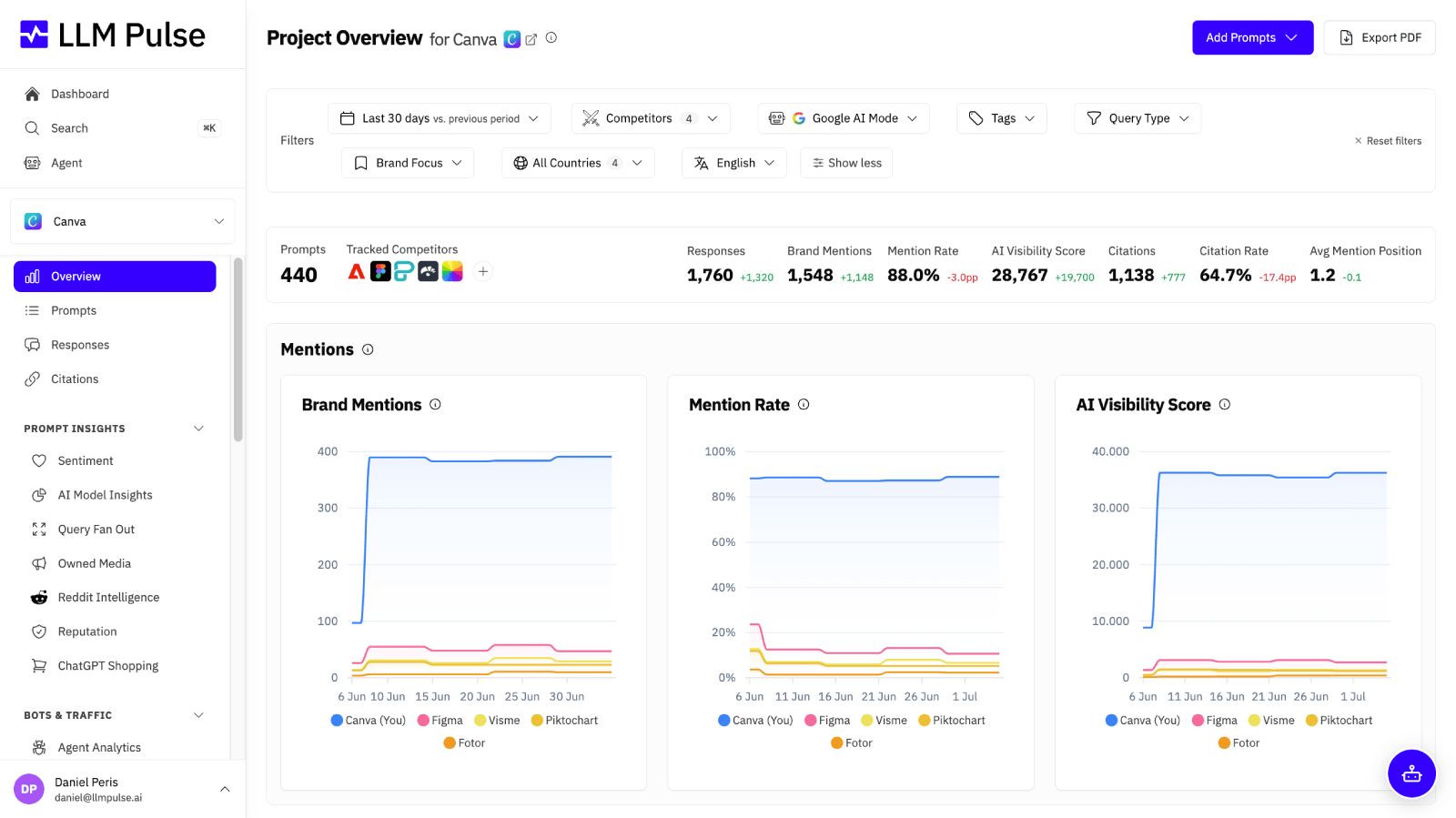
Comparing the best AI Mode trackers helps you pick one that answers all three questions in a single view.
This is exactly what LLM Pulse is built to do. It tracks your brand’s visibility and citations across Google AI Overviews and Google AI Mode (alongside ChatGPT, Perplexity, and Gemini) for the prompts that matter to you. You see which sources each AI answer cites, your share of voice against competitors, and how your visibility trends as you ship the changes above. Because “which sources the AI cites” is precisely what LLM Pulse measures, you can tie content work directly to whether you start appearing in the answer. For the broader framework, see our guide to AI search optimization.
Summary
AI Overviews and AI Mode are not a new SEO game with secret levers. They are grounded in Google’s index, may use query fan-out to spread a question across many sub-queries, and cite passage-level answers from indexed pages that best satisfy those sub-queries, sometimes from a wider and more diverse set of links than classic Search. Win strong organic rankings, write answer-first extractable passages that cover the sub-questions, back them with real experience and third-party presence, keep them fresh and crawlable, and skip the fake shortcuts like llms.txt. Then track which queries trigger AI answers and whether you are cited, so your optimization is evidence-based rather than guesswork. The engines differ, so if you also care about other assistants, see how to rank in ChatGPT and rank in Perplexity, and how each assistant sources its answers in where ChatGPT gets its data.
FAQ
How does an AI Overview work?
An AI Overview is generated by a Gemini model using Google’s Search systems. Google says AI Overviews may use query fan-out and show supporting links from pages that are indexed and eligible to appear in Search with a snippet.
What are AI Overview sources and how are they chosen?
Sources are pages from Google’s index that best answer the query and its fan-out sub-queries at the passage level. Strong organic performance helps, but Google also says AI features can surface a wider and more diverse set of helpful links than classic web search. Corroboration across multiple trusted sources increases the chance a claim is surfaced.
How do I rank in AI Overviews?
Start by ranking well organically, since most cited pages already rank on page one. Then make your content easy to extract: lead each section with a direct answer, use clear headings and lists, cover the related sub-questions, and back it with genuine expertise and first-hand experience. Keep it fresh and crawlable. There is no separate AI-only ranking system to game.
How is AI Mode different from AI Overviews for SEO?
The same Search fundamentals apply to both, but Google says AI Mode and AI Overviews may use different models and techniques. AI Mode leans harder on fan-out for complex, multi-part, conversational questions and follow-ups, which rewards pages that comprehensively cover a topic and its sub-intents rather than a single narrow keyword.
Do I need an llms.txt file or special schema to appear in AI Overviews?
No. Google says you do not need new machine-readable files or special schema markup to appear in AI Overviews or AI Mode. Structured data is still useful for supported Search features, but it is not a prerequisite for AI citation. Focus on useful content and crawlability instead.
Does blocking AI crawlers keep me out of AI Overviews?
AI Overviews use Google’s core crawling and indexing. Search Console’s Search generative AI setting now lets you exclude your site from AI Overviews and AI Mode without affecting other Search results. Googlebot and Google-Extended remain separate crawling and data-use controls. Review each setting deliberately.
How do I know if my content is being cited in AI Overviews?
Standard rank trackers do not capture this reliably because AI answers vary and personalize. Use a tool that runs your target prompts against Google’s AI surfaces and records whether your domain appears as a cited source. LLM Pulse tracks AI Overviews and AI Mode citations and share of voice across your prompts each week so you can measure it directly.
Why did my traffic drop even though I still rank on page one?
When an AI Overview answers the query at the top of the page, fewer users scroll to the classic blue links, so click-through can fall even at a stable ranking. The response is to become one of the cited sources inside the AI answer, and to focus on queries and intents where a click to your site still has clear value.