



When people have a health question now, a growing share ask an AI before they open a search engine or call a doctor. That makes the sources those answers cite a matter of public trust, not just marketing. So we looked at what the models actually reach for.
LLM Pulse analyzed nearly 825,000 citations from AI answers to generic, non-branded health questions asked in the United States. The answers came from ChatGPT, Google AI Mode, Google AI Overviews, Gemini and Perplexity. You can explore the full interactive study at llmpulse.ai/data-studies/top-us-health-sources. Here is what the models cite when someone asks about symptoms, treatments, supplements, insurance or finding care.
Table of Contents
Headline findings
- Peer-reviewed research sits at the top. PubMed Central (pmc.ncbi.nlm.nih.gov), the free biomedical archive run by the US National Institutes of Health, is the single most-cited source for health questions: 33,669 citations, 4.1% of everything, and it appears across a wide spread of health topics. Add PubMed, ScienceDirect, Nature and the journal aggregators and academic research is the largest editorial source type.
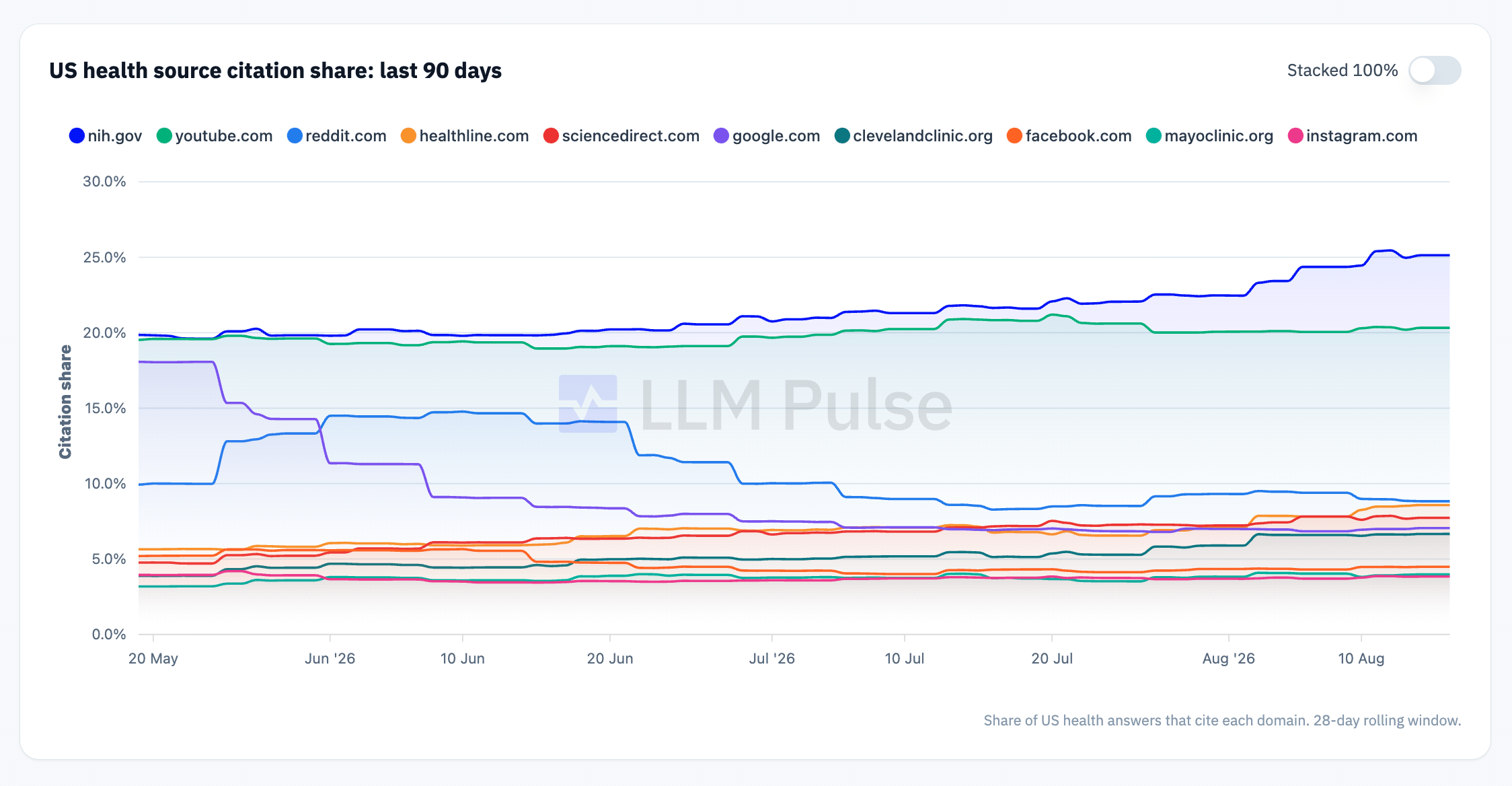
- YouTube and Reddit are enormous. YouTube is the second most-cited domain overall (26,992 citations), and Reddit is fourth (11,119). Social and user-generated content pulls 6.2% of all health citations, more than government sites (3.4%) and hospitals (1.0%) combined.
- ChatGPT trusts medical authority most. Google’s search AI trusts Reddit and YouTube most. ChatGPT sends 24.1% of its health citations to authoritative medical sources (government, academic journals, medical references, hospitals) and only 1.9% to social platforms. Google AI Overviews and AI Mode cite Reddit and YouTube four to five times more often than ChatGPT does (8.5% and 7.6% versus 1.9%). This is the clearest split between the engines.
- Authority gets cited first. When a model does cite a .gov page or a medical reference, it tends to place it near the top of the answer. Average citation position is 5.5 for government sources and 5.7 for medical references, versus 8.5 for social and user-generated content. In ChatGPT, where the ordering is starkest, academic sources land at an average position of 0.75 while Reddit and YouTube sit at 4.88.
- The marquee medical names are the exception, not the rule. Only 17.3% of all health citations go to authoritative medical sources. The other four-fifths flow to a long tail of commercial sites, apps, insurers and platform domains. The famous health brands (Mayo Clinic, WebMD, Healthline, Cleveland Clinic) each hold well under 1% of citations individually.
Most-cited domains
Ranked by total citations across all five engines. Share is of all 824,997 citations. The full ranking, including per-engine citation counts and source-type labels, is in the full interactive study.
| # | Domain | Source type | Citations | Share |
|---|---|---|---|---|
| 1 | pmc.ncbi.nlm.nih.gov | Academic/Journals | 33,669 | 4.08% |
| 2 | youtube.com | UGC/Social | 26,992 | 3.27% |
| 3 | google.com | Commercial/Platform | 26,107 | 3.16% |
| 4 | reddit.com | UGC/Social | 11,119 | 1.35% |
| 5 | sciencedirect.com | Academic/Journals | 6,841 | 0.83% |
| 6 | healthline.com | Medical publisher | 6,456 | 0.78% |
| 7 | pubmed.ncbi.nlm.nih.gov | Academic/Journals | 5,378 | 0.65% |
| 8 | play.google.com | Commercial/Platform | 4,453 | 0.54% |
| 9 | goodrx.com | Medical publisher | 4,337 | 0.53% |
| 10 | facebook.com | UGC/Social | 4,211 | 0.51% |
| 11 | apps.apple.com | Commercial/Platform | 4,168 | 0.51% |
| 12 | instagram.com | UGC/Social | 3,604 | 0.44% |
| 13 | medicalnewstoday.com | Medical publisher | 3,490 | 0.42% |
| 14 | mayoclinic.org | Medical publisher | 3,475 | 0.42% |
| 15 | linkedin.com | UGC/Social | 3,283 | 0.40% |
| 16 | fda.gov | Government/Institutional | 2,524 | 0.31% |
| 17 | ncbi.nlm.nih.gov | Academic/Journals | 2,494 | 0.30% |
| 18 | my.clevelandclinic.org | Medical publisher | 2,436 | 0.30% |
| 19 | webmd.com | Medical publisher | 2,321 | 0.28% |
| 20 | health.usnews.com | News media | 1,874 | 0.23% |
| 21 | mdpi.com | Academic/Journals | 1,828 | 0.22% |
| 22 | health.clevelandclinic.org | Medical publisher | 1,733 | 0.21% |
| 23 | cdc.gov | Government/Institutional | 1,668 | 0.20% |
| 24 | health.harvard.edu | Medical publisher | 1,632 | 0.20% |
| 25 | nature.com | Academic/Journals | 1,560 | 0.19% |
Source-type breakdown
Every domain was grouped into seven source types. Share is of all 824,997 citations.
| Source type | Share of citations | Average position |
|---|---|---|
| Commercial and platform | 75.4% | 7.25 |
| Academic and journals | 8.3% | 6.56 |
| UGC and social | 6.2% | 8.53 |
| Medical publishers | 4.6% | 5.71 |
| Government and institutional | 3.4% | 5.51 |
| News media | 1.2% | 6.83 |
| Hospitals and providers | 1.0% | 7.38 |
Grouping the four authoritative medical types together (government, academic, medical publishers, hospitals) gives 17.3% of all citations. Social and user-generated content is 6.2%. The remaining three-quarters is a long tail: apps, insurers, supplement makers, comparison sites, and platform domains like Google, the app stores and Amazon. The platform domains matter because Google’s own AI products lean on Google properties: google.com alone accounts for 3.2% of all citations and shows up almost entirely inside AI Mode and AI Overviews.
Which engine trusts what
| Engine | Citations | Authoritative medical | Social/UGC | Commercial/platform |
|---|---|---|---|---|
| ChatGPT | 157,708 | 24.1% | 1.9% | 72.9% |
| Perplexity | 43,334 | 18.4% | 3.3% | 77.7% |
| Gemini | 50,595 | 16.8% | 1.2% | 80.9% |
| Google AI Overviews | 249,784 | 15.8% | 8.5% | 74.4% |
| Google AI Mode | 323,576 | 15.1% | 7.6% | 76.1% |
| All engines | 824,997 | 17.3% | 6.2% | 75.4% |
Two patterns stand out. ChatGPT is the most authority-first engine: nearly a quarter of its health citations go to medical, academic or government sources, and it almost never cites Reddit or YouTube. Google’s two search-integrated products, AI Overviews and AI Mode, are the opposite end: they cite social and user-generated content four to five times more than ChatGPT. Gemini, Google’s standalone assistant, behaves differently from Google’s search AI and cites social content the least of any engine (1.2%).
Notable findings
- The single biggest health source is a government research archive, not a health brand. PubMed Central alone is cited more than YouTube, Google and Reddit. For AI answers about health, the raw research literature outweighs the consumer health publishers people recognize by name.
- Reddit is a top-five health source. For a category where accuracy carries real stakes, that AI cites a discussion forum more than the FDA (2,524), the CDC (1,668) or any single hospital system is worth sitting with. Google’s search AI drives most of it.
- Authority is placed first, social is placed last. The ordering inside answers is consistent: government and medical references get the earliest citation slots, social and user-generated content the latest. Models appear to treat authoritative sources as the lead and social content as supporting color.
- Gemini cites raw DOI resolver links. Gemini reaches journal articles through doi.org rather than the publisher’s own domain, a quirk that does not appear in the other engines and that changes how a publisher would need to think about attribution.
- The health “brand” middle is thin. Below the research archives and the social platforms, no single consumer health publisher holds even 1% of citations. Visibility in AI answers for health is won at the level of individual pages and studies, not by domain authority alone.
Methodology
LLM Pulse analyzed 824,997 citations from AI responses collected between mid-April and mid-July 2026 across ChatGPT, Google AI Mode, Google AI Overviews, Gemini and Perplexity, from generic (non-branded) health questions tracked in the United States. Questions come from brands in healthcare and adjacent industries. We kept only citations to third-party sources: pages a tracked brand owns were excluded, as were the handful of citations to brands’ own tracked competitor sets (0.3% of the total), so the ranking reflects sources AI reaches for on its own rather than sources any one brand is monitoring.
Domains were grouped into seven source types by hand: government and institutional (.gov, WHO), academic and journals (PubMed Central, PubMed, ScienceDirect, Nature, MDPI and journal aggregators), medical publishers (Healthline, WebMD, Mayo Clinic, Cleveland Clinic, Medical News Today, GoodRx, Harvard Health), hospitals and providers, news media, social and user-generated content (Reddit, YouTube, Facebook, Instagram, LinkedIn, TikTok), and everything else as commercial or platform. Citation position is the order a source appears in an answer, so lower is earlier; position scales differ between engines, so within-engine comparisons are the most reliable.
This data reflects the health questions brands choose to monitor, so it is weighted toward the categories those brands operate in. It is a large real-world sample, not a census of every health question asked of AI. The complete domain-by-domain breakdown is in the full interactive study.
About LLM Pulse
LLM Pulse is an all-in-one AI search visibility platform. It shows brands how they appear across AI answers from ChatGPT, Perplexity, Gemini and Google’s AI features, which sources those answers cite, and what to do to earn more of that visibility. Teams use it to track share of voice, monitor sentiment, audit citations and measure AI-driven traffic in one place.
FAQ
What sources does AI cite most for health questions?
PubMed Central leads with 4.1% of 824,997 citations, ahead of YouTube, Google.com and Reddit. Only 17.3% of citations go to authoritative medical sources; 75.4% go to commercial and platform domains.
Why does AI cite Reddit and YouTube for health questions?
Mostly Google’s search AI does: AI Overviews and AI Mode send 8.5% and 7.6% of their citations to social platforms, against 1.9% for ChatGPT and 1.2% for Gemini.
Which AI engine cites medical authority most?
ChatGPT, at 24.1% of its health citations, versus 18.4% for Perplexity, 16.8% for Gemini, 15.8% for AI Overviews and 15.1% for AI Mode.
Do the well-known health brands dominate AI answers?
No. Mayo Clinic, WebMD, Healthline and Cleveland Clinic each hold well under 1% of citations, all of them behind YouTube and Reddit.
Where does this data come from?
LLM Pulse analyzed 824,997 citations from AI answers to generic, non-branded US health questions, collected across five engines between mid-April and mid-July 2026. Pages owned by tracked brands were excluded.