



Last updated: October 5, 2026
AI search moved from novelty to buying channel in about eighteen months, and the tooling market exploded to match. Dozens of AI visibility platforms now compete for your budget, most of them launched in the last year, and on the surface they can look interchangeable. They are not. The differences that matter are rarely the ones on the pricing page, and choosing badly means rebuilding your measurement stack a year from now.
Table of Contents
Below are the seven things we would look at before committing to any AI visibility tool. We build LLM Pulse, so we use it throughout as a concrete example, but the criteria apply no matter which vendor you end up choosing.
1. Model coverage you do not have to pay extra to unlock
Your customers do not ask a single AI model about your category, so your tool cannot watch a single model either. The first question is how many engines a platform tracks, and the second, more revealing one, is how many are included before you hit an enterprise tier. Plenty of tools advertise broad coverage, then gate everything past ChatGPT behind a custom quote.

Look for the standard models a platform includes. LLM Pulse includes ChatGPT, Gemini, Google AI Mode, Google AI Overviews, and Perplexity. Claude, Copilot, Grok, DeepSeek, Naver AI Briefing, Baidu AI and Meta AI are self-serve paid add-ons. Alexa for Shopping is available as a self-serve paid add-on. Further models are available through Talk to sales.
2. Depth beyond “were we mentioned?”
A mention count is the floor, not the ceiling. The tools worth paying for tell you which sources a model trusts, in what tone it describes you, and how your share of voice compares to competitors over time. That is the difference between knowing you appeared and knowing why, and what to do about it.
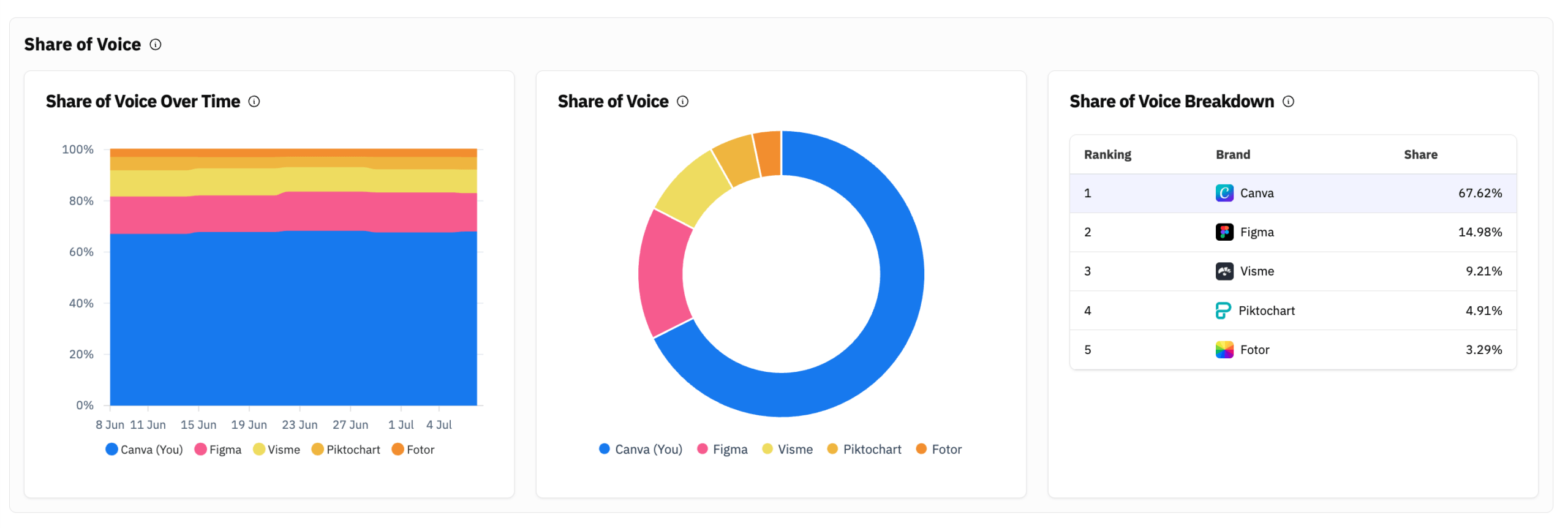
Insist on citation analysis, competitor benchmarking, share of voice, and sentiment. LLM Pulse includes sentiment analysis. Our guide to the GEO KPIs is a good yardstick for what real depth looks like.
3. Optimization, not just monitoring
Every serious platform, LLM Pulse included, now does both monitoring and optimization, but the depth varies enormously. A dashboard that only reports the weather leaves you to guess what to do next. The valuable part is what happens after the measurement: recommendations grounded in your own data, the ability to test content changes and see their impact, and content intelligence that shows what is actually driving your visibility.
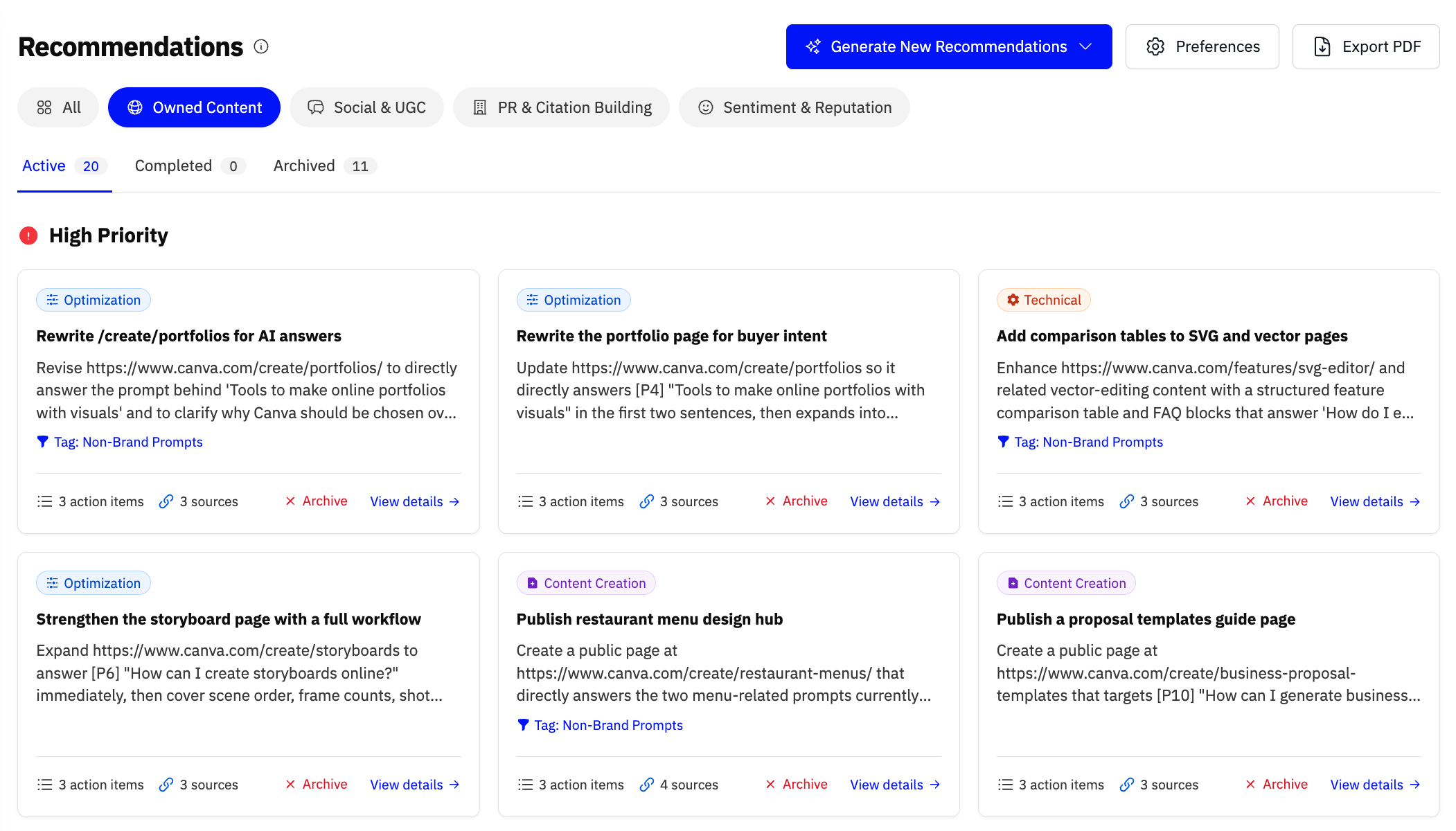
Ask whether recommendations are generic best-practice checklists or built on the real data from your projects, and whether you can run experiments rather than guess. If you are still shaping strategy, our playbook on improving brand visibility in ChatGPT and our complete GEO guide show the kind of closed loop to expect.
4. Integrations and data you can take with you
Your AI visibility data is only useful if it reaches the places your team already works. A platform that traps insights in its own UI creates a reporting bottleneck. The strong ones offer a full API, native connectors and a way to tie AI mentions back to real traffic and revenue.
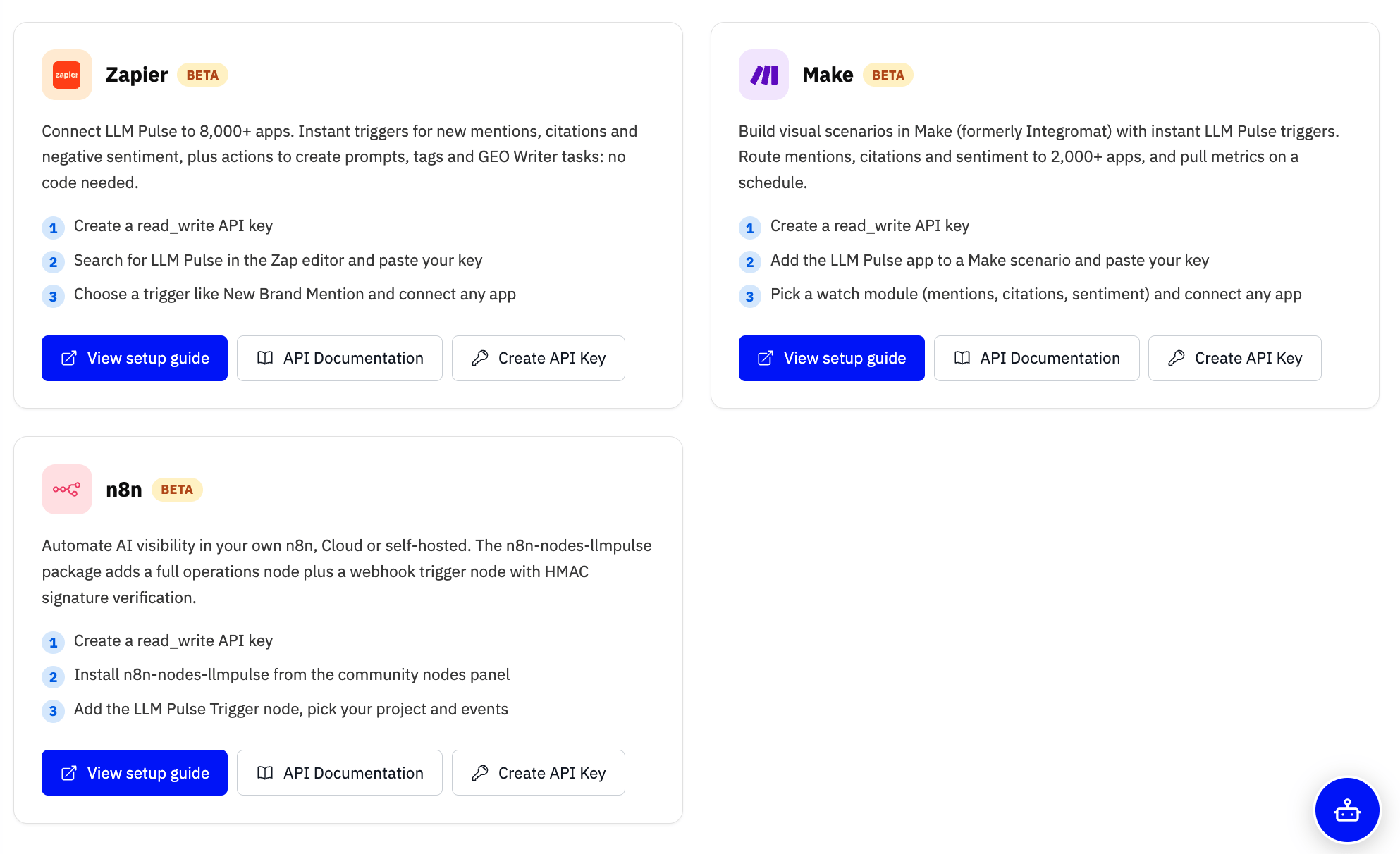
Check for an API, MCP access, CLI support, a Looker Studio connector, and web analytics integrations. LLM Pulse includes OAuth MCP, Web Analytics, a REST API, CLI, and Looker Studio access. White label and embed are agency arrangements set up with the team. On top of that, a growing library of connectors, including brand new Zapier, Make and n8n integrations, lets you pipe AI visibility data into thousands of other tools and automate workflows without writing a line of code.
5. Product velocity and a visible roadmap
AI search changes weekly. New models launch, engines change how they cite, and features that mattered last quarter get commoditized. A tool that shipped a great demo but updates twice a year will fall behind the thing it is supposed to measure.
Look for evidence of momentum: a public changelog, frequent releases, and a roadmap that responds to how the category is actually moving. Look for a public release history and ask how feature requests are evaluated. LLM Pulse publishes a changelog, which gives buyers a concrete record of shipped updates.
6. The team behind the tool
Buying this software also means evaluating the team that will maintain it. Look at support commitments, release history, security practices, and whether customers can reach people who understand the product. LLM Pulse is bootstrapped, while several competitors are venture funded; funding model alone does not determine product quality.
LLM Pulse is fully bootstrapped and the team works directly with customers. Buyers should still evaluate the same concrete signals they would for any vendor, including support terms, product updates, and data handling.
7. Traction, trust and honest pricing
Adoption is a proxy for reliability. A tool trusted by a wide range of companies, across very different industries, has been stress-tested in ways a demo never will be. Pair that with pricing you can understand and approve without a sales call, and you have a vendor you can commit to.
Ask every vendor for references, security documentation, and evidence that it supports organizations like yours. Public claims about customer counts or growth should be independently verifiable before they influence a buying decision.
Plans are available through self-serve checkout from €49/mo. If you want to see how it stacks up against specific competitors, our honest take on LLM Pulse alternatives and our roundups of the best AEO tools and best GEO tools are good places to keep comparing.
Your quick checklist
Before you sign, run any tool through these seven questions:
| What to check | Why it matters |
|---|---|
| Models included per plan | Coverage should scale with needs, not force an enterprise tier |
| Citations, sentiment, share of voice | Depth turns a mention count into a strategy |
| Optimization features | Recommendations and testing, not just reporting |
| API and integrations | Data must reach where your team already works |
| Release cadence and roadmap | The tool must keep pace with AI search |
| Founding team and independence | Fast iteration and support you can rely on |
| Traction and transparent pricing | Proven adoption and no procurement maze |
Tick most of these boxes and you will reduce the risk of rebuilding your stack next year. Choose an LLM Pulse plan to use the same checklist on your own project.
FAQ
What is an AI visibility tool?
It is a platform that tracks how AI search engines like ChatGPT, Gemini, Perplexity and Google AI describe, cite and recommend your brand, then helps you improve that presence. Think of it as analytics for the AI answers your customers now rely on instead of the classic ten blue links.
Why does model coverage matter so much?
Buyers spread their questions across several AI models, and each one cites different sources and reaches a different audience. If your tool only watches one or two engines, you are blind to most of the conversation, which is why broad standard coverage beats coverage locked behind an enterprise quote.
Is monitoring enough, or do I need optimization too?
Monitoring tells you where you stand, but on its own it leaves you to guess your next move. The tools worth paying for close the loop with recommendations built on your own data and the ability to test changes, so measurement turns into action rather than a dashboard you stare at.
Why should the team behind the tool matter to me?
In a market this fast, the pace and quality of iteration depend entirely on the people building the product. An entrepreneurial, hands-on founding team that talks to customers directly tends to ship faster and support better than a large organisation where your feedback joins a long queue.
Does bootstrapped versus venture-backed actually change the product?
Not by itself. Funding can affect resources and incentives, but it does not prove how a product will develop. Compare release history, support terms, security, pricing, and customer references instead.
How much should an AI visibility tool cost?
Entry pricing ranges from around €49 to €100 a month for self-serve plans, with enterprise tiers climbing well beyond that. The better question than “what is cheapest” is what full functionality costs once you add the models and seats you actually need, and whether you can start without a sales call.
How do I get started with LLM Pulse?
See current LLM Pulse pricing for plan details.