



Last updated: September 28, 2026
OpenAI reported 900 million weekly active ChatGPT users in February 2026. For consumer and B2B buyers alike, “did ChatGPT recommend us?” has become a question you cannot defer.
Table of Contents
The problem: there is no rank #1 position in ChatGPT. There is no algorithm leaderboard. The model picks two or three brands per answer, and which brands it picks is shaped by a messy stack of training data, real-time web search, citation patterns, third-party sources, and your live reputation. OpenAI does not publish a complete ranking formula. This playbook walks through nine concrete steps to move the needle in 90 days, plus the pitfalls that waste budget and the timeline you should realistically expect.
How ChatGPT chooses which brands to mention
Before you can improve visibility, you need to understand the inputs. ChatGPT’s brand recommendations come from a layered system, and each layer rewards different work.
Training data (the slow layer)
The base model still leans on text it was trained on, which includes large public corpora through a cut-off date that varies by model version. Brands that built deep mention footprints in Wikipedia, Reddit, news, GitHub, Stack Overflow, and large reference sites years before AI search existed got a head start. You cannot retroactively inject yourself into a frozen training set, but you influence the next training cycle every time your brand is mentioned across the open web today.
Live web search (the fast layer)
For many search-intent prompts, ChatGPT performs a live web lookup and grounds its answer in retrieved pages. OpenAI documents its own search systems, direct partner content, crawlers such as OAI-SearchBot, and third-party search providers. Bing is one disclosed provider, so Bing rankings can help, but the short-term lever is broader than Bing alone: make your best pages crawlable, indexable, current, and reinforced by trusted third-party sources.
Citations and source selection
When ChatGPT does cite, it cites a narrow set of “trusted” domains per category. In SaaS, that means G2, Capterra, TrustRadius, and category trade press. In consumer reviews, Reddit, YouTube, Wirecutter, and specialist blogs. In finance, Investopedia, NerdWallet, Bankrate, and Financial Times. Your visibility ceiling is largely determined by how many of these category-trusted domains describe your brand accurately.
Partnerships and direct integrations
OpenAI has signed content deals with several large publishers including the Financial Times, Axel Springer, News Corp, Vox Media, Condé Nast, the Associated Press, The Atlantic, and others. These agreements make partner content available for attributed summaries and links, but they do not guarantee citations or preferred placement. You cannot buy your way into the partner list, but you can pitch tier-one publishers harder than you used to.
Connectors and apps
ChatGPT can use connected apps and other tools to bring live data into a conversation when a user invokes them. For software vendors, that can create a direct product-discovery path, but it is separate from organic placement in ordinary ChatGPT Search answers.
Step 1: Audit your current ChatGPT visibility
You cannot improve what you do not measure. The first step is establishing a baseline across the 30 to 50 prompts that actually matter for your business, run repeatedly so you can see drift week to week.
Build a prompt list that mirrors real buyer behaviour
Skip vanity prompts like “what is the best CRM ever.” Start with the language your customers actually use on sales calls and in support tickets. A balanced prompt set covers:
- Generic category prompts (“best project management software for remote teams”)
- Comparison prompts (“Notion vs ClickUp for engineering teams”)
- Alternative prompts (“alternatives to Asana”)
- Use-case prompts (“best CRM for solo founders selling to enterprise”)
- Branded prompts (“is [your brand] any good”)
- Long-tail intent prompts (“how do I migrate from Trello to a tool with better reporting”)
Aim for 30 prompts as a starting baseline and add another 20 over time as you learn which queries actually convert.
Run the prompts weekly, not once
ChatGPT answers are non-deterministic. The same prompt can return slightly different brands across two consecutive runs, and the answer drifts significantly week to week as the web index updates and the model is fine-tuned. A one-off audit will mislead you. Repeated runs surface the signal.
Capture the right metrics
For each prompt, log: mention rate (does your brand appear at all), position when mentioned, sentiment (positive, neutral, negative framing), citations (which third-party URLs the model links to), and share of voice versus your top three competitors. Free LLM Pulse Visibility Reports automate this baseline across ChatGPT, Perplexity, Gemini, Google AI Mode, and Google AI Overviews, and we recommend running them before you commit to any major strategy bet. See also our guide to tracking brand mentions in AI.
Step 2: Earn third-party mentions on sources ChatGPT trusts
Off-site mentions are the single strongest predictor of AI visibility in the largest study to date. Ahrefs analysed 75,000 brands and found branded web mentions predicted AI visibility far more reliably than backlinks, domain rating, or any other technical SEO metric. YouTube mentions showed the strongest single correlation.
Practically, this means you spend your effort on the five domain categories below.
Reddit is consistently among the top three most-cited domains in ChatGPT for consumer and B2B queries. Research by 5W found Wikipedia and Reddit together drive over 25 percent of all ChatGPT citations in the US, and Reddit’s share varies significantly by category and time period. The play here is not to spam subreddit threads with your own product name from a brand account. Reddit’s anti-promotion culture is aggressive and will get you banned. Instead, instruct customer success and partnerships teams to flag organic mentions, engage subreddit communities with genuine answers from personal accounts, and sponsor relevant subreddit AMAs where applicable. Encourage power users to write honest comparison threads.
YouTube
YouTube transcripts are indexed and surface heavily in AI answers, particularly for product comparisons and tutorials. Two angles work: pitch creators in your category for review videos (paid or free), and publish your own first-party YouTube channel with how-tos, customer stories, and product walkthroughs. Long-form videos with clear, transcribed spoken mentions of your brand and use cases compound over time.
News and tier-one publishers
OpenAI’s content partnerships make selected publisher material available for attributed summaries and links, but OpenAI does not say those deals guarantee preferred placement. Pitch original data, customer milestones, and category commentary to outlets like TechCrunch, Forbes, Business Insider, and category-relevant trade press. Press releases on PR Newswire and Business Wire get indexed and occasionally surface, but original journalism carries far more weight.
Niche authority sites
Every category has a small set of niche review sites and authority blogs that ChatGPT leans on. For SaaS: G2, Capterra, TrustRadius, Software Advice. For finance: NerdWallet, Bankrate, Investopedia. For consumer tech: Wirecutter, The Verge, Tom’s Guide. For ecommerce platforms: BigCommerce blog, Shopify Plus blog, eCommerce Fuel. Build active, accurate profiles on every review platform relevant to your category. Maintain them. Respond to reviews. Update product info.
Wikipedia
If your brand qualifies for a Wikipedia article and does not yet have one, it is worth pursuing through a notable third-party submitter (not your own account). Wikipedia is a top-five citation source for ChatGPT in many categories. Trying to write your own Wikipedia article almost always backfires because of conflict-of-interest policy and rapid deletion. Engage a Wikipedia editor with verifiable, notable secondary sources backing every claim.
Step 3: Build cite-worthy owned content
Off-site is the bigger lever, but owned content matters because it is the page ChatGPT often links to once a user clicks through, and because crawlable, useful pages can be retrieved and cited. Three content patterns earn citations consistently in 2026.
Comparison and alternatives pages
ChatGPT loves a clear, structured comparison. “X vs Y” and “alternatives to Z” pages with side-by-side feature tables, honest verdicts, and clear use-case recommendations get cited far more often than generic homepage copy. Use feature tables with consistent columns, name the winner per use case explicitly, and avoid the “everyone is great” hedge that makes the model unable to extract a clean recommendation.
Definition and “what is” pages
Lead with a 40 to 60 word definition that the model can lift verbatim. Use the inverted pyramid: direct answer first, then supporting context, then nuance and edge cases. Page titles should match the exact phrasing users type. Avoid clever marketing headlines that the model cannot parse into an answer.
Integration and use-case guides
Long-tail prompts often look like “how do I use X with Y for Z.” Pages that name a specific tool stack and a specific outcome are extraction targets. “How to track AI search performance in GA4,” “Using Looker Studio with AI visibility data,” and similar concrete recipes punch above their weight.
Across all three patterns, freshness matters more than people realise. Ahrefs found that AI-cited URLs in ChatGPT are on average about 393 days newer than the URLs cited in Google’s organic results for the same query. Update your top 20 visibility pages every 30 to 60 days at minimum.
Step 4: Get the technical SEO right for AI crawlers
Most visibility work is content and PR, but a small technical foundation either unlocks or blocks everything else. The good news: it is mostly a checklist.
robots.txt for AI bots
Confirm your robots.txt allows OAI-SearchBot for ChatGPT Search visibility, plus PerplexityBot and other live retrieval bots you care about. Decide separately on GPTBot for OpenAI training use, ChatGPT-User for user-triggered actions, ClaudeBot/Claude-SearchBot, and Googlebot for Google Search AI features. Many teams accidentally blocked these bots in 2023 or 2024 and never reverted. If you want to be cited and recommended, you must be crawlable. Our free AI bot access checker spots these mistakes.
llms.txt
The llms.txt file is an experimental convention that offers AI systems a hand-curated map of a site. It is not a confirmed ChatGPT ranking input, and Google says its AI search features do not use it. Treat it as optional documentation, not a visibility requirement. Use our free llms.txt generator to produce one in under five minutes.
Schema markup
Structured data remains useful for conventional search features when it accurately matches visible content, but Google says there is no special schema required for AI search. Use supported schema types where they genuinely describe the page. Our schema analyzer flags missing markup. Do not over-engineer; a clean implementation of four to five schema types beats a sprawling tag soup.
Core web vitals and rendering
JavaScript-heavy pages can be harder for crawlers to process consistently. If your site is a single-page app, ensure key content is server-side rendered or pre-rendered. Strong mobile performance and fast server responses help pages get crawled and indexed reliably across search systems.
Internal linking and entity clarity
Search crawlers use links to discover pages and understand site relationships, but OpenAI does not publish an internal entity graph built from a site’s link structure. Use descriptive anchor text, link related pages to each other, and maintain a clear hub-and-spoke architecture for each major topic. The aim is for the model to understand “this site is the authoritative source on X” within one or two crawl passes.
Step 5: Win the long tail with FAQ and comparison content
Many buyer-intent ChatGPT queries are long-tail and conversational. These are easier to win than head terms because category leaders rarely cover them. The trick is to build a system that publishes long-tail content at scale without diluting quality.
Mine support tickets and sales calls
Every question a prospect asks in a sales call or a customer asks in support is a potential FAQ page. If you have a Gong or Chorus account, mine call transcripts for the exact phrasing. If not, ask your support team to dump the top 50 questions from the last quarter. Each one becomes either an FAQ block on an existing page or a dedicated long-tail post.
Build comparison matrices systematically
For every major competitor in your space, publish a head-to-head page. Cover the same five categories: features, pricing, target customer, switching cost, and verdict. Use a consistent table format so users (and the model) can scan. Do not avoid naming competitors directly; ChatGPT will name them anyway in the answer, and your absence from the comparison guarantees you lose the prompt.
Cover the alternatives query
The single highest-intent prompt category is “alternatives to X.” Brands that publish honest, useful alternatives content (including their own product as #1, but with real reasoning) get cited disproportionately in this prompt class. Our how to rank in ChatGPT guide covers the prompt-class strategy in more detail.
Step 6: Use reviews and case studies as visibility signals
Reviews on G2, Capterra, TrustRadius, Trustpilot, and category-specific platforms function as both ranking signal and trust signal for ChatGPT. The model reads review sites heavily and the review snippets often appear verbatim in answers.
Volume and recency both matter
Review profiles can provide current third-party evidence about a product. Keep them accurate and continue collecting genuine reviews, but do not assume a fixed citation uplift or recency threshold. Build a review velocity programme: post-purchase emails, in-app review prompts after a success moment, and CSM-driven review requests at quarterly business reviews.
Case studies with real numbers
Case studies that name customers, quote a specific outcome, and include verifiable numbers get cited. Generic “leading enterprise improved efficiency” testimonials do not. Aim for one new case study per month, named customer, specific metric, single-quote pull-out at the top.
Review keyword diversity
Train your team to ask reviewers to mention specific use cases and integrations, not just “great product.” A G2 review that says “best CRM for solo founders selling to enterprise” is gold for that exact ChatGPT prompt. Encourage natural language that mirrors how users actually search.
Step 7: Fix negative ChatGPT sentiment about your brand
Visibility is not just whether the model mentions you. It is how it frames you. ChatGPT can be confidently wrong about your pricing, your refund policy, a feature you launched six months ago, or a controversy from 2022 that you have long since resolved. Negative or outdated sentiment kills conversions even when you are mentioned.
Audit sentiment per prompt
Track sentiment as a first-class metric, not an afterthought. LLM Pulse brand sentiment analysis classifies every mention as positive, neutral, or negative and attributes the framing to the underlying citation sources. This tells you not just that sentiment is negative but which third-party source the negative framing is coming from.
Source-attack the framing
If a 2022 Reddit thread drives negative sentiment, the fix is not to convince ChatGPT to ignore it. The fix is to seed enough recent counter-evidence on the same domain class that the model has a better story to tell. Encourage updated reviews, publish refreshed comparison content, get tier-one publishers to cover your recent improvements.
Correct factual errors directly
For factual errors (wrong pricing, wrong feature list, wrong founding year), the highest-leverage fix is updating the canonical sources the model leans on: your own pricing page, Crunchbase, LinkedIn, Wikipedia, Bloomberg profile, and G2 listing. ChatGPT will continue to repeat the old number until enough authoritative sources contradict it.
Stress-test edge cases
Run prompts that explicitly invite criticism: “what are the downsides of [your brand],” “why would I choose a competitor over [your brand],” “what do users complain about with [your brand].” How the model frames the answer reveals where your sentiment risk sits and gives you a hit list to address.
Step 8: Defend against competitor mentions ranking above you
You may show up in ChatGPT but consistently lose share of voice to two or three competitors. Defensive visibility work is as important as offensive work.
Identify the prompts where you lose
Run your prompt set, filter to prompts where you appear in position 3, 4, or below, and rank those prompts by business value. These are your highest-ROI defensive targets. Often it is five or six prompts driving most of the share-of-voice gap.
Reverse-engineer the citations
For each losing prompt, look at which third-party sources ChatGPT cites and which competitor each citation favours. If a competitor wins because they have three G2 reviews quoting a specific use case and you have one, the path is obvious. If they win because a 2024 TechCrunch article positioned them as the category leader, you need a 2026 piece reframing the category.
Counter-position with comparisons
Publish “X vs us” comparison pages for every competitor that beats you in ChatGPT. The page becomes an indexable source that search-connected assistants may retrieve alongside third-party coverage. Keep the comparison accurate so readers and retrieval systems encounter consistent facts across sources.
Engage the citation sources directly
If a niche review site consistently ranks a competitor first, pitch the editor with new data, fresh customer stories, and a request to update the listing. Most listing sites refresh annually or quarterly and welcome updates from brands with new evidence.
Step 9: Measure visibility weekly and iterate
The biggest reason brands fail at AI visibility is they treat it as a project rather than a programme. A one-off audit and a single sprint of content does not move the needle. Weekly measurement, monthly review, quarterly bigger bets is the cadence that works.
What to track every week
- Mention rate across your prompt set (and per model: ChatGPT, Perplexity, Gemini, Google AI Mode, Google AI Overviews)
- Average position when mentioned
- Share of voice versus your top three competitors
- Sentiment breakdown (positive, neutral, negative)
- Citation sources: which third-party domains are driving your mentions
- New competitors entering your category answers
What to do monthly
Review the prompts where your share of voice moved the most, both up and down. Identify the cause: did a competitor publish a new comparison? Did Bing re-rank a key page? Did one of your reviews go viral? Adjust the content backlog accordingly.
Where LLM Pulse fits
You can run this manually with a spreadsheet and a stopwatch. We have customers who started exactly that way. It works until you hit roughly 20 prompts across five models, at which point the maths breaks: 20 prompts times 5 models times 4 weeks is 400 evaluations per month, and you cannot scrape ChatGPT for this volume without violating the terms of service.
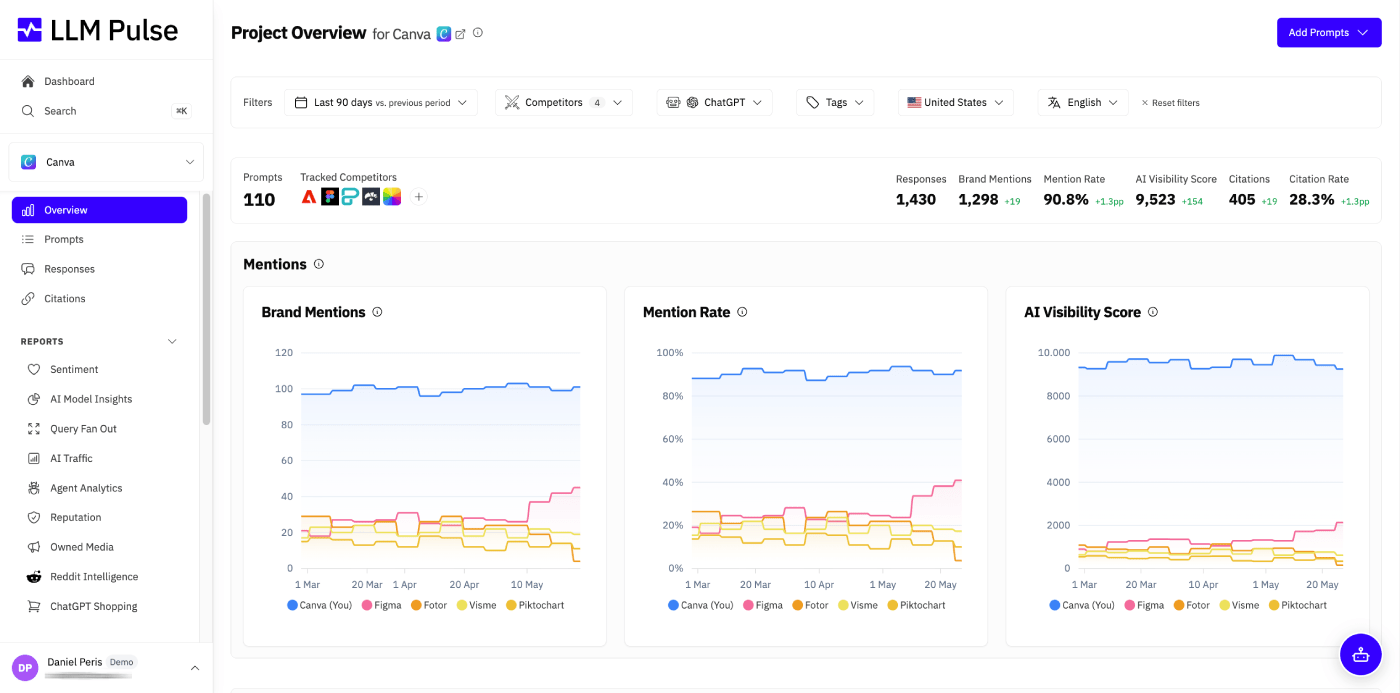
LLM Pulse automates the loop. Each prompt runs against all five models, parses out brand mentions and citations, scores sentiment, and rolls everything up into share-of-voice dashboards. Starter supports 50 prompts across five standard models. LLM Pulse includes unlimited team seats, MCP access, Looker Studio, the REST API, and the CLI, while white-label access is offered through agency and white-label arrangements. See pricing for details.
If you want to compare platforms before choosing one, we also published a detailed guide covering the 18 Best ChatGPT Tracking Tools in 2026. It breaks down the main tools on the market, including their strengths, limitations, pricing models, and the type of teams they are best suited for. It is a useful starting point if you are evaluating different approaches to AI visibility monitoring and brand tracking across ChatGPT and other answer engines.
Common mistakes when trying to improve ChatGPT visibility
Five mistakes account for most of the wasted effort we see.
Chasing rank position rather than mention rate
ChatGPT does not have stable rank positions. The same prompt run twice can return brands in a different order. Tracking “position 1 in ChatGPT” is a fool’s errand because the metric is noisy. Track mention rate (how often you appear at all) and share of voice (how often you appear versus your top competitors). Those metrics are statistically reliable.
Optimising only your own site
The biggest visibility lever sits off-site. Teams that double down on owned content while ignoring Reddit, YouTube, review platforms, and tier-one publishers cap themselves below the ceiling that off-site authority sets. Reverse the balance: roughly 70 percent of effort to off-site, 30 percent to owned content.
Spamming generic press releases
PR Newswire blasts and generic announcements waste budget. ChatGPT weights original journalism in real publications far higher than wire releases. Pitch real journalists with real angles. Treat it like the PR work it actually is.
Ignoring sentiment
Mention rate without sentiment is a vanity metric. A brand mentioned 50 percent of the time with neutral or negative framing converts worse than a brand mentioned 30 percent of the time with strong positive framing. Track sentiment as a first-class metric. See our brand sentiment feature.
Treating ChatGPT as one channel
ChatGPT, Perplexity, Gemini, Google AI Mode, and Google AI Overviews behave differently. The same prompt can return entirely different brands on each. Optimising only for ChatGPT and assuming the same tactics carry over is a known trap. Track all five from day one. Our AI search optimization guide covers the cross-model strategy.
Realistic timeline: when will you see results?
\nThere is no dependable timetable for changing an AI answer. Live retrieval can reflect an updated page sooner than a model-training change, while off-site authority work may take longer. Record the date of each change, monitor the affected prompts weekly, and compare movement with your baseline. If nothing changes, confirm crawler access, indexing, source coverage, and whether the prompt set reflects real buyer language.\n
Summary
Improving brand visibility in ChatGPT is not one tactic, it is a system: audit, earn third-party mentions, ship cite-worthy owned content, get the technical foundation right, win the long tail, build review volume, fix sentiment, defend share of voice, measure weekly. None of the steps are individually clever. Together they compound.
The teams that win at ChatGPT visibility in 2026 treat it like SEO in 2010: a programme, not a project. They measure relentlessly, optimise on real data not hunches, and accept that the payoff is three to six months out. The ones that lose treat it like a hack: one comparison page, one Reddit post, and frustration when the model does not change its mind.
If you want the measurement layer running tomorrow morning, start with a free LLM Pulse visibility report. It gives you the baseline you need before you commit to any of the nine steps above. From there, you can decide where to spend.
FAQ
How long does it take to see results from improving ChatGPT visibility?
Live retrieval can reflect updated pages sooner than model-training changes, but there is no guaranteed timeline. Measure weekly and judge progress against the prompts and sources you changed.
Is ChatGPT visibility the same as ranking in Google AI Overviews?
No. ChatGPT, Perplexity, Gemini, Google AI Mode, and Google AI Overviews each use different retrieval and ranking systems. The same prompt can return entirely different brands across each. Track all five if AI search matters to your business. Our AI search optimization guide covers cross-model strategy.
Can I pay OpenAI to get my brand mentioned in ChatGPT?
No paid placement is available inside ChatGPT answers. OpenAI now offers ads separately below chats, and says advertisers cannot shape or alter answers. Publisher licensing is also separate from advertising and does not guarantee citations.
Does blocking AI crawlers hurt my visibility?
Yes, but the bot matters. Blocking OAI-SearchBot can stop your pages and snippets from appearing in ChatGPT Search, although links may still surface; blocking GPTBot affects OpenAI training use, not ChatGPT Search inclusion. For Perplexity, allow PerplexityBot for search results and decide separately on Perplexity-User because it is user-triggered. Many teams blocked these accidentally in 2023 to 2024. Run our AI bot access checker to confirm you are crawlable.
How many prompts should I track to measure ChatGPT visibility?
30 prompts is a strong starting baseline. 50 to 100 is where most serious teams operate. Beyond 150 you hit diminishing returns unless you run multiple geographies or product lines. LLM Pulse plans start at 50 prompts (€49 a month) on Starter and scale up to 2,400 prompts (€1,199 a month) on Scale++, with custom Enterprise plans beyond that.
What is more important: owned content or third-party mentions?
Third-party mentions, by a clear margin. The Ahrefs 75,000-brand study found branded web mentions are a far stronger predictor of AI visibility than any owned-content metric. Owned content still matters because strong search visibility and clear crawlable pages feed ChatGPT retrieval, but the dominant lever is off-site authority.
Do I need an llms.txt file to be visible in ChatGPT?
It is not a confirmed ChatGPT ranking input. Google says its AI search features do not use llms.txt, so treat the file as optional documentation rather than a visibility requirement. Use our free llms.txt generator to produce one in under five minutes.
How is LLM Pulse different from tracking visibility manually?
Manual tracking caps out at roughly 20 prompts because of scraping limits and time cost. LLM Pulse automates prompt tracking from 50 prompts upward, depending on plan, across all five major AI search surfaces (ChatGPT, Perplexity, Gemini, Google AI Mode, Google AI Overviews), parses mentions, citations, and sentiment, and rolls up share of voice for unlimited team members. Pricing starts at €49 a month. See our best ChatGPT tracking tools list for the alternatives.