Semrush now includes AI visibility in its SEO + AI Search plans. Public pricing starts at $139 per month or $117.33 per month billed annually, while the $199 Starter plan tracks 50 prompts daily. Teams focused only on AI search should compare that bundled SEO scope with dedicated platforms on engine coverage, prompt limits, citations, and reporting.
Semrush has been a staple in the SEO toolkit for years, and their recent addition of AI Overview tracking shows they’re trying to adapt to how search is changing. But is Semrush the best choice for tracking your visibility in AI-powered search engines?
Table of Contents
If you’re specifically looking to optimize for ChatGPT, Perplexity, Google AI Mode, and other AI search platforms, you might find that dedicated alternatives offer deeper insights and better value.
This guide covers the best alternatives to Semrush’s AI features, what each platform offers, and how to choose the right one for your needs.
What does Semrush offer for AI search tracking?
Here’s what Semrush actually provides:
Multi-engine tracking: The standalone toolkit includes 25 prompts for daily tracking across ChatGPT Search, Google AI Mode, Google AI Overviews, and Gemini. Its weekly Brand Performance reports cover ChatGPT, Google AI Mode, Gemini, and Perplexity.
Bundled access: AI visibility is now included in Semrush’s SEO + AI Search plans.
Pricing: SEO starts at $139 monthly or $117.33 per month billed annually. Starter costs $199 monthly or $165.17 per month billed annually and tracks 50 prompts daily.
Limitations: Semrush bundles AI visibility with its broader SEO product. Teams focused only on generative search may prefer a dedicated tracker with a different engine mix or prompt workflow.
Why look for alternatives?
There are several reasons you might want to explore other options:
Platform coverage: Semrush tracks several AI platforms, though availability varies by report. Check that the models each tool covers match the ones your audience uses.
Cost efficiency: If you’re primarily interested in AI search optimization rather than traditional SEO, paying for Semrush’s full suite might not make sense.
Depth of AI insights: Dedicated AI visibility platforms often provide more granular data like citation analysis, prompt-level tracking, and AI-specific competitor benchmarking.
Specialization: Tools built specifically for AI search tend to evolve faster with new features as the space develops.
Best alternatives to Semrush for AI search tracking
1. LLM Pulse
What it does: LLM Pulse is a dedicated AI search visibility platform that tracks how your brand appears across ChatGPT, Perplexity, Gemini, Google AI Mode, and AI Overviews.
Key features:
Multi-platform tracking across ChatGPT, Perplexity, Gemini, Google AI Mode, and AI Overviews, with a Models Comparison view showing how your visibility differs across each one
Citation and source analysis to see which websites AI models reference when discussing your industry
Brand sentiment tracking that explains how each AI model frames your brand and why
GEO Writer that identifies why certain pages get cited by AI and recommends what to improve
Query fan-out that shows retrieval subqueries when an AI platform exposes them
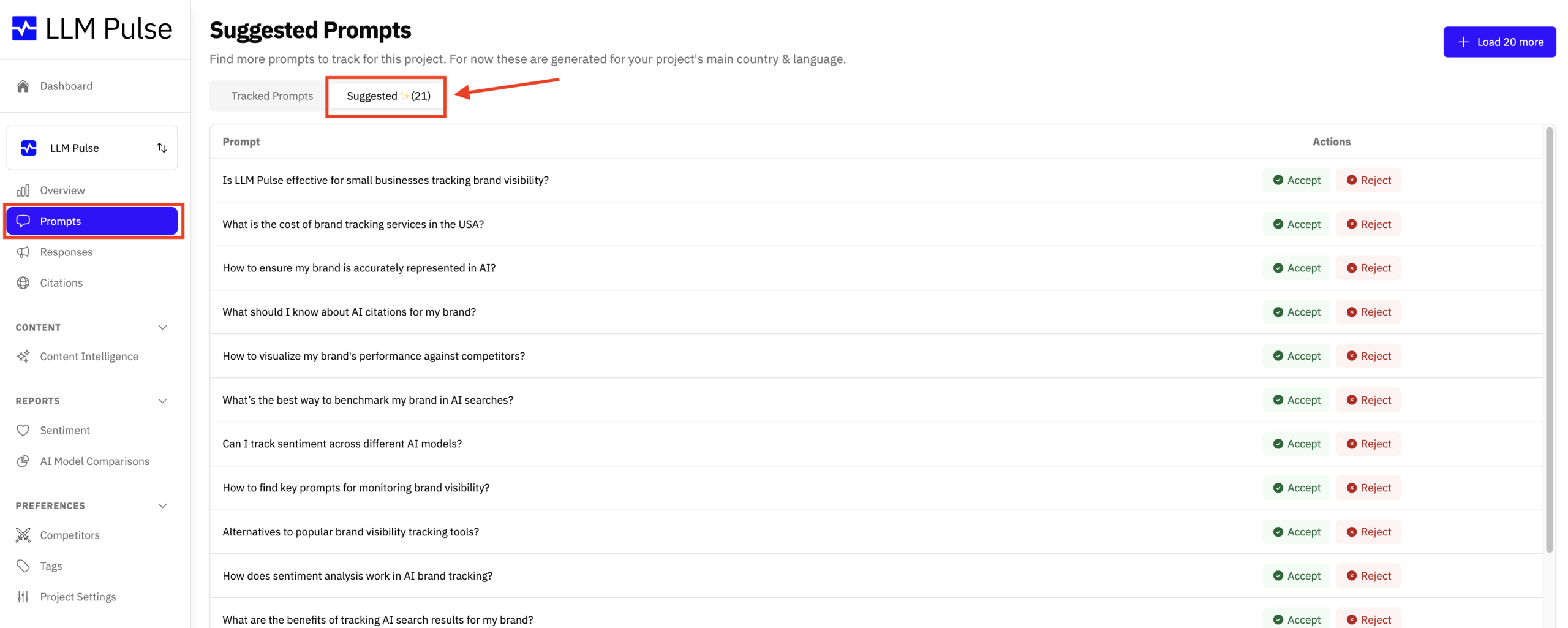
AI-powered prompt suggestions and prompt research to discover the questions your audience is actually asking AI models
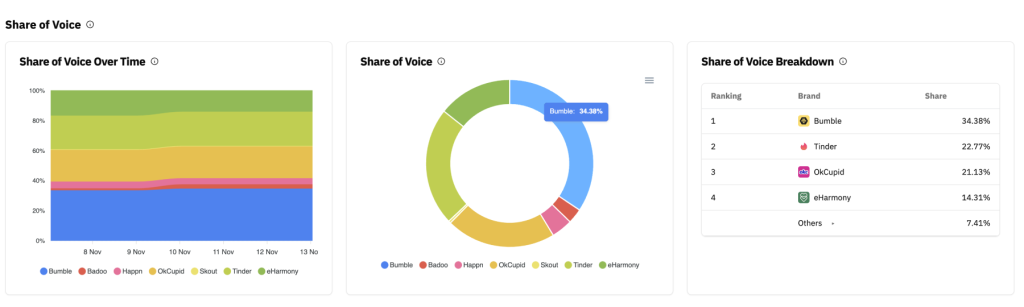
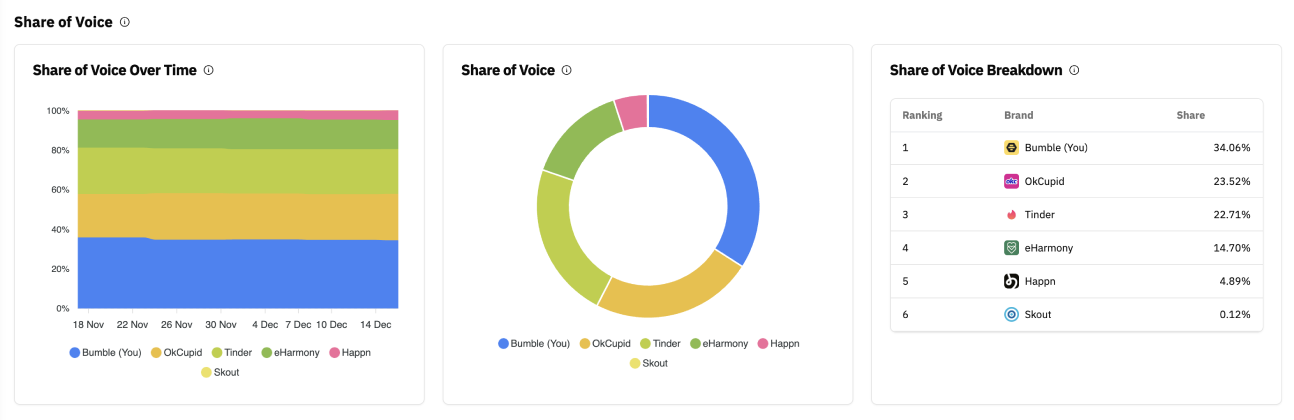
Share of voice and competitor benchmarking across all tracked models
Chrome Extension (Query Detector) that captures web-search queries exposed in ChatGPT responses
Web analytics integration (GA4, Plausible, Piano, PostHog, Adobe Analytics) plus a Google Search Console connection that imports your real search queries and measures AI-driven traffic
REST API, CLI, webhooks (with Zapier, Make, and n8n connectors), and a Looker Studio connector; full white-label portals on your own domain plus embeddable iframe dashboards through an agency arrangement
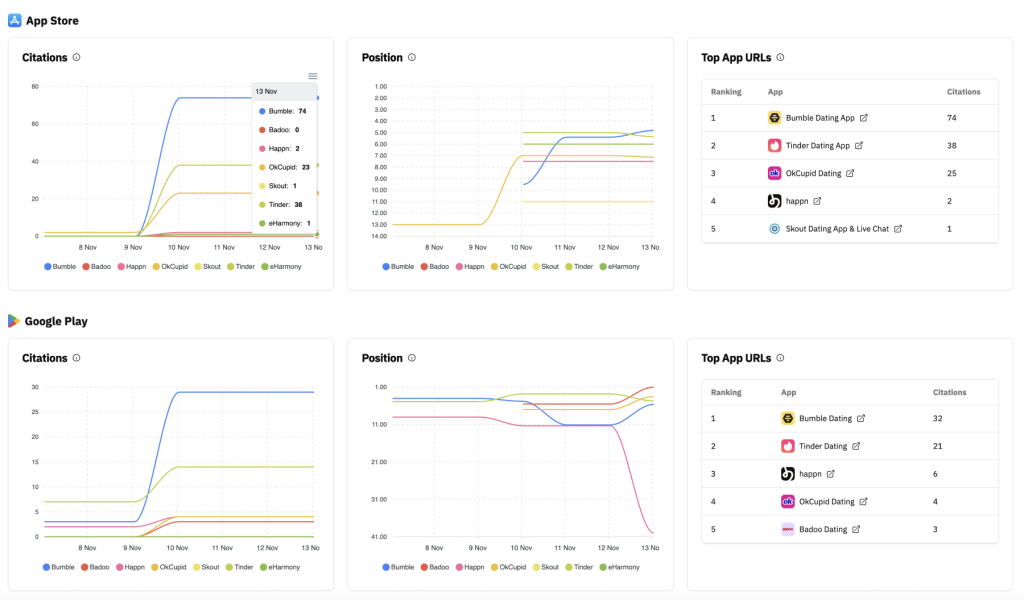
App store tracking for iOS and Google Play citations in AI-generated answers
ChatGPT Entities: see how ChatGPT understands and frames your brand as an entity, not just mention counts
ChatGPT Shopping: product-level tracking in ChatGPT shopping answers
GEO Testing: test content changes and measure AI-visibility lift before rolling them out site-wide
Reputation monitoring to track how AI answers frame your brand
Agent Analytics to see which AI crawlers (GPTBot and peers) hit your site and which pages they fetch, from your own server or CDN logs
MCP & CLI for developer workflows: query LLM Pulse from Claude, Cursor, or the command line
Annotations and tags to mark launches/campaigns on the timeline and organise prompts at scale
Share of voice tracking in LLM Pulse
Best for: Brands and agencies that want comprehensive AI search visibility tracking across multiple platforms, not just Google.
Pricing: Self-serve plans from €49/month. More accessible than enterprise-only options while still providing professional-grade tracking.
Pros:
Tracks five standard AI models, with additional models available as paid add-ons
Built specifically for AI search optimization
Regular updates as new AI search platforms emerge
Citation tracking shows not just visibility but actual mentions
Cons:
Doesn’t include traditional SEO features like backlink analysis or keyword research
Newer platform compared to established names like Semrush
Requires separate tool if you also need traditional SEO tracking
Mobile app direct links tracking in LLM Pulse
2. BrightEdge
What it does: Enterprise SEO platform that added generative AI tracking to their suite. Focuses heavily on content optimization with AI insights.
Key features:
Generative AI tracking across multiple engines
Content recommendations based on AI search patterns
Integration with their broader content marketing platform
Enterprise-grade analytics and reporting
Best for: Large enterprises already invested in BrightEdge’s ecosystem or those needing both traditional SEO and AI tracking at scale.
Pricing: Enterprise pricing (typically $10,000+ annually). Not publicly listed.
Pros:
Comprehensive platform combining traditional and AI search
Strong enterprise features and support
Advanced content optimization capabilities
Robust integrations with marketing tech stacks
Cons:
Very expensive compared to alternatives
Overkill for small to medium businesses
Requires significant onboarding and training
Long contract commitments typical
3. Authoritas
What it does: SEO platform that added AI Overview tracking to their existing rank tracking capabilities.
Key features:
AI Overview monitoring as part of rank tracking
Traditional SEO metrics and reporting
Multi-location tracking
API access for custom integrations
Best for: Agencies and enterprises already using Authoritas who want to add AI tracking without switching tools.
Pricing: Custom enterprise pricing, typically mid-market to enterprise level.
Pros:
Good integration if you’re already in their ecosystem
Combines traditional and AI search tracking
Strong agency features
Cons:
AI features feel more like an add-on than core focus
Limited to Google AI Overviews
Pricing not accessible for smaller businesses
Less specialized in AI search optimization
4. Advanced Web Ranking
What it does: Rank tracking platform that added some AI Overview tracking capabilities.
Key features:
AI Overview tracking alongside traditional ranks
White-label reporting for agencies
Multi-location and device tracking
Historical data and trend analysis
Best for: Agencies looking for an affordable option that combines traditional rank tracking with basic AI Overview monitoring.
Pricing: Starts around $49/month, making it one of the more affordable options.
Pros:
Much more affordable than Semrush or enterprise options
Good for agencies with white-label reporting
Combines traditional and AI tracking in one tool
Cons:
AI tracking is basic compared to dedicated platforms
Tracks ChatGPT, Google AI, Gemini, and Perplexity
AI Visibility is one part of a broader SEO platform
Limited depth of AI-specific insights
5. Custom tracking solutions
What it does: Building your own dashboard using APIs from ChatGPT, Perplexity, and other platforms, combined with Google Search Console data.
Key features:
Fully customizable to your specific needs
Can track exactly what matters to you
No recurring subscription costs once built
Complete control over data and methodology
Best for: Technical teams with development resources and very specific tracking requirements.
Pricing: Development time + API costs (varies widely).
Pros:
Total customization
Ownership of your tracking system
Can be cost-effective at scale
No vendor lock-in
Cons:
Requires significant technical expertise
Ongoing maintenance burden
Time-consuming to build and iterate
API costs can add up
No out-of-the-box reporting or visualizations
How to choose the right alternative
Choosing the best Semrush alternative depends on your specific situation:
Choose LLM Pulse if:
You want dedicated AI search visibility tracking across multiple platforms
You don’t need traditional SEO tools bundled in
You’re specifically optimizing for AI search engines beyond just Google
You want citation tracking and competitor benchmarking for AI
Brand visibility monitoring in LLM Pulse
Choose BrightEdge if:
You’re an enterprise with significant budget
You need both traditional SEO and AI tracking at scale
Content optimization is a priority
You want white-glove service and support
Choose Authoritas or Advanced Web Ranking if:
You primarily need traditional rank tracking but want basic AI monitoring
You’re an agency needing white-label reporting
Budget is a major constraint
You want basic AI monitoring alongside traditional rank tracking
Stick with Semrush if:
You’re already heavily invested in their ecosystem
You need their full suite of SEO tools
You want ChatGPT, Google AI, Gemini, and Perplexity tracking inside Semrush
Traditional SEO is still your primary focus with AI as secondary
Build custom if:
You have specific tracking needs no platform addresses
You have technical resources available
You need to integrate deeply with proprietary systems
You’re tracking at massive scale where custom becomes cost-effective
The future of AI search tracking
AI search is evolving rapidly. What started with Google’s AI Overviews has expanded to include ChatGPT search, Perplexity, Claude, Gemini, and numerous other platforms experimenting with AI-powered search.
Semrush tracks AI visibility inside its SEO + AI Search plans. Dedicated trackers may still suit teams that need a different model mix or more specialized workflows.
If AI search optimization is becoming central to your strategy, a dedicated platform will give you better coverage and deeper insights. If traditional SEO remains your primary focus with AI as a secondary concern, Semrush or similar all-in-one platforms might still make sense.
The key is understanding where your audience is actually searching and making sure you’re tracking visibility on those platforms, not just the ones your current tool happens to cover.
Suggested prompts in LLM Pulse
Getting started with AI search tracking
Whichever alternative you choose, here are some best practices:
Start with a baseline: Before investing in any tool, manually test your visibility across different AI platforms to understand your starting point.
Focus on platforms that matter: Don’t track everything. Identify which AI search engines your target audience actually uses.
Track competitors: AI search visibility is relative. Knowing you appear 30% of the time means little without knowing your competitors appear 60% of the time.
Monitor citations, not just visibility: Being mentioned is good, but being cited as a source is better. Look for tools that distinguish between these.
Connect to business outcomes: Track not just visibility but whether that visibility correlates with brand searches, traffic, or conversions.
The shift to AI search is real, and having proper tracking in place now will give you a significant advantage as more users adopt these platforms. Whether you choose LLM Pulse, stick with Semrush, or explore another alternative, the important thing is to start measuring your AI search visibility before your competitors do.
FAQ
What are the main limitations of the Semrush compared to newer AI visibility platforms?
The toolkit covers sentiment, share of voice, citations, prompt research, and competitor analysis. Teams should compare its 25 daily prompts per domain with the prompt limits, model coverage, and workflows offered by dedicated trackers.
Which features are missing in the Semrush that other tools provide?
Alternatives may offer more tracked prompts, different engines, full-response review, query fan-out data, or integrations that fit a team’s reporting workflow. Semrush itself already provides daily tracking, citations, sentiment, and multi-engine coverage.
How does the Semrush measure visibility across ChatGPT, Perplexity and Google AI results?
It mainly measures presence at a high level, which is useful but limited. It does not break down the order of mentions, the strength of citations, or the specific sources the AI pulled from. As a result, brands get visibility numbers, but not the underlying story behind how each engine reaches its conclusions.
When should a brand consider switching from the Semrush to a more specialized AI visibility solution?
A switch becomes valuable when AI search starts influencing acquisition, reputation or competitive strategy. If a brand needs precise insight into how it is cited, how sentiment shifts across engines or how competitors gain visibility, a more specialized tool offers far richer data and clearer decision-making support.
What factors matter most when choosing an alternative to the Semrush for tracking brand citations and share of voice?
The key factors are depth of tracking, number of engines covered and the quality of the citation-level data. Tools that measure sentiment, fan-out queries, ranking order and update frequency offer a more realistic picture of how AI systems perceive and recommend a brand, which is essential for shaping strategy.
Is LLM Pulse better than Semrush for AI visibility tracking?
LLM Pulse tracks five standard models and adds GEO Writer, full-response analysis, and query fan-out workflows. Semrush Starter tracks 50 prompts daily inside a broader SEO + AI Search plan.
Can LLM Pulse replace Semrush entirely?
No, and it’s not designed to. LLM Pulse focuses exclusively on AI search visibility. Most teams use LLM Pulse alongside their existing SEO tool (Semrush, Ahrefs, etc.) to cover both traditional search and AI search. The Looker Studio connector makes it easy to unify reporting.
How many AI evaluations does LLM Pulse run per month?
The Starter plan includes 50 tracked prompts across five AI models. Growth increases the allowance to 150 prompts.
Discover your brand's visibility in AI search effortlessly
Co-Founder of LLM Pulse and AI search expert. With extensive experience working as an SEO for global brands and large enterprises, he’s the subject matter expert building the product to deliver value to our users.