




Last updated: September 28, 2026
Share of voice used to be a media metric. Marketers compared their ad spend or social mentions to competitors and called the ratio “SoV”. Then AI search rewrote the surface area of discovery, and the metric had to follow.
Table of Contents
This post defines share of voice in AI search, separates it from Mention Rate and Citation Rate, and walks through a numerical example with 50 prompts across 5 models. By the end, you will know how to calculate AI share of voice yourself and how to interpret the numbers in CMO reporting.
What is share of voice?
Share of voice is the percentage of total marketing presence in a category that belongs to your brand. The concept dates back to the 1960s, when ad agencies wanted a single number for “how loud is my brand compared to competitors”. The traditional formula is simple: your spend or impressions divided by total category spend or impressions.
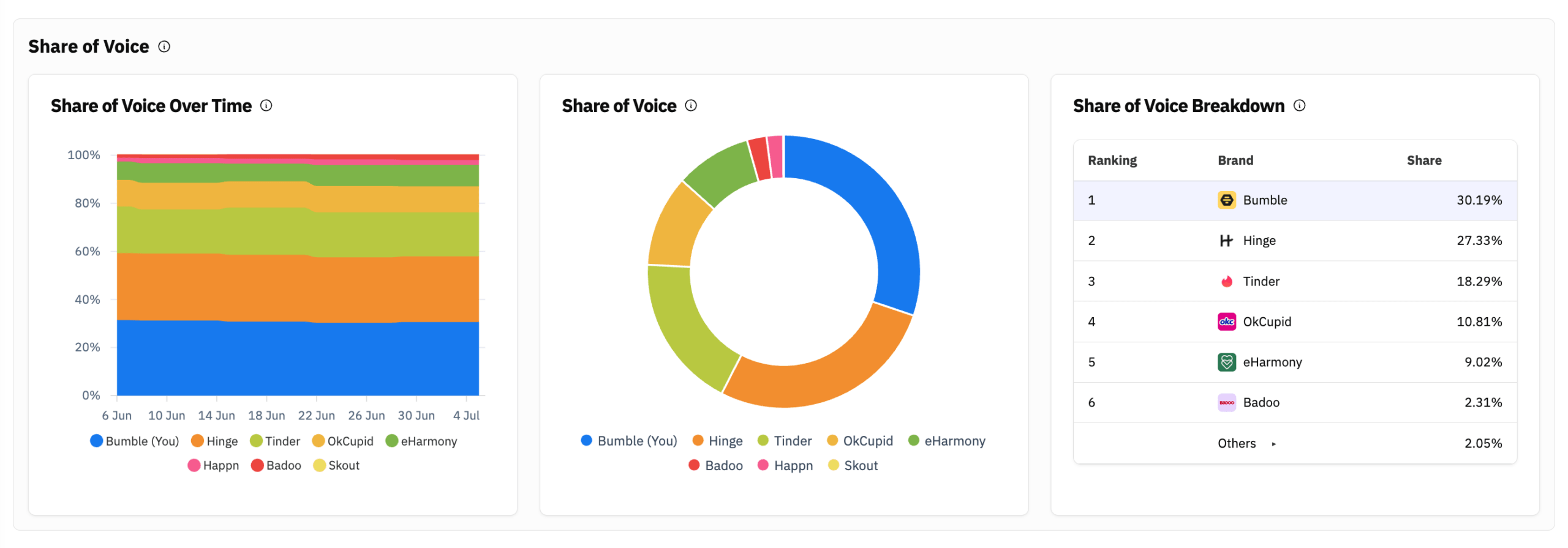
For decades, marketers measured SoV in three contexts: paid media (ad impressions or budget), organic search (ranked keywords and CTR estimates), and social (branded mentions). Each answered the same question: when a buyer looks for a solution in your category, how often do they see your brand instead of a rival? That answer matters because share of voice predicts share of market. The Binet and Field research at the IPA formalised this: brands that hold a higher SoV than their current market share tend to grow; brands with lower SoV tend to shrink.
Why share of voice changed when AI search became dominant
Classic SoV assumed a world of links and impressions. A buyer typed a query, got a list of blue links, and either clicked yours or a competitor’s. The whole discovery surface was visible, countable, and rankable. AI search broke that assumption in three ways.
First, the surface inverted from “links” to “answers”. ChatGPT, Perplexity, Gemini, Google AI Mode, and Google AI Overviews do not show ten options. They give you one synthesised answer, sometimes naming brands inline, sometimes citing URLs as footnotes, sometimes both. The unit of measurement is no longer “did I rank?”. It is “did I get named?”.
Second, visibility is fragmented across models. Your brand might dominate ChatGPT, get cited by Perplexity, and be invisible on Gemini. A single-channel SoV score hides that fragmentation.
Third, citations and mentions are not the same. An AI answer can name “Brand X” in prose without citing your website, or cite your URL without naming the brand in the body. These are different outcomes, and lumping them together hides what is happening. See our write-up on tracking sources and citations in AI search. That fragmentation is why share of voice should sit beside absolute visibility and citation metrics rather than replacing them.
Share of voice, Mention Rate, and Citation Rate
Track these outcomes independently because each answers a different question.
Share of Voice
Share of Voice is competitive. Divide your brand mentions by the total mentions across your brand and selected competitors. If your brand has 38 mentions and the comparison set has 120 total, your Share of Voice is 31.7 percent.
Mention Rate
Mention Rate is absolute visibility. Divide responses that mention your brand by total responses. If 38 of 250 responses mention you, Mention Rate is 15.2 percent. See our guide to tracking brand mentions in LLMs for extraction mechanics.
Citation Rate
Citation Rate is the percentage of responses that cite a domain you own. It can rise or fall independently of mentions because an answer may name a brand without linking to it, or cite a brand’s page without naming the brand in the prose. For the wider set of signals, see our GEO metrics guide.
The math: explicit formulas for each
Here is the formula table. Mention Rate and Citation Rate use total evaluations as the denominator. Share of Voice uses total mentions across the selected competitive set.
| Metric | Formula | What it tells you | Best for |
|---|---|---|---|
| Mention Rate | (responses mentioning your brand / total AI evaluations) x 100 | How often AI surfaces your brand | Absolute visibility |
| Citation Rate | (responses citing your domain / total AI evaluations) x 100 | How often your domain is cited | Source visibility and referral analysis |
| Share of Voice | your brand mentions / total mentions for your brand and selected competitors x 100 | Your share of competitive mentions | Benchmarking against rivals |
| AI Visibility Score | sum of (100 / mention position) / total evaluations | Mention visibility weighted by position | Comparing prominence across answers |
| Raw mention count | number of brand mentions | The input used for Share of Voice | Auditing the competitive denominator |
One aggregation note: calculate cross-model Share of Voice from raw mention counts. For Mention Rate and Citation Rate, aggregate event counts and evaluations before dividing.
A worked example
Let’s run a real calculation. Brand X tracks 50 prompts weekly across 5 AI models (ChatGPT, Perplexity, Gemini, Google AI Mode, Google AI Overviews). That gives 50 x 5 = 250 AI evaluations per week, or roughly 1,000+ per month. Brand X has two main competitors: A and B. After one week:
- Brand X appears in the answer body of 38 evaluations, is cited in 22, and is mentioned (anywhere) in 45.
- Competitor A appears in the body of 52 evaluations. Competitor B appears in 30.
The math:
- Mention Rate (Brand X): 38 / 250 = 15.2%. Brand X appears in roughly one of every seven AI responses.
- Citation Rate (Brand X): 22 / 250 = 8.8%. The domain is cited less often than the brand is mentioned.
- Share of Voice (Brand X vs A vs B): 38 / (38 + 52 + 30) = 31.7%. Brand X receives just under a third of mentions across the selected competitive set.
- Additional string matches: if a broader alias rule produces 45 matches, report that separately and document the matching rule rather than calling it another Share of Voice metric.
Now do the same per model. Brand X might score 22% on Perplexity (good), 18% on ChatGPT (decent), and 6% on Gemini (poor). The aggregate gives you the headline; per-model Share of Voice shows where your competitive position differs. Our overview of AI search optimization covers what to do with that signal.
How to set up share of voice tracking step by step
The setup is the same whether you run it manually or use a tool. The discipline is what matters.
- Define the prompt universe. Pick 30 to 100 prompts that represent the questions your buyers ask AI search. Mix branded (“is Brand X reliable”), category (“best CRM for small business”), and comparison (“Brand X vs Competitor A”) prompts. A garbage prompt list gives you a garbage score.
- Choose your AI models. Default to ChatGPT, Perplexity, Gemini, Google AI Mode, and Google AI Overviews. Add Claude or Copilot if your audience uses them heavily. Single-model SoV is misleading.
- Define your competitor set. Pick 3 to 5 named rivals. Without competitors, you have a visibility score, not a SoV.
- Choose a cadence that matches how quickly your team needs to respond. LLM Pulse supports daily, weekly, and monthly tracking across all five standard models.
- Aggregate and chart. Store raw mention and citation events, then compute Share of Voice, Mention Rate, and Citation Rate with their correct denominators. Trend beats snapshot.
- Reconcile with web traffic. Cross-reference share of citation with referral traffic in GA4 or Plausible. A rising citation rate should correlate with more AI-driven sessions. If it does not, your cited pages are not converting exposure into clicks.
Benchmarking against competitors: what is a good share of voice in AI search?
There is no universal good score. Share of Voice changes with the prompt set, selected competitors, models, markets, and brand density. Treat the competitive set and prompt universe as part of the metric definition, then compare the trend on a like-for-like basis.
The single most useful benchmark is “is my SoV growing or shrinking relative to my named competitors”. If Brand X went from 12% to 15% this quarter while Competitor A dropped from 18% to 14%, that is a clean win regardless of category benchmarks.
How share of voice trends over time
One-shot SoV measurements lie. AI answers fluctuate by prompt phrasing, model version, index recency, and sheer randomness inside the model’s sampling. A single week’s score is a snapshot, not a verdict.
Trend tracking solves this. Run the same prompt universe weekly, log raw events, chart share of voice as a time series. Three patterns emerge. Trending up: your content investments are working. Trending flat: fine if you are the category leader, bad if you are the challenger. Trending down: competitors are pulling ahead, possibly through content velocity, PR coverage, or a model retraining. Diagnose with per-model breakdowns: a drop on one model suggests a model-specific change; a drop across all five suggests a real authority shift.
When the prompt universe changes, annotate the break or report a like-for-like cohort. LLM Pulse carries values forward for empty periods in existing series, but it does not invent historical values for prompts that did not yet exist.
Tools that measure AI share of voice
You can run this manually with a spreadsheet and the model APIs (cheap, time-consuming) or use a tool that does the prompt-running, parsing, aggregation, and visualisation for you.
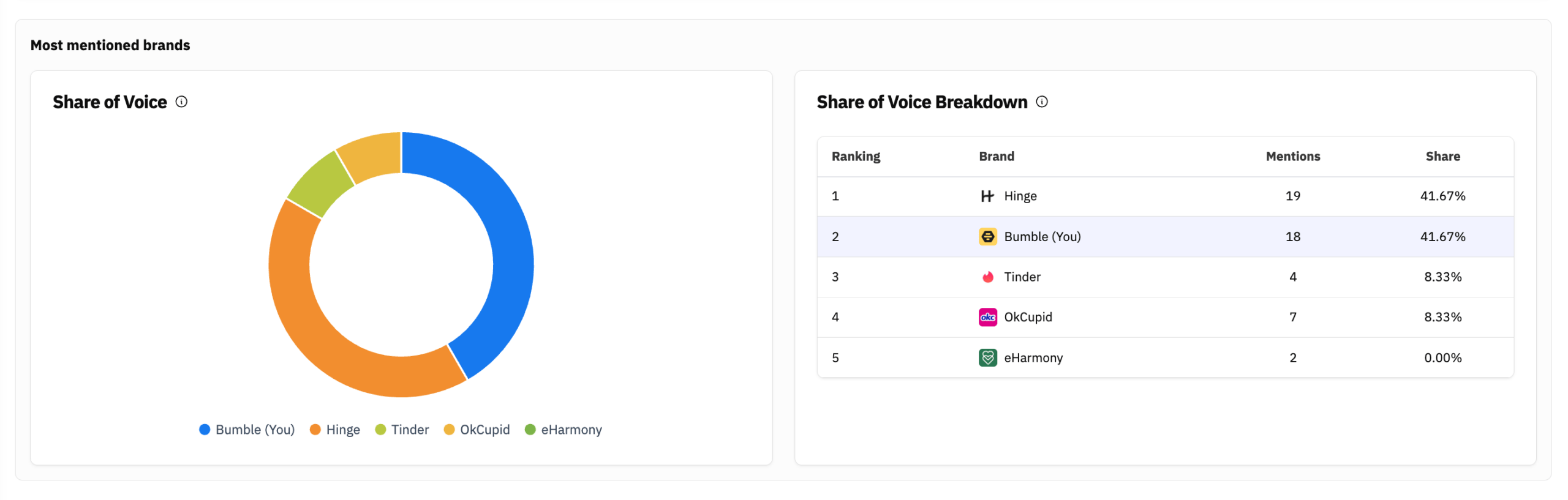
LLM Pulse calculates Share of Voice, Mention Rate, and Citation Rate with multi-model aggregation and competitive benchmarking. It tracks ChatGPT, Perplexity, Gemini, Google AI Mode, and Google AI Overviews, with sentiment analysis included. Plans start at €49 per month for 50 prompts. Read the full overview of the best AI visibility tools in 2026 for context.
Other categories of tools to know about (plain text, not links):
- Generic AI visibility platforms. Several vendors in the AEO and GEO space offer share-of-voice modules: tryrankwise, otterly, scrunch, athenahq, getprofound. Coverage and model support vary; check whether they aggregate across all major AI surfaces or only one or two.
- Legacy SEO suites with bolted-on AI. Ahrefs, Semrush, and similar tools have added AI-mode coverage but their core metric model is still link-based. Useful for cross-referencing.
- Spreadsheets and custom pipelines. Hit each model’s API, parse responses with a regex or LLM-based extractor, aggregate in BigQuery. Transparent, time-intensive.
For evaluation criteria, see our debunk of AI rank tracking myths and the sister post on the best AEO tools available right now.
Common mistakes when calculating AI share of voice
Four mistakes show up over and over in agency reports and CMO dashboards.
- Averaging percentages across models. If ChatGPT gives Brand X a 20% share of answer on 50 prompts and Gemini gives 10% on the same 50, do not compute (20 + 10) / 2 = 15%. Aggregate the events: wins divided by total evaluations. With unequal denominators, the average-of-percentages trick gives you a wrong number.
- Single-model bias. Reporting SoV from just one model (usually ChatGPT) tells you about that one model. Buyers use multiple AI surfaces. A multi-model average is the credible number for category-level visibility.
- Not normalising by prompt count. Comparing 38 wins out of 250 evaluations to 22 wins out of 100 is unfair until you express both as percentages. Always report SoV as a rate.
- Conflating mentions and citations. “We got 50 mentions this month” sounds great until you realise none included a link. Or vice versa: high citations with low brand mentions means the AI uses your content but does not attribute the brand. Different problems, different fixes. Track separately.
How to use share of voice in reporting and strategy
SoV becomes useful when it drives decisions. Three patterns that work in 2026 CMO reporting.
Dashboard headline metric. Make share of answer the single visibility KPI in your CMO dashboard. Show the current value, week-over-week change, and rank against named competitors. Keep share of citation and share of mention one level deeper.
Content gap analysis. Filter your prompt universe to prompts where competitors win and you do not. Read the AI’s answer text. Patterns leap out: maybe the AI prefers comparison-style content, maybe it cites a source type you do not produce. Each gap is a content brief.
Competitive positioning. If a rival’s SoV is rising on a specific prompt cluster, look at what content they shipped in the previous month. Retrieval timing varies, so treat recent competitor publishing as a lead to investigate rather than proof of causation. LLM Pulse offers unlimited seats, CSV and Excel exports, and Looker Studio, with white-label through an agency arrangement.
Summary
Share of voice in AI search is your share of brand mentions across your brand and selected competitors. Mention Rate and Citation Rate are separate metrics that use total evaluations as their denominator.
Calculate it weekly across the major AI models, normalise by prompt count, segment by competitor, and chart the trend. A good score depends on the prompt universe and selected competitors. The most useful comparison is the like-for-like trend relative to those named competitors.
If you want this measured automatically across ChatGPT, Perplexity, Gemini, Google AI Mode, and Google AI Overviews with sentiment overlay and competitive benchmarking built in, LLM Pulse runs the full pipeline. Plans start at €49 per month. Start with the pricing page or book a demo.
FAQ
What is share of voice in AI search?
Share of voice in AI search is your brand mentions divided by total mentions across your brand and selected competitors for a defined prompt and model set. Mention Rate and Citation Rate should be reported separately.
How is AI share of voice different from social SoV?
Social SoV counts mentions on platforms like X, LinkedIn, and Reddit. AI share of voice counts the times AI assistants surface your brand when buyers ask category questions. The unit of measurement shifts from “user-generated post” to “AI-generated answer”, and buying intent is much higher in AI search.
Can I calculate share of voice without a tool?
Yes, with a spreadsheet and the model APIs. Define your prompt list, send each prompt to each model weekly, log whether your brand appears, and divide. The tradeoffs are time (several hours of work plus API costs) and consistency (parsing answers reliably for brand mentions is the actual hard part).
What’s a good share of voice score?
There is no universal benchmark because the result depends on the prompt set, models, markets, and competitors included. Use a fixed definition and compare your own trend against the same competitive set.
How often should I track AI share of voice?
Weekly. Daily is noisy; monthly loses signal. Weekly cadence matches how most serious AI visibility platforms run their pipelines.
Does share of voice differ by AI model?
Yes, often dramatically. The same brand can hold 22% share of answer on Perplexity, 18% on ChatGPT, and 6% on Gemini in the same week. Per-model breakdowns are where optimisation decisions get made.
How is Citation Rate different from Mention Rate?
Citation Rate tracks the share of responses that link to a URL you own. Mention Rate tracks the share of responses where your brand appears in the text, with or without a link. They use the same evaluation denominator but count different events.
Does share of voice in AI predict revenue?
Not directly. SoV predicts visibility; visibility predicts traffic; traffic predicts pipeline. The chain holds up best when you reconcile share of citation with referral traffic in GA4 or Plausible, the closest “visibility to click” attribution AI search provides.