



Last updated: August 30, 2026
If you have ever asked ChatGPT for the best CRM or the best AI visibility tool, you have used the new front page of the internet. The brands named in that answer get the click and the customer. Everyone else, no matter how well they rank on Google, is invisible.
Table of Contents
The AI Visibility Score is the single metric that tells you whether your brand is one of those answers. This post walks through what it is, the formula, how position weighting works, the difference between raw and weighted scores, and how to benchmark against competitors. By the end you can calculate it on a napkin and know what a healthy number looks like for your category.
What is an AI Visibility Score?
In LLM Pulse, the AI Visibility Score is the position-weighted rate of brand mentions across a defined prompt set. The unweighted percentage of responses that mention the brand is Mention Rate, historically called Brand Visibility. Think of it as a click-through rate equivalent for generative search: instead of measuring whether someone clicked your link, it measures whether the AI even said your name.
The math is simple in raw form. You take relevant prompts, run them through one or more AI models, count how many answers contain your brand, and divide by the total number of evaluations. Multiply by 100 and you have a percentage. That is the foundation of every AI visibility metric on the market, including the version we use at LLM Pulse.
It gets interesting in two layers: position weighting (was your brand the first option or the seventh?) and prompt selection (are you measuring the questions your buyers actually ask?). With both layers, the AI Visibility Score becomes the most actionable metric in generative engine optimization. For a wider view, see our guide to which GEO metrics you should track.
Why traditional SEO metrics fail in AI search
Keyword rankings, organic traffic, and impressions all assume one thing: the user sees a list of ten links and chooses one. That model is breaking. When your buyer asks Perplexity “what is the best invoicing tool for freelancers”, they do not see ten links. They see one synthesized answer and maybe four citations.
Three things break:
- Position 1 no longer exists in the old sense. There is one answer, and either your brand is named in it or it is not.
- Impressions are invisible. Search Console will not tell you how many times Gemini said your name. There is no equivalent dashboard from OpenAI.
- Click-through rates do not apply. A mention with a citation is worth something even if the user never clicks, because the AI has endorsed you.
This is why the AI Visibility Score has to exist as a separate metric. Mentions, citations, and AI Visibility Score complement impressions, backlinks, and rankings; they do not replace those established metrics. For more on this shift, see our breakdown of common AI rank tracking myths.
The two visibility metrics you should track
Mention frequency and mention position answer different questions, so track the unweighted Mention Rate beside the position-weighted AI Visibility Score.
| Score name | Formula | What it tells you |
|---|---|---|
| Mention Rate (historically Brand Visibility or Visibility) | (Mentions / Total evaluations) x 100 | The raw share of AI answers that include your brand at all. |
| Weighted AI Visibility Score | Sum of (1 / position) for each mention, divided by total evaluations, x 100 | How prominently you appear: Pos 1 = 100%, Pos 2 = 50%, Pos 3 = 33%, Pos 4 = 25%, and so on. |
Why both? Because they answer different questions. Mention Rate tells you how often the brand appears. AI Visibility Score tells you how early it appears when mentioned. A brand can have a 20 percent raw visibility but a 4 percent weighted score, mentioned often but always as an afterthought. That gap is where category leaders separate from also-rans.
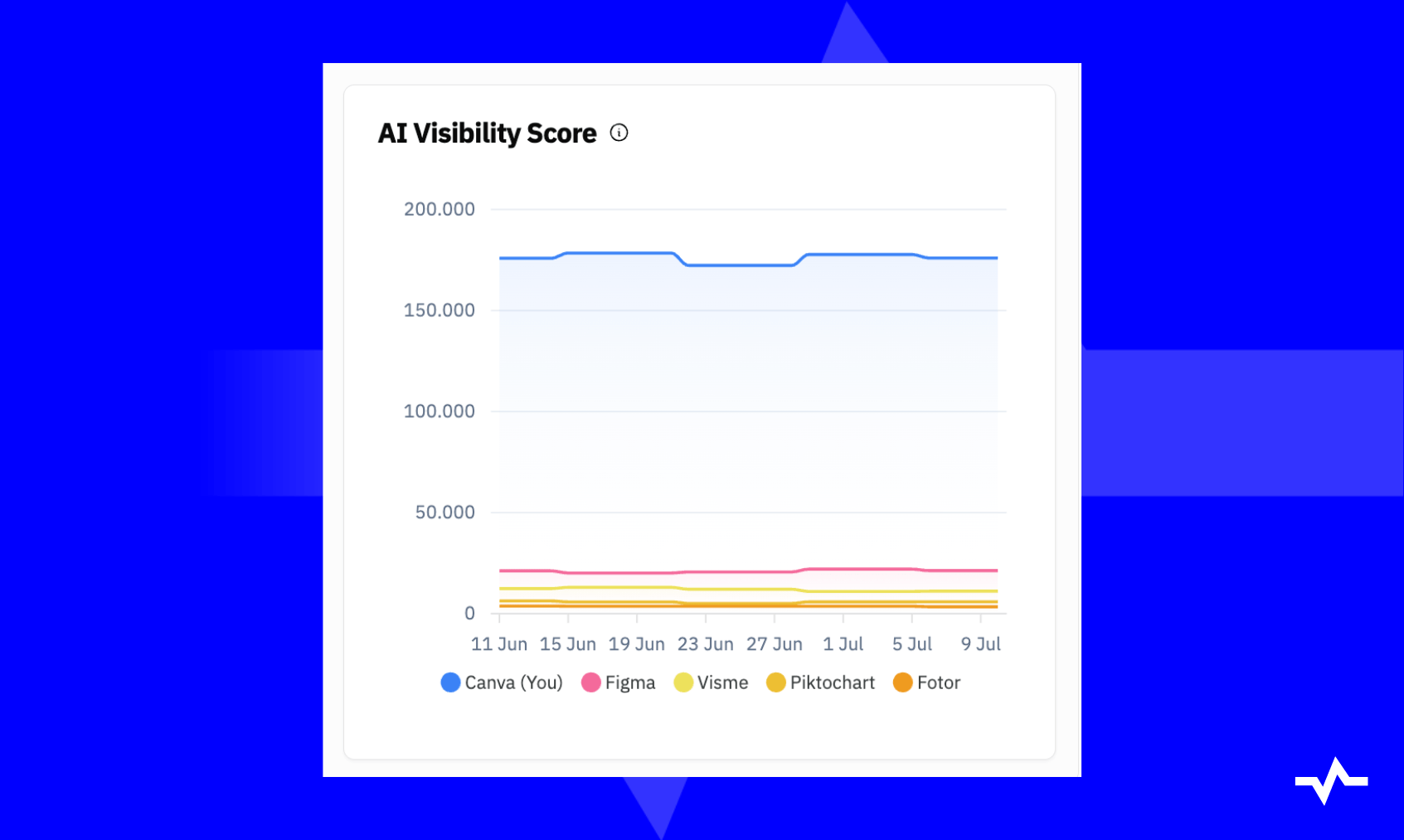
In LLM Pulse, both scores are computed automatically per project, per model, and per locale, so you can see if your brand is strong on Perplexity but weak on Gemini:
How AI Visibility Score is calculated step by step
Here is the exact pipeline LLM Pulse uses to compute the AI Visibility Score, which you can replicate in a spreadsheet if you want.
- Define your prompt set. Start with 30 to 100 prompts that reflect how real buyers ask AI about your category. Mix branded, comparative, and unbranded queries.
- Pick your model coverage. At minimum, run each prompt across ChatGPT, Perplexity, Gemini, Google AI Mode, and Google AI Overviews. Single-model scores are biased.
- Run on a fixed cadence. Weekly is the right default. One prompt across five models once a week equals five evaluations per prompt per week.
- Parse each answer for brand mentions. A mention is any unambiguous reference to your brand name (exact match or near-variant). Citations to your domain count separately, do not confuse them with mentions.
- Record the position of each mention. Position is the ordinal rank within the answer: 1 if named first, 2 if second, and so on. If your brand is mentioned multiple times, count the earliest occurrence.
- Calculate Brand Visibility. Mentions divided by total evaluations, times 100.
- Calculate the Weighted AI Visibility Score. For each mention the weight is 1 divided by the position (1.0 for position 1, 0.5 for position 2, 0.33 for position 3, 0.25 for position 4). Sum all weights, divide by total evaluations, multiply by 100.
Written as a formula:
Brand Visibility = (Number of mentions / Number of evaluations) x 100
Weighted AI Visibility Score = (Sum of (1 / position) across all mentions / Number of evaluations) x 100
Report both numbers alongside each other. One without the other lies.
A worked example
Numbers make this concrete. You are tracking a B2B SaaS brand called Acme with a prompt set of 50 prompts, run weekly across the 5 default AI models. That is 50 x 5 = 250 weekly evaluations.
After parsing one week of results:
- Acme is mentioned in 38 of the 250 answers.
- Position distribution of those 38 mentions: 6 in position 1, 9 in position 2, 11 in position 3, 7 in position 4, 5 with an assumed average position of 6 for this example.
Raw Brand Visibility: (38 / 250) x 100 = 15.2%
Weighted AI Visibility Score. Compute weights:
- 6 mentions x (1/1) = 6.00
- 9 mentions x (1/2) = 4.50
- 11 mentions x (1/3) = 3.67
- 7 mentions x (1/4) = 1.75
- 5 mentions x average (1/6) ≈ 0.83
Sum of weights = 16.75. Weighted score = (16.75 / 250) x 100 = 6.7%
So Acme has a raw Brand Visibility of 15.2 percent but a Weighted AI Visibility Score of only 6.7 percent. Acme shows up in roughly one in six AI answers but rarely as the first-mentioned option. This shows lower prominence, not proof that the model recommends or rejects the brand. Investigate the prompts and cited sources behind the gap. That kind of gap analysis is impossible with a single number.
Mentions vs citations vs share of voice: do not confuse them
These three metrics are often used interchangeably and they should not be.
- Mentions: the brand name appears in the body of the AI answer. “I’d recommend Acme, Beta, and Gamma.” That is three mentions.
- Citations: the AI links out to a URL on your domain, as a numbered footnote or inline source. A citation often happens without a mention and a mention often happens without a citation. See our guide to monitoring citations and sources.
- Share of Voice: your share of all branded mentions in the category. If five competitors share 100 mentions and you have 28, your share of voice is 28 percent. Relative, not absolute.
The AI Visibility Score is built from mentions. It does not include citations, and it is not the same as share of voice. You need all three to run a credible AI search audit. See our guide to share of voice in AI search and how to track brand mentions in LLMs.
How often AI Visibility Score should be tracked
Weekly is the right cadence.
Daily is situational. It can help during launches or active reputation work, but the natural variance and higher query volume require careful aggregation.
Monthly can miss fast changes. It may be enough for slow-moving programs, but teams making frequent interventions usually need a shorter feedback loop.
Use a consistent cadence so you can compare changes over time. Daily tracking is useful when you need faster feedback, while weekly tracking can smooth some query-level variation.
What is a “good” AI Visibility Score
Context matters. Scores depend on the prompt universe, models, market, language, and brand set. The table below is illustrative rather than a universal industry benchmark:
| Brand stage | Raw Brand Visibility | Weighted AI Visibility Score |
|---|---|---|
| Top 3 enterprise brand (category leader) | 12% to 25% | 6% to 13% |
| Established midmarket brand | 5% to 15% | 2% to 7% |
| Emerging brand or new entrant | 1% to 5% | 0.3% to 2% |
| Not yet on the AI radar | under 1% | under 0.3% |
Notice the pattern: weighted scores typically run at roughly half the raw score, often lower. If your weighted score is much closer to your raw score, you are consistently mentioned at the top of answers, which is a strong leadership signal. If your weighted score is a fraction of your raw score, you are in the long tail and should focus on becoming an early option, not just any option.
The right target depends on your category and prompt set. The reliable rule: aim to beat last week’s number, then aim to beat your closest competitor.
How to benchmark AI Visibility Score against competitors
An AI Visibility Score in isolation is interesting. Next to four competitors, it is actionable. The playbook:
- Lock the prompt set. Use the same prompts for your brand and every competitor. Apples-to-apples requires a fixed set.
- Lock the models and locales. Five models for everyone, same time period, same languages.
- Track both raw and weighted scores. A competitor with a higher raw score and lower weighted score is wider but shallower. A competitor with a higher weighted score is winning the recommended-first slot.
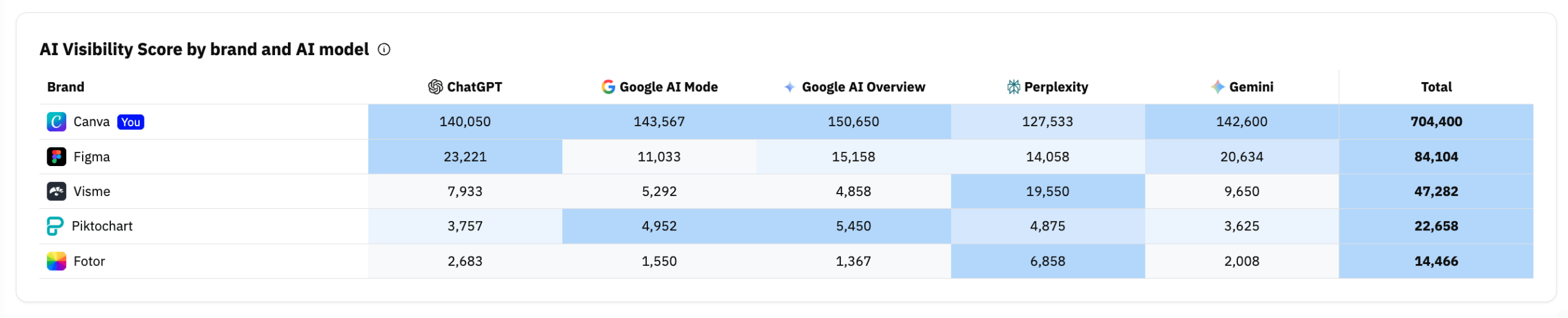
- Segment by model. Some competitors dominate Perplexity but are invisible on Gemini. The model split tells you which content sources each AI is favoring.
- Watch the weekly delta. A competitor whose Weighted AI Visibility Score is climbing 1.5 points per week is shipping content that moves the needle. You should know what they published and when.
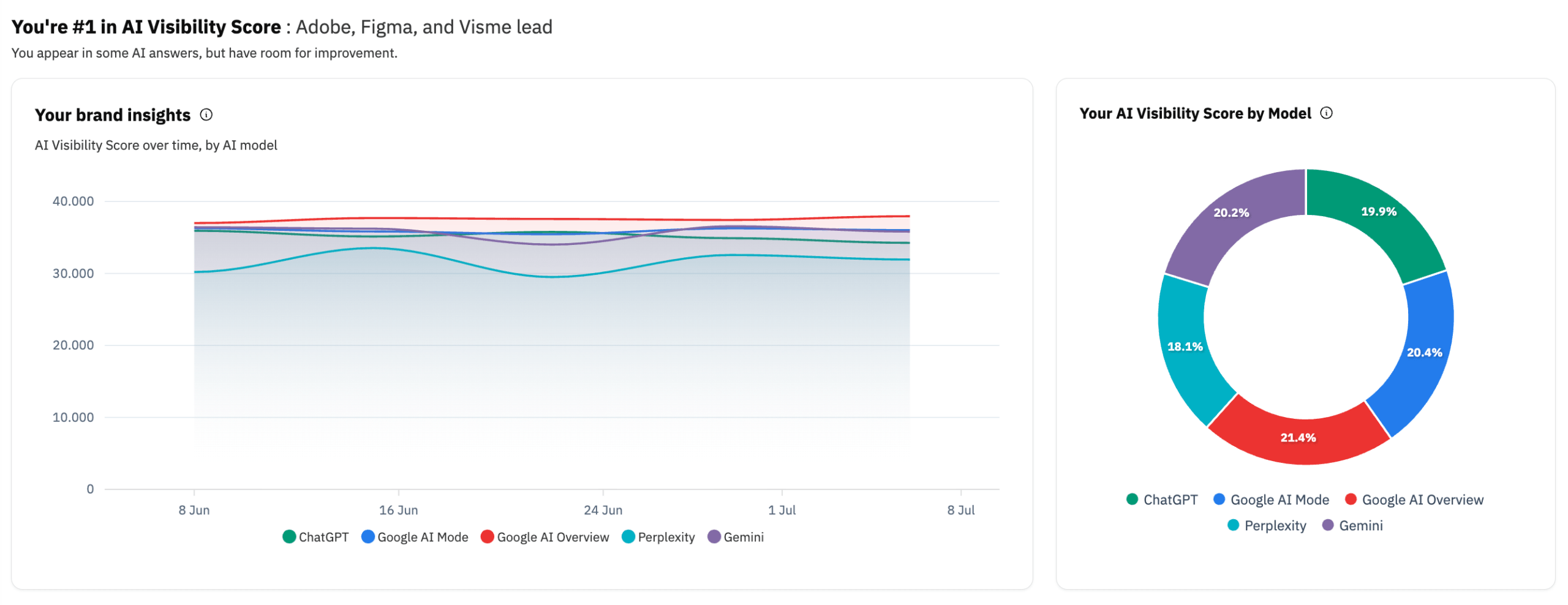
In LLM Pulse, competitor benchmarking is built in. You can add competitors to a project, while the interface summarizes the Top 4 plus Others, and compare Mention Rate, AI Visibility Score, Share of Voice, and citation counts over the same period:
Common AI Visibility Score mistakes
Five mistakes show up over and over. Avoid them and you will be ahead of most teams.
- Single-model bias. Reporting your ChatGPT-only score and calling it your AI Visibility Score is a category error. Each model has different training data and retrieval behavior. Track at least the big five (ChatGPT, Perplexity, Gemini, Google AI Mode, Google AI Overviews).
- Conflating raw and weighted scores. A 15 percent visibility without specifying which version is meaningless. Always label and always show both.
- Ignoring sentiment overlay. Mention frequency does not reveal tone. Sentiment should be read beside visibility rather than folded into the score.
- Not normalising by prompt count. Grow your prompt set from 50 to 150 and the raw mention count rises even if your visibility rate is flat. Always report the percentage, not the absolute count, across periods.
- Treating one bad week as a trend. Weekly data has variance. Wait for two or three consecutive weeks before declaring a decline.
How to use AI Visibility Score in reporting
The AI Visibility Score is most useful in three reporting views.
The CMO dashboard view
One number, one chart: your overall Weighted AI Visibility Score over time, with a competitor overlay. The CMO does not want model-by-model breakdowns at first glance, they want to know if the brand is going up or down. Tag the line with content launches, PR moments, and competitor releases so the trend has narrative.
The content gap view
Prompt-level breakdown: which prompts is your brand winning (mentioned, top position) and which is it losing (not mentioned at all)? Each losing prompt is a content brief. This is where the AI Visibility Score becomes a concrete editorial roadmap.
The competitive positioning view
Side-by-side bar chart of your Weighted AI Visibility Score against your top four competitors, broken out by model. This view ends “are we winning” debates in 90 seconds. For more on positioning content for AI answers, see our AI search optimization guide and the complete guide to Generative Engine Optimization.
Tools that calculate AI Visibility Score
You can compute a simple version in a spreadsheet using the formulas above. The friction is collecting answers at scale, parsing them consistently, and doing it weekly across five models without it becoming a full-time job. That is why most teams use a dedicated platform.
LLM Pulse is the platform we build, and the AI Visibility Score (both raw Brand Visibility and Weighted AI Visibility Score) is one of its core metrics. Plans start at €49 per month, and Starter includes 50 prompts across five models. The platform handles prompt execution, mention parsing, position tracking, weighted scoring, and competitor benchmarking. It also includes sentiment, CSV and Excel exports, MCP, Looker Studio, and REST API access. For a side-by-side comparison, see our roundup of the 15 best AI visibility tools.
Other categories you may evaluate alongside a dedicated platform:
- Traditional SEO platforms with bolt-on AI tracking. Weaker on weighted scoring and prompt-level granularity.
- Generic LLM monitoring tools. Built for prompt engineering, retrofitted for visibility. Often missing competitor benchmarking.
- In-house scripts. Feasible with engineering bandwidth, expensive to maintain as model APIs change.
- Ad-hoc spreadsheets. Fine for a one-off audit, unworkable as an ongoing dashboard.
Summary
The AI Visibility Score is the single most important metric for measuring how visible your brand is in AI search. Two versions matter: Brand Visibility (mentions divided by evaluations) and the Weighted AI Visibility Score (the same calculation with position weighting, where position 1 is worth 100 percent, position 2 is 50 percent, position 3 is 33 percent, and so on).
Track both. Run them weekly across all five major AI models. Benchmark against competitors on the same prompt set. Use the prompt-level breakdown to find content gaps, overlay sentiment, and do not treat one noisy week as a trend.
If you want the score calculated automatically with model splits, competitor benchmarks, and reports, LLM Pulse runs it for you starting at €49 per month.
FAQ
What is AI Visibility Score?
AI Visibility Score is the percentage of AI-generated answers that mention your brand for a defined prompt set, calculated as mentions divided by total evaluations. It comes in two versions: raw Brand Visibility (a simple mention rate) and Weighted AI Visibility Score (which gives more credit when your brand appears earlier in the answer).
How is AI Visibility Score different from share of voice?
AI Visibility Score is absolute (your mention rate against all evaluations), while share of voice is relative (your mentions as a percentage of all brand mentions in the category). A brand can have a high AI Visibility Score in a niche category where total mentions are low, or a low AI Visibility Score with a high share of voice if competitors are barely mentioned either. You need both metrics.
What is a good AI Visibility Score?
There is no universal good range. The result depends on the prompt set, models, market, language, and competitors. Establish a fixed baseline, compare it with relevant competitors, and judge sustained movement rather than applying a generic category cutoff.
How often should I measure AI Visibility?
Weekly is a practical default. Daily can help during launches or active reputation work if results are aggregated carefully, while monthly may suit slower programs. Keep the prompt set and methodology stable enough to compare periods.
How is the Weighted AI Visibility Score calculated?
For each mention, the weight is 1 divided by the position. Position 1 is worth 1.00, position 2 is 0.50, position 3 is 0.33, position 4 is 0.25, and so on. Sum the weights across all mentions, divide by the total number of evaluations, and multiply by 100. This gives more credit to brands named first in an answer.
Can I calculate AI Visibility Score in a spreadsheet?
Yes, the formulas are simple enough for a spreadsheet. The hard part is collecting the AI answers at scale, parsing them for brand mentions and positions consistently, and doing it weekly across five models. Most teams find that running the pipeline manually costs more in time than a dedicated platform costs in subscription.
Does sentiment affect AI Visibility Score?
Not directly. The score counts mentions regardless of tone. However, sentiment is the essential overlay: a 20 percent visibility score with 40 percent negative sentiment is a different story from a 20 percent score with 80 percent positive sentiment. Always view AI Visibility Score alongside sentiment analysis.
Which AI models should AI Visibility Score cover?
At minimum, ChatGPT, Perplexity, Gemini, Google AI Mode, and Google AI Overviews. These are the five mainstream consumer-facing AI surfaces in 2026 and they are the five standard surfaces LLM Pulse tracks. Customers can add Claude, Copilot, Grok, DeepSeek and Alexa for Shopping (formerly Amazon Rufus) as additional models.