



Last updated: September 14, 2026
You already know AI Overviews exist. You have probably seen your own brand sitting under one, or worse, missing from one where it should obviously appear. The question that matters now is not whether AI Overviews are real. It is how to optimize for AI Overviews so your page is the one Google quotes.
Table of Contents
This playbook explains Google’s documented eligibility rules, practical SEO foundations, observed citation patterns, and a workflow for measuring changes. No fluff, no “AI is the future” filler. Just the workflow you can run on a page this afternoon.
What are Google AI Overviews?
AI Overviews are the AI-generated summaries Google places above the traditional ten blue links on Search results. They synthesize an answer from multiple web sources, cite each source with a small expandable card, and increasingly handle multi-part queries that used to require several searches in a row.
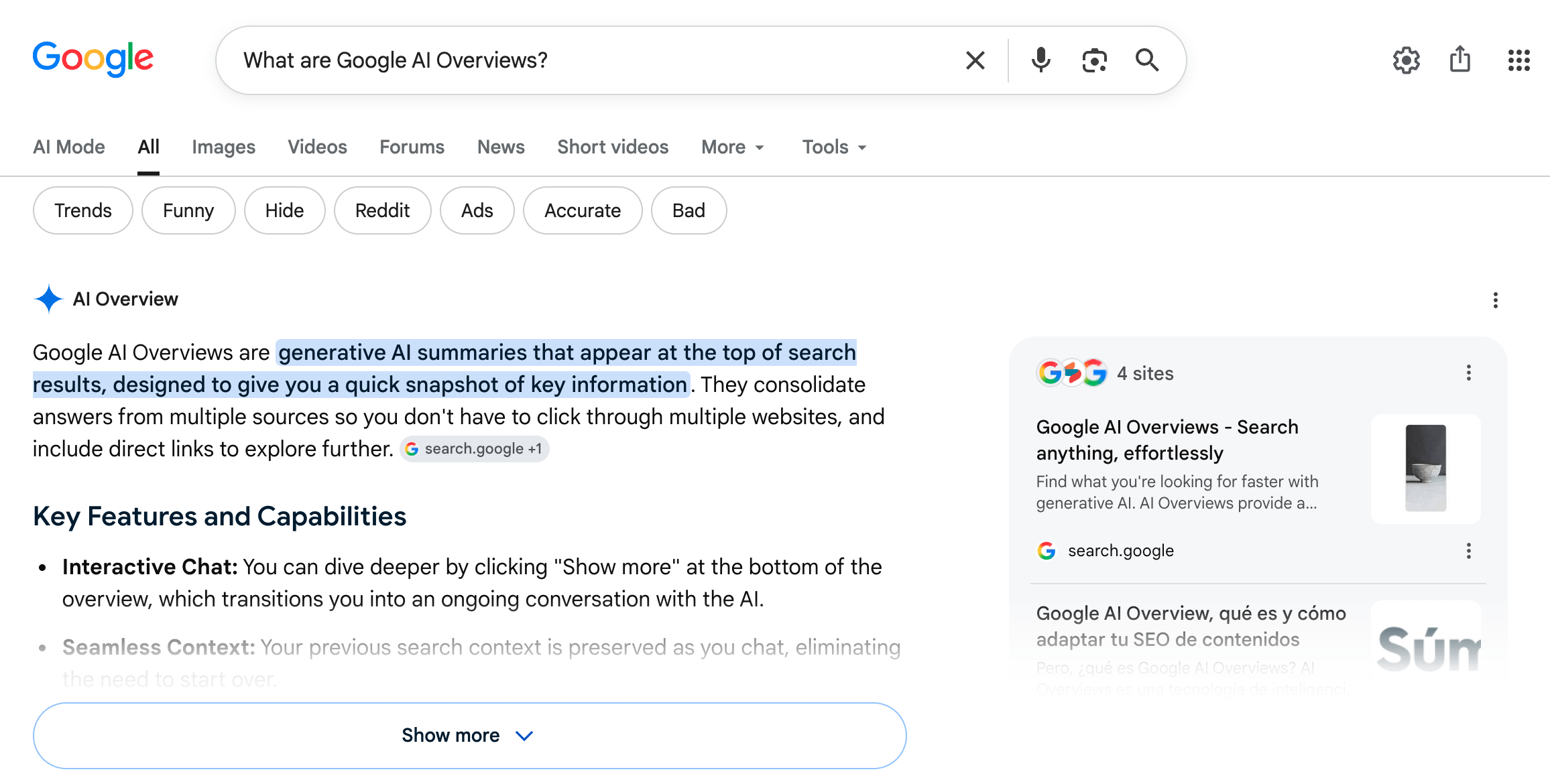
AI Overview frequency varies widely by query type, country, device, and measurement method. Google says they appear when its systems determine that a generative response will add value. Google made Gemini 3 the default model for AI Overviews globally in January 2026. Supporting links come from pages indexed and eligible to appear in Search with a snippet. If you only want to monitor where you stand today before optimizing, our roundup of the best Google AI Overviews trackers covers the tools that surface citations in real time.
AI Overviews vs Google AI Mode: do not confuse the two
Two different surfaces, two different opportunities. Treat them as one and you will waste optimization effort.
AI Overviews sit at the top of the standard Google Search results page. They are concise, citation-anchored summaries triggered by specific query intents (mostly informational, how-to, comparative, and definitional). The user is still on a normal SERP and can scroll past to the organic listings.
Google AI Mode is a distinct, conversational search experience accessed via a dedicated tab or a quick toggle. It is closer in feel to Perplexity or ChatGPT search: full conversational threads, follow-up questions, deeper retrieval, and a different ranking signal mix. AI Mode often surfaces longer answers and a different citation pool.
The two surfaces share the same documented SEO foundation. AI Mode supports follow-up questions and broader exploration, while AI Overviews provide summaries within the standard results page. Google does not publish separate ranking-factor percentages for them. We covered the mechanics of AI Mode separately in our guide to AI search optimization. For this post, every recommendation is calibrated for the AI Overview slot specifically.
How AI Overviews actually pick their sources
Before the ranking factors make sense, you need a mental model of how the system works. It is not a simple “rank one wins” pipeline.
Step 1: query fan-out when useful. Google says AI Overviews and AI Mode may issue multiple related searches across subtopics and data sources to develop a response.
Step 2: retrieval from eligible Search results. Supporting pages must be indexed and eligible to show a snippet. Google does not publish a required passage length or organic ranking position for inclusion.
Step 3: response with supporting links. Google combines retrieved information into a response and presents links that help people explore further. The number and type of supporting sources vary by query.
Step 4: normal Search quality systems still apply. Google says the same SEO best practices used for Search also apply to its AI features. It does not publish a required source-category mix.
The practical implication is to publish accurate, useful pages that satisfy the query and remain eligible for Search. A page does not need a specific blue-link position, and there is no separate AI Overview optimization requirement.
SEO practices that support AI Overview eligibility
Google does not publish nine separate AI Overview ranking factors. It recommends the same SEO fundamentals used for Search, including useful content, indexability, internal links, page experience, and structured data that matches visible content.
- Clear answers. Use descriptive headings and answer the question directly. Google does not publish a required word count or question-and-answer format for AI Overview eligibility.
- Valid structured data. Use supported markup only when it matches the visible page content. Google says special schema is not required for AI Overviews or AI Mode.
- Current information. Keep dates, prices, product details, and other time-sensitive facts accurate. Google does not publish a universal content-age cutoff for AI Overviews.
- Citation-worthy stats. Pages that introduce a specific, sourced number (“35 percent of US queries”, “5 to 8 sources per response”) get cited as the carrier of that fact. Generic claims do not.
- Original research and quotes. First-party data, survey results, customer quotes, and proprietary analysis are citation magnets. The model prefers sourcing a fact to its origin, not to a third repeater.
- Scannable formatting. Short paragraphs, descriptive subheadings, bulleted lists, tables. The passage retrieval layer slices on these boundaries, so well-formatted pages produce cleaner candidate passages.
- Brand authority signals. Mentions across reputable third-party sites, consistent entity definition across the open web, Wikidata presence, knowledge graph entries. AI Overviews disproportionately cite recognized brands when ties are close.
- Content depth without padding. Comprehensive answers that cover the topic at multiple zoom levels (definition, mechanics, examples, edge cases) without throat-clearing. Padding hurts. Depth helps.
- E-E-A-T. Experience, expertise, authoritativeness, trustworthiness. Authored bylines with real credentials, citations to primary sources, reviewed-by lines for medical or legal topics, transparent dating.
Notice what is not on this list: keyword density, exact-match anchors, raw backlink count. Those still matter for the underlying organic index that feeds AI Overviews, but they are not the differentiator at the citation layer.
A 10-step playbook to optimize a single page for AI Overviews
Pick one page you care about. Run this top to bottom. Allow two to three hours for a thorough pass.
- Identify the target query and its sub-questions. Take your seed query and decompose it the way Gemini does. Write 5 to 10 sub-questions you would expect to see covered in any good answer. These become your H2 and H3 candidates.
- Audit the live AI Overview. Search the seed query in an incognito window. Read the current AI Overview. Note the 5 to 8 cited sources, the structure of the answer, which facts each source carried, and which sub-questions feel under-served. Your opening is wherever the current Overview is weakest.
- Rewrite the page outline as question-answer pairs. Convert every H2 into a real question a human would ask. Below each H2, put a 40 to 80 word direct answer as the first paragraph. After that, expand with examples, mechanism, or edge cases. The first paragraph is the citation candidate.
- Add relevant evidence. Include statistics only when you have a reliable primary source or your own documented data. Do not invent a number to make a section look citable.
- Add supported structured data where applicable. Keep it consistent with visible content and validate it. Do not add FAQPage or HowTo markup solely to target an AI Overview.
- Compress your top-of-page answer. The first 150 words after the H1 should self-contain a complete, citation-ready answer to the seed query. Use it as a TL;DR. Everything below is depth for users who want more.
- Tighten formatting. Short paragraphs (2 to 4 sentences). Bullet lists with parallel structure. At least one comparison table if the topic warrants it. Bold the key terms inside paragraphs, sparingly.
- Update or add a real author byline. Real name, real role, link to a real author bio with credentials. For YMYL topics, add a “reviewed by” line with a verifiable expert.
- Earn at least one third-party mention. Pitch a related industry roundup, a podcast, a guest post, or a HARO-style answer that links back to this page. Brand authority signals to the AI Overview layer track third-party context, not just backlinks.
- Request recrawling, then track. Request recrawling in Search Console and monitor the query over time. Google does not promise a fixed recrawl, indexing, or AI Overview inclusion timeline. Use LLM Pulse to track citation frequency across the cluster of related queries, not just the seed.
Content structures that win AI Overview citations
Three patterns appear repeatedly in cited passages. If you take nothing else from this post, take these.
Pattern 1: definition + 3 bullets + table. A 30 to 50 word definition that answers “what is X”. Below it, three bullets covering the most-asked sub-questions (“how it works”, “when to use it”, “what it costs” or equivalent). Then a small table comparing X with its closest two alternatives. AI Overviews pull the definition for the lead, the bullets for the body, and the table when the user clicks “compare”.
Pattern 2: stat + source + implication. A single sentence carrying a specific number, an inline source phrase (“according to Pew Research’s 2026 search study”), and a single-sentence implication (“which means a third of your high-intent traffic now never reaches your page”). This is the format AI Overviews love because the unit of citation is the fact, and the fact is wrapped in a citable sentence.
Pattern 3: FAQ-anchored sections. Use real audience questions where they help readers. Answer directly, then add the detail the question needs. Google does not require a fixed answer length or FAQ schema for AI Overviews, and this format has no guaranteed citation advantage.
Stack the three together on a single page and you get a structure Google’s system can parse end to end. The page is no longer “one document”, it is a set of citation-ready passages.
Technical setup checklist
Optimization fails if the technical layer is broken. Run through this checklist before you do any content work.
- Schema markup: use supported types that match the visible page, such as Article, Organization, Product or BreadcrumbList where relevant. Validate the markup.
- No special AI file required: Google says AI Overviews and AI Mode do not require an
llms.txtfile or other AI-specific text file. - Internal linking: Every important page should have 5 to 15 contextual internal links pointing in, with descriptive anchor text. Topical clusters help authority propagate.
- Page speed: Core Web Vitals still factor into the underlying organic ranking. LCP under 2.5 seconds, CLS under 0.1, INP under 200ms.
- Indexability: Keep target pages crawlable by Googlebot, indexed, and eligible to show a snippet. Google-Extended does not control Google Search or its AI features.
- Structured headings: One H1, descriptive H2s phrased as questions, H3s for sub-points. No skipped levels.
- Image alt for image-AIO: When AI Overviews include image carousels, alt text and surrounding caption text become retrieval signals. Describe the image as if to a screen reader, not for keyword stuffing.
- Author and reviewer markup: Person schema linked from Article schema, with a real
sameAsreference to a verifiable profile (LinkedIn, Wikipedia, ORCID).
None of this is glamorous. All of it is table stakes. Skip the technical layer and the content optimizations will not compound.
How to track whether your optimization is working
Here is where most teams give up. They optimize a page, refresh Google a few times, do not see themselves in the AI Overview, and conclude AI Overviews are unfixable. The reality is that you cannot tune what you cannot measure.
The metric to track is share of answer: across a defined cluster of target queries, what percentage of the AI Overview citations point to your domain? A single appearance is noise. A 12 percent share of answer across 80 cluster queries is a real signal. We covered the broader set of metrics that matter in our guide to GEO metrics, and we busted the most persistent measurement myths in AI rank tracking myths.
LLM Pulse runs every prompt you define across five AI surfaces: ChatGPT, Perplexity, Gemini, Google AI Mode, and Google AI Overviews. Each run records whether your brand appeared, at which position, and which URLs were cited as sources. The AI Overviews module is purpose-built for the slot: it captures the AIO citation panel, normalizes the cited URLs, and tracks AIO citation rate over time by keyword cluster. You can drill from a cluster down to a single query, see the exact sources Google chose this week vs last week, and identify which competitors are pulling citations away from you.
If you only want to monitor (not optimize), our roundup of AI Overviews trackers lists the alternatives. If you want a full GEO measurement stack with the AIO surface as a first-class citizen, LLM Pulse starts at €49 a month, and Starter includes 50 prompts across all five models.
Common mistakes that block AI Overview citations
Most of these are obvious in hindsight. All of them are common in practice.
- Burying the answer. The actual answer to the H2 question sits in paragraph 4. The retrieval layer never gets there. Move it up.
- Padding before the meat. “In today’s fast-paced digital landscape” eats your citation budget. Cut the intro paragraph by half, then again.
- One-source-fits-all schema. Adding FAQ schema to a page that does not contain FAQs. Adding HowTo schema to a marketing landing page. Markup must match visible content; it does not guarantee an AI citation.
- No specific numbers. A page with zero citation-worthy facts has nothing to cite. Add at least one sourced stat per major section.
- Stale freshness. A “2024 guide” on a fast-moving topic. Either update with a meaningful 2026 refresh or accept the citation gap.
- Generic author byline. “By Editorial Team” with no profile. AI Overviews under-cite anonymous content on YMYL topics.
- Long unbroken paragraphs. A 9-sentence paragraph is one chunk to the retrieval layer. Three 3-sentence paragraphs are three chances to be a citation.
- Competing on a query you cannot win. Trying to muscle into the AI Overview for “what is SEO” against the top 50 SEO publishers is a losing fight. Pick the sub-question (e.g., “how does AI Overview ranking differ from organic SEO”) where the citation pool is thinner.
Case patterns: what high-citation pages have in common
Across tracked queries, pages that repeatedly appear as supporting links often share practical qualities such as clear answers, current facts, and primary sourcing. These are observations, not a published Google formula.
They lead with the answer. First 100 words after the H1 contain the complete, citation-ready response. Everything below is depth.
They answer one tight question per section. H2s phrased as the question, immediate answer below, expansion after. Six to twelve such sections per page. No section trying to cover three different questions.
They cite primary sources, not aggregators. The stats they carry point back to the original research, study, or dataset. AI Overviews then cite them as a clean intermediary.
They earn unprompted third-party mentions. Look at any high-citation page and you will find it referenced by name across podcasts, Reddit threads, Slack communities, and industry roundups. That ambient mention pattern is invisible to standard backlink tools but very visible to the AI Overview source diversity layer.
They distinguish themselves on one specific fact. A page that has “the” benchmark, “the” definition, “the” framework, or “the” first-published statistic for some sub-question becomes the default source for that fact. Other pages cite around it. AI Overviews cite straight to it.
The takeaway: do not try to be the most comprehensive page on a topic. Try to be the obvious source for one specific question inside it. Repeat that across the cluster and you build durable AIO presence.
Summary
How to optimize for AI Overviews comes down to four moves. First, restructure pages as question-answer pairs with the answer first, depth after. Second, add the schema, the freshness markers, the author bylines, and the technical baseline so Google’s systems can parse you cleanly. Third, write content with the three patterns that earn citations: definition plus bullets plus table, stat plus source plus implication, FAQ-anchored sections. Fourth, measure share of answer across a defined cluster, not just one query, and tune from there.
None of this is a hack. It is a slower, more durable game than classic SEO tricks, because the underlying system rewards genuine clarity, genuine authority, and genuine usefulness. For broader context on the discipline, see our GEO vs SEO playbook, our deep dive on how to rank in ChatGPT, our guide to monitoring citations and sources, and our companion explainer on what answer engine optimization is.
FAQ
How long does it take to appear in AI Overviews?
There is no guaranteed timeline. A page must be crawled, indexed, and snippet-eligible, and then Google decides whether an AI Overview adds value for the query and which supporting links to show. Monitor after recrawling, but do not promise a fixed number of weeks.
Do AI Overviews use the same ranking as organic Google?
Google says AI features use the same core SEO foundation as Search, but a page does not need to rank at a specific organic position to appear as a supporting link. It must be indexed and eligible to show a snippet.
Can I force my page into AI Overviews?
No. There is no submission process, no markup that guarantees inclusion, and no paid placement. You optimize for the signals AI Overviews favor and you accept the probabilistic nature of the slot. Anyone selling “guaranteed AI Overview placement” is selling vapor.
Does AI Overview traffic convert?
AI Overviews can change click behavior, but the effect varies by query and site. Google reports that clicks from AI features can be high quality, while it does not promise a 1.3 to 2 times conversion multiplier. Measure your own referrals and conversions.
Does llms.txt help AI Overview citations?
Google Search ignores llms.txt for visibility and rankings. Googlebot controls crawling, while Search Console’s Search generative AI setting controls inclusion in AI Overviews and AI Mode. Google-Extended is a separate data-use control.
Do AI Overviews replace SEO?
No, they extend it. The underlying organic index still feeds AI Overviews, so all the SEO fundamentals (technical health, content quality, backlinks, internal linking) still matter. What changes is the unit of competition: from “rank #1 for the query” to “be the cited source for one sub-question inside the query”. Treat AI Overview optimization as an additional layer on top of SEO, not a replacement.
How do I see which AI Overviews cite me?
Manual checking does not scale. Use a dedicated AIO tracker. LLM Pulse captures the AI Overviews citation panel for every prompt you track across the standard AI surfaces, and rolls up citations by domain so you see your share of answer per cluster.
What’s the difference between AI Overviews and AI Mode?
AI Overviews sit above traditional search results and give a concise, citation-anchored summary. Google AI Mode is a separate conversational tab where users have multi-turn threads with deeper retrieval and a different ranking signal mix. Optimize for AI Overviews with scannable, citation-ready passages. Optimize for AI Mode with deeper topical authority. Both pull from the same underlying index but apply different layers on top.