




Last updated: October 5, 2026
Surfer SEO earned its place as one of the most popular content optimization tools on the market. The Content Editor, SERP Analyzer, and on-page scoring are mature, and a generation of content teams learned to write for Google with Surfer open in a second tab. The reason teams are shopping for alternatives in 2026 is not that Surfer got worse. It is that the question changed. Optimizing a page to rank on Google is no longer the whole job. Buyers now ask ChatGPT for recommendations, run research through Perplexity, and read Gemini’s AI answers before they ever click a blue link. Surfer still centers its workflow on content optimization, but its current paid plans also track AI visibility, prompts, sources, and brand sentiment.
Table of Contents
This guide compares the best Surfer SEO alternatives in 2026 across both sides of that gap. LLM Pulse sits at number one because it is the only option in the list that handles content optimization for AI search and measures real AI visibility outcomes in the same product, and because it is what we build. The rest of the list is honest about who does what and where the trade-offs sit.
Why teams look for Surfer SEO alternatives
Surfer built a huge following among content marketers, in-house SEO teams, and agencies who wanted a faster, data-backed way to ship pages that rank. The reasons people start looking elsewhere in 2026 are consistent.
The measurement trade-off. Surfer still pairs AI visibility with a broader content and SEO workflow. Standard includes 25 AI prompts refreshed weekly, while Pro and Peace of Mind raise the allowance and refresh daily. Teams that want a dedicated AI visibility workspace may still prefer a specialist, but Surfer now measures AI answers directly.
The pricing curve. Standard is listed at $99 per month on annual billing with 360 documents and 25 AI prompts refreshed weekly. Pro is $182 with 50 prompts refreshed daily and five brand workspaces. Peace of Mind is $299 with unlimited documents and 100 prompts refreshed daily.
AI limits vary by tier. Discovery does not include AI prompt tracking. Standard includes weekly tracking, while Pro and Peace of Mind provide larger daily allowances. Teams should compare prompt volume and refresh cadence, not assume AI tracking is absent.
Content-led rather than tracking-led. Surfer remains a content optimization platform first, even though it now measures AI visibility directly. Buyers should decide whether they want AI tracking embedded in a content workflow or a dedicated visibility product.
Workspace limits. Pro includes five brand workspaces, while Peace of Mind lists unlimited brand workspaces. Teams should compare the current collaboration limits with their client structure.
Evaluation criteria
Each Surfer SEO alternative was scored against eight criteria. Use them to pick the tool that fits your actual workflow.
- Measures real AI visibility. Does the tool query ChatGPT, Perplexity, Gemini, and Google AI surfaces on a schedule, or does it only score content against the Google SERP?
- Multi-model coverage. Which standard engines are included, and which require Enterprise add-ons?
- Content optimization and AEO support. Content briefs, editor scoring, FAQ extraction, query fan-out, topic recommendations.
- Citation and source tracking. Which URLs each engine cites, and how often.
- Competitor benchmarking. Share of voice against named competitors, not a vague industry average.
- Sentiment and tone. How AI engines talk about you, scored per response.
- Agency fit. Multi-project, white-label, unlimited seats, exportable reports, API.
- Pricing transparency and value. Self-serve and published, or sales-led and hidden?
Quick comparison table
| Tool | Best for | Starting price | Content optimization | Real AI tracking | Engines covered |
|---|---|---|---|---|---|
| Surfer SEO (baseline) | Content optimization with AI visibility tracking | $99/mo | Yes, Content Editor | Yes, from Standard | ChatGPT, Perplexity, Gemini, Google AI Mode, and AI Overviews |
| LLM Pulse | AI search content + real AI visibility tracking in one tool | €49/mo | Yes, GEO Writer + query fan-out | Yes, recurring | 5 standard engines |
| Frase | Fast AEO briefs and FAQ-rich content | $49/mo | Yes, brief generator | Light, tier-gated | 2 to 5 by tier |
| Clearscope | Premium content briefs for editorial teams | $129/mo | Yes, premium briefs | Light brand visibility layer | Limited, evolving |
| MarketMuse | Topical authority and content strategy | Pricing by quote | Yes, briefs and strategy | AI visibility available; model coverage varies by plan | N/A |
| NeuronWriter | Budget content optimization | $23/mo | Yes, NLP recommendations | No | N/A |
| Scalenut | AI writing + SEO in one place | $59/mo | Yes, Cruise Mode + editor | No | N/A |
| SE Ranking | Classic SEO suite + AI add-on | $129/mo Core; AI add-on from $89/mo | Limited, add-on | Yes, as add-on | 4 in AI add-on |
Prices reflect published self-serve plans at the time of writing. Confirm on each vendor’s site and watch for annual discounts, add-on costs, and seat caps that change the real bill.
1. LLM Pulse, the top Surfer SEO alternative for AI search and content
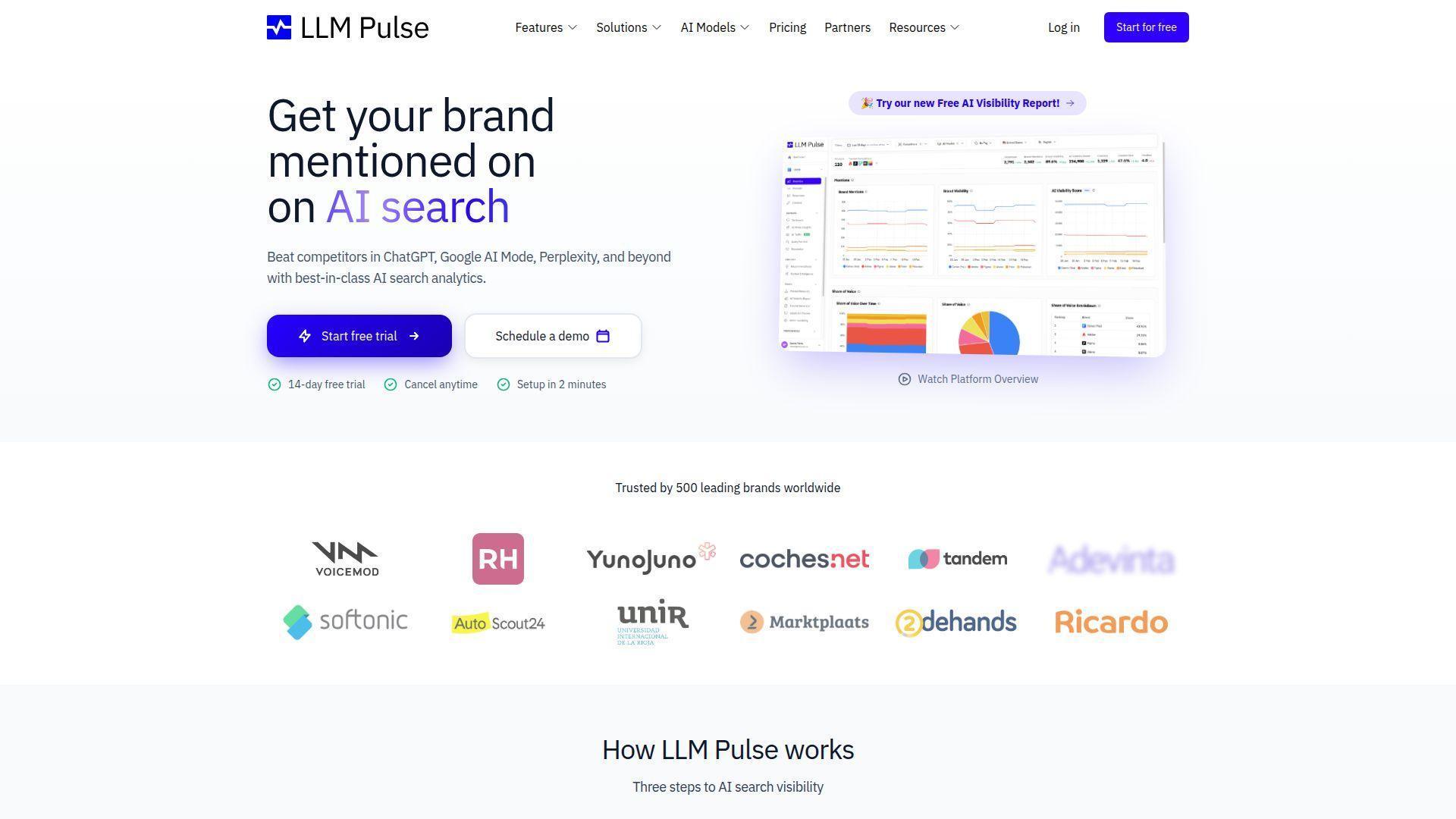
LLM Pulse is the option to pick when you want to stop guessing whether your content is paying off in AI search. Surfer scores your draft against the Google SERP and, on higher tiers, layers on an AI tracker. LLM Pulse builds content briefs from what AI engines are actually citing and then measures whether the page you published moved your AI visibility across five AI engines, with citation tracking and brand sentiment analysis. It handles both ends of the workflow inside the same product, with a dedicated AI visibility focus.
For a content team migrating from Surfer, the workflow is direct. You add your brand and competitors, set up a prompt list (prompt research helps you build it or import your existing keyword and topic library), and the platform runs those prompts at the selected cadence across ChatGPT, Perplexity, Gemini, Google AI Mode, and Google AI Overviews. You see whether you are mentioned, where you rank in the answer, who got cited, what sentiment the model used, and how your share of voice compares to named competitors. GEO Writer turns that data into article briefs and topic recommendations grounded in real AI behavior, not a Content Score against ten blue links.
Key features
- 5 standard AI engines. ChatGPT, Perplexity, Gemini, Google AI Mode, and Google AI Overviews. Paid accounts can add Claude, Copilot, Grok, DeepSeek, Naver AI Briefing, Baidu AI and Meta AI themselves. Alexa for Shopping is available as a self-serve paid add-on. Further models are available through Talk to sales.
- Flexible tracking across five standard models. Each prompt runs across all five standard models at the selected cadence, and results feed the same visibility, citation, and competitor views.
- GEO Writer for AI-grounded briefs. GEO Writer generates publish-ready article briefs from what AI engines are actually citing, not a heuristic Content Score against the live Google SERP.
- Query fan-out and prompt research. Query fan-out shows retrieval subqueries exposed by supported AI responses. Prompt research helps build prompt lists with AI suggestions.
- Citation tracking. Every AI response captures cited sources, so you see exactly which URLs each engine is leaning on.
- Brand sentiment. Sentiment scoring at the response level, per model, per locale.
- Share of voice and competitor tracking. Share of voice against named competitors, not a generic industry number.
- Models comparison. Compare how different engines answer the same prompt side by side.
- Unlimited team members. Surfer caps included seats by plan.
- White-label and embed, agencies-ready. Custom-domain white-label portals with your branding, plus embeddable iframe dashboards you can drop into your own app, available through an agency or enterprise arrangement.
- API, MCP, and Looker Studio. REST API, CLI, webhooks, MCP integration, and a Looker Studio connector with a ready-made template. Google Search Console, GA4, Plausible, Piano, PostHog, Adobe Analytics, and app store integrations available.
Watch-outs
LLM Pulse is an AI search and GEO platform first, with GEO Writer as a layer on top. If your only need is optimizing pages to rank on Google with a live SERP Content Score, a dedicated content optimization tool like Surfer or Clearscope will feel more focused. We also do not pretend to be a full classical SEO platform with keyword rank tracking, backlink analysis, and technical site audits. For those, pair LLM Pulse with a classic SEO stack. If you are buying mainly for the AI surface, you do not need another platform alongside it.
Pricing
Self-serve plans start at €49 a month on Starter (50 prompts across the five standard models), €99 on Growth (150 prompts), €299 on Scale (450 prompts), plus higher-volume Scale+ (€599, 1,200 prompts) and Scale++ (€1,199, 2,400 prompts). Enterprise is custom. See pricing for the full breakdown.
2. Frase
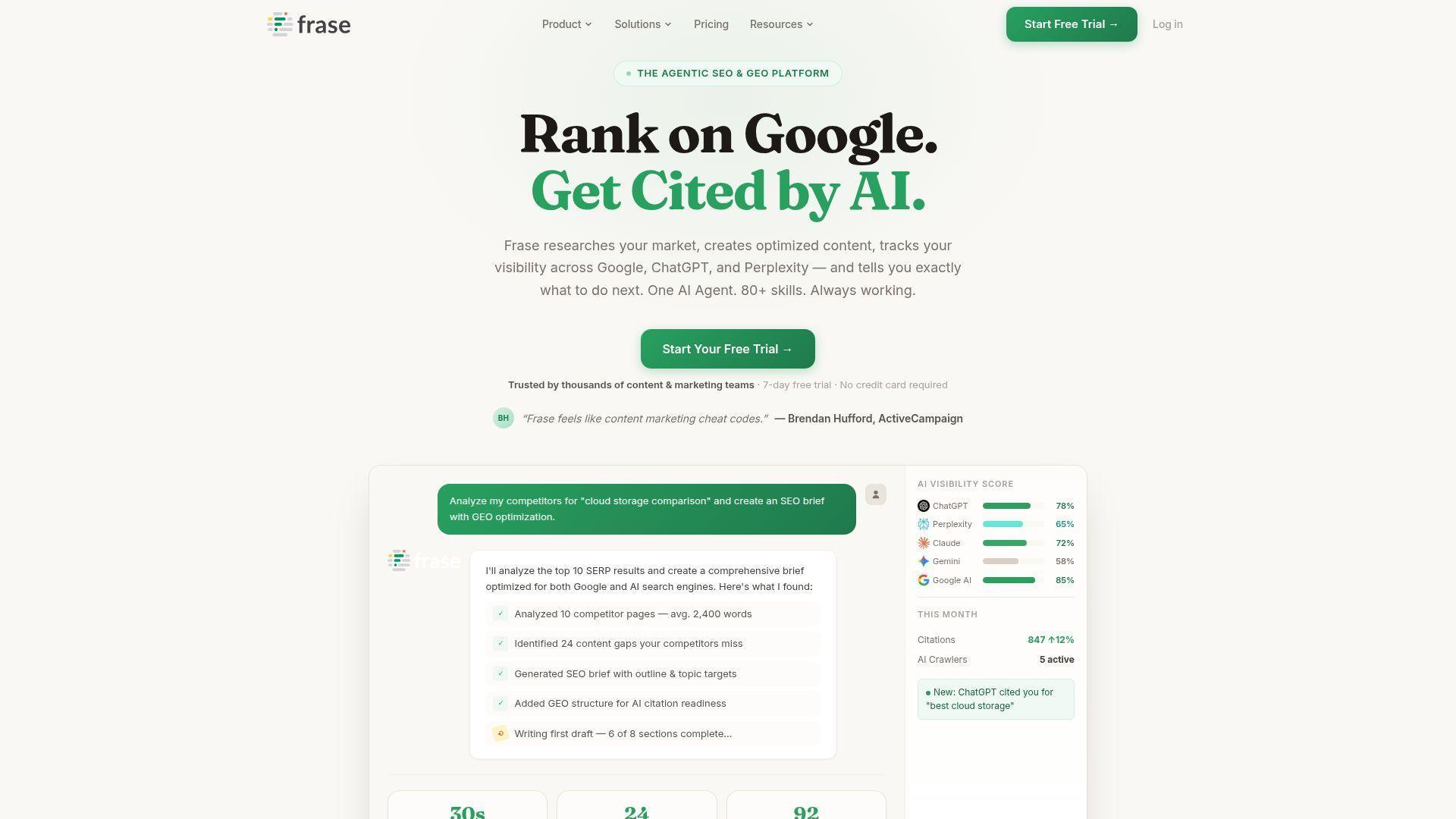
Frase is the most direct content optimization alternative to Surfer on price. Where Surfer leans on live SERP analysis and a polished editor, Frase is built around fast brief generation and FAQ extraction, with SEO and GEO scoring that nudges writers toward AI-friendly structure. It is cheaper at entry and added an AI tracker module of its own.
Key features
- Fast content brief and outline generation from SERP data.
- FAQ extraction and answer-focused content structuring.
- SEO and GEO dual scoring for drafts.
- AI tracker module on higher tiers covering a handful of engines.
Watch-outs
Frase’s tracker is tier-gated (2 engines on Starter, scaling up by plan) and lighter than purpose-built visibility tools. Article allowances cap per tier (10/40/100), so high-volume publishers hit the ceiling. It is a brief generator first, not a measurement platform.
Pricing
Starter $49/mo (10 articles, 1 seat), Professional $129/mo (40 articles, 3 seats), Scale $299/mo (100 articles). Annual billing discounts apply.
3. Clearscope
Clearscope is the premium content optimization choice and the closest like-for-like to Surfer on brief quality. Editorial teams that care about getting the brief exactly right tend to love it. The interface is calm, keyword coverage suggestions feel curated, and the optimization experience is best in class.
Key features
- Premium content briefs with keyword, heading, and entity recommendations.
- Tracked Topics for monitoring how content ranks over time.
- Brand visibility tracking layer covering AI surfaces alongside search.
- Unlimited users on every plan.
Watch-outs
Clearscope sits at the high end. Essentials at $129/mo is more than Surfer’s Essential, with 20 tracked topics and 20 drafts. The AI visibility layer is a useful complement but closer to AI signal awareness than a purpose-built tracking platform.
Pricing
Essentials $129/mo (20 tracked topics, 20 drafts), Business $399/mo, Enterprise custom. All plans include unlimited users.
4. MarketMuse
MarketMuse approaches content from a topical authority angle. Instead of optimizing one page against the SERP, it models entire topic clusters and tells you where your site has authority gaps. It is a planning and strategy tool as much as an optimization one.
Key features
- Topic modeling and content cluster planning.
- Briefs grounded in topical authority scoring.
- Content inventory and gap analysis across your whole site.
- Personalized difficulty based on your domain’s existing authority.
Watch-outs
MarketMuse is strategy-led, which is powerful for planning but heavier than a quick draft-scoring tool. It does not measure AI answer visibility, and the most useful tiers get expensive. Teams that just want fast page optimization may find it more than they need.
Pricing
Free tier available, Optimize from $99/mo, with Research and Strategy tiers above. Higher tiers are custom-quoted.
5. NeuronWriter
NeuronWriter is the budget content optimization pick and a near like-for-like swap for Surfer’s core Content Editor job at a fraction of the price. It uses NLP-driven term recommendations, competitor SERP analysis, and a content editor with a clear optimization score.
Key features
- NLP-based content recommendations and scoring against the SERP.
- Competitor analysis and content structure suggestions.
- GSC integration, WordPress and Shopify publishing on higher tiers.
- Generous AI credit allowances even on low tiers.
Watch-outs
The interface is more utilitarian than Surfer or Clearscope. NeuronWriter now includes a small standard AI monitoring allowance on each plan, with broader model coverage available through an advanced add-on. Its core remains content optimization, but it is no longer content-only. If cost is the main reason you are leaving Surfer, it is still hard to beat on value.
Pricing
Free tier, Bronze $23/mo (2 projects, 25 analyses), Silver $45/mo (5 projects, 50 analyses), Gold $69/mo (GSC and CMS integrations), up to Diamond $117/mo. 17% off annual.
6. Scalenut
Scalenut bundles AI writing with SEO content optimization in one workflow. Its Cruise Mode generates a full first draft from a keyword, then the content optimizer scores it against the SERP. For teams that want generation and optimization in the same tool, it is a tidy package.
Key features
- Cruise Mode for end-to-end AI article drafting.
- SEO content optimizer with real-time scoring.
- Keyword planner and content clustering.
- AI writing templates and a built-in editor.
Watch-outs
Scalenut is generation-first, so the optimization depth is a notch below dedicated tools like Clearscope. There is no AI answer visibility tracking, and, as with most AI writers, the output still needs a human editing pass.
Pricing
Starter $59/mo, Plus $89/mo, Pro $199/mo on monthly billing, with cheaper annual rates. A 7-day trial is available.
7. SE Ranking
SE Ranking is the pick if you want a full classical SEO suite (rank tracking, backlinks, site audit, keyword research) and are willing to treat AI as an add-on. It is the broadest traditional toolset in this list, and it bolts AI search tracking and content marketing on as separate modules.
Key features
- Full classic SEO suite: rank tracking, backlinks, technical audit.
- AI Search add-on tracking AI answer visibility across a few engines.
- Content Marketing add-on for briefs and content optimization.
- Agency features and white-label reporting.
Watch-outs
The headline SEO price does not include the AI Search add-on, which starts at $89 per month for 200 checks. The standalone SE Visible product starts at $99 per month for 200 prompts. Worth shortlisting if classical SEO is non-negotiable.
Pricing
Core starts at $129/mo on monthly billing and Growth at $279. The AI Search add-on starts at $89/mo; SE Visible starts at $99/mo.
Other alternatives worth considering
A few more tools come up in Surfer replacement conversations. On the content optimization side: Page Optimizer Pro (granular on-page scoring favored by technical SEOs), Outranking (AI writing plus SERP-driven optimization and content workflows), and GrowthBar (lightweight, blogger-friendly optimization with keyword tools). On the AI visibility side, teams that have decided they only want tracking and not content tooling often shortlist Profound (free Trial, with ongoing brand tracking sold through custom Enterprise pricing), and Otterly (entry-level AI visibility tracking). If you want both content and tracking in one tool, that is the gap LLM Pulse fills.
Head-to-head: LLM Pulse vs Surfer SEO
The clearest way to think about Surfer versus LLM Pulse is to remember that they were built for different jobs. Surfer optimizes pages to rank on Google. LLM Pulse measures and improves how you show up in AI answers. For many teams the right answer is LLM Pulse alone, or LLM Pulse plus a classic SEO suite. Here is the breakdown.
| Dimension | Surfer SEO | LLM Pulse |
|---|---|---|
| Primary job | Optimize pages to rank on Google | Measure AI visibility and inform content with real signal |
| Content optimization | Yes, mature Content Editor | Yes, via GEO Writer + query fan-out |
| Real AI engine querying | AI visibility tracking from Standard | Yes, recurring across 5 standard engines |
| Engines on entry plan | Five AI surfaces from Standard | 5 |
| Sentiment per response | Yes, brand sentiment | Yes, per model, per locale |
| Citation tracking | Yes, source and citation analysis | Yes, every response |
| Competitor share of voice | SERP competitors | Yes, against named competitors in AI answers |
| White-label | Limited | Yes, custom-domain portals and iframe embed |
| Seats | Plan-dependent collaboration and brand workspace limits | Unlimited |
| Entry price | $99/mo annually billed (25 prompts weekly on ChatGPT) | €49/mo (50 prompts) |
| Looker Studio | No native connector | Yes, with ready-made template |
| API / MCP | API yes | REST API + MCP integration |
If your bottleneck is shipping pages that rank on Google, Surfer remains a strong tool. If your bottleneck is knowing whether that content is showing up and being recommended in real AI answers, you have outgrown a SERP-only optimizer. LLM Pulse is the tool to add, or for most mid-market teams, the one to lead with.
Cost savings analysis: optimizing for Google vs measuring AI visibility
The right comparison is not “what does Surfer cost vs LLM Pulse cost” in isolation. It is “what does it cost to optimize content and measure real AI visibility”. Here is what teams actually pay across realistic configurations.
| Configuration | Monthly cost | What you get | What you miss |
|---|---|---|---|
| Surfer Standard alone | $99 | 360 documents, Content Editor, SERP scoring, and 25 AI prompts refreshed weekly | Weekly ChatGPT tracking on Standard |
| Surfer Pro alone | $182 | 360 documents, 50 AI prompts refreshed daily, and 5 brand workspaces | Light AI tracking, Google-first, seat caps |
| Surfer Pro plus a separate AI tracker | $182 + $189 = $371 | SERP optimization + multi-engine AI tracking | Two tools, two logins, no unified dashboard |
| LLM Pulse Starter | €49 | 50 prompts across five standard models and unlimited seats | Lower prompt volume (50) than power users need |
| LLM Pulse Growth | €99 | 150 prompts across five standard models and unlimited seats | For ultra-high prompt volumes you may want Scale |
| LLM Pulse Scale | €299 | 450 prompts and agency-ready analytics | None for most mid-market and agency cases |
The configuration that closes the loop on AI search matters more than the headline price. Surfer tells you how to optimize the page for Google. LLM Pulse tells you whether the page you published is now showing up in ChatGPT, Perplexity, and Gemini. LLM Pulse provides five-engine measurement, sentiment, citations, share of voice, GEO Writer briefs, and unlimited seats. Its self-serve plans start at €49 per month; check current pricing for access details. Surfer Standard is $99 per month on annual billing and combines content optimization with a smaller weekly AI prompt allowance. For agencies, LLM Pulse supports multi-project reporting, while white-label is available through an agency or enterprise arrangement.
Switching from Surfer SEO to LLM Pulse
The two products live at different layers of the workflow, so you can run them in parallel during a transition month with no break in content production.
Step 1: Export your Surfer keyword and topic library. Pull your existing target keywords and content topics into a CSV. LLM Pulse imports prompt lists in bulk, so the work transfers directly.
Step 2: Set up brand, competitors, and locales in LLM Pulse. Add named competitors so share-of-voice reporting works from day one, and add the locales you sell in so sentiment and visibility break down by market.
Step 3: Import the prompt list and let it run. Each prompt runs across ChatGPT, Perplexity, Gemini, Google AI Mode, and Google AI Overviews at the selected cadence. Prompt Research helps you fill gaps if your existing library is thin.
Step 4: Switch from Surfer Content Scores to GEO Writer briefs. Instead of optimizing against the live Google SERP, GEO Writer builds publish-ready briefs from what AI engines are actually citing for your target prompts.
Step 5: Connect Looker Studio and web analytics. The ready-made Looker Studio template gives you a dashboard out of the box, and GA4, Plausible, and Piano integrations connect AI visibility data to traffic outcomes.
Step 6: Run both tools for a month if you are nervous. Keep Surfer for pages already mid-production, use LLM Pulse for new briefs and all AI tracking. After 4 weeks the data tells you whether to renew Surfer.
Summary and final recommendation
Surfer SEO made content optimization for Google fast and measurable, and it is still good at that job. But the job changed. In 2026 the question is not only “will this page rank on Google” but “is my content showing up and being recommended in ChatGPT, Perplexity, Gemini, and Google’s AI surfaces”. Surfer’s AI Tracker is a start, yet it is tier-gated and bolted onto a SERP-first tool. LLM Pulse is built for the AI surface from the ground up and still gives you content briefs grounded in real AI behavior.
For most mid-market teams, the clean recommendation is LLM Pulse: 5-engine tracking, sentiment, citations, share of voice, GEO Writer, unlimited seats, REST API access, and a Looker Studio connector. Plans start at €49 per month, with 450 prompts available at €299. If classical SEO depth is non-negotiable, keep a traditional suite and add LLM Pulse for the AI layer. Generate your free AI visibility report first to see how your brand looks across the major engines before you decide.
FAQ
Is Surfer SEO still worth it in 2026?
Yes for what it does: optimizing pages to rank on Google with a mature Content Editor and SERP Analyzer. Teams move on when they realize a high Content Score does not tell them whether they appear in AI answers. Surfer’s AI Tracker helps but is tier-gated and lighter than purpose-built AI visibility platforms.
What is the best Surfer SEO alternative for AI visibility?
LLM Pulse. It tracks your brand across ChatGPT, Perplexity, Gemini, Google AI Mode, and Google AI Overviews, and GEO Writer turns that data into content briefs. Surfer optimizes for Google rankings; LLM Pulse measures and improves AI answer visibility.
Which Surfer SEO alternative is cheapest?
For pure content optimization, NeuronWriter Bronze at $23/mo is the entry. LLM Pulse combines AI visibility tracking with content tools. Its self-serve plans start at €49 with 50 prompts across 5 standard engines, while citations, GEO Writer, and brand sentiment analysis are also available. Check current pricing for access details.
Does LLM Pulse replace Surfer SEO or sit next to it?
For most teams it replaces it. GEO Writer handles content briefs using real AI-engine signal, and the rest of LLM Pulse covers the AI measurement Surfer cannot. Teams that need a live Google-SERP Content Score for high-volume traditional SEO sometimes keep a content optimizer alongside, but they are the exception.
What is the best Surfer SEO alternative for agencies?
LLM Pulse covers the agency stack: unlimited seats, multi-project management, CSV and Excel exports, REST API access, and a Looker Studio connector with a ready-made template. Plans start at €49 per month, while white-label is available through an agency or enterprise arrangement. SE Ranking is the alternative if you want classical SEO depth alongside, accepting AI as an add-on.
Does Surfer SEO track ChatGPT and other AI answers?
Surfer tracks ChatGPT, Perplexity, Gemini, Google AI Mode, and Google AI Overviews from Standard, with source analysis and brand sentiment. LLM Pulse is a dedicated alternative with five standard engines, citations, and brand sentiment.
How long until I see results after switching?
Measurement is immediate: within the first week you have a baseline across the 5 engines for every prompt. Content-side results take longer. Most teams see meaningful AI visibility shifts 4 to 12 weeks after they start publishing against GEO Writer briefs, the same horizon as classic SEO content gains.