



Last updated: August 10, 2026
AI search answers are not static. The model that recommends your brand today can cite a completely different set of sources next week, quietly reshaping who gets discovered. SEOs spent years watching tools like Mozcast and Algoroo to know when Google’s algorithm moved. Until now, AI search had no equivalent. That gap is exactly what Tremor fills.
Table of Contents
What is Tremor by LLM Pulse?
Tremor is a weekly seismograph for AI search. Every Tuesday it compares the most recent complete week to the one before it and scores how much each AI model shifted, on a single magnitude from 0 (calm) to 10 (major upheaval). One headline reading summarizes the whole market, and each model also gets its own score so you can see where the movement is concentrated.
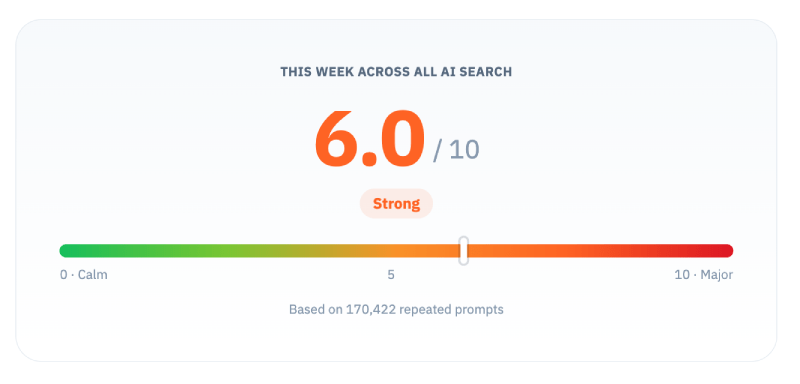
To give a sense of scale, a recent reading came in at 6.0 out of 10 across all AI search, based on more than 170,000 repeated prompts, which lands in “strong” territory. Some weeks are calm, others are stormy, and the point of Tremor is to tell the difference at a glance.
How we measure the AI search volatility
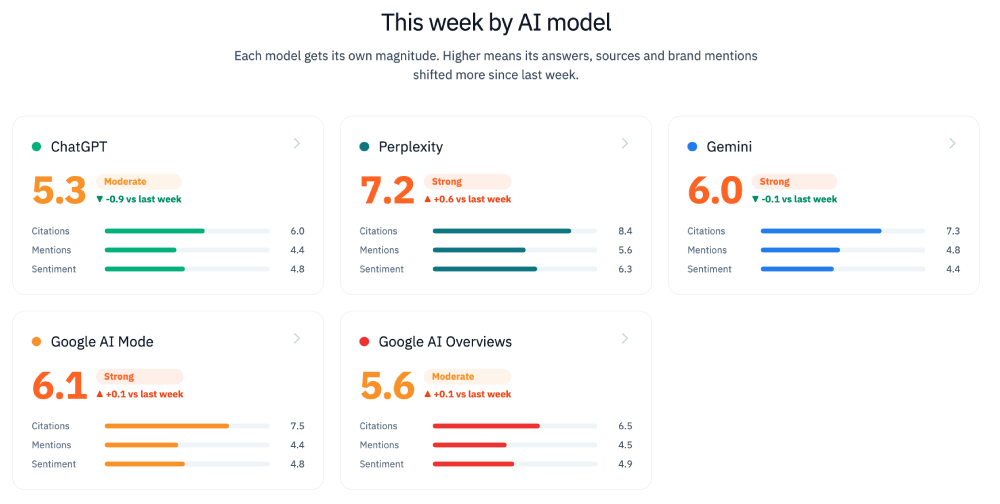
Tremor takes the prompts that ran in both the current and the previous week, and for each AI model it measures how much three things moved.
- Citation churn compares the set of domains a model cited this week versus last week, using Jaccard distance. This is the strongest signal, the AI-search equivalent of “the results just changed,” and it carries the most weight in the final score.
- Mention churn tracks how often brands appeared, disappeared or moved position in answers from one week to the next.
- Sentiment variation captures how much the tone toward brands shifted over the same period.
Each signal is calibrated to a 0 to 10 scale and blended, with citations weighted most heavily, into the headline magnitude. The “all” reading is the average of the per-model scores. Everything is built on the LLM Pulse dataset across ChatGPT, Perplexity, Gemini, Google AI Mode and AI Overviews. If you want the broader context on what to measure, see our guide to the GEO metrics that actually matter.
Reading the scale
The magnitude maps to five plain-language bands, so a number always has meaning:
| Band | Magnitude | What it means |
|---|---|---|
| Calm | 0 to 2 | Answers barely moved week over week |
| Minor | 2 to 4 | Small shifts, business as usual |
| Moderate | 4 to 6 | Noticeable reshuffling worth watching |
| Strong | 6 to 8 | Significant change in citations and recommendations |
| Major | 8+ | An unusually large change relative to that model’s recent baseline |
Why it matters
A spike in Tremor means an AI model just reshuffled who it cites and recommends. That is a leading indicator that your own AI visibility may have moved, for better or worse, often before you would notice it in your traffic. Catching the wave early is the difference between reacting and being caught off guard.
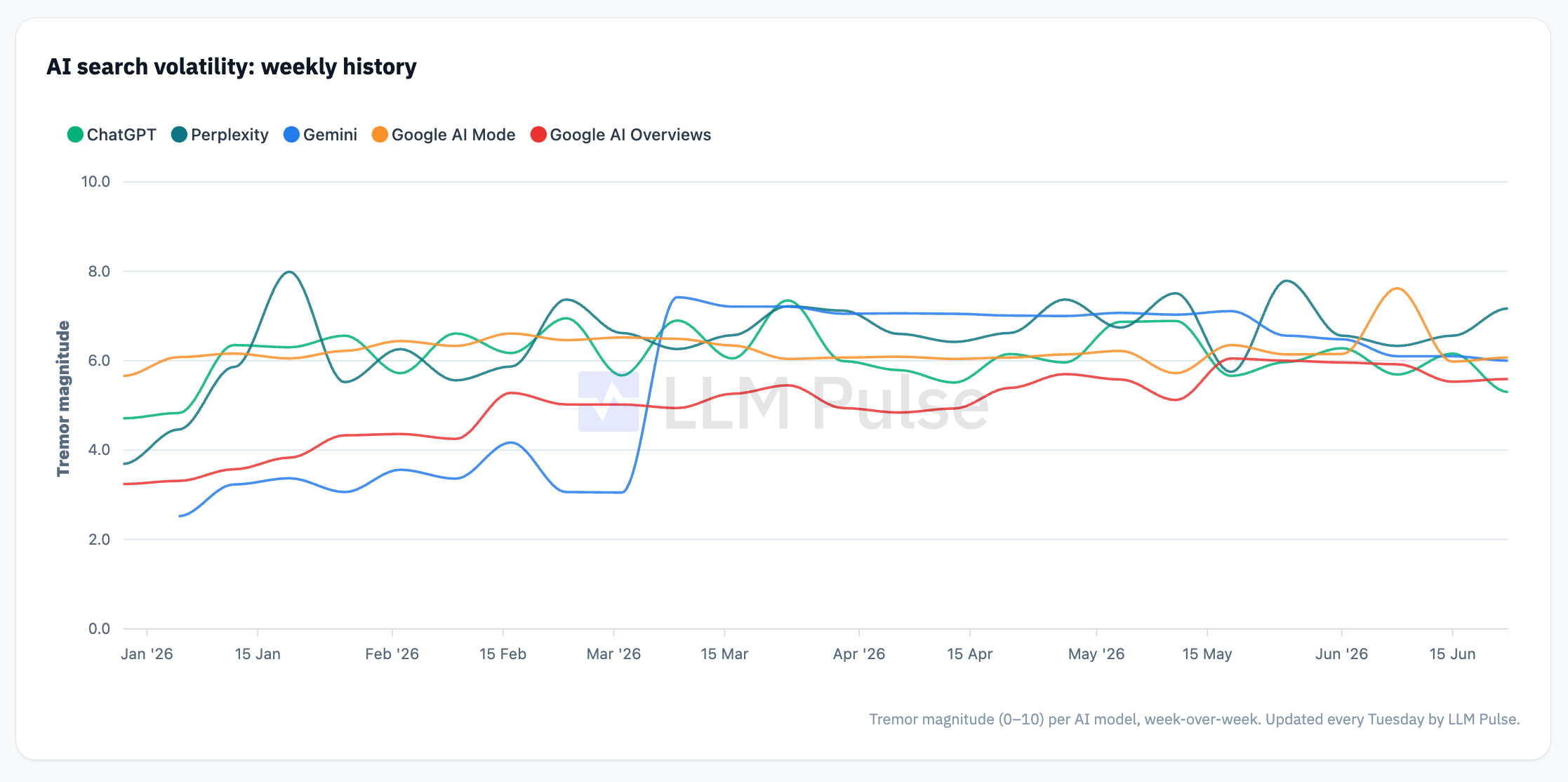
Because Tremor scores each model separately, it also tells you where to look first. A quiet week on ChatGPT but a storm on Google AI Mode means your AI search risk is concentrated in one place, and you can focus your attention there instead of guessing. If the storm is hitting one engine, our playbooks on improving brand visibility in ChatGPT and the Google AI Overviews checker tools are good next reads.
Free to read, built on LLM Pulse
Tremor is free and public, updated every week, with the per-model history charted over time. It is the market-wide view: how the whole AI search market is moving. The natural next step is to turn that signal on your own brand. With LLM Pulse you can track citations, brand mentions, sentiment and share of voice across every major AI model, the same data that powers Tremor, applied to you and your competitors. You can also keep an eye on individual engines with dedicated tools like our Perplexity rank trackers roundup.
See this week’s Tremor reading, then choose an LLM Pulse plan to see how AI search is shifting for your brand specifically.
FAQ
What is Tremor?
Tremor is a free weekly tracker that measures how volatile AI search is. Each Tuesday it scores how much every major AI model changed its answers compared to the previous week, on a single magnitude from 0 to 10, so you can tell a calm week from a turbulent one at a glance. Think of it as a seismograph for ChatGPT, Perplexity, Gemini and Google AI.
What does a high Tremor magnitude mean?
A high score means a model significantly reshuffled the sources it cites and the brands it mentions from one week to the next. In practice it is an early warning that AI visibility in your space is in flux, and that your own mentions and citations may have moved, for better or worse, before it shows up anywhere else.
How often is Tremor updated?
Every Tuesday. Each update compares the latest complete week against the one before it, using only the prompts that ran in both weeks, so the reading reflects a clean week-over-week change rather than a noisy partial sample.
Which signals go into the score?
Three signals. Citation churn measures how much the set of cited domains changed and carries the most weight, mention churn tracks how brands appeared, disappeared or moved position in answers, and sentiment variation captures how the tone toward brands shifted. Each is calibrated to a 0 to 10 scale and blended into the single headline magnitude.
Where does the data come from?
From the LLM Pulse dataset, built on a large set of prompts repeated week after week across ChatGPT, Perplexity, Gemini, Google AI Mode and AI Overviews. Because the same prompts are re-run each week, the comparison is consistent rather than apples to oranges.
Does Tremor track my specific brand?
Not on its own. Tremor is the market-wide view of how AI search is moving as a whole. To see volatility, citations, mentions, sentiment and share of voice for your own brand and competitors, you track them directly in LLM Pulse, which is the same dataset Tremor is built on.