



Last updated: October 5, 2026
Walk into a sales call in 2026 and the buyer has already done the research. Not on Google. In ChatGPT, in Perplexity, in Google’s AI Mode. They typed “best B2B CRM under 50 seats” or “ClickUp vs Asana for product teams” and a generative answer named three or four tools, summarised the trade-offs, and built the shortlist for them.
Table of Contents
If your SaaS is not in that answer, you are not in the deal. This guide covers the nine AI visibility tools we recommend for SaaS companies in 2026, what to look for when category prompts matter more than brand searches, and how to wire AI visibility into HubSpot or Salesforce so your CRO stops asking why the marketing dashboard does not match the new logos.
Why SaaS buyers depend on AI search differently from consumers
Consumer search in ChatGPT looks like “best running shoes for flat feet” or “summer dress ideas”. One prompt, one answer, one purchase decision a few days later. SaaS buying does not behave that way.
A B2B SaaS purchase typically involves three to six stakeholders, a sales cycle of 45 to 120 days, and dozens of comparison searches across the journey. The IT lead asks “is this SOC 2 compliant?” The end user asks “is the UI better than Notion?” The CFO asks “what is the total cost of ownership for a 200-seat ClickUp deployment?” Each of those queries now happens in an AI assistant before, during, and after the demo.
That changes what you have to measure. Tracking your brand mention rate in ChatGPT is necessary but not sufficient. You need to know whether you appear when the buyer searches by category (“best CRM for B2B teams”), by use case (“software for managing remote engineering teams”), by competitor comparison (“ClickUp vs Asana”), and by integration (“project management tool that works with HubSpot”). Each of those prompt types feeds a different stage of the funnel, and each produces a different visibility score.
The other shift is multi-stakeholder repetition. A single deal can generate twenty or thirty AI search interactions across stakeholders. If your product wins three of those and loses twenty-seven, the deal stalls and nobody knows why. A proper AI visibility tool gives you that breakdown by prompt cluster, not just an aggregate score.
Top AI queries that drive SaaS pipeline
To make this concrete, here are the prompt patterns we see SaaS buyers run most often in AI assistants. If your visibility tool cannot show you results across all of these, you are flying blind on most of your pipeline.
- Best-in-category: “best CRM for B2B SaaS”, “best project management tool for startups under 50 people”.
- Use case: “software for tracking customer onboarding”, “platform for managing remote engineering teams”.
- Competitor head-to-head: “ClickUp vs Asana”, “HubSpot vs Salesforce for series B startups”.
- Alternatives: “alternatives to Notion for technical docs”, “free alternatives to Calendly with team scheduling”.
- Integration: “CRM that integrates with Stripe and HubSpot”, “BI tool that connects to Snowflake and Salesforce”.
- Pricing and ROI: “is Gong worth the price for a 30-person sales team”, “total cost of Mixpanel vs Amplitude at 10 million events”.
- Implementation: “how long does it take to migrate from Pipedrive to HubSpot”, “Snowflake setup time for mid-market data teams”.
- Security and compliance: “SOC 2 compliant project management tools”, “HIPAA-ready CRMs for healthcare SaaS”.
- Industry-specific: “best billing platform for fintech”, “marketing automation for B2B logistics SaaS”.
- Job-to-be-done: “tool to automate lead routing”, “software to consolidate customer feedback from email and Slack”.
A SaaS visibility programme should track 50 to 150 prompts across those patterns, segment results by AI model, and run weekly so you can connect mention shifts to content updates, launches, or competitor moves.
What to look for in an AI visibility tool for SaaS
Most AI visibility tools were built for ecommerce or consumer brands. They optimise for brand mention rate and sentiment. Useful, but not enough for SaaS. When you evaluate a tool, weight these criteria heavily.
Category and feature prompt tracking: the tool must let you run prompts that do not contain your brand name. “Best CRM for B2B teams” is the prompt that matters. The tool should show whether your brand appears in the answer, at what position, and which competitors are mentioned alongside.
Competitor benchmarking: weekly share-of-voice across a defined competitor set, with breakdown by prompt cluster. If you are number one on “best CRM” but number five on “HubSpot vs your-brand”, you have a positioning problem that aggregate scores hide.
Multi-language coverage: SaaS deals come from English-speaking markets first, but enterprise expansion almost always pulls in German, French, Spanish, Portuguese, or Japanese queries. The tool must support tracking the same prompt across locales, not just translate the UI.
Sentiment per product line: a mature SaaS often has three or four product lines (core platform, mobile app, analytics module, enterprise add-on). You want sentiment broken down per product, not pooled. Otherwise a great mobile launch can be hidden by complaints about the analytics module.
CRM and revenue integration: AI visibility data is only valuable to RevOps if it can sit next to HubSpot or Salesforce data. Look for native integrations, a real API, MCP support, and a Looker Studio or similar BI connector so you can join visibility trends to pipeline.
Citation tracking: when AI answers cite a source, you want to know which domain won the citation. For SaaS, this often surfaces G2 listings, Reddit threads, or independent reviews that you can then influence.
Multi-model coverage: ChatGPT, Perplexity, Gemini, Google AI Mode, and Google AI Overviews behave very differently. A tool that only tracks one or two of those is a partial picture, especially for SaaS where Perplexity skews technical and Google AI Mode skews high-intent commercial.
Comparison table
| Tool | Best for | Starting price | Models tracked | SaaS-relevant strength |
|---|---|---|---|---|
| LLM Pulse | SaaS of any size | €49/mo | 5 standard models | Category prompts, GA4/Plausible integration, MCP, and REST API |
| Profound | Enterprise SaaS | From $99/mo, billed yearly | Multiple | SOC 2, deep analytics |
| AthenaHQ | Mid-market SaaS | From $295/mo | 9 listed on Starter | SaaS-focused dashboards |
| Scrunch AI | SaaS CX teams | From $250/mo | 9 | Customer experience angle |
| Otterly | Early-stage SaaS | ~$29/mo | 4 | Simple setup, low cost |
| SE Ranking | SaaS on SE Ranking SEO | Add-on (~$89/mo) | 6 | Bundled with SEO suite |
| Trakkr | SaaS with review content | $100/mo | 8 | Reviews and comparison angle |
| Semrush | SaaS on Semrush | Add-on | Limited | Sits inside Semrush dashboard |
1. LLM Pulse: best for SaaS
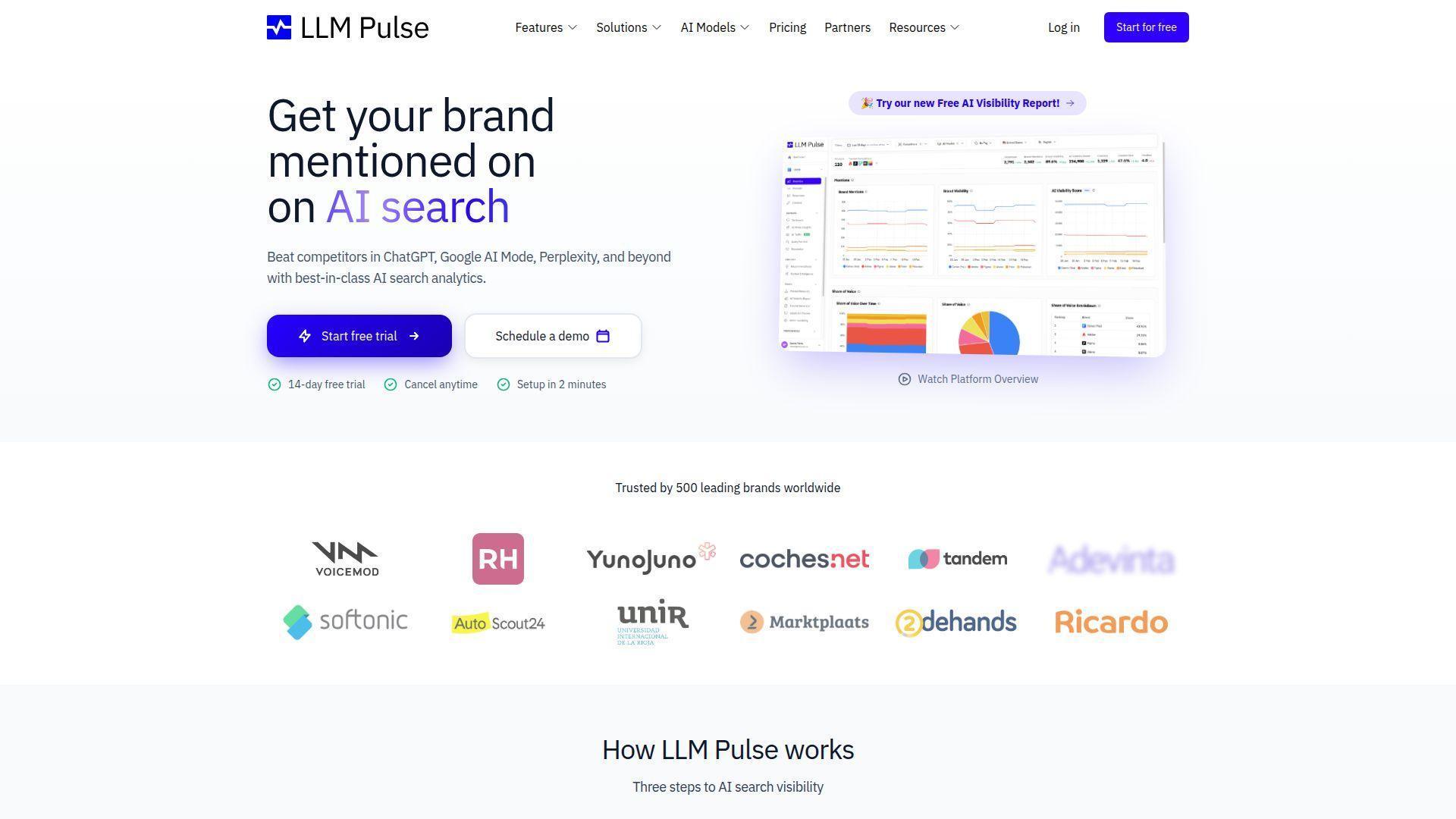
LLM Pulse is the AI visibility platform we recommend for SaaS companies across the spectrum, from seed-stage startups tracking 50 category prompts to publicly listed SaaS with thousands of monitored queries. It is an all-in-one AI search platform covering tracking, analysis, optimization, and AI traffic analytics, a scope that maps cleanly onto how growth, product marketing, and RevOps teams already split the work.
The reason it earns the top spot for SaaS specifically is that it does not assume your brand is the only thing worth tracking. Every prompt runs across five AI models at the selected cadence, with results broken down by model, prompt, competitor, citation source, and position, and sentiment analysis layered on top.
For SaaS marketing and RevOps teams, four capabilities matter most. The web analytics integration supports several analytics providers. OAuth MCP is available. The REST API and Looker Studio connector can feed external CRM or BI workflows, though LLM Pulse does not advertise a native HubSpot or Salesforce connector.
SaaS-specific extras that punch above the price: brand sentiment broken out per product line, citation source analysis that shows which Reddit threads or G2 listings AI assistants cite when answering your category queries, prompt research tools that surface the actual queries buyers run in your space, and query fan-out visibility for Google AI Mode (which matters disproportionately for high-intent SaaS searches).
Key features
- 5 standard AI models tracked weekly (ChatGPT, Perplexity, Gemini, Google AI Mode, Google AI Overviews), with Claude, Copilot, Grok, DeepSeek, Naver AI Briefing, Baidu AI and Meta AI available as self-serve paid add-ons. Alexa for Shopping is available as a self-serve paid add-on. Further models are available through Talk to sales.
- Category and feature prompt tracking (not just brand prompts) with competitor mention breakdown
- Weekly competitor benchmarking with share-of-voice per prompt cluster
- Multi-language and multi-locale support for global SaaS expansion
- Brand and competitor sentiment analysis, filterable by model, prompt tags, and locale
- Citation source analysis with domain-level breakdown (G2, Reddit, your own blog, competitor blogs)
- Native GA4, Plausible, Piano, PostHog, and Adobe Analytics integration to correlate AI mentions with referral traffic
- REST API and Looker Studio connector for building external HubSpot or Salesforce reporting workflows
- MCP server for Claude, ChatGPT, and Cursor (ask your data in natural language)
- Webhooks plus Zapier, Make, and n8n connectors for custom automations and data warehousing
- Google Search Console integration that feeds your real buyer search queries into prompt generation
- Query fan-out tracking for Google AI Mode (high-intent SaaS searches)
- GEO Writer for AI-ready content briefs based on actual buyer prompts
- Models Comparison view to spot where ChatGPT vs Perplexity diverge on your category
- Chrome Extension (Query Detector) for ad-hoc prompt checking during sales calls
- White-label and embed: branded portals on your own custom domain, plus embeddable iframe dashboards for your app, by separate arrangement
- Agent Analytics to see which AI crawlers hit your site and which pages they fetch, from your own server logs
- Unlimited team members (sales, marketing, product, exec all in)
- CSV and Excel exports for board decks and investor updates
Watch-outs
- Best results come from running 100+ prompts; SaaS with very narrow ICPs may need help curating the initial prompt set
- The MCP and API are powerful but require some technical setup if you want a custom HubSpot or Salesforce sync
- Sentiment analysis runs in batch and can take a few hours to update after a fresh execution; not a real-time view
Pricing
Starter at €49/month for 50 prompts (around €0.98/prompt), Growth at €99/month for 150 prompts (€0.66/prompt), Scale at €299/month for 450 prompts (€0.66/prompt), Scale+ at €599/month for 1,200 prompts, Scale++ at €1,199/month for 2,400 prompts, and Enterprise custom for larger SaaS programmes with bespoke models and SLAs. LLM Pulse includes five standard AI models, unlimited team members, and MCP. See pricing for current details and customer examples.
2. Profound
Key features
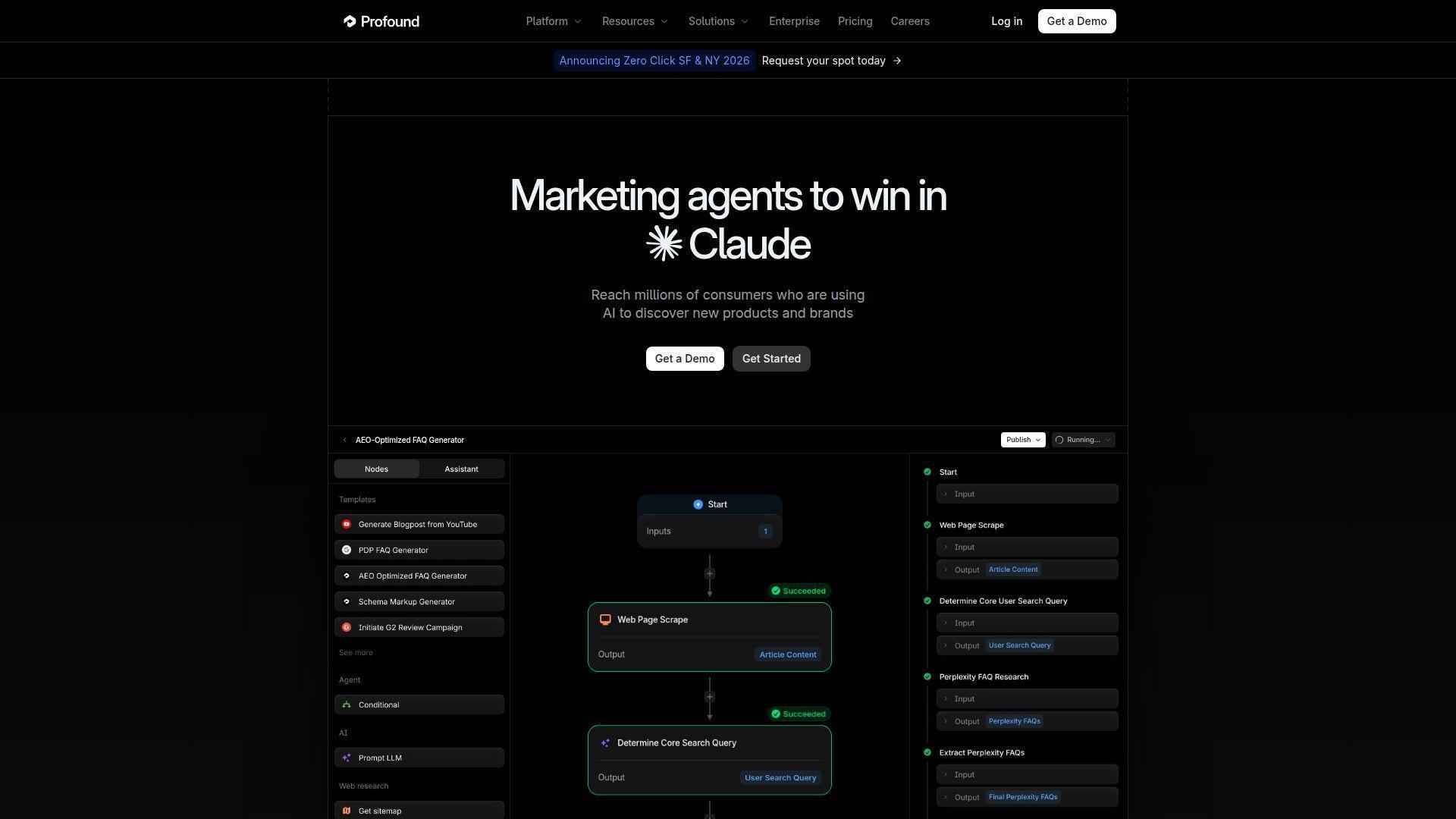
- Enterprise-grade AI visibility platform with deeper analytical drill-downs
- SOC 2 Type II compliance, which matters for SaaS in regulated verticals
- Multi-model tracking with custom prompt sets
- Custom dashboards and account management
- Pitched at enterprise teams with budget for white-glove onboarding
Watch-outs
- Starter is $99/month billed yearly for ChatGPT; Growth is $399/month billed yearly for ChatGPT, Perplexity, and Google AI Overviews; broader coverage requires Enterprise
- Starter is self-serve and Growth has a free trial path; Enterprise remains sales-led
- Overkill for mid-market SaaS that only needs a few hundred prompts tracked
Pricing
Profound now offers a free Trial with 50 unique prompts run daily for seven days across ChatGPT, Gemini, and Google AI Overviews. For brand accounts, ongoing tracking is sold through custom Enterprise packages with tailored prompt limits and up to nine answer engines.
3. AthenaHQ
Key features
- AI visibility platform with a SaaS-tilted positioning
- Tracks brand and category mentions across ChatGPT, Perplexity, and other AI assistants
- Dashboards aimed at marketing leaders rather than analysts
- Competitor benchmarking and trend views
- Onboarding includes prompt suggestion support
Watch-outs
- Newer entrant, so depth of historical data and integration breadth is still growing
- Credit-based pricing ($295/month for 3,600 credits on the self-serve tier) can make monthly spend less predictable than fixed-prompt plans
- API and BI connectors are less developed than the top picks on this list
Pricing
Essential is free with $25 credit and 300 credits. Starter is $295/month with 3,600 credits; Enterprise is custom.
4. Scrunch
Key features
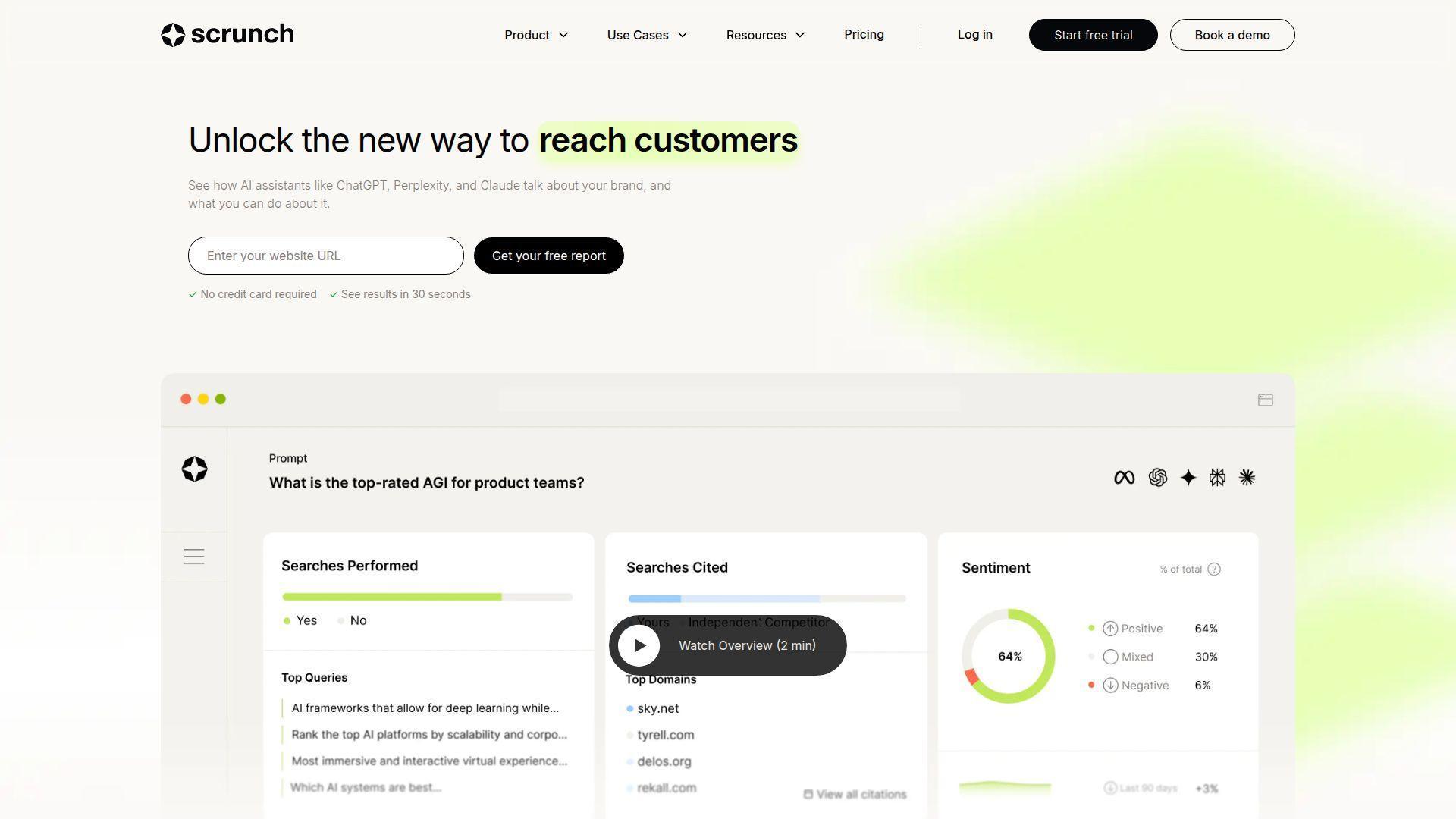
- AI visibility framed through a customer experience lens, useful for SaaS with strong CX or support-led growth
- Tracks how AI assistants describe your product across the buyer journey
- Sentiment and tone analysis on AI-generated answers
- Reports designed for cross-functional CX and marketing teams
- Helpful for SaaS that wants to align messaging across marketing and support
Watch-outs
- Less pure-play SEO/SEM focused; if you want raw mention rate dashboards, others fit better
- Core pricing is public, while Enterprise remains sales-led
- Integration with HubSpot and Salesforce typically goes through API rather than native connectors
Pricing
Core is $250/month for 125 prompts and four LLMs, with a 7-day free trial. Enterprise pricing is custom, with up to nine LLMs and the live Agent Experience Platform.
5. Otterly
Key features
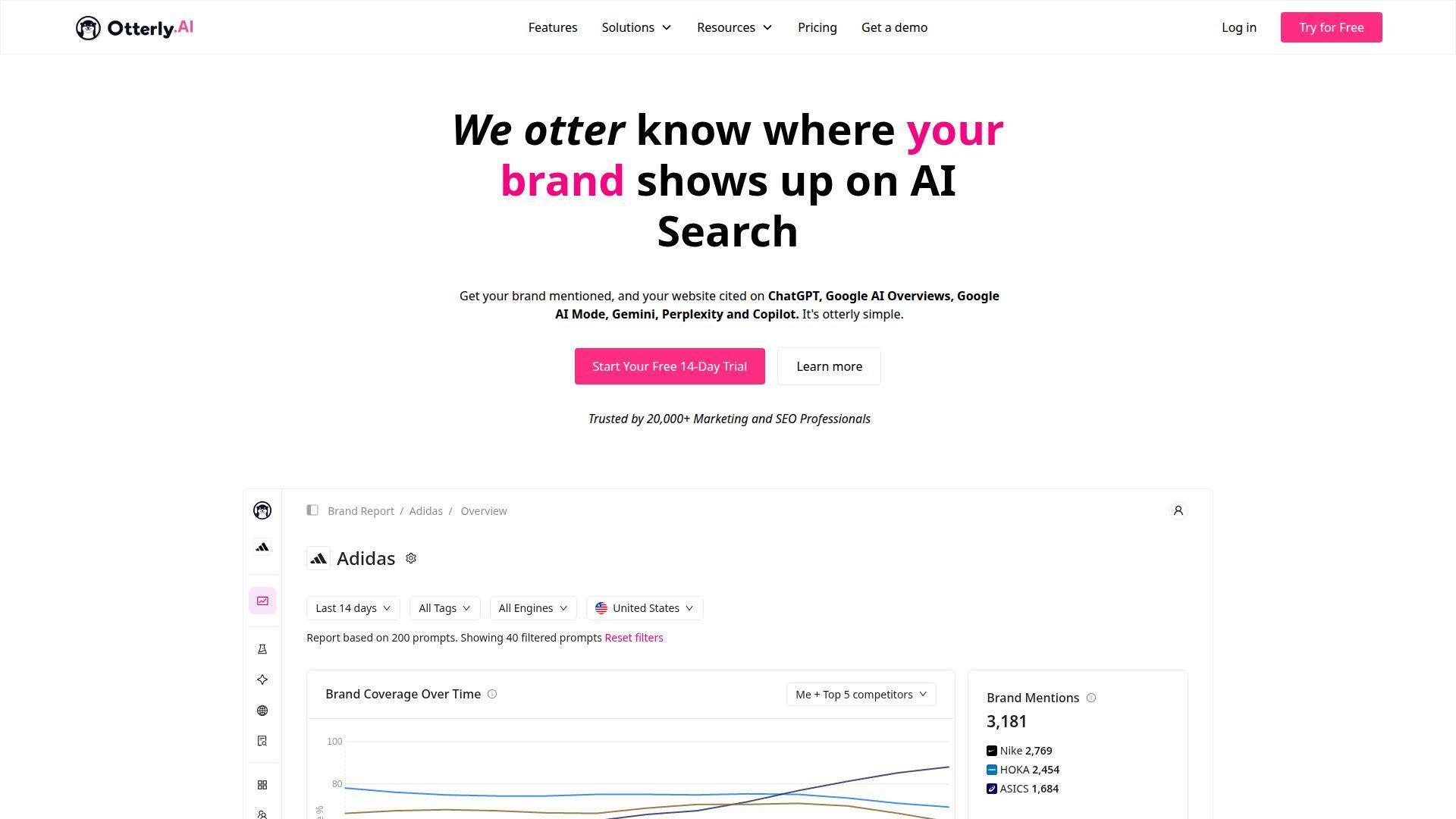
- Entry-level AI visibility tool with a quick setup flow
- Tracks brand mentions and basic category prompts across major AI assistants
- Simple, no-frills dashboard suitable for founders and small marketing teams
- Useful as a first-step tool for seed-stage SaaS validating whether AI visibility matters in their category
- Light on configuration overhead
Watch-outs
- Limited number of AI models tracked compared to the leaders, so coverage is partial
- Competitor benchmarking and citation tracking are basic
- No native CRM connector; Google Looker Studio, API, and MCP are available from Standard
- Will hit a ceiling quickly once your SaaS scales beyond a handful of prompts
Pricing
Starts around $29/month on the entry plan (check provider site). Higher tiers for more prompts and seats.
6. SE Ranking
Key features
- SEO platform that has added AI search tracking as an add-on module
- Useful if your SaaS marketing team already runs SE Ranking for keyword and rank tracking
- Bundles AI tracking inside the existing reports and dashboards
- Includes basic AI mention monitoring for major assistants
- Good for SaaS that wants AI visibility data without adding another vendor
Watch-outs
- Add-on rather than a purpose-built AI visibility platform, so depth is shallower
- Tracks 6 AI platforms (ChatGPT, ChatGPT Search, Perplexity, Google AI Overviews, Google AI Mode, Gemini), which is competitive but the add-on depth is shallower than specialist tools
- If you outgrow it, you will likely need a dedicated tool anyway
- Multi-language and competitor benchmarking are basic
Pricing
SE Ranking Core starts at $129 per month for 100 daily prompts and 10 projects. The AI Search add-on is available at $89, $179, or $345 per month. The standalone SE Visible product starts at $99 for 200 prompts and 3 projects.
7. Trakkr
Key features
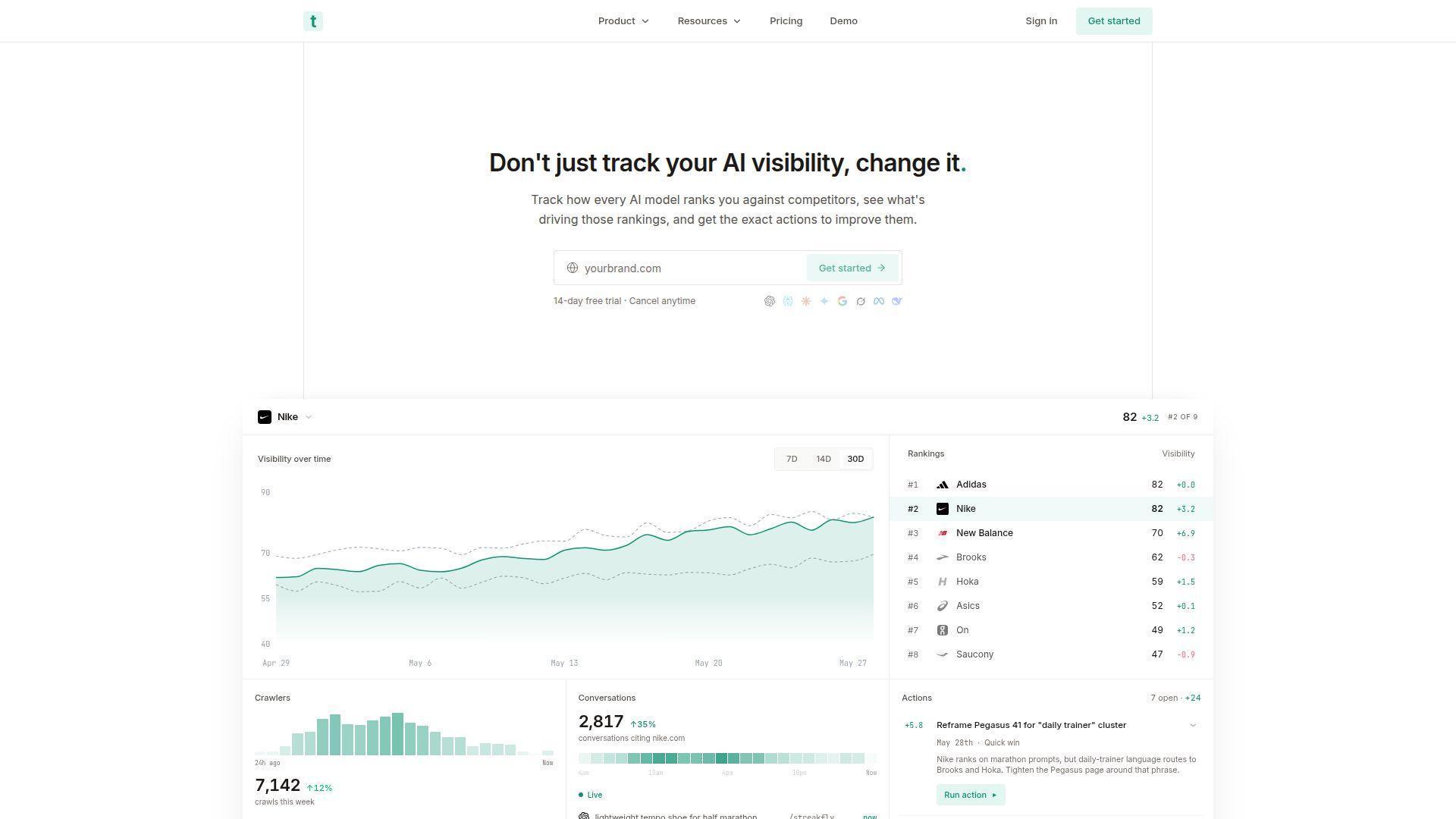
- AI visibility tool with an angle on reviews and comparison content tracking
- Useful for SaaS that invests heavily in G2, Capterra, or Reddit-based content strategies
- Tracks how comparison and review content gets cited in AI answers
- Highlights which third-party domains influence answers in your category
- Helps SaaS that wants to influence answers via review-site SEO and PR
Watch-outs
- Narrower scope than full-stack AI visibility tools; works best as a complement, not a replacement
- Integration with CRMs is limited; expect to pull data via API or export
- Smaller user base means fewer tutorials and community resources
Pricing
Growth is $100/month for one brand and 50 prompts. Scale is $500/month for ten brands and 50 prompts per brand. Both include eight models, and a 14-day trial is available. Enterprise pricing is custom.
8. Semrush
Key features
- The marketing suite many SaaS teams already use for SEO and PPC
- Adds AI visibility features inside the existing Semrush interface, so no new tool to learn
- Useful for SaaS marketing teams that want one dashboard for organic, paid, and AI
- Combines AI tracking with backlink and keyword data
- Strong reporting and exports for agency-style monthly reviews
Watch-outs
- AI tracking is not the core of the product, so depth is more limited than specialists
- Number of AI models tracked and refresh cadence may lag the dedicated AI visibility platforms
- Sentiment and citation tracking are not on par with purpose-built tools
- Pricing can be high once you add AI modules on top of the core Semrush plan
Pricing
Semrush now includes AI visibility in its SEO + AI Search plans. Public pricing starts at $139 monthly or $117.33 per month billed annually, while Starter tracks 50 prompts daily.
How to integrate AI visibility with your SaaS pipeline (HubSpot/Salesforce)
The reason most SaaS marketing teams cannot defend their AI visibility programme to the CFO is that the data lives in a separate dashboard from the pipeline data. Fix that and you can answer questions like “did our mention rate on ‘best CRM’ translate into demos last quarter?” Here is the practical playbook we recommend, using LLM Pulse as the reference because the integrations are well-documented.
Step 1: define your prompt set against your ICP and stage. Group prompts into clusters that map to the buyer journey: awareness (best-in-category), consideration (head-to-head, alternatives), decision (pricing, security, integrations). Aim for 50 to 150 prompts across clusters.
Step 2: connect web analytics first. Use the native GA4 and Plausible integration to overlay AI mentions with referral traffic from ChatGPT (chat.openai.com), Perplexity (perplexity.ai), and Google AI products. This is the cheapest way to validate that visibility shifts cause traffic shifts.
Step 3: push visibility data into HubSpot or Salesforce via the API. The REST API exposes prompt-level metrics. Your RevOps team can build a custom sync if it wants visibility data in CRM objects.
Step 4: build a Looker Studio dashboard that joins pipeline and visibility. The Looker Studio connector with a ready-made template drops AI visibility data into the BI tool most SaaS RevOps teams already use. Join it with the HubSpot or Salesforce connector and you have one view of mentions, traffic, MQLs, and closed-won.
Step 5: use MCP for ad-hoc questions. The MCP integration lets your team query the data directly from Claude, ChatGPT, or Cursor. During a marketing standup, anyone can ask “which competitors gained share on the CRM prompts last week?” and get an answer without opening a dashboard. For RevOps, this collapses the time from question to insight.
Step 6: review weekly, report monthly. Weekly stand-ups should look at mention rate shifts by prompt cluster and competitor moves. Monthly board updates should connect AI visibility trends to pipeline and ARR. The reason to wire CRM and BI integration in early is that this monthly report writes itself once the data flows.
Summary
For SaaS in 2026, AI search is no longer an experimental channel. It is where the buyer shortlist gets built, often before your SDRs ever get a conversation. The right AI visibility tool tracks category prompts (not just brand), benchmarks competitors, supports the languages your buyers actually use, ties sentiment to product lines, and integrates with the CRM and BI stack your RevOps team already runs.
LLM Pulse leads our recommendation because it covers all of that at a price point that lets a seed-stage SaaS start tracking 50 category prompts for €49/month and scale to enterprise programmes without changing tools. Profound and AthenaHQ are credible alternatives if you are firmly in the enterprise segment with a budget for sales-led onboarding. Scrunch fits CX-led SaaS. Otterly is fine as a starting point. SE Ranking, Trakkr, and Semrush make sense as add-ons if you already live inside those suites. Pick the tool that matches your stage and your data integration needs, and start tracking before your next quarterly board meeting. Or if you already know what you need, see current LLM Pulse pricing.
FAQ
How is AI visibility different from SEO for SaaS companies?
Traditional SEO measures whether your page ranks for a keyword. AI visibility measures whether your brand is named, recommended, or compared favourably inside the AI-generated answer for a buyer-intent prompt. For SaaS, the prompts are often longer and more specific than Google searches (“best CRM for B2B SaaS under 100 seats with HubSpot integration”), and the answer is not a list of blue links but a synthesised recommendation. You need to track both.
Which AI models should a SaaS company track first?
Start with ChatGPT, Perplexity, Gemini, Google AI Mode, and Google AI Overviews. Those five cover the majority of B2B buyer research today. ChatGPT and Perplexity dominate technical evaluation queries. Google AI Mode and AI Overviews are where high-intent commercial searches now resolve. LLM Pulse tracks all five standard models and starts at €49/month.
How many prompts should a SaaS track in an AI visibility tool?
For a focused single-product SaaS, 50 prompts across awareness, consideration, and decision clusters is a reasonable starting point. For mid-market SaaS with multiple product lines and target ICPs, 150 to 450 prompts is the right range. Enterprise SaaS with global expansion and several segments often track 1,000 or more. The right number is whatever covers each ICP and product line with at least 10 to 15 prompts per cluster.
Can I track AI visibility per product line or per ICP segment?
Yes, the better tools let you tag prompts so you can filter the dashboard by product, ICP, language, or any other dimension. In LLM Pulse, tags drive segmentation across visibility, sentiment, and citations, so a SaaS with three product lines can see which product is winning AI mentions and which one is losing ground to a specific competitor.
How do I connect AI visibility data to HubSpot or Salesforce?
Three practical options are available. The REST API can feed a custom CRM sync and the Looker Studio connector can support joined BI reporting. OAuth MCP is available for interactive questions. These are integration building blocks, not native HubSpot or Salesforce connectors.
Is there a free AI visibility tool for SaaS startups?
There are limited free trials and very low-tier plans on some tools, but a genuinely free SaaS-grade AI visibility programme does not really exist yet. The reason is that each prompt has to be executed across multiple AI models on a recurring schedule, and that has real cost. The cheapest serious option is LLM Pulse Starter at €49/month includes 50 prompts across five models.