



Shoppers increasingly ask an AI which product to buy instead of typing into a search box. That turns the citations inside those answers into a new kind of shelf. So we looked at which retailer and marketplace domains AI engines actually cite when they answer.
LLM Pulse analyzed 391,073 citations from AI answers to generic (non-branded) shopping questions tracked in the United States, collected between April 12 and July 11, 2026 across ChatGPT, Google AI Mode, Google AI Overviews, Gemini and Perplexity. The questions are the everyday “best X”, “where to buy Y”, “top X for Z” queries shoppers now ask an AI. You can explore the full interactive study at llmpulse.ai/data-studies/top-us-retailers.
Table of Contents
The short version: AI does not send shoppers to Amazon and Walmart nearly as often as you would expect. Retailers are a small slice of where AI points people, Reddit and YouTube get cited more than every big-box retailer combined, and which retailer you see depends heavily on which AI you ask.
Headline findings
- Amazon is the most widely cited retailer, but retailers as a category are tiny. Amazon.com appears across more distinct shopping topics than any other retailer, and it is the single most-cited retail domain once the data is balanced across topics. Yet all the major retailer and marketplace domains combined account for just 2.9% of citations in these shopping answers.
- AI mostly sends shoppers to brand and manufacturer sites, not to stores. About 64.7% of citations point to brand-owned and long-tail sites (the maker of the product, DTC shops, niche stores), 11.3% to Google’s own properties, 10.4% to Reddit and YouTube, 7.4% to review and editorial media, and only 2.9% to the big retailers.
- Reddit and YouTube out-cite every big-box retailer combined. Reddit and YouTube together drew 40,678 citations. Every major retailer and marketplace on our list combined drew 11,308. That is 3.6 times more community and video content than storefronts.
- ChatGPT is roughly 3x more retailer-friendly than Google AI Overviews. 6.05% of ChatGPT’s citations in these shopping answers went to major retailers, versus 2.14% for Google AI Mode, 1.92% for Google AI Overviews, and just 0.92% for Gemini. If you sell through retailers, ChatGPT is the engine most likely to surface them.
- Amazon’s AI visibility is almost entirely a Google story. Of Amazon.com’s citations, 1,107 came from Google AI Mode and AI Overviews. ChatGPT cited amazon.com just 6 times in the entire sample. Perplexity cited it zero times. When an AI links to Amazon, it is almost always Google’s AI doing it.
- Widest reach does not mean best placement. Amazon’s average citation position is 9.67, near the bottom of the retailer pack. Walmart (5.72), Target (6.27), Nordstrom (5.35), REI (4.87) and Zappos (3.45) are cited higher up the answer. Amazon is mentioned broadly but rarely gets the first slot.
- Google’s AI produced most of the shopping citations. Google AI Mode and AI Overviews together generated 69.1% of all citations in the panel, so any brand’s AI shopping visibility in the US is disproportionately decided by Google today.
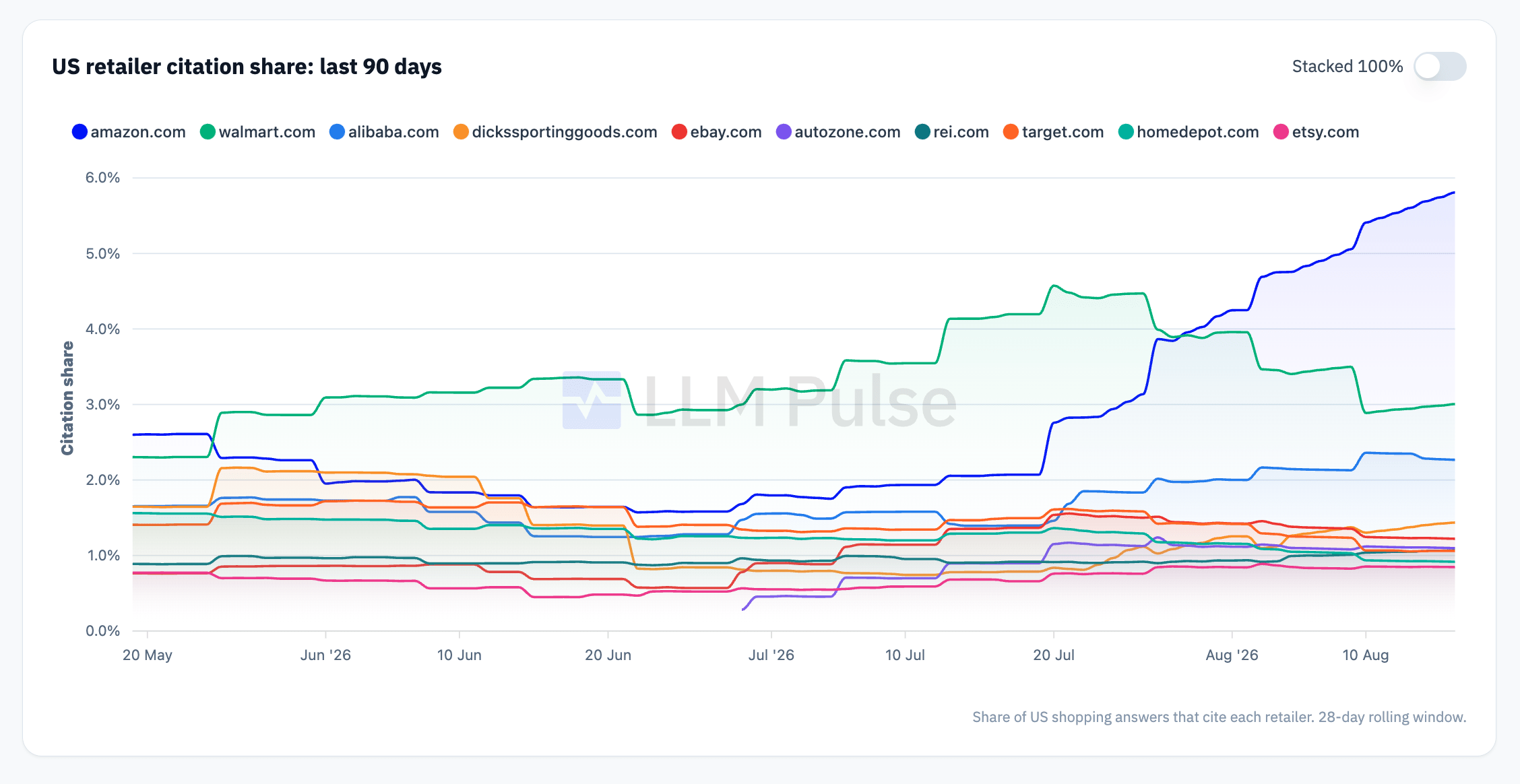
Most-cited retailers in AI shopping answers
Ranked by how broadly each retailer appears across distinct shopping topics, which is more stable than raw volume when one topic can dominate a single domain. Citations are the balanced cross-panel count (see methodology). The full ranking is in the full interactive study.
| Rank | Retailer | Citations | Avg. position | |
|---|---|---|---|---|
| 1 | amazon.com | 1,114 | 9.67 | |
| 2 | walmart.com | 1,027 | 5.72 | |
| 3 | alibaba.com | 197 | 1.87 | |
| 4 | ebay.com | 264 | 9.12 | |
| 5 | target.com | 288 | 6.27 | |
| 6 | etsy.com | 157 | 7.95 | |
| 7 | bestbuy.com | 562 | 7.13 | |
| 8 | nordstrom.com | 229 | 5.35 | |
| 9 | homedepot.com | 292 | 6.91 | |
| 10 | aliexpress.com | 26 | 8.38 | |
| 11 | macys.com | 198 | 4.75 | |
| 12 | lowes.com | 96 | 8.17 | |
| 13 | staples.com | 89 | 5.87 | |
| 14 | officedepot.com | 21 | 7.30 | |
| 15 | dickssportinggoods.com | 252 | 6.91 | |
| 16 | bhphotovideo.com | 196 | 5.15 | |
| 17 | rei.com | 185 | 4.87 | |
| 18 | cvs.com | 99 | 4.17 | |
| 19 | kohls.com | 43 | 6.51 | |
| 20 | wayfair.com | 21 | 8.13 | |
| 21 | tractorsupply.com | 60 | 7.16 | |
| 22 | newegg.com | 29 | 6.87 | |
| 23 | costco.com | 11 | 4.74 | |
| 24 | ulta.com | 202 | 5.31 | |
| 25 | zappos.com | 39 | 3.45 |
Amazon and Walmart lead the field on breadth, cited across more distinct shopping topics than anyone else, and the drop after them is steep. Category specialists (Best Buy for electronics, Home Depot and Lowe’s for home improvement, REI and Dick’s for sporting goods, Ulta and Sephora for beauty, Chewy for pets) show up concentrated in their niches rather than broadly.
Where AI actually sends shoppers
| Destination | Citations | Share |
|---|---|---|
| Brand, manufacturer and long-tail sites | 252,910 | 64.7% |
| Google properties (google.com, etc.) | 44,272 | 11.3% |
| Reddit and YouTube (community and video) | 40,678 | 10.4% |
| Review and editorial media | 29,020 | 7.4% |
| App stores (App Store, Google Play) | 12,885 | 3.3% |
| Major retailers and marketplaces | 11,308 | 2.9% |
The practical takeaway for brands: in AI shopping answers, being listed by a retailer is not the main path to visibility. Two thirds of citations go to brand-owned and manufacturer sites, which means your own product and content pages are the biggest lever. Community and video (Reddit, YouTube) and independent review media together out-cite every retailer combined, so earned mentions in those places matter more than shelf space on a marketplace.
How the engines differ
Retailer share of each engine’s shopping citations:
| Engine | Retailer share of citations |
|---|---|
| ChatGPT | 6.05% |
| Perplexity | 3.73% |
| Google AI Mode | 2.14% |
| Google AI Overviews | 1.92% |
| Gemini | 0.92% |
ChatGPT is the most likely to point a shopper at a named retailer. Gemini is the least, citing a major retailer in under 1% of cases and leaning almost entirely on brand sites and editorial content.
The engines also disagree on which retailers to trust. Amazon barely exists in ChatGPT and Perplexity shopping answers; it appears almost only through Google’s AI. Walmart, by contrast, shows up strongly in ChatGPT. So a brand’s retail visibility in AI is not one number: it splits by engine, and optimizing for ChatGPT is a different job than optimizing for Google AI Overviews.
Notable findings
- Breadth without prominence. Even the widest-reaching retailer, Amazon, gets cited near the bottom of the answer (average position 9.67) when it appears at all. Retailers that win the top slots tend to be category specialists (Zappos, REI, CVS) rather than the giants.
- Marketplaces behave oddly. Alibaba appears with a very high average position (1.87) but only in a specific slice of sourcing and wholesale questions, not consumer retail. Treat it as a B2B signal, not a shopping one.
- “E-commerce” is broader than retail. Many tracked e-commerce brands are software, services, or marketplaces whose shopping questions never cite a store at all, which is part of why the retailer share is only 2.9%.
Methodology
LLM Pulse analyzed 391,073 citations from AI responses to generic (non-branded) shopping questions tracked in the United States, collected between April 12 and July 11, 2026 across ChatGPT, Google AI Mode, Google AI Overviews, Gemini and Perplexity. The questions were about 1,468 non-branded, shopping-intent queries (“best X”, “where to buy Y”, “top X for Z”) tracked across e-commerce categories. We counted the domains cited in each answer, excluded a brand’s own citations, and grouped known retailer and marketplace domains.
Citation volume in a dataset like this concentrates, so one topic can dominate a single retailer’s total. We balance the data across topics before ranking, and we rank primarily by how broadly a retailer appears rather than by raw citation volume, which is more robust to that concentration. Citation counts in the ranking table use the balanced cross-panel total.
This data reflects the shopping questions brands choose to monitor, so it is weighted toward the categories those brands operate in. It is a large real-world sample of AI shopping answers, not a census of every shopping question asked in the US. The complete retailer-by-retailer breakdown is in the full interactive study.
About LLM Pulse
LLM Pulse is an all-in-one AI search visibility platform. It shows brands how they appear across ChatGPT, Google AI Mode and AI Overviews, Gemini, Perplexity and more: which questions surface them, which competitors and sources get cited, and what to do to earn more mentions. Teams use it to track, benchmark and improve their visibility in AI answers.
FAQ
Which retailers does AI cite most in shopping answers?
Amazon and Walmart lead on breadth (1,114 and 1,027 balanced citations), followed by Alibaba, eBay, Target and Best Buy. The drop after the top two is steep.
Where does AI actually send shoppers?
Not to stores. 64.7% of citations go to brand, manufacturer and long-tail sites, 11.3% to Google properties, 10.4% to Reddit and YouTube, and only 2.9% to major retailers and marketplaces.
Why does Amazon barely appear in ChatGPT shopping answers?
Amazon’s AI visibility is almost entirely a Google story: 1,107 of its citations came from Google AI Mode and AI Overviews, while ChatGPT cited amazon.com 6 times and Perplexity zero.
Which AI engine cites retailers most?
ChatGPT, at 6.05% of its shopping citations, then Perplexity (3.73%), Google AI Mode (2.14%), AI Overviews (1.92%) and Gemini (0.92%).
Do Reddit and YouTube matter for shopping questions?
More than storefronts. Together they drew 40,678 citations against 11,308 for every major retailer and marketplace combined, 3.6 times as many.