



Last updated: August 10, 2026

Table of Contents
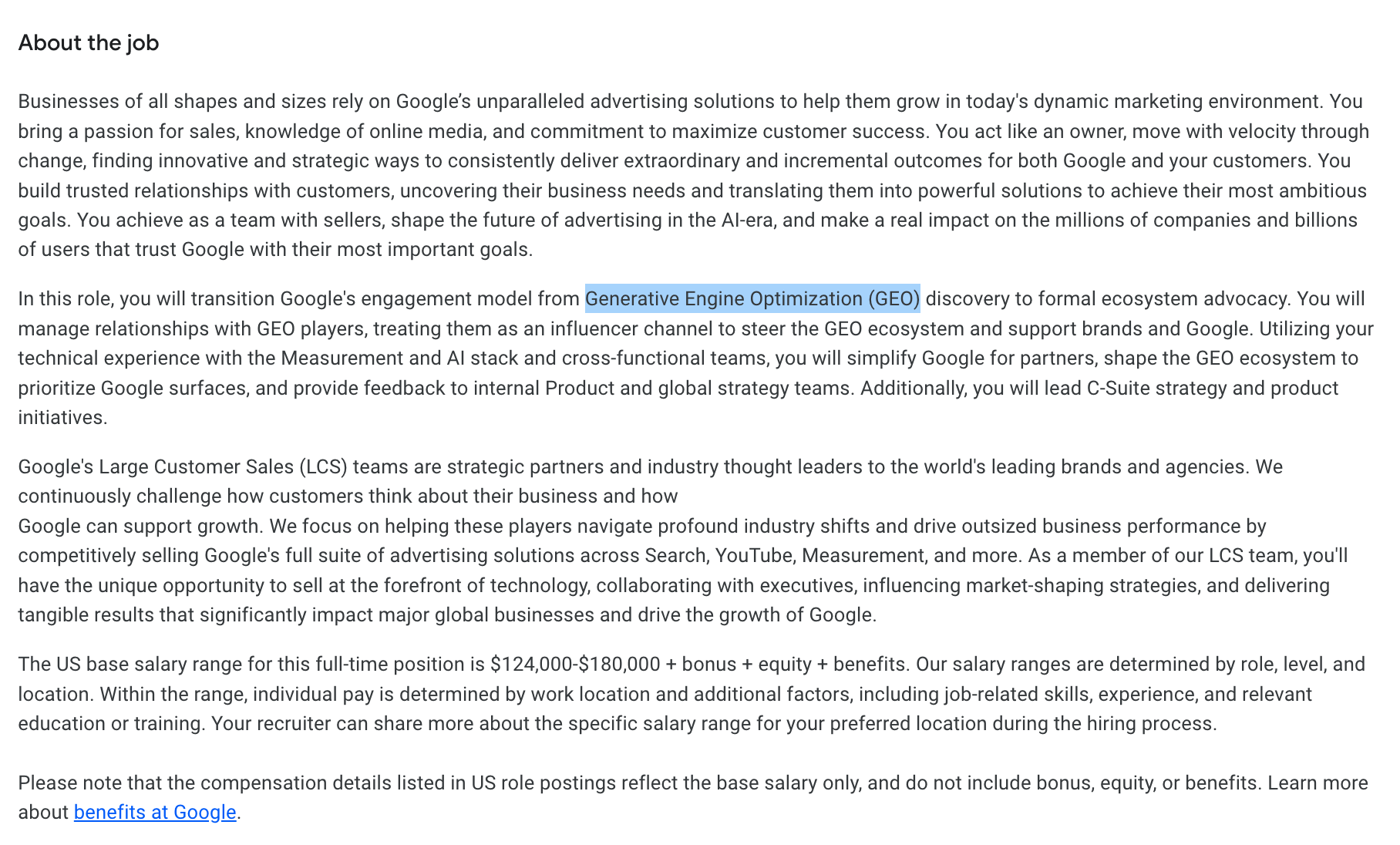
Over the past few months, a recurring debate has taken over LinkedIn and industry conversations. Some argue that “GEO is just SEO”, while others claim that “GEO is something entirely new”. There are also those who dismiss it as a simple rebranding exercise. Until recently, this discussion was mostly theoretical. That changed when in April 2026 Google published a job opening for a GEO (Generative Engine Optimization) Partner Manager.
This is not a minor detail. When a company like Google formalizes a role around a concept, it signals intent. More importantly, it signals that the concept is already relevant enough to justify internal structure, hiring, and ecosystem development. In this case, GEO is no longer just a term used by early adopters. The language has entered the market, even though Google’s official Search documentation still frames optimization for AI features as search optimization, not a separate rulebook.
GEO vs. SEO: same foundations, different surface
Generative Engine Optimization builds on the foundations of SEO, but it responds to a fundamental shift in how information is discovered and consumed. Traditional SEO focused on ranking web pages within search engine results. The objective was clear: appear as high as possible among a list of links. In contrast, GEO operates in an environment where users increasingly interact with AI-driven interfaces such as ChatGPT, Gemini, or Google’s own AI-powered search experiences.
These interfaces lead with synthesized answers, often supported by a smaller set of links and citations than a traditional results page. Within those answers, only a limited number of brands, sources, and perspectives are included. As a result, the competitive dynamic changes significantly. Visibility is no longer about ranking position. It is about being selected, cited, and represented within a generated response.
Google is not just naming it, it is structuring it
The structure of Google’s job posting reinforces this shift. The role is not limited to content optimization or technical SEO. It is designed to work with partners, agencies, and platforms that are already operating within this emerging space. This suggests that Google sees GEO not as an isolated tactic, but as an ecosystem that will involve multiple stakeholders, including tooling providers, service companies, and enterprise clients.
This evolution is driven by user behavior rather than industry hype. More users are turning to AI systems to ask questions, compare products, and make decisions. In many cases, they consume the generated answer directly, without clicking through to external websites. This reduces the importance of traditional traffic metrics and increases the importance of being present within the answer itself. In this context, visibility becomes more qualitative. It is defined by how a brand is described, which sources are cited, and how it compares to competitors within the same response.
The new visibility gap
Despite this shift, most companies still lack the infrastructure to understand what is happening. They do not know whether they appear in AI-generated answers, how their brand is positioned, or which competitors are being favored. Without this visibility, any attempt to optimize for GEO remains speculative.
This is where a new category of tools is emerging. Just as SEO gave rise to platforms focused on rank tracking, keyword research, and backlink analysis, GEO is creating demand for tools that can monitor AI-generated outputs. These tools are designed to execute real prompts across models, capture full responses, and extract structured data such as mentions, citations, sentiment, and share of voice. The underlying shift is from tracking rankings to tracking answers.
Final thoughts
In practical terms, this means that brands need to rethink how they approach visibility. It is no longer sufficient to optimize individual pages for specific keywords. Instead, they must ensure that their content is structured, authoritative, and widely referenced across the web so that AI systems can confidently include them in generated responses. At the same time, they need continuous monitoring to understand how those systems evolve and how their presence changes over time.
Ultimately, whether GEO is considered an extension of SEO or a distinct discipline is less important than what it represents. The way users discover information is changing, and with it, the mechanisms that determine visibility. Google’s decision to invest in GEO roles indicates that this transition is already underway.
Working with clients on SEO or GEO?
If you are an agency or provider and want to understand how your clients show up across ChatGPT, Gemini, or Google AI Overviews, tools like LLM Pulse are built specifically for this purpose. They enable teams to track, analyze, and improve their presence within AI-generated answers with full visibility across models.
FAQ
What is GEO (Generative Engine Optimization)?
GEO refers to the practice of optimizing how brands appear within AI-generated answers rather than traditional search results. Instead of ranking links, the goal is to be mentioned, cited, and accurately represented inside responses from systems like ChatGPT, Gemini, or Google AI Mode.
Is GEO just another name for SEO?
Not exactly. GEO builds on SEO foundations such as content quality and authority, but it focuses on a different surface: AI-generated answers. While SEO is about ranking pages, GEO is about being selected and included in a synthesized response.
Why is Google’s GEO job opening important?
Because it is a concrete market signal that Google is engaging with the language and ecosystem around GEO. The listing does not create a separate Google ranking system, but it shows that AI-driven discovery is important enough to involve dedicated partner work.
How does GEO change the concept of visibility?
Visibility moves from position-based to inclusion-based. Instead of competing for rankings, brands compete to be part of the answer itself. This makes factors like citations, sentiment, and positioning more important than traditional traffic metrics.
How can brands track and improve their GEO performance?
Brands need to monitor how they appear across AI-generated answers by tracking mentions, citations, sentiment, and competitors. Tools like LLM Pulse automate this process and help teams understand where they stand and how to improve their presence over time.