For years, competitive visibility in search was closely tied to performance metrics such as rankings, traffic, and clicks. In AI-driven search systems like Gemini, Google AI Mode, ChatGPT, and Perplexity, those signals are no longer fully visible or consistently available.
Clicks from LLMs still exist, and in some cases they can be meaningful. However, they are no longer the only, or even the primary, indicator of visibility. Much of the influence now happens before a click, within the generated response itself, where brands are mentioned, compared, or implicitly recommended.
Table of Contents
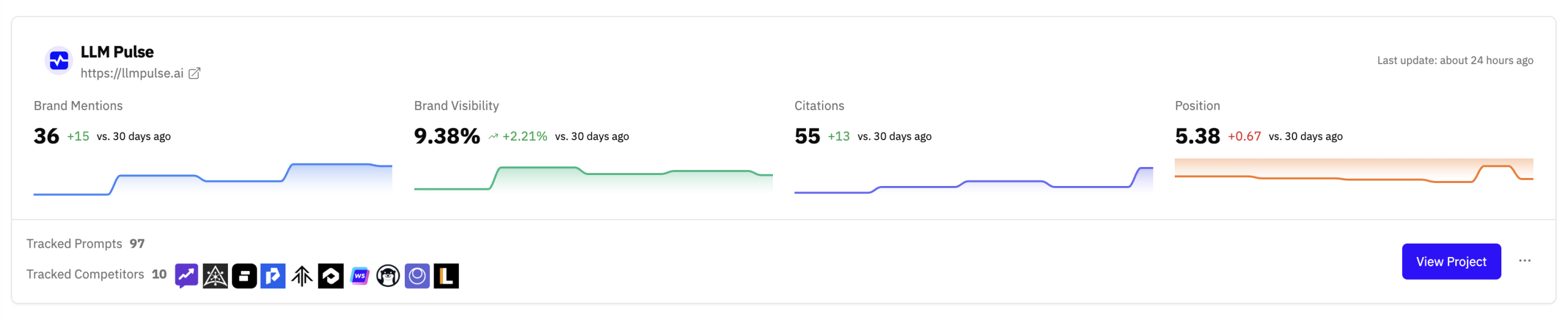
This shifts the nature of the game. Visibility in AI search is less purely performance-driven than traditional SEO. It is shaped by how often a brand is referenced, how it is framed, and how it compares to competitors across a wide range of generated responses. Success is less about winning a single result and more about building consistent presence over time.
GEO metrics aim to capture this shift. Rather than focusing only on downstream outcomes, they measure relative visibility, brand presence, and share of voice within generative search systems. In this article, we outline which KPIs matter most for competitive visibility in GEO (Generative Engine Optimization) in 2026, and how teams can use them to understand where they stand as generative search reshapes how visibility is earned.
Brand mentions
Brand mentions measure how often a brand is referenced in AI-generated responses.
This includes plain-text mentions and linked anchor text, as long as the brand name is explicitly present. URLs or domains alone are not enough. What matters is whether the brand is part of the generated narrative.
Just to note that AI answers don’t always include links, that when they do those links don’t stand out much, and that simply having your brand mentioned can already drive brand searches on Google, SERP traffic, and business.
To give you an idea, we get more leads from people who discovered us via ChatGPT than from direct traffic coming from ChatGPT itself.
Why it matters:
Brand mentions are the most direct signal of presence in AI search. If a brand is not mentioned, it effectively does not exist in the model’s output, regardless of how strong its traditional SEO performance might be.
How to interpret it:
Mentions should never be analyzed in isolation. Raw volume can be misleading. The real value comes from comparing mentions across competitors, topics, models, and markets.
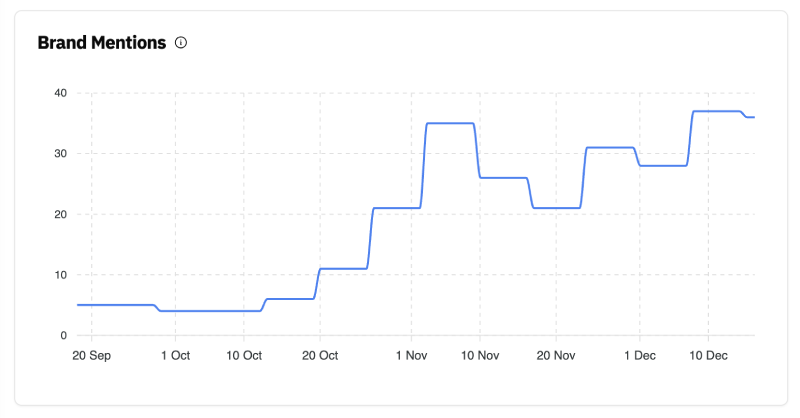
LLM Pulse allows you to easily track brand mentions across your monitored prompts, filter them by country, language, tag or topic, and model, and compare them with your competitors’ mentions.
Brand visibility
Brand visibility builds on mentions by adding structure and context.
Instead of asking “how many times am I mentioned?”, visibility asks “how visible am I across the total set of AI-generated responses being analyzed?”. It accounts for frequency, distribution, and coverage across prompts.
Why it matters:
Visibility reflects consistency. A brand that appears sporadically is less influential than one that shows up repeatedly across many relevant queries.
How to interpret it:
Brand visibility is best tracked over time. In GEO, progress is rarely immediate. Gains tend to accumulate gradually as models reinforce patterns in their generated outputs.
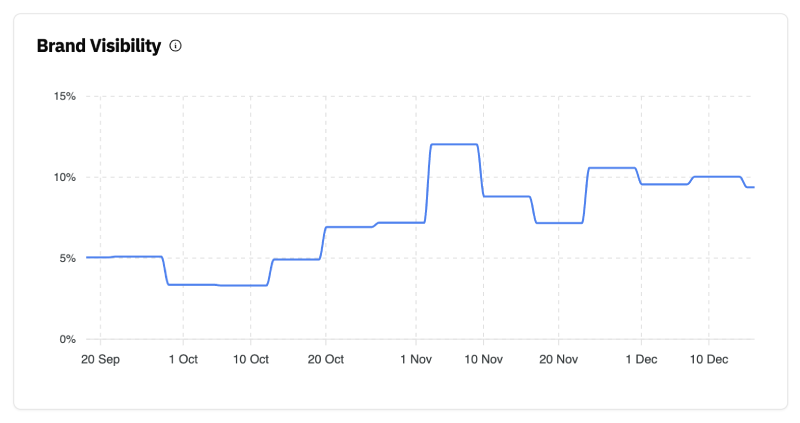
Just like brand mentions, visibility can be filtered, compared against competitors, and analyzed across different dimensions.
Share of Voice
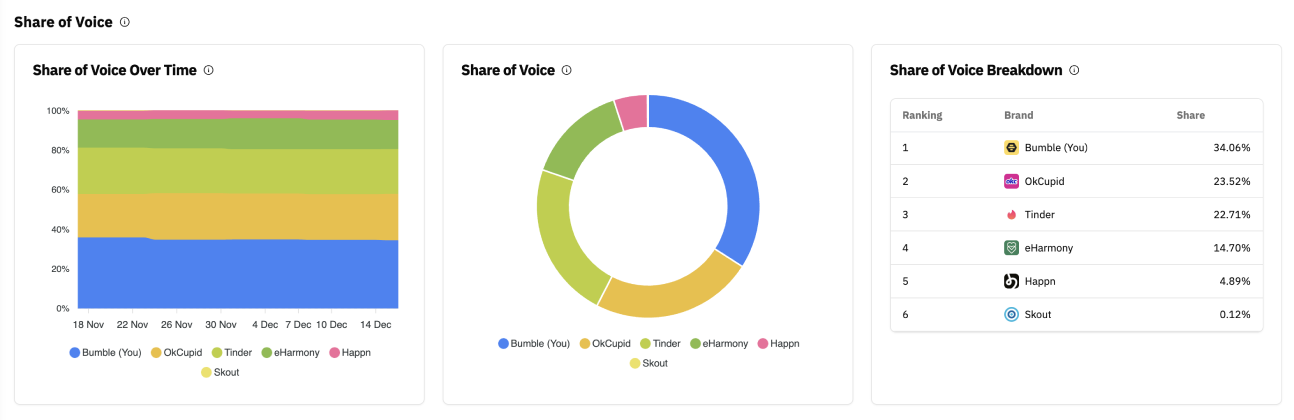
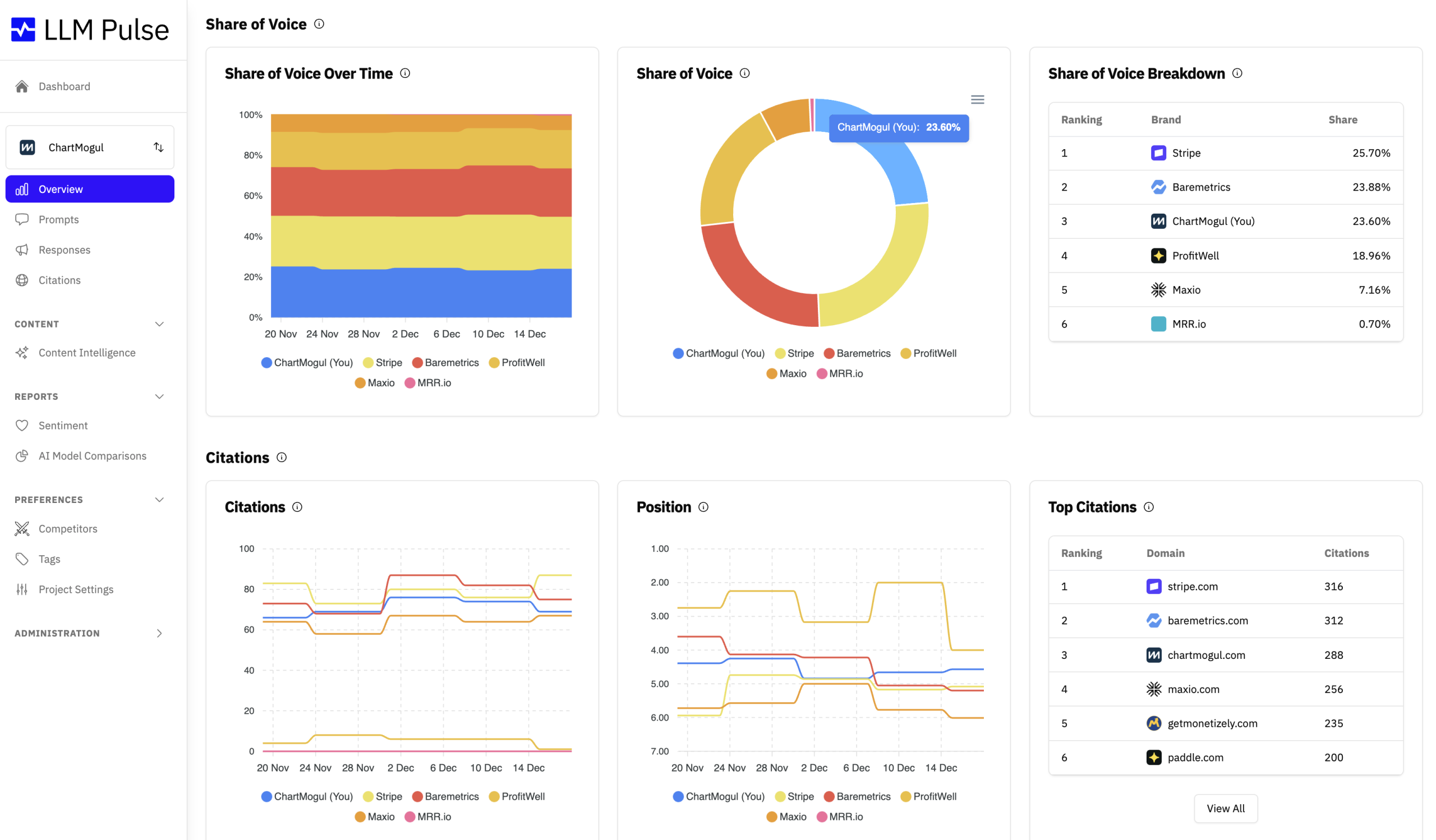
Share of voice (SoV) measures a brand’s visibility relative to its competitors within AI-generated results.
It answers a simple but critical question: when generative models respond to relevant prompts, how often is your brand mentioned compared to others in the same category?
Why it matters:
AI search is inherently comparative. Models frequently generate summaries, lists, and recommendations that surface multiple brands at once. In this context, competitive visibility is what determines whether a brand is seen, remembered, or ignored.
How to interpret it:
A growing share of voice is often more meaningful than an increase in raw mentions. It indicates that a brand is strengthening its position within the competitive landscape, even if overall volume remains stable.
Brand sentiment (reputation)
Brand sentiment evaluates how a brand is framed when it appears in AI-generated responses.
It looks at tone, descriptors, and implied positioning. Is the brand recommended, mentioned neutrally, or associated with warnings, limitations, or negative caveats?
Why it matters:
Visibility without reputation is fragile. A brand that appears frequently but in a negative or dismissive context may be eroding trust rather than building it.
How to interpret it:
Sentiment should always be analyzed alongside brand mentions and share of voice. Sudden shifts often reflect changes in public perception, media narratives, or competitor positioning being absorbed by generative models.
In our view, it is especially important to monitor reputational prompts such as user opinions, product or service comparisons, complaints, alternatives, and “best vs worst” queries. These prompts are where sentiment is most explicit, most comparative, and most likely to influence downstream decisions.
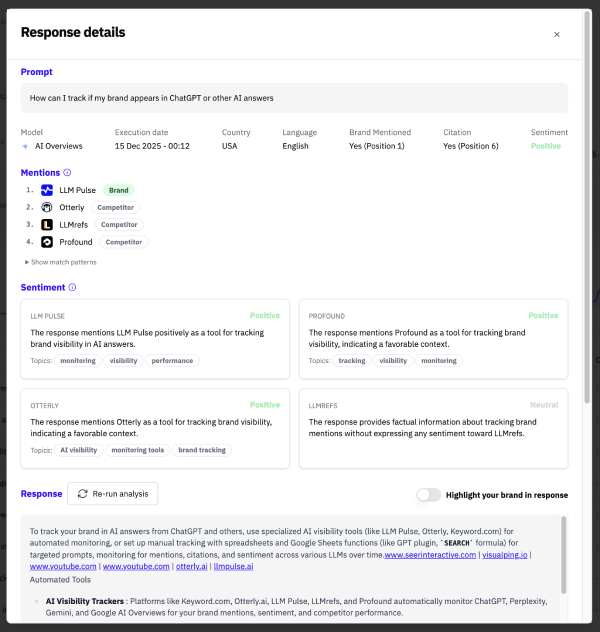
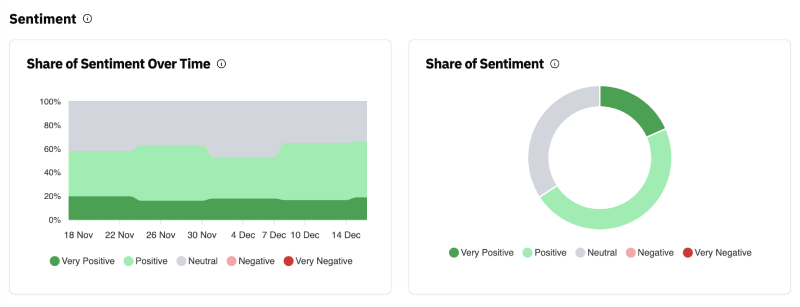
LLM Pulse analyzes the sentiment associated with each brand mention, both for your own brand and for competitors, and allows you to quickly identify AI responses that contain negative sentiment, the citations that contributed to generating those responses, and more. This data is then used to build the “Share of Sentiment” metric.
Citations and sources
Citations measure when an AI response includes a clickable link to a source. This source can be your own website, a competitor’s website, a third-party site that mentions you and your competitors, or a site that mentions one or more competitors but not your brand.
These citations represent the information sources the model relied on to generate its answer. The link may appear as a plain URL or as anchor text. In both cases, it counts as a citation as long as it is clickable in the AI response.
Why it matters:
Citations are a strong trust signal. They show which domains the model chooses to ground its answers, support claims, or justify recommendations.
How to interpret it:
Not every brand mention results in a citation. Mentions indicate narrative presence. Citations indicate source dependency. Over time, consistent citations tend to align with stronger perceived authority and more stable visibility in AI search.
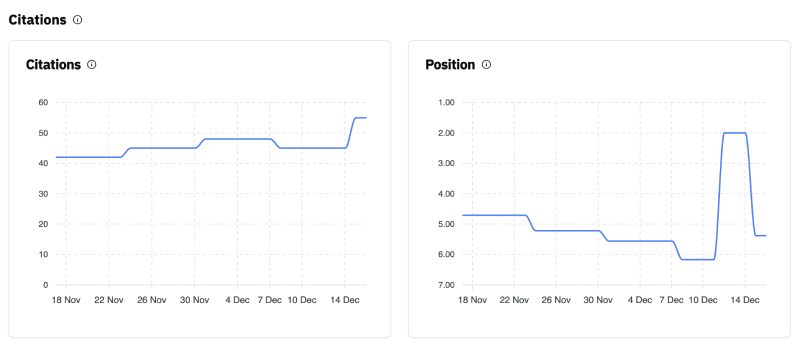
Having visibility into the citations that appear in responses to a prompt or set of prompts helps you understand what content to create or optimize, and which third-party websites you should aim to be featured on. Citations can include websites, forums, user review platforms, social media, and other external sources.
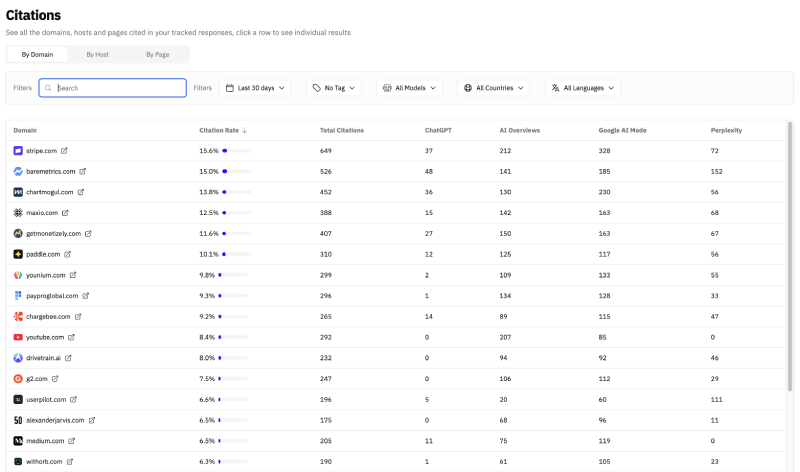
It is important to track website citations to your own domain, but also to monitor when competitors’ URLs are cited.
Traffic from AI search
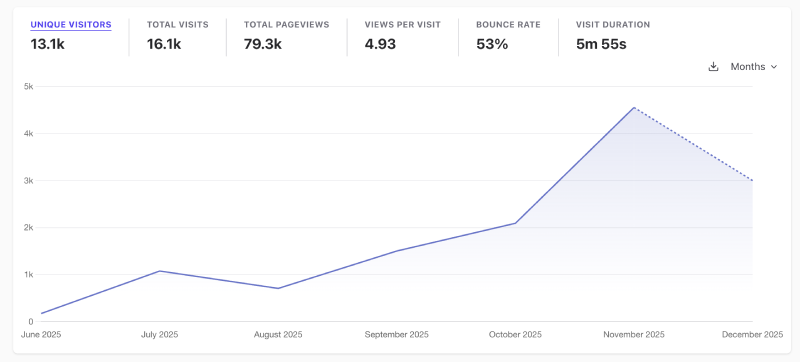
Traffic measures visits generated from AI-powered search experiences to owned properties. While clicks from LLM-based systems do occur and can be meaningful in specific scenarios, they capture only a fraction of the influence AI search has on user decision-making and brand consideration.
Why it matters:
Traffic remains a concrete outcome. It helps connect GEO visibility to familiar performance metrics and provides a partial signal of downstream impact.
How to interpret it:
Traffic alone is not a reliable proxy for visibility in AI search. A lack of clicks does not imply a lack of visibility, especially when AI responses satisfy user intent without requiring further action.
Web traffic from ChatGPT, Perplexity, and similar AI systems can be measured using web analytics tools such as Google Analytics or Plausible Analytics:
Revenue and business impact
Revenue links GEO metrics to tangible business outcomes.
This may include direct conversions from AI-driven traffic, assisted conversions influenced by AI exposure, or longer-term brand demand shaped by repeated visibility in generative responses.
Why it matters:
Ultimately, GEO metrics need to earn their place alongside traditional analytics. Revenue is what makes that conversation possible at a business level.
How to interpret it:
Attribution will rarely be clean or exact. The impact of GEO is typically indirect, delayed, and cumulative. The objective is not perfect attribution, but directional clarity on whether increased AI visibility is contributing to growth over time.
Putting GEO metrics together
No single KPI explains performance in AI search. GEO needs to be understood as a system, where different signals work together to describe how a brand is represented and perceived by generative models.
Brand mentions indicate whether a brand is present in AI-generated responses. Visibility and share of voice add competitive context, showing how that presence compares to others in the same space.
Sentiment and citations provide insight into trust and reputation. They reveal not just whether a brand appears, but how it is framed and which sources models rely on to support their answers.
Traffic and revenue help connect AI visibility to business outcomes. They translate exposure and perception into signals that teams can relate to performance and growth.
When measured together, these KPIs provide a realistic picture of who is winning visibility in AI search, and why.
FAQ
What are GEO metrics and why do they matter in AI search?
GEO metrics are used to measure how visible and influential a brand is within AI-generated responses. Unlike traditional SEO metrics, they focus on presence, context, and relative visibility inside systems such as Gemini, ChatGPT, Perplexity, or Google AI Mode, where rankings and clicks are no longer the dominant signals shaping user perception.
How are AEO metrics different from traditional SEO KPIs?
Traditional SEO KPIs are designed to measure post-response outcomes, including rankings, traffic, and conversions. GEO metrics operate earlier in the funnel. They measure whether a brand appears in generated answers, how it is framed, and how it compares to competitors within the response itself, regardless of whether a click happens.
Which GEO KPIs are most important for competitive visibility?
For competitive visibility, the most relevant GEO KPIs are brand mentions, brand visibility, and share of voice. Together, they indicate whether a brand is consistently surfaced across AI-generated responses and how strong that presence is relative to competing alternatives.
Do clicks and traffic still matter in GEO?
Clicks from AI systems still exist and, in some cases, can be valuable. However, they are no longer a sufficient proxy for visibility. Many AI responses fully satisfy user intent without sending traffic elsewhere, which is why GEO prioritizes presence, context, and competitive positioning before downstream performance.
How do citations and brand sentiment affect GEO performance?
Citations signal authority and trust by showing which sources AI systems rely on to support their answers. Brand sentiment reflects how a brand is positioned or evaluated within those responses. Over time, visibility combined with positive sentiment and consistent citations tends to produce more durable and defensible GEO performance.