Last updated: March 31, 2026
Latest review: 30th of March, 2026.
Table of Contents
ChatGPT is now a search engine
ChatGPT has undergone a remarkable transformation since its launch in late 2022. What started as a conversational AI chatbot has evolved into a full-fledged search engine — one that more than 200 million people use every week to find information, compare products, and make decisions.
The introduction of ChatGPT Search marked a turning point. Powered by Bing’s index, ChatGPT can now fetch real-time web results, cite sources, and provide up-to-date answers on virtually any topic. This isn’t a gimmick bolted onto a chatbot. It’s a fundamentally different way for people to discover brands, products, and services.
Users are no longer just asking ChatGPT to write emails or explain concepts. They’re asking questions like:
- “What’s the best CRM for small businesses?”
- “Compare Notion vs. Asana for project management”
- “Which running shoes are best for flat feet?”
Every one of these queries is a potential brand discovery moment. And if your brand isn’t showing up in ChatGPT’s responses, you’re invisible to a rapidly growing audience that may never visit Google for the same question.
How ChatGPT searches actually work
Understanding how ChatGPT finds and presents information is essential if you want your brand to appear in its responses. Here’s a technical breakdown of the process.
The two knowledge sources: training data and real-time web search
ChatGPT draws from two distinct sources when answering queries:
- Training data — a massive corpus of text from books, websites, articles, and other sources, with a knowledge cutoff date. This is ChatGPT’s “memory” and shapes its default understanding of brands, products, and topics.
- Real-time web search — when enabled, ChatGPT can search the web to fetch current information, recent news, pricing, and live data that falls outside its training window.
Both sources influence whether your brand appears in responses. Training data determines baseline awareness, while web search provides fresh context and citations.
“ChatGPT doesn’t show ten results. It gives one answer. You’re either in it or you’re invisible. That’s why AI visibility isn’t a nice-to-have anymore, it’s a core growth channel.
When ChatGPT uses web search vs. training data
ChatGPT doesn’t search the web for every query. It decides dynamically based on the nature of the question:
- Web search is triggered when the query involves recent events, current pricing, live data, or when the user explicitly asks ChatGPT to search the web.
- Training data is used for general knowledge questions, conceptual explanations, and topics where timeliness isn’t critical.
- Both sources combine for many queries — ChatGPT uses its training data as a foundation and supplements with web results for verification or freshness.
For brand visibility, this means you need presence in both: enough web authority to appear in real-time search results, and enough online footprint to have been captured in training data.
How ChatGPT selects and cites sources
When ChatGPT performs a web search, it evaluates multiple sources and selects those it considers most relevant and authoritative. The selection criteria include:
- Relevance to the specific query
- Authority of the source (established publications, official websites, well-known platforms)
- Freshness of the content
- Consistency — information that appears across multiple credible sources is more likely to be included
ChatGPT tends to favor sources that provide comprehensive, well-structured answers. Pages that directly address a question in clear language are more likely to be cited than those that bury the answer in promotional copy.
The role of Bing in ChatGPT search
ChatGPT’s web search functionality is powered by Bing’s search index. This means that Bing’s crawling, indexing, and ranking signals play a direct role in what ChatGPT can find and surface. If your website isn’t indexed by Bing, or ranks poorly in Bing results, your chances of appearing in ChatGPT’s web-sourced answers decrease significantly.
That said, unofficially, there are indications that ChatGPT may also surface content that aligns with what performs well on Google, likely due to overlapping sources, shared content ecosystems, and broader web signals. While Bing is the primary engine, Google visibility can still indirectly influence what gets cited.
Key implications:
- Submit your sitemap to Bing Webmaster Tools
- Ensure your site is crawlable and well indexed by Bing
- Don’t ignore Bing SEO just because your Google rankings are strong
- Strong Google visibility can still help indirectly through broader web presence
How ChatGPT formats search results
Unlike Google’s list of blue links, ChatGPT presents search results as part of a conversational, synthesized answer. When web search is used, you’ll typically see:
- Inline citations — numbered references within the text that link to source URLs
- Source cards — clickable links at the bottom of the response showing the websites ChatGPT pulled from
- Synthesized summaries — ChatGPT doesn’t just quote sources; it weaves information from multiple pages into a coherent answer
This format means that even a single mention or citation in a ChatGPT response can carry significant weight. Users perceive the response as a curated, expert recommendation rather than a list of options to sift through.
What ChatGPT searches look like for users
To understand the brand visibility opportunity, it helps to see how real users interact with ChatGPT for search-like queries.
Example 1: “Best project management tools for remote teams”
ChatGPT might respond with a ranked list of 5-7 tools, each with a brief description of strengths and weaknesses. Some tools will be mentioned by name, some will be recommended, and some will include citations to review sites or the tool’s own website.
Example 2: “Compare HubSpot vs. Salesforce for startups”
ChatGPT generates a structured comparison covering pricing, features, ease of use, and best-fit scenarios. It may cite G2 reviews, official pricing pages, or industry analysis articles.
Example 3: “How to choose a CRM”
ChatGPT provides a framework for evaluation (budget, team size, integrations, etc.) and then mentions specific brands as examples within each category.
There are three levels of brand visibility in these responses:
- Mentioned — your brand name appears in the answer. This builds awareness.
- Cited — ChatGPT links to your website or a page that features your brand. This drives traffic.
- Recommended — ChatGPT positions your brand as a top choice or best fit. This drives conversions.
The difference matters. Being mentioned is good. Being recommended is powerful.
ChatGPT vs. Google: how search behavior is changing
The rise of ChatGPT as a search tool doesn’t mean Google is disappearing. But the way people search — and what they expect from search results — is shifting in important ways.
| Dimension | ChatGPT | |
|---|---|---|
| Search intent | Navigational + informational | Conversational + evaluative |
| Output format | 10 blue links + ads + featured snippets | Synthesized answer with inline citations |
| Brand discovery | Ranking position on SERPs | Mention, recommendation, or citation in response |
| User trust | Users evaluate multiple sources | Response feels like advice from a knowledgeable expert |
| Click behavior | Users click through to websites | Many users accept the answer without clicking sources |
| Personalization | Based on search history and location | Based on conversation context and prior messages |
The most significant difference is trust. When Google shows you a list of results, you know you’re looking at a mix of organic results and ads. When ChatGPT recommends a brand, it feels like a personal recommendation from someone who has done the research for you. This makes ChatGPT mentions disproportionately influential on purchase decisions.
Another crucial difference: there are no page-two results in ChatGPT. Either your brand appears in the response, or it doesn’t exist in that conversation. There’s no equivalent of ranking on page three and still getting some traffic. It’s binary visibility.
How to get your brand found in ChatGPT
Getting your brand to appear in ChatGPT responses requires a different approach than traditional SEO. Here are the strategies that work.
1. Create authoritative, comprehensive content
ChatGPT favors sources that provide thorough, well-structured answers. To increase your chances of being cited:
- Publish in-depth guides that cover topics comprehensively
- Use clear headings, lists, and structured formatting
- Answer specific questions directly — don’t bury the answer under paragraphs of fluff
- Include data, statistics, and concrete examples
- Keep content updated and accurate
2. Get mentioned on high-authority sites
ChatGPT’s training data and web search both draw heavily from authoritative sources. Digital PR is one of the most effective strategies for AI visibility:
- Earn mentions in industry publications and review sites
- Contribute guest articles to reputable outlets
- Get featured in “best of” lists and comparison articles
- Build relationships with journalists and industry analysts
- Pursue awards and recognitions that get covered online
3. Build a strong brand presence across the web
ChatGPT aggregates information from many sources. The more consistently your brand appears across the web, the more likely it is to be included in responses:
- Maintain active profiles on relevant platforms (G2, Capterra, Product Hunt, industry directories)
- Engage in communities where your audience hangs out (Reddit, forums, Slack communities)
- Build Wikipedia presence if your brand qualifies for notability
- Maintain consistent, up-to-date information on your website and social profiles
4. Use structured data
Structured data helps search engines — including Bing, which powers ChatGPT Search — understand your content better:
- Implement Schema.org markup (Organization, Product, FAQ, HowTo, Review)
- Use JSON-LD format for clean implementation
- Mark up your FAQ pages so questions and answers are machine-readable
- Add product schema with pricing, availability, and review data
5. Keep information consistent across sources
When ChatGPT encounters conflicting information about your brand, it may omit your brand entirely or present inaccurate details. Ensure consistency in:
- Product descriptions and feature lists
- Pricing information
- Brand positioning and messaging
- Company details (founding date, headquarters, team size)
6. Generate positive reviews and social proof
ChatGPT draws heavily from review platforms and user-generated content when making recommendations:
- Encourage satisfied customers to leave reviews on G2, Capterra, Trustpilot, and industry-specific platforms
- Respond to reviews (positive and negative) to show engagement
- Showcase case studies and customer success stories on your website
- Build a strong presence on Reddit and other discussion platforms where real users share opinions
7. Create content that directly answers common questions
ChatGPT excels at answering specific questions. Create content that mirrors the types of queries your audience asks:
- Build FAQ sections on your site with clear, concise answers
- Create comparison pages (“Your Product vs. Competitor”)
- Publish “how to choose” and “best of” guides in your category
- Address common objections and concerns transparently
8. Monitor your ChatGPT visibility
You can’t improve what you don’t measure. Tracking your brand’s presence in ChatGPT responses is essential to understanding whether your efforts are working — and where to focus next. We’ll cover the tools and metrics for this in the next section.
How to track your brand’s visibility in ChatGPT
One of the biggest challenges with AI search visibility is measurement. Unlike Google, where you can check your ranking for any keyword, ChatGPT doesn’t have a simple search results page you can audit.
Why manual checking doesn’t work:
- ChatGPT responses vary by user, session, conversation history, and even time of day
- The same prompt can produce different results for different users
- You can’t see a “universal” ChatGPT ranking the way you can check Google SERPs
- Manual spot-checking gives you anecdotal data, not statistically meaningful insights
This is why automated tracking tools have become essential for brands serious about AI visibility.
LLM Pulse is purpose-built for this. It continuously monitors how your brand appears across ChatGPT, Perplexity, Google Gemini, Google AI Mode, and AI Overviews — tracking mentions, citations, and sentiment in AI-generated responses. Plans start at €49/month with a 14-day free trial and unlimited seats, so your entire marketing team can access the data.
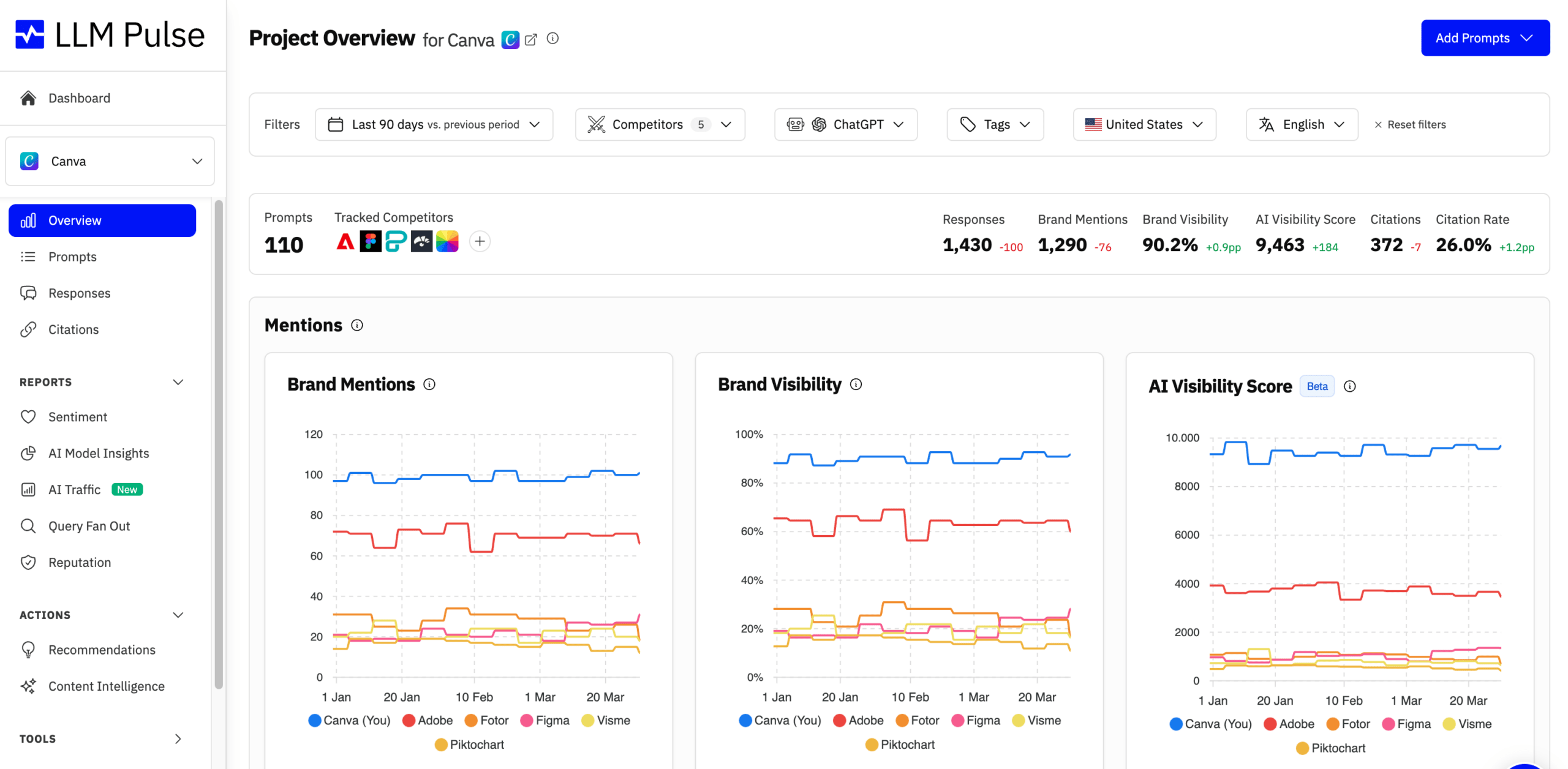
The key metrics to track for ChatGPT visibility include:
- Mention rate — how often your brand is named in responses to relevant prompts
- Citation rate — how often your website is linked as a source
- Sentiment — whether ChatGPT describes your brand positively, negatively, or neutrally
- Share of voice — how your visibility compares to competitors in the same category
Tracking these metrics over time reveals patterns: which content strategies are working, where competitors are gaining ground, and how algorithm changes affect your visibility.
ChatGPT competitors: the full AI search landscape
ChatGPT isn’t the only AI-powered search experience. The landscape is expanding rapidly, and brands need visibility across multiple platforms.
Perplexity AI
Perplexity has carved out a niche as a research-focused AI search engine. It’s known for heavy citation usage — every claim is linked to a source. Perplexity is popular among professionals and researchers who want verifiable answers. Its citation-first approach means that having authoritative, well-indexed content is especially important for visibility here.
Google AI Mode
Google’s AI Mode transforms traditional Google Search into a conversational experience. Users can ask follow-up questions, get synthesized answers, and explore topics in a chat-like interface — all within Google. Since it’s built on Google’s index, traditional SEO signals carry over, but the presentation format is entirely different.
Google AI Overviews
AI Overviews (formerly SGE) are AI-generated summaries that appear at the top of Google search results. They synthesize information from multiple sources and can significantly reduce click-through rates to organic results. Being cited in an AI Overview is becoming as important as ranking in the top three organic positions.
Google Gemini
Google’s standalone AI assistant competes directly with ChatGPT. Gemini has deep integration with Google’s ecosystem (Gmail, Docs, Maps) and uses Google’s search index for real-time information. As Google pushes Gemini across its products, its influence on brand discovery will grow.
Microsoft Copilot
Microsoft Copilot is Bing-powered AI integrated into Windows, Edge, and Microsoft 365. It draws from the same Bing index that powers ChatGPT Search, so optimization efforts for ChatGPT often benefit Copilot visibility as well.
Emerging players: Claude, Grok, and DeepSeek
Several newer AI assistants are gaining traction. Claude (by Anthropic) is known for nuanced, thoughtful responses. Grok (by xAI) integrates with the X platform for real-time social data. DeepSeek has gained attention for its open-source models and strong performance. While their search market share is currently small, their user bases are growing, and forward-thinking brands are already monitoring visibility across these platforms.
FAQ
Does ChatGPT use Google?
Not officially. ChatGPT’s web search feature is powered by Bing rather than Google. This means that Bing’s index and ranking signals determine what ChatGPT can retrieve when searching the web. If you’ve been focusing exclusively on Google SEO, it’s worth making sure your site is also well indexed and performs well on Bing.
How does ChatGPT choose which brands to mention?
ChatGPT selects brands based on a combination of its training data and real-time web search results. Brands that are frequently mentioned across authoritative sources, have strong review profiles, and provide clear, comprehensive information are more likely to appear. There’s no single ranking factor — it’s the cumulative weight of your brand’s online presence.
Can I pay to appear in ChatGPT results?
Not directly — at least not yet. As of early 2026, ChatGPT does not sell sponsored placements within its responses. OpenAI has explored advertising models, but there is currently no self-serve ad product for ChatGPT Search. Visibility is earned through content quality, brand authority, and web presence. This could change in the future as OpenAI explores monetization.
How often does ChatGPT update its knowledge?
ChatGPT’s training data is updated periodically (typically every few months) through new model releases. Its web search capability, however, provides access to real-time information every time it’s used. This means that even if your brand isn’t in ChatGPT’s training data, it can still appear in responses through web search results — as long as your content is indexed and authoritative.
Is ChatGPT replacing Google?
ChatGPT is not replacing Google, but it is capturing a growing share of search behavior. Many users now go to ChatGPT first for product research, recommendations, and complex questions — queries that previously would have gone to Google. Google remains dominant for navigational searches and quick lookups, but the trend is clear: conversational AI search is growing, and brands need to be visible in both ecosystems.
How do I check if my brand appears in ChatGPT?
You can manually ask ChatGPT relevant questions and see if your brand is mentioned, but this only gives you a snapshot — responses vary by user and session. For systematic tracking, use a dedicated AI visibility monitoring tool like LLM Pulse that continuously tracks your brand’s mentions, citations, and sentiment across ChatGPT and other AI search engines.
What is ChatGPT’s market share in search?
ChatGPT’s exact search market share is difficult to pin down because it doesn’t operate like a traditional search engine. However, with over 200 million weekly active users and growing adoption for search-like queries, it represents a significant and rapidly expanding share of the information discovery market. Some estimates suggest AI chatbots collectively handle 5-10% of queries that would previously have gone to traditional search engines, and this percentage is climbing steadily.
Can I optimize for ChatGPT specifically?
There’s no “ChatGPT SEO” playbook the way there is for Google, but you can absolutely influence your visibility. The strategies outlined in this guide — authoritative content, digital PR, strong web presence, structured data, consistent information, positive reviews, and direct question-answering content — all increase your likelihood of appearing in ChatGPT responses. The key difference from traditional SEO is that brand authority and topical expertise matter more than technical on-page optimization.