Latest review: 2nd of April, 2026.
A year ago, “ChatGPT tracking” wasn’t even a category. Today, every brand with an online presence needs to know what ChatGPT says about them — because millions of people now ask ChatGPT for product recommendations, service comparisons, and brand opinions instead of typing a query into Google.
Table of Contents
The shift is massive. When a potential customer asks ChatGPT “What’s the best project management tool for remote teams?” and your brand doesn’t appear in the response, you’ve lost a discovery opportunity you didn’t even know existed. Worse, if ChatGPT mentions your brand but gets the facts wrong — outdated pricing, discontinued features, or inaccurate comparisons — there’s reputational damage happening at scale, invisibly.
We spent six weeks testing every ChatGPT tracking tool we could find — running identical prompts, comparing data accuracy, evaluating dashboards, and stress-testing pricing tiers. This guide distills what we learned into an honest, detailed comparison of the 18 best options available in 2026.
What is a ChatGPT tracking tool?
A ChatGPT tracking tool monitors how your brand, products, and competitors appear in ChatGPT’s responses. Think of it as brand monitoring for the AI era — except instead of scanning news articles and social media posts, these tools scan the outputs of large language models.
“For years, brands measured discoverability through rankings. With ChatGPT, that is no longer enough. The question now is much simpler and much more brutal: are you part of the answer or not? From what we’re seeing, the companies that monitor this early are the ones that will understand the shift before everyone else.
Here’s why this matters more than most marketers realize:
- ChatGPT influences purchasing decisions. Studies show that over 40% of users who receive a brand recommendation from ChatGPT go on to research that brand further. If ChatGPT consistently recommends your competitor, you’re losing pipeline before it even enters your funnel.
- You can’t see AI responses organically. Unlike a Google search result you can check manually, ChatGPT responses vary by user, session, and context. The only way to systematically monitor what ChatGPT says about you is with dedicated tooling.
- Misinformation spreads silently. ChatGPT might cite outdated pricing, attribute features to the wrong product, or omit your brand from a category it belongs in. Without tracking, you’d never know.
- Share of voice is shifting to AI. Traditional share-of-voice metrics measure visibility in search results, social media, and PR coverage. But a growing slice of brand discovery now happens inside AI conversations — and that requires new measurement tools.
- Citation tracking reveals content gaps. When ChatGPT cites a competitor’s blog post as a source but never references yours, that’s a signal your content strategy needs adjustment for AI discoverability.
In short, a ChatGPT tracking tool gives you visibility into a channel that is increasingly shaping how people discover, evaluate, and choose brands.
How ChatGPT tracking works
Under the hood, most ChatGPT tracking tools follow a similar workflow — though the sophistication of each step varies dramatically between platforms.
1. Prompt execution
The tool sends a set of carefully crafted prompts to ChatGPT’s API at regular intervals. These prompts simulate the questions your potential customers might ask — things like “What are the best CRM tools for startups?” or “Compare Salesforce vs HubSpot for small businesses.” The quality and diversity of these prompts directly impacts the usefulness of the data you get back.
2. Response parsing and brand mention detection
Each ChatGPT response is analyzed to detect whether your brand (or your competitors) is mentioned. This sounds simple, but it’s nuanced — the tool needs to handle variations in brand names, abbreviations, product line names, and contextual references. Advanced tools also track how the brand is mentioned: as a recommendation, a comparison, a warning, or a neutral reference.
3. Citation and source extraction
When ChatGPT cites external sources (URLs, studies, articles), tracking tools extract and catalog these citations. This data reveals which content assets are being used by ChatGPT as reference material — and which of your competitors’ content is getting cited most frequently.
4. Sentiment analysis
The best tools don’t just tell you that you were mentioned — they tell you how you were mentioned. Sentiment analysis classifies each mention as positive, negative, or neutral, and some tools go further with fine-grained scoring. This is typically powered by a secondary AI model that evaluates the context around each brand mention.
5. Share of voice calculation
Share of voice (SoV) in the AI context measures how often your brand appears relative to competitors across a set of prompts. If 100 prompts are executed and your brand appears in 35 responses while your top competitor appears in 50, your AI share of voice is 35% vs their 50%. This metric, tracked over time, reveals whether your brand’s AI visibility is growing or shrinking.
6. Trend aggregation and reporting
Raw data gets aggregated into dashboards, charts, and reports that show trends over time. Weekly or daily refresh cadences let you spot changes in AI visibility — for example, a sudden drop in mentions after a competitor launches a major content campaign, or a spike in negative sentiment after a PR incident.
Quick comparison: best ChatGPT tracking tools
| Tool | Best for | ChatGPT tracking | Other AI models | Refresh cadence | Starting price |
|---|---|---|---|---|---|
| LLM Pulse | Overall best | Full (mentions, citations, sentiment) | Perplexity, Gemini, AI Mode, AI Overviews | Weekly | €49/mo |
| SE Ranking | SEO + ChatGPT combo | Brand monitoring in AI answers | Google AI Overviews | Weekly | $65/mo |
| Peec AI | Multilingual tracking | Full mention tracking | Gemini, Perplexity, Copilot | Weekly | €89/mo |
| AIclicks | Prompt-level audits | Prompt-by-prompt analysis | Gemini, Perplexity | Weekly | $49/mo |
| Profound | Enterprise compliance | Full tracking + compliance | Multi-model | Daily/custom | $499/mo |
| Scrunch AI | Enterprise analytics | Advanced analytics | Multi-model | Daily | $300/mo |
| Otterly AI | Known brand tracker | Core mention tracking | Gemini, Perplexity, Copilot | Weekly | $29/mo |
| Semrush AI Toolkit | Existing Semrush users | Integrated AI tracking | Google AI Overviews | Weekly | Add-on pricing |
| AthenaHQ | Data-driven teams | Credit-based deep analysis | Multi-model | On-demand | $295/mo |
| Similarweb | Market intelligence | Market-level traffic data | Multi-model | Monthly | Custom pricing |
| Promptmonitor | Budget option | Core tracking | 8+ models | Weekly | $29/mo |
| GEO Metrics | Broad AI coverage | Full tracking | 15+ AI engines | Weekly | €80/mo |
| Rankscale AI | Budget multi-model | Multi-model at scale | Multiple models | Weekly | $39/mo |
| Rankshift | Competitive analysis | Competitor benchmarking | Perplexity, Gemini | Weekly | $59/mo |
| AI Peekaboo | Lightweight monitor | Basic monitoring | Limited | Weekly | Free tier available |
| Writesonic GEO | Content optimization | Tracking + optimization tips | Multi-model | Weekly | $49/mo |
| Hall AI | Real-time monitoring | Near real-time alerts | Multiple models | Daily | $79/mo |
| Nightwatch | SEO teams | Add-on ChatGPT tracking | Limited | Weekly | $49/mo |
1. LLM Pulse — best overall ChatGPT tracker
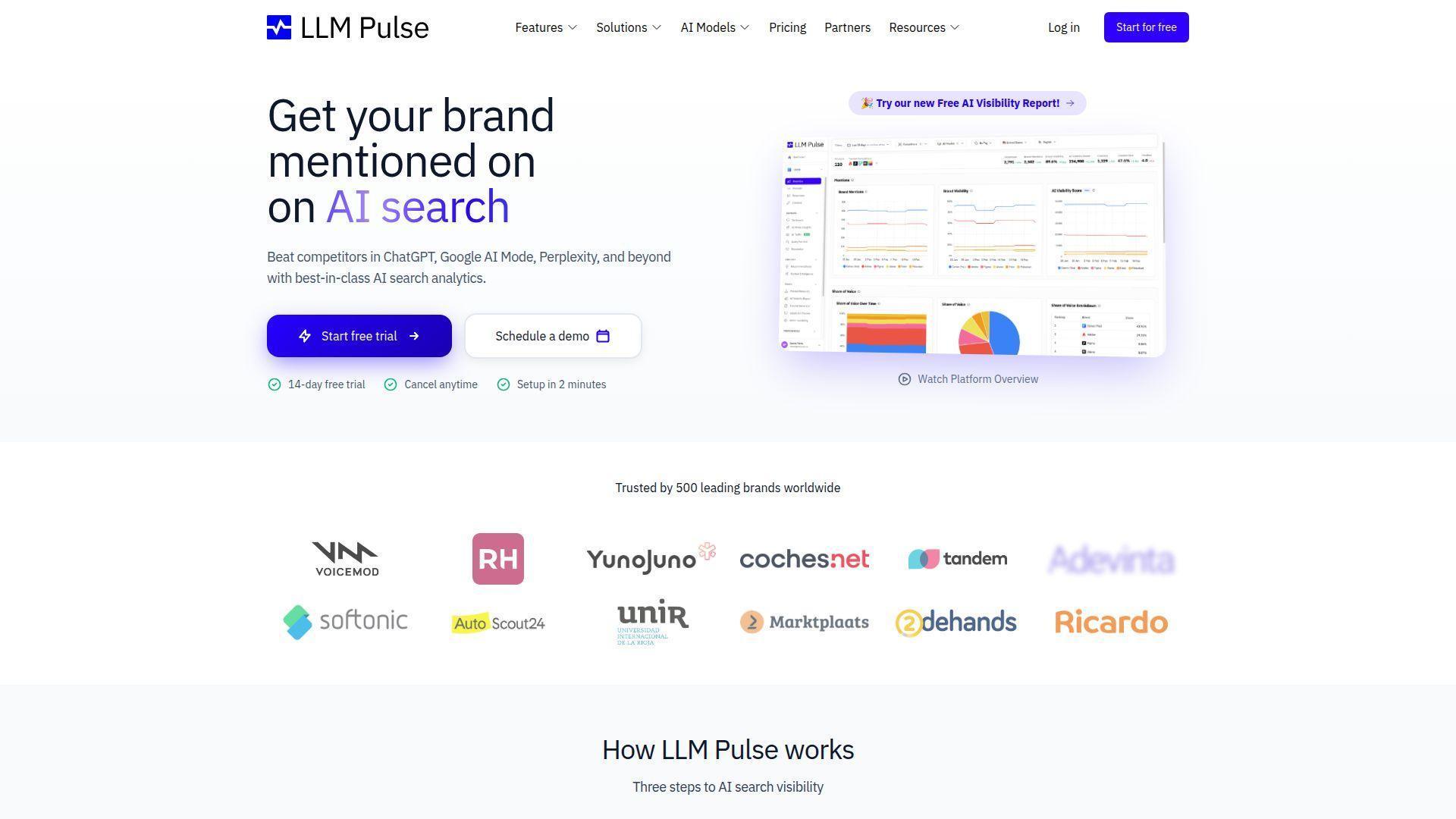
LLM Pulse is a dedicated AI visibility analytics platform built from the ground up to track how brands appear across ChatGPT, Perplexity, Gemini, Google AI Mode, and AI Overviews. Unlike tools that bolt AI tracking onto existing SEO platforms, LLM Pulse treats AI model monitoring as its core product — and the depth shows.
The platform executes prompts weekly against multiple AI models and parses every response for brand mentions, competitor mentions, and source citations. Each mention is then run through sentiment analysis to classify whether the AI model is speaking positively, negatively, or neutrally about your brand. The result is a comprehensive picture of your AI visibility that goes far beyond simple “mentioned or not” tracking.
Why LLM Pulse stands out
What separates LLM Pulse from the rest of the field is its combination of depth and accessibility. The prompt-level granularity lets you see exactly which queries trigger mentions of your brand (and which don’t), while the citation tracking reveals which of your content assets ChatGPT is actually referencing as sources. The share-of-voice dashboard makes it immediately clear how you stack up against competitors across different prompt categories.
“One of the biggest mistakes is to think this is only about visibility. It’s also about reputation. We’ve seen cases where ChatGPT mentions a brand with outdated context, wrong comparisons, or a framing that doesn’t match reality. If you’re not monitoring that, you don’t just lose visibility, you lose control of the narrative. That’s why tracking both presence and sentiment is becoming essential.
The platform also tracks multiple AI models from a single dashboard — ChatGPT, Perplexity, Gemini, Google AI Mode, and AI Overviews — so you get a unified view of your AI visibility without juggling separate tools. Unlimited team seats mean your entire marketing, SEO, and product team can access the data without per-seat charges eating into your budget.
Key features
- Multi-model tracking: Monitor ChatGPT, Perplexity, Gemini, Google AI Mode, and AI Overviews from one dashboard
- Brand mention detection: Identifies every instance where your brand or competitors are referenced in AI responses
- Citation tracking: Extracts and catalogs every URL that ChatGPT cites as a source, so you can see which content assets drive AI visibility
- Sentiment analysis: Classifies each mention as positive, negative, or neutral using AI-powered sentiment scoring
- Share of voice: Calculates your brand’s visibility relative to competitors across prompt categories with a top-4 + “Others” breakdown
- Weekly prompt execution: Prompts are refreshed weekly to capture changes in AI model behavior over time
- Unlimited seats: No per-user pricing — your whole team gets access
- REST API and Looker Studio integration: Export data programmatically or plug directly into Looker Studio for custom reporting
- Multi-language and multi-locale support: Track prompts across different languages and regional contexts
- Daily prompt metrics aggregation: Data is rolled up daily for clean trend analysis and historical comparisons
Watch-outs
- Weekly refresh cadence means you won’t catch day-to-day fluctuations (though this is standard for the category)
- The platform is focused exclusively on AI visibility — if you need traditional SEO rank tracking in the same tool, you’ll need a complementary platform
- New product, so the brand is less established than legacy SEO tools that have added AI tracking as a feature
Pricing
LLM Pulse starts at €49/month with a 14-day free trial Plans scale based on the number of prompts and projects you need to track. All plans include unlimited seats, full API access, and coverage across all supported AI models. Enterprise plans with custom prompt volumes and dedicated support are available on request.
Is your brand showing up in ChatGPT?
Most brands are invisible to AI. Find out if yours is one of them.
2. SE Ranking — best SEO + ChatGPT combo
SE Ranking has built a reputation as a comprehensive SEO platform, and their AI tracking capabilities add ChatGPT monitoring into an already robust toolkit. For teams that want traditional SEO rank tracking and AI visibility monitoring in a single subscription, SE Ranking is one of the most practical choices.
Why SE Ranking stands out
The integration between traditional SERP tracking and AI response monitoring is seamless. You can see how your brand performs in both conventional search results and ChatGPT responses side by side, which makes it easier to identify gaps and opportunities across both channels. The platform’s existing keyword research and competitor analysis tools provide useful context for understanding why certain brands appear in AI responses.
Key features
- Combined SEO rank tracking and ChatGPT brand monitoring in one platform
- Google AI Overviews tracking alongside traditional SERP features
- Competitor analysis across both search and AI channels
- Keyword research tools that help identify high-value AI prompts
Watch-outs
- AI tracking is an add-on to the core SEO product, not the primary focus
- Limited coverage of non-Google AI models compared to dedicated AI tracking tools
- ChatGPT tracking depth may not match purpose-built platforms like LLM Pulse
Pricing
SE Ranking starts at approximately $65/month for the core SEO platform. AI tracking features are included in higher-tier plans or available as add-ons. A 14-day free trial is available.
3. Peec AI — best for multilingual ChatGPT tracking
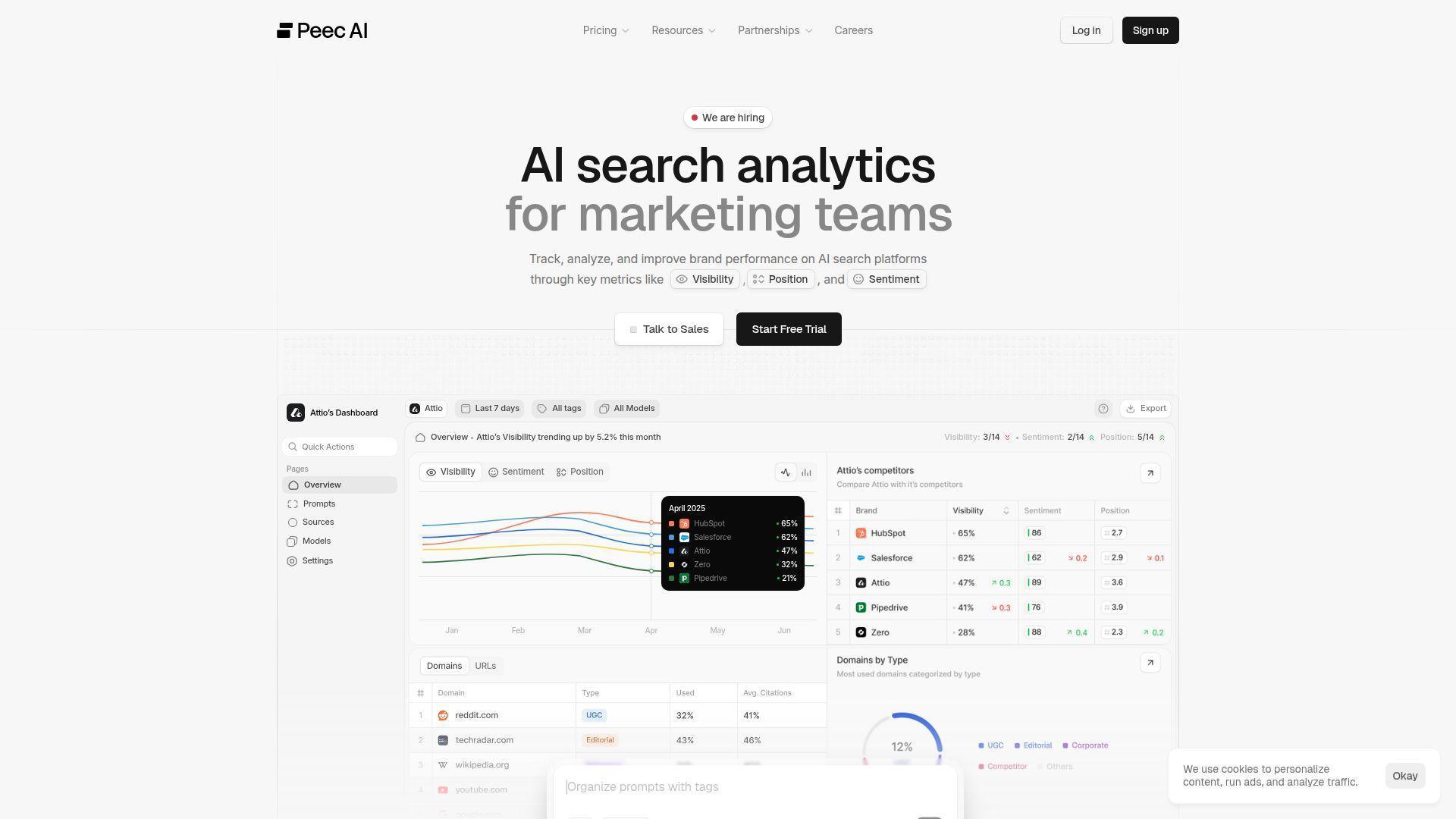
Peec.ai has carved out a strong niche with its multilingual capabilities, supporting ChatGPT tracking across 115+ languages. For global brands that need to monitor how ChatGPT represents them in French, German, Japanese, Arabic, and dozens of other languages, Peec AI is the clear specialist.
Why Peec AI stands out
Multilingual AI tracking is deceptively complex. ChatGPT’s responses vary significantly across languages — a brand might be recommended in English queries but completely absent in Spanish ones. Peec AI handles this by executing prompts natively in each target language and applying language-specific parsing and sentiment analysis. The breadth of language coverage (115+) is unmatched in the category.
Key features
- ChatGPT tracking in 115+ languages
- Multi-model support including Gemini, Perplexity, and Microsoft Copilot
- Language-specific sentiment analysis
- Regional visibility comparison dashboards
- Automated multilingual prompt generation
Watch-outs
- Higher starting price point at €89/mo reflects the multilingual capabilities
- May be more tool than you need if you only operate in one or two languages
- Interface complexity increases with the number of languages tracked
Pricing
Peec AI starts at €89/month. Pricing scales with the number of languages and prompts tracked. Custom enterprise plans are available for global brands with extensive language requirements.
4. AIclicks — best for prompt-level ChatGPT audits
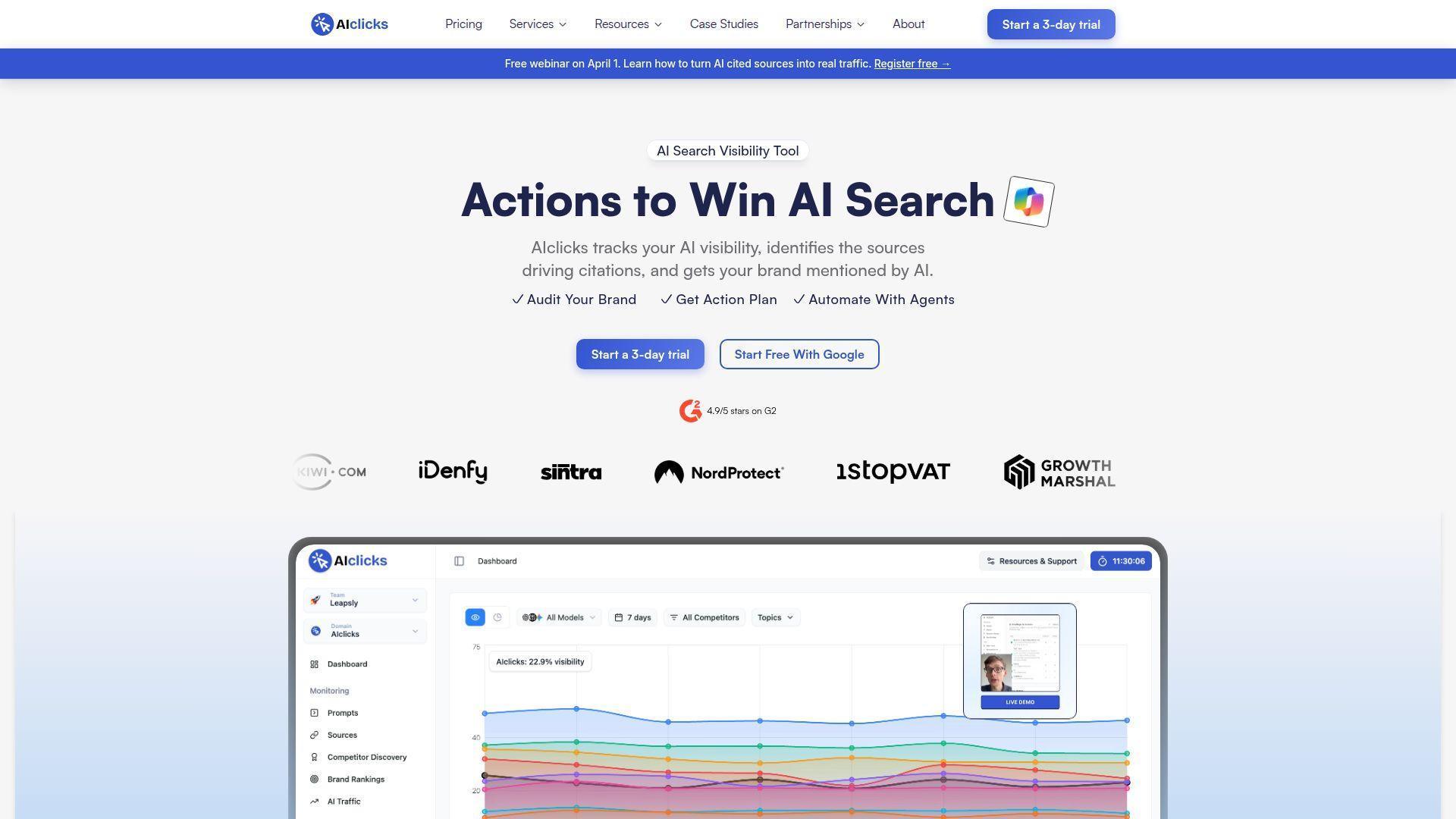
AIclicks focuses on giving marketers granular, prompt-by-prompt visibility into ChatGPT responses. If you want to understand exactly what happens when someone asks ChatGPT a specific question about your industry, AIclicks provides the most detailed prompt-level audit data in the category.
Why AIclicks stands out
While most tools aggregate data across prompts, AIclicks makes it easy to drill down into individual prompt-response pairs. You can see the exact wording ChatGPT used, where your brand appeared in the response, what competitors were mentioned alongside you, and which sources were cited — all for each specific prompt. This level of granularity is valuable for content strategists who want to reverse-engineer what drives AI mentions.
Key features
- Detailed prompt-by-prompt response analysis
- Side-by-side comparison of responses across ChatGPT, Gemini, and Perplexity
- Response position tracking (where your brand appears within a response)
- Historical prompt response comparison
- Exportable audit reports
Watch-outs
- The granular focus can mean less polished high-level dashboards compared to competitors
- Smaller AI model coverage than some alternatives
- Best suited for hands-on analysts rather than executive-level reporting
Pricing
AIclicks starts at $49/month. Higher tiers increase the number of prompts and competitors you can track. A limited free trial is available.
5. Profound — best for enterprise compliance
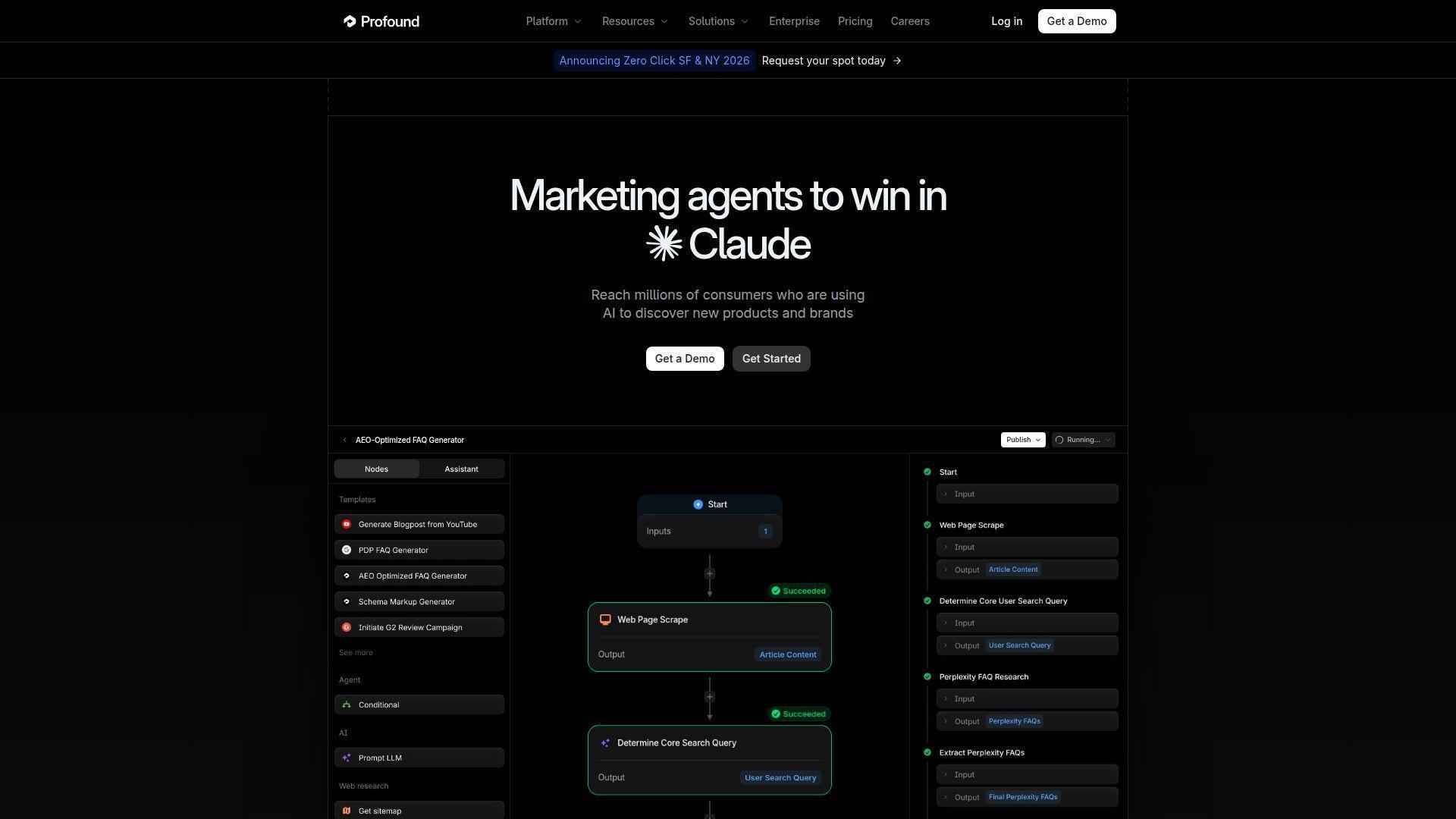
Profound targets enterprise organizations that need ChatGPT tracking with the compliance and security standards that large companies require. With SOC 2 and HIPAA compliance, Profound is built for regulated industries like healthcare, finance, and government contracting.
Why Profound stands out
For enterprise buyers, the tool itself is only part of the decision — compliance, security, and integration capabilities matter just as much. Profound checks all the enterprise boxes: SOC 2 Type II certification, HIPAA compliance, SSO integration, role-based access controls, and dedicated customer success managers. The ChatGPT tracking itself is comprehensive, but the enterprise wrapper is what justifies the premium price.
Key features
- SOC 2 Type II and HIPAA compliant infrastructure
- Multi-model ChatGPT tracking with enterprise-grade data handling
- Custom prompt execution schedules (daily or custom cadence)
- SSO and role-based access control
- Dedicated customer success and onboarding
- Custom API integrations and data exports
Watch-outs
- Starting price of $499/mo puts it well above most alternatives
- Enterprise sales cycle — expect demos and contract negotiations rather than self-serve signup
- May be overkill for small-to-mid-size teams without compliance requirements
Pricing
Profound starts at $499/month with annual contracts. Custom enterprise pricing is available based on prompt volume, model coverage, and compliance requirements.
6. Scrunch AI — best enterprise analytics
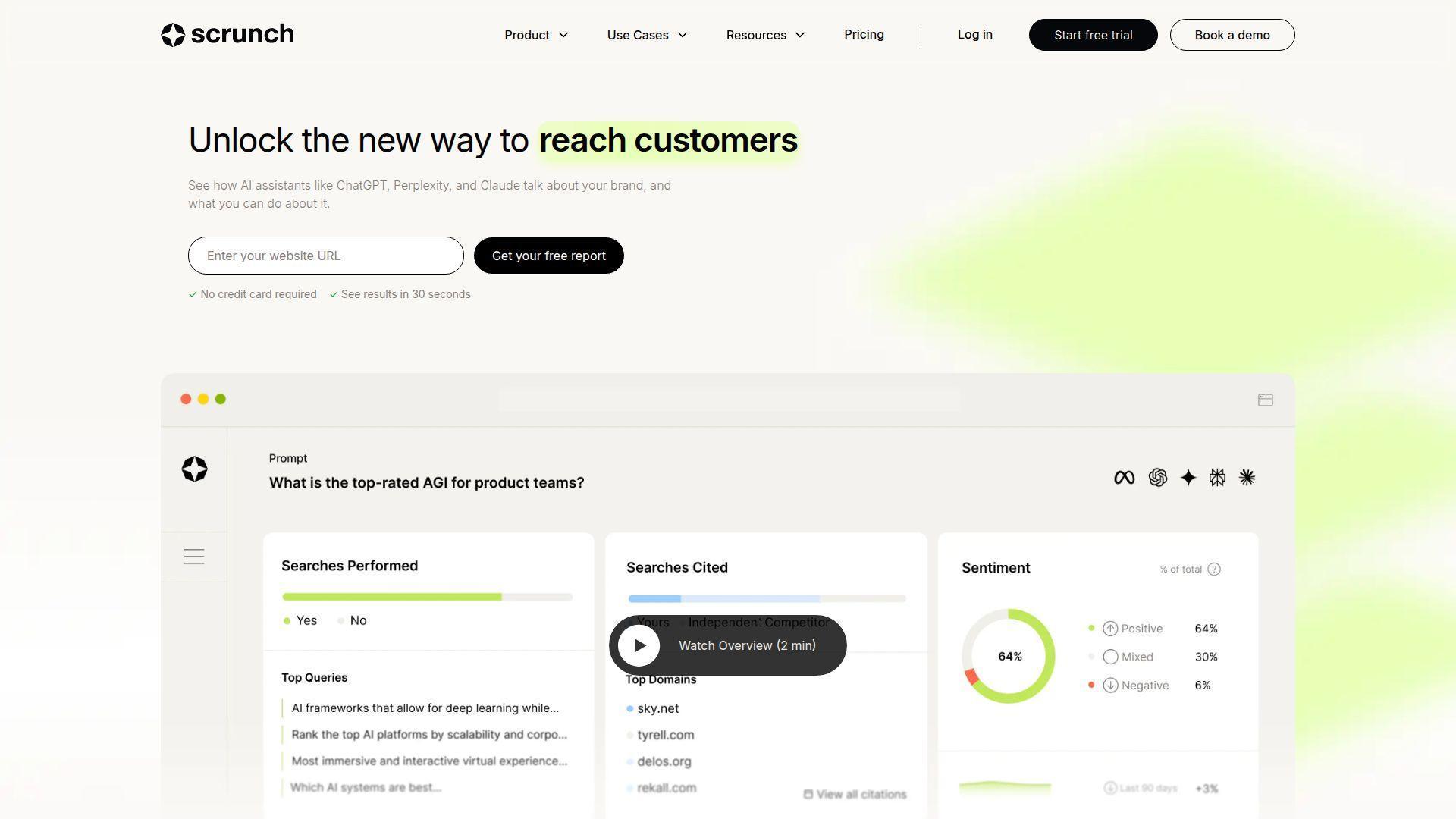
Scrunch AI positions itself as an enterprise-grade AI analytics platform with deep ChatGPT tracking capabilities. The platform combines brand monitoring with advanced analytics features designed for data teams that want to slice AI visibility data in sophisticated ways.
Why Scrunch AI stands out
Scrunch AI’s analytics layer is genuinely powerful. Beyond basic mention tracking and sentiment analysis, the platform offers cohort analysis, statistical significance testing for visibility changes, and custom metric definitions. SOC 2 compliance makes it suitable for enterprise deployment, and the API is robust enough for teams that want to build custom dashboards or feed AI visibility data into their existing BI stack.
Key features
- Advanced analytics with cohort analysis and trend decomposition
- SOC 2 compliant infrastructure
- Daily refresh cadence for faster visibility into changes
- Robust API for custom integrations
- Multi-model tracking across major AI platforms
- Custom metric builder for specialized reporting needs
Watch-outs
- $300/mo starting price positions it as a premium option
- The depth of analytics features can feel overwhelming for smaller teams
- Onboarding requires time investment to fully leverage the platform’s capabilities
Pricing
Scrunch AI starts at $300/month. Enterprise plans with advanced features and custom SLAs are available. Demo required for onboarding.
7. Otterly AI — best known ChatGPT tracker
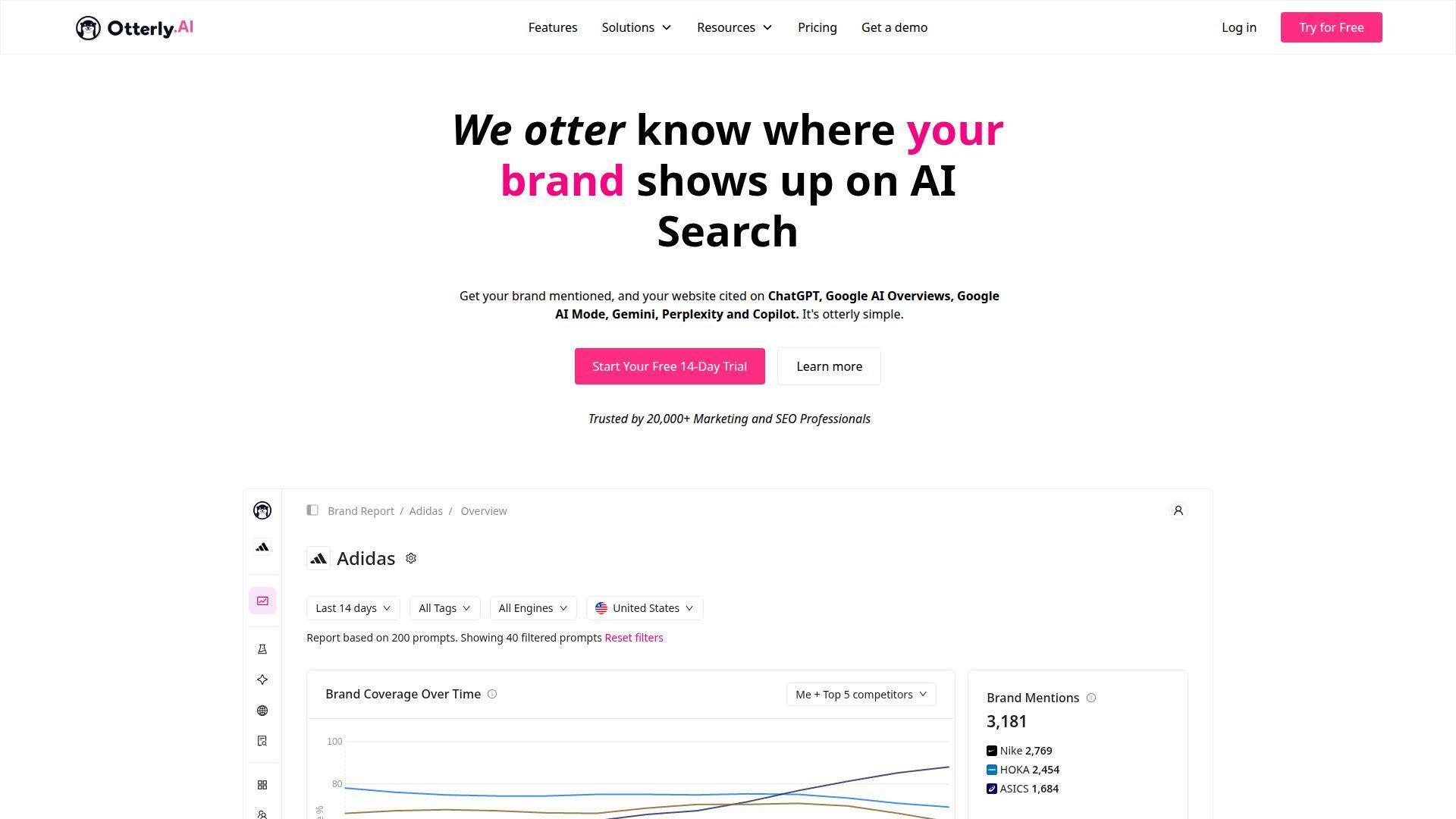
Otterly AI is arguably the most recognized name in the ChatGPT tracking space. As one of the first tools built specifically for monitoring AI model responses, it has established a loyal user base and a track record that newer entrants are measured against.
Why Otterly AI stands out
Brand recognition and community matter. Otterly AI has extensive documentation, a well-established knowledge base, and an active user community sharing best practices. The tool covers the fundamentals well — ChatGPT mention tracking, competitor monitoring, and basic sentiment indicators — at a price point that’s accessible to smaller teams. The Lite plan at $29/mo makes it an easy entry point for teams just starting with AI visibility monitoring.
Key features
- Core ChatGPT mention tracking with competitor benchmarking
- Multi-model support including Gemini, Perplexity, and Microsoft Copilot
- Established platform with proven reliability
- Active user community and extensive documentation
- Simple, intuitive dashboard design
Watch-outs
- Feature depth has been surpassed by newer competitors, particularly in citation tracking and sentiment analysis
- The Lite plan is limited in prompt volume and model coverage
- Higher-tier plans needed to unlock the full feature set can add up quickly
Pricing
Otterly AI’s Lite plan starts at $29/month. Pro and Business plans offer increased prompt limits and additional features at higher price points.
8. Semrush AI Toolkit — best for existing Semrush users
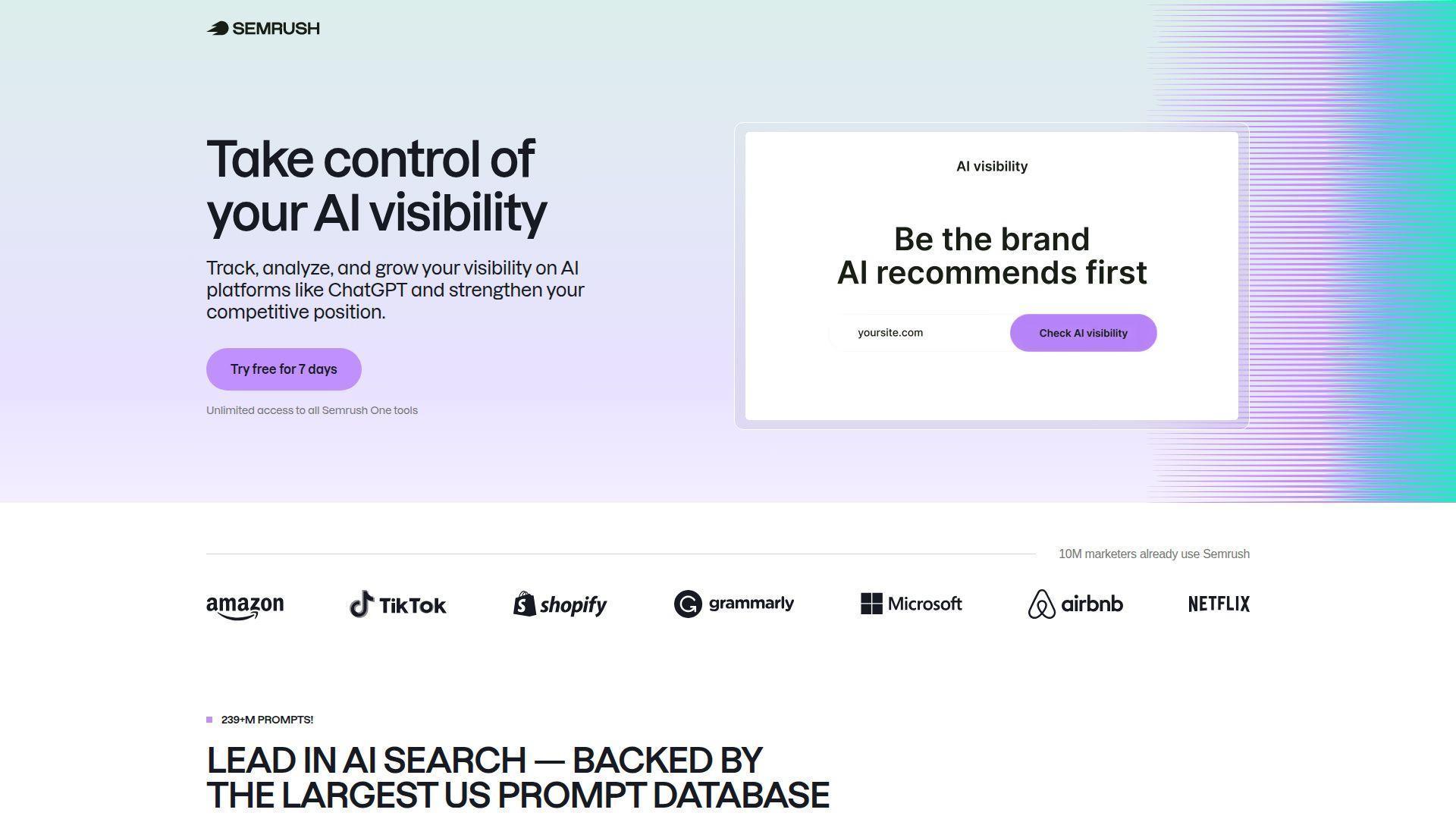
Semrush hardly needs an introduction in the SEO world, and their AI Toolkit brings ChatGPT tracking capabilities into the platform that millions of marketers already use daily. If your team lives in Semrush, adding AI tracking without switching to a new tool has obvious appeal.
Why Semrush AI Toolkit stands out
The value proposition is integration. Your AI visibility data sits alongside your keyword rankings, backlink profiles, site audits, and content analytics. For teams that have built their entire SEO workflow around Semrush, the ability to add ChatGPT monitoring without learning a new platform or managing another subscription is compelling. The AI tracking data also benefits from Semrush’s massive keyword database and competitive intelligence capabilities.
Key features
- ChatGPT and Google AI Overviews tracking integrated into the Semrush ecosystem
- Unified dashboard combining traditional SEO and AI visibility metrics
- Leverages Semrush’s existing keyword and competitor databases
- Seamless workflow for teams already using Semrush
- Reporting that combines SEO and AI metrics in single views
Watch-outs
- AI tracking is a secondary feature, not the core product — updates and depth may lag behind dedicated tools
- Requires an existing Semrush subscription, which starts at $139.95/mo
- Coverage of AI models beyond Google’s ecosystem may be limited
Pricing
The AI Toolkit is available as an add-on to existing Semrush plans. Semrush base plans start at $139.95/month, with AI features included in higher tiers or available as add-ons.
9. AthenaHQ — best for data-driven teams
AthenaHQ takes a credit-based approach to ChatGPT tracking, giving data-driven teams the flexibility to allocate resources across different types of analysis. The platform appeals to teams that want maximum control over how they spend their tracking budget.
Why AthenaHQ stands out
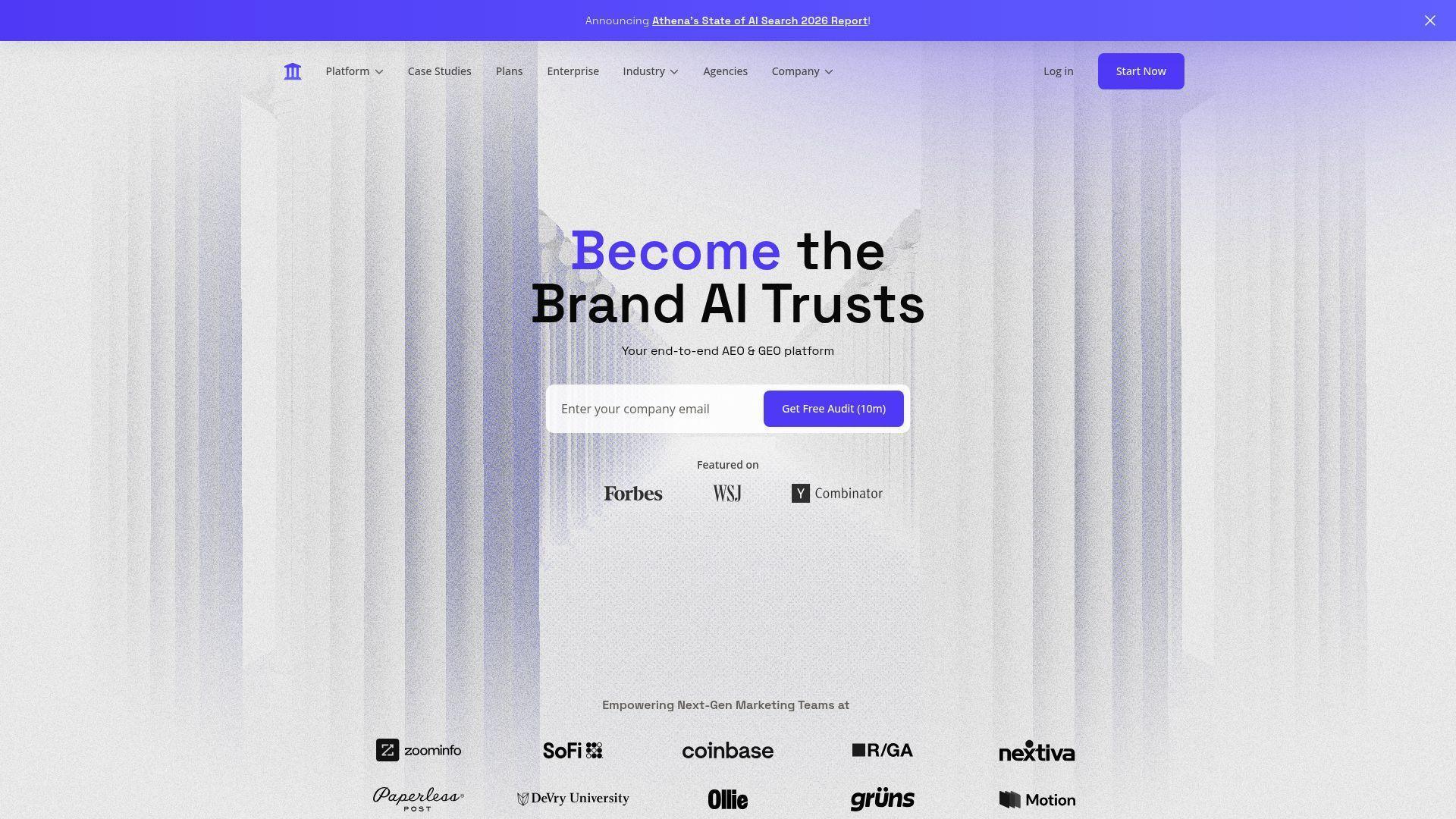
The credit-based model is AthenaHQ’s defining feature. Instead of fixed prompt limits, you get a pool of credits that can be used for ChatGPT tracking, Perplexity analysis, deep sentiment dives, or competitive benchmarking — in whatever proportions your team needs. This flexibility is valuable for teams whose tracking needs vary significantly month to month, or for agencies managing multiple clients with different priorities.
Key features
- Flexible credit-based system for on-demand analysis
- Multi-model tracking with customizable depth per analysis
- Advanced data export and API access for custom analytics pipelines
- Collaborative workspaces for team-based analysis
- Custom prompt library management
Watch-outs
- Credit-based pricing can be unpredictable if usage spikes
- $295/mo starting price is on the higher end for teams that may not use all credits
- Requires more active management than set-and-forget subscription tools
Pricing
AthenaHQ starts at $295/month with a set number of credits. Additional credit packs are available, and enterprise plans offer custom credit allocations.
10. Similarweb — best for market-level ChatGPT intelligence
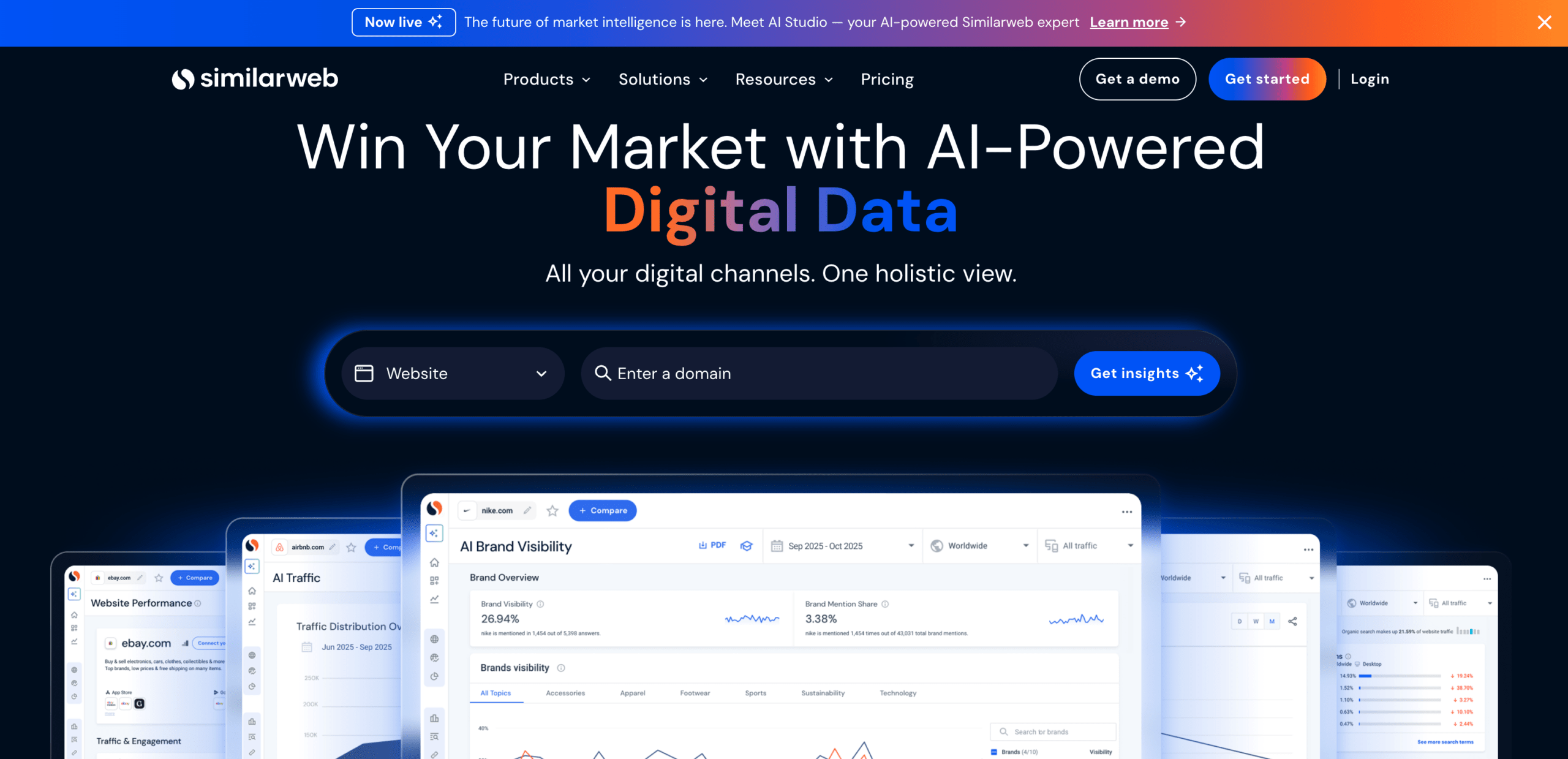
Similarweb brings its market intelligence pedigree to AI tracking, offering a unique perspective on how ChatGPT drives traffic and shapes market dynamics at the macro level. Rather than focusing on individual brand mentions, Similarweb excels at painting the big picture of AI’s impact on your industry.
Why Similarweb stands out
Similarweb’s strength has always been market-level data, and their AI tracking follows the same philosophy. The platform can show you how much referral traffic ChatGPT drives to your site versus competitors, how AI-driven discovery is shifting market share in your category, and which brands are gaining or losing ground in AI-mediated brand discovery. This macro-level intelligence is difficult to get from tools focused on prompt-level tracking.
Key features
- Market-level AI traffic analysis and referral tracking
- Industry-wide AI visibility benchmarking
- ChatGPT referral traffic measurement and trend analysis
- Competitive market share data across AI channels
- Integration with Similarweb’s broader digital intelligence platform
Watch-outs
- Custom pricing means no transparent self-serve option
- Less granular at the prompt level than dedicated ChatGPT tracking tools
- Best suited for strategic analysis rather than tactical content optimization
Pricing
Similarweb uses custom pricing based on features and scale. Contact their sales team for a quote. Enterprise plans are the primary offering.
11. Promptmonitor — best budget option
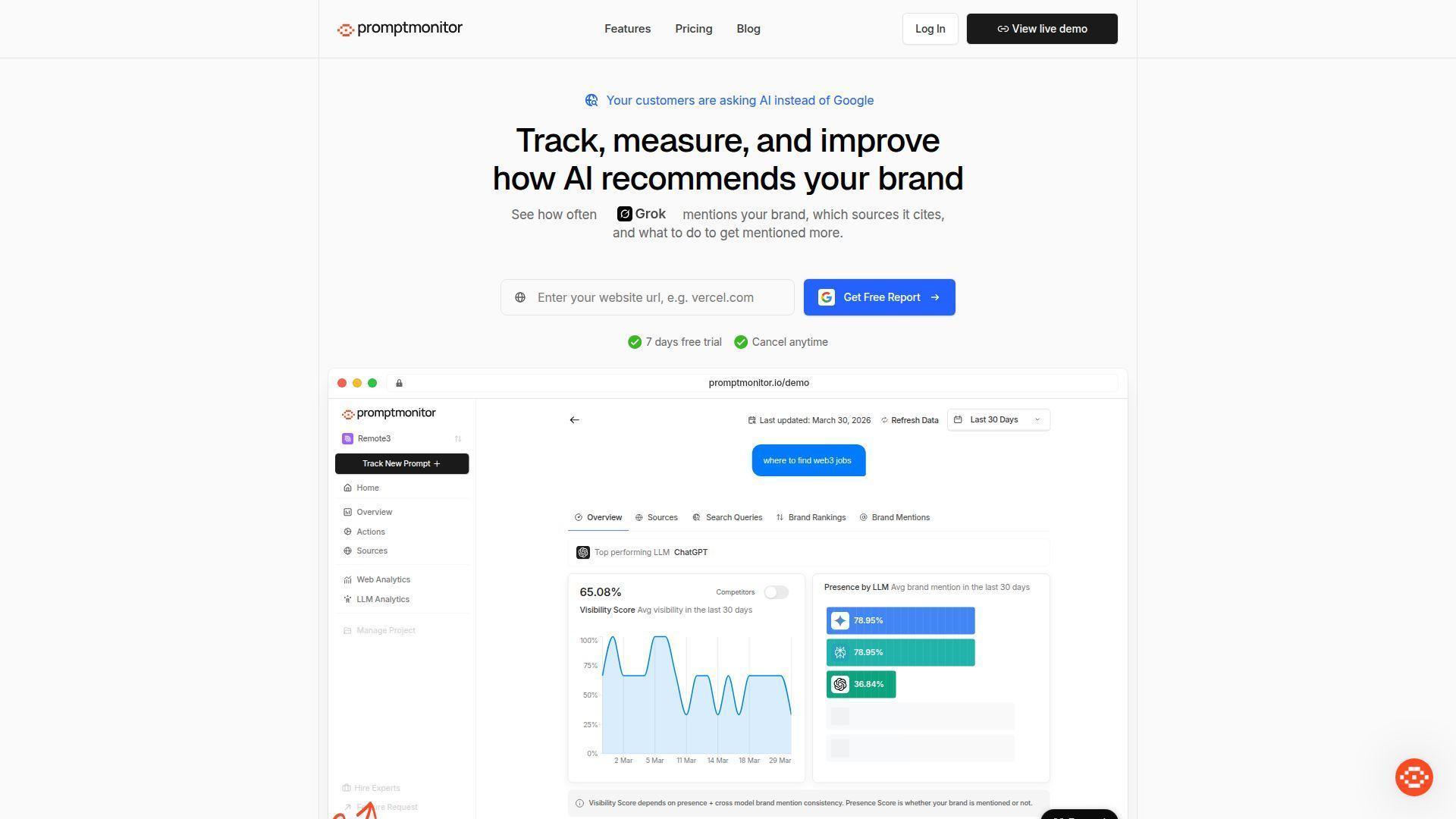
Promptmonitor delivers ChatGPT tracking at one of the lowest price points in the market, making it an excellent entry point for small teams and startups that want AI visibility data without a significant budget commitment. With support for 8+ AI models, it offers surprising breadth for the price.
Why Promptmonitor stands out
At $29/month, Promptmonitor removes the financial barrier to AI visibility tracking. The tool covers the basics well: prompt execution against ChatGPT and other models, brand mention detection, and basic competitive tracking. For teams that are just beginning to take AI visibility seriously and want to validate the concept before investing in a premium tool, Promptmonitor is a low-risk starting point.
Key features
- Support for 8+ AI models including ChatGPT, Gemini, and Perplexity
- Core brand mention tracking and competitor monitoring
- Basic share of voice metrics
- Simple, no-frills dashboard
- Weekly refresh cadence
Watch-outs
- Feature depth is limited compared to premium alternatives — sentiment analysis and citation tracking may be basic or absent
- Dashboard and reporting capabilities are functional but not sophisticated
- Prompt volume limits on the base plan may feel restrictive for larger operations
Pricing
Promptmonitor starts at $29/month. Higher tiers with increased prompt limits and additional features are available.
12. GEO Metrics — best for broad AI model coverage
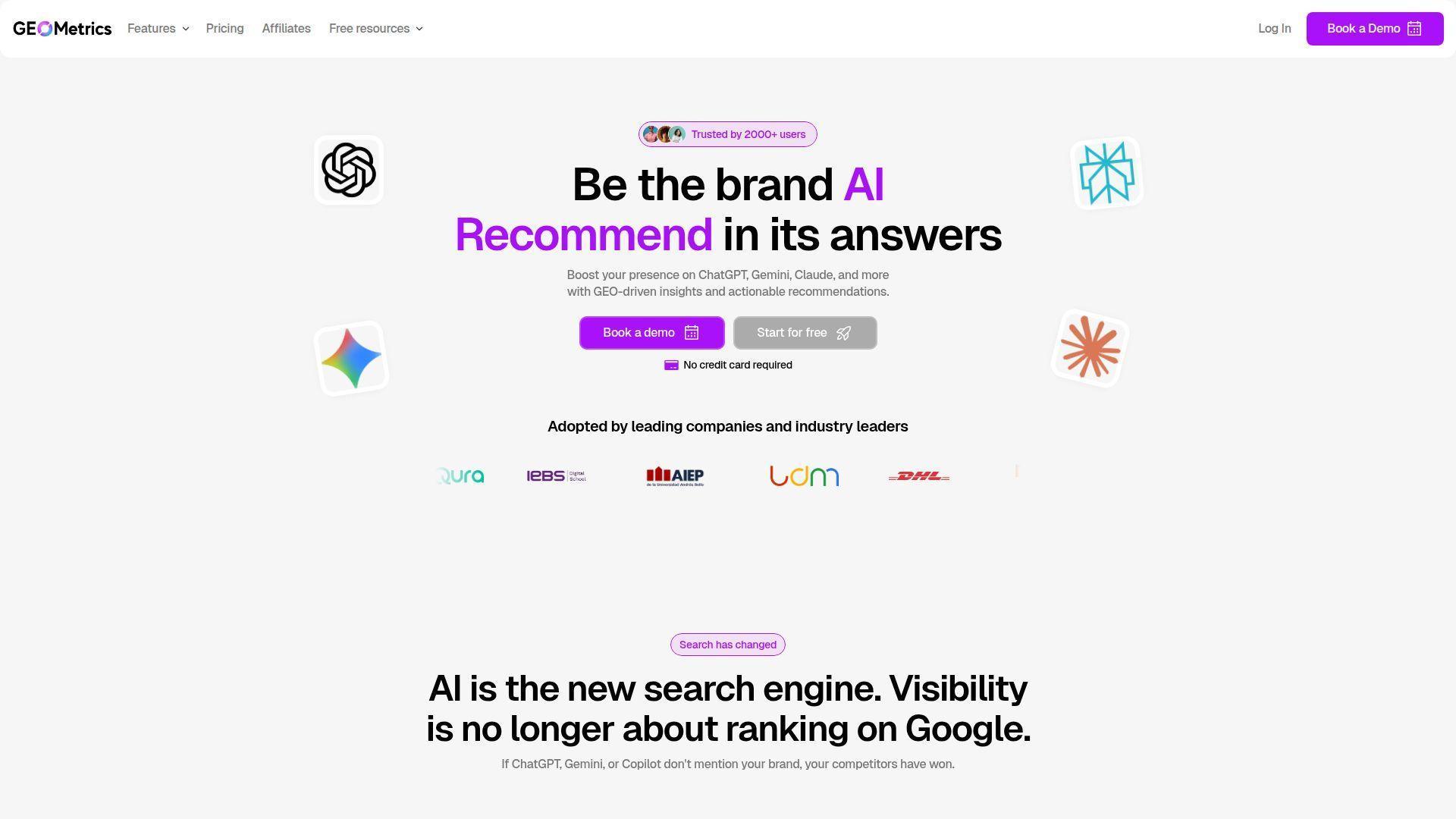
GEO Metrics takes a breadth-first approach to AI tracking, supporting 15+ AI engines including ChatGPT, Gemini, Perplexity, Claude, and several emerging models. If your brand needs to monitor visibility across the widest possible range of AI platforms, GEO Metrics covers more ground than most alternatives.
Why GEO Metrics stands out
The AI landscape is fragmenting. While ChatGPT dominates headlines, a significant and growing share of AI-driven brand discovery happens across Perplexity, Gemini, Claude, and region-specific models. GEO Metrics monitors 15+ of these engines simultaneously, giving you the broadest view of your AI visibility across the entire ecosystem. For brands that can’t afford blind spots in emerging AI channels, this breadth is valuable.
Key features
- Tracking across 15+ AI engines — the widest coverage in this roundup
- Unified cross-model visibility dashboard
- Model-by-model performance comparison
- Emerging AI model tracking as new platforms gain adoption
- Weekly refresh across all monitored models
Watch-outs
- Breadth of coverage may come at the expense of depth on any single model
- €80/mo starting price is mid-range — not the cheapest, not the most expensive
- Some of the 15+ models tracked may not be relevant to your market
Pricing
GEO Metrics starts at €80/month. Pricing scales with the number of brands, prompts, and models tracked.
13. Rankscale AI — best for multi-model tracking at budget price
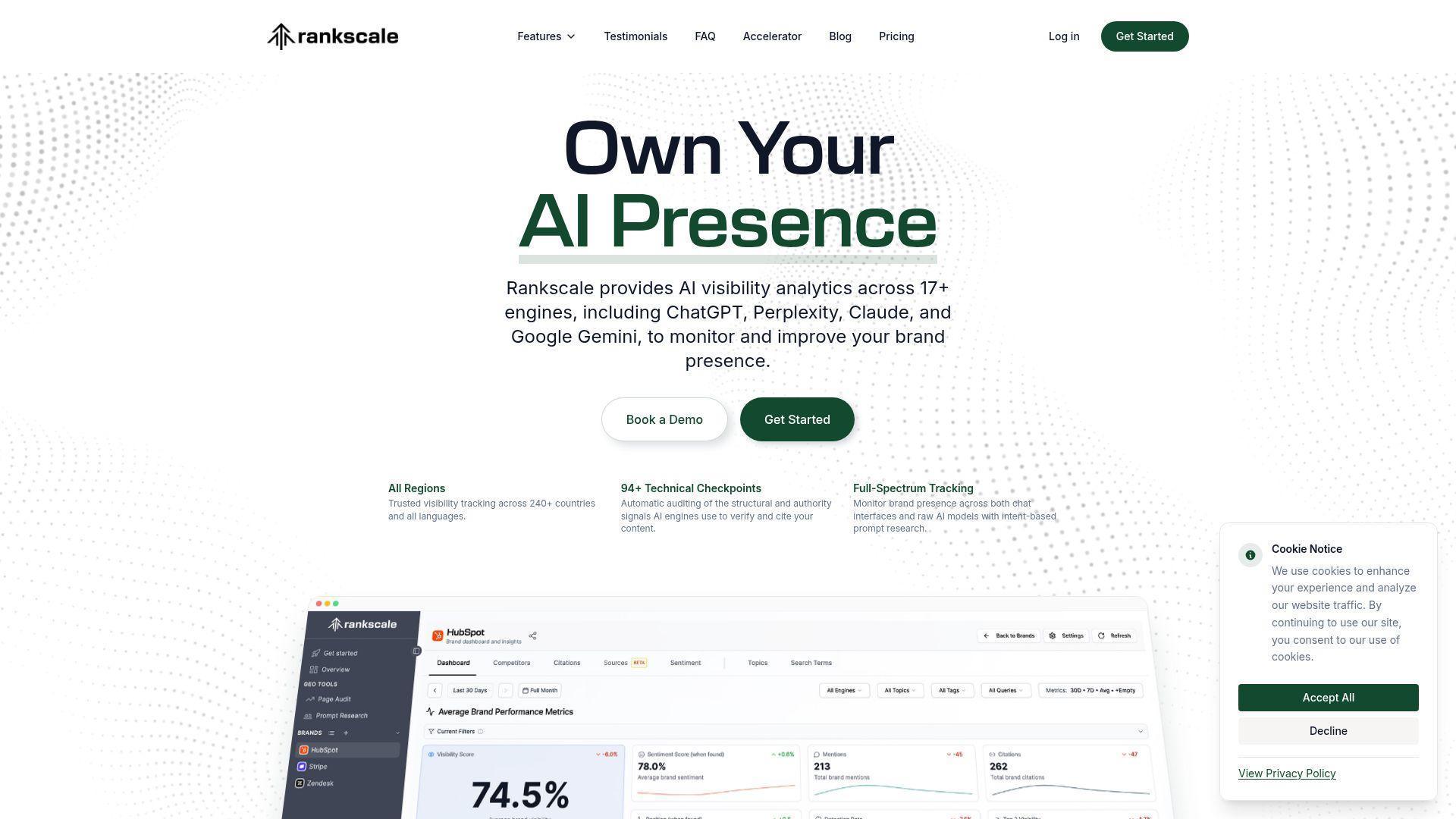
Rankscale AI hits a sweet spot between multi-model coverage and affordability. The platform tracks your brand across multiple AI models — including ChatGPT — at a price point that undercuts most competitors offering similar breadth.
Why Rankscale AI stands out
If you want multi-model tracking but can’t justify the price tags of enterprise platforms like Scrunch AI or Profound, Rankscale AI offers a compelling middle ground. The platform monitors ChatGPT, Gemini, Perplexity, and other models with clean dashboards and straightforward reporting. It’s not the most feature-rich option, but the value-for-money ratio is strong.
Key features
- Multi-model tracking across ChatGPT, Gemini, Perplexity, and more
- Clean, intuitive dashboard design
- Competitive tracking and share of voice
- Affordable pricing for multi-model coverage
- Weekly refresh cadence
Watch-outs
- Newer platform with a smaller user base and less community support
- Advanced features like citation tracking and deep sentiment analysis may be limited
- Integration options are more limited than established platforms
Pricing
Rankscale AI starts at $39/month, making it one of the more affordable multi-model tracking options available.
14. Rankshift — best for competitive ChatGPT analysis
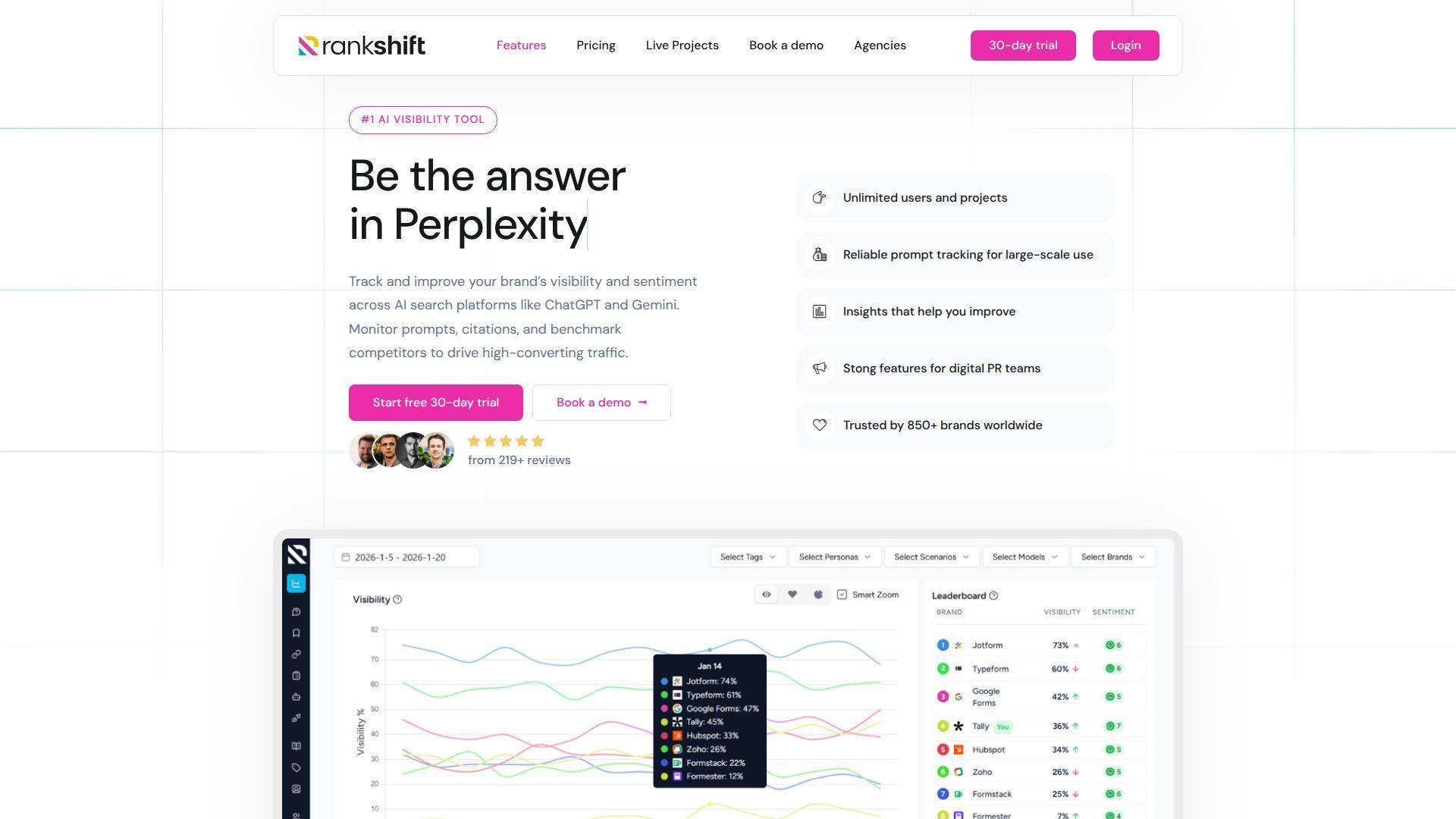
Rankshift puts competitive intelligence at the center of its ChatGPT tracking experience. While most tools focus on your own brand’s visibility, Rankshift is designed for teams that are primarily interested in understanding how they stack up against specific competitors in AI responses.
Why Rankshift stands out
The competitive analysis features are where Rankshift shines. The platform makes it easy to set up head-to-head comparisons, track how competitor visibility changes over time, and identify the specific prompts where competitors appear but you don’t. For teams in highly competitive markets where understanding your AI positioning relative to rivals is the primary use case, Rankshift provides a focused and effective toolkit.
Key features
- Head-to-head competitive comparison dashboards
- Competitor visibility trend tracking over time
- Gap analysis showing prompts where competitors appear but you don’t
- Multi-model comparison across ChatGPT, Perplexity, and Gemini
- Competitive share of voice breakdowns
Watch-outs
- The competitive focus means some features like citation tracking and content optimization are less developed
- $59/mo starting price is mid-range
- Best for teams with a clear competitive analysis use case — less suited for general AI visibility monitoring
Pricing
Rankshift starts at $59/month. Plans scale based on the number of competitors and prompts tracked.
15. AI Peekaboo — best lightweight ChatGPT monitor
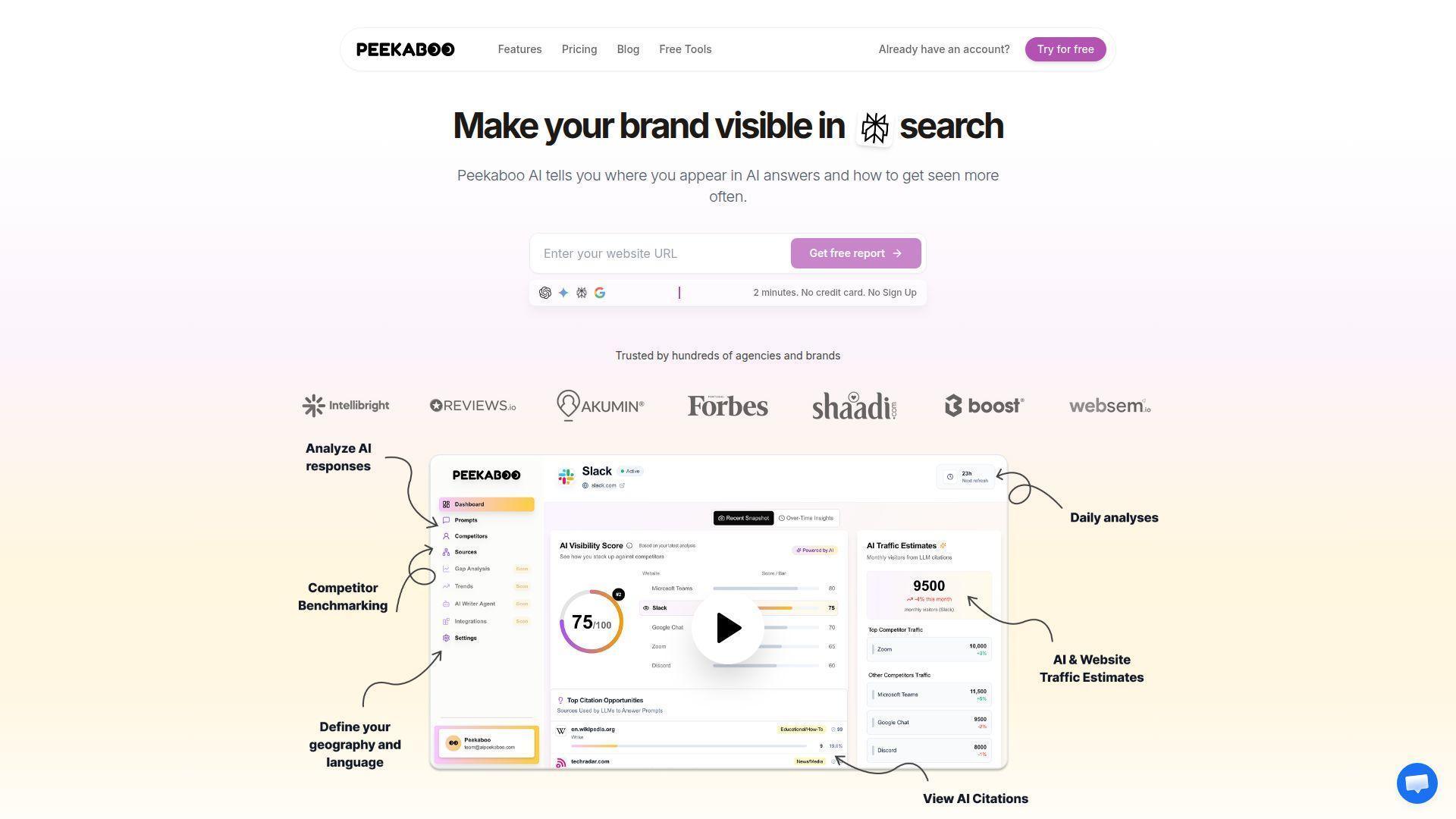
AI Peekaboo takes a minimalist approach to ChatGPT tracking. With a free tier available, it’s the most accessible entry point for brands that want to dip their toes into AI visibility monitoring without any financial commitment.
Why AI Peekaboo stands out
Sometimes you just want a simple answer to a simple question: “Does ChatGPT mention my brand?” AI Peekaboo strips away the complexity of enterprise dashboards and multi-model analytics to focus on delivering clear, straightforward answers. The free tier makes it possible to get started in minutes with zero risk, and the paid plans add depth gradually as your needs grow.
Key features
- Free tier for basic ChatGPT monitoring
- Simple, intuitive interface with minimal learning curve
- Quick setup — start monitoring in minutes
- Basic mention tracking and alerts
- Affordable paid plans for expanded tracking
Watch-outs
- Limited AI model coverage beyond ChatGPT
- Feature depth is minimal compared to comprehensive platforms
- Free tier restrictions may feel too limiting for serious monitoring needs
- Less suitable for teams that need detailed analytics and reporting
Pricing
AI Peekaboo offers a free tier with basic monitoring. Paid plans with expanded features are available at competitive price points.
16. Writesonic GEO — best for content optimization + ChatGPT tracking
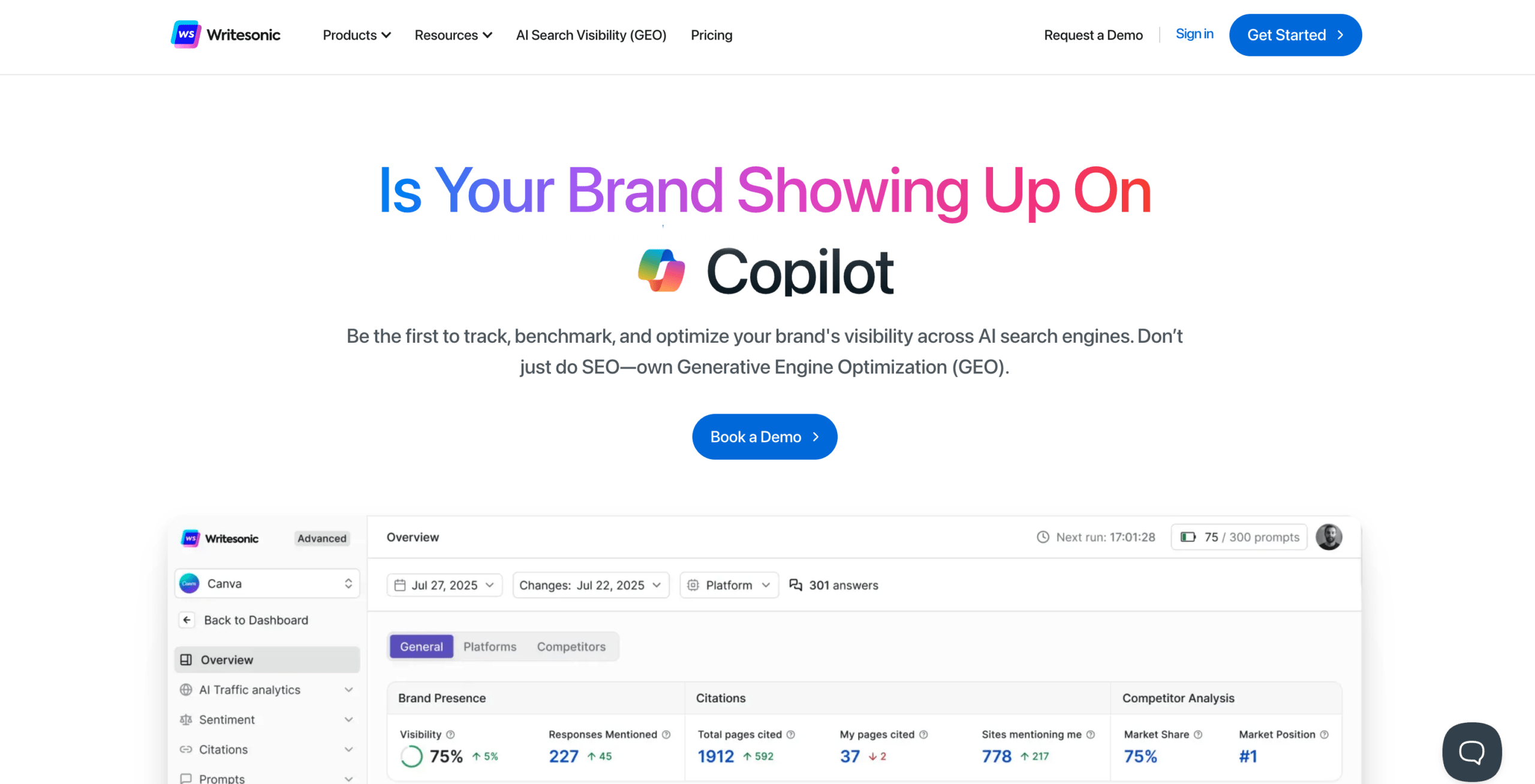
Writesonic GEO blends ChatGPT tracking with actionable content optimization recommendations. Instead of just showing you where your brand appears (or doesn’t) in AI responses, it provides specific guidance on how to improve your content to increase AI visibility.
Why Writesonic GEO stands out
Most ChatGPT tracking tools tell you the “what” but leave the “how to fix it” to you. Writesonic GEO bridges that gap with optimization recommendations tied to your tracking data. If ChatGPT isn’t mentioning your brand for a high-value prompt, the platform suggests content changes — structure, formatting, topic coverage, and source-worthiness signals — that could improve your chances of appearing in future AI responses.
Key features
- Combined tracking and content optimization in one platform
- AI-powered recommendations for improving AI visibility
- Multi-model tracking across ChatGPT and other platforms
- Content gap analysis based on AI response data
- Integration with Writesonic’s broader content creation tools
Watch-outs
- Optimization recommendations are algorithmically generated — not all suggestions will be equally actionable
- Tracking depth may be lighter than dedicated monitoring tools
- Best suited for content-focused teams rather than pure brand monitoring use cases
Pricing
Writesonic GEO starts at $49/month. Higher tiers include more advanced optimization features and increased tracking limits.
17. Hall AI — best for real-time ChatGPT monitoring
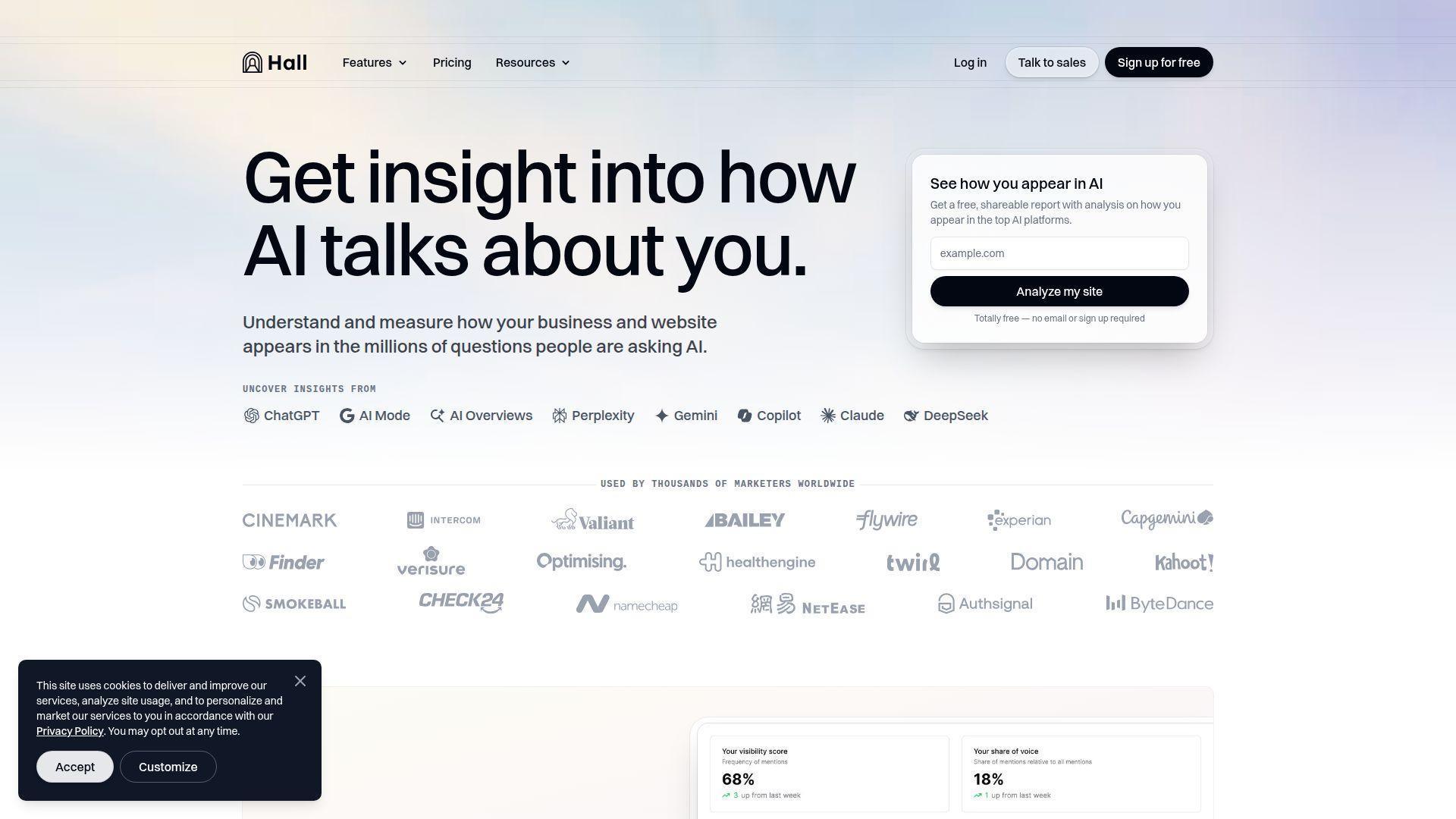
Hall AI differentiates itself with a focus on speed and freshness. While most ChatGPT tracking tools operate on weekly refresh cycles, Hall AI offers near real-time monitoring with daily updates and rapid alerting for significant visibility changes.
Why Hall AI stands out
For brands operating in fast-moving markets — crisis communications, product launches, competitive battles — waiting a week for updated AI visibility data can be too slow. Hall AI’s daily refresh cadence and real-time alerting system means you’ll know within hours if ChatGPT’s narrative about your brand has shifted. The alerting system can notify you immediately when your brand is mentioned, dropped, or when sentiment changes significantly.
Key features
- Daily refresh cadence — significantly faster than the weekly industry standard
- Near real-time alerts for visibility changes and sentiment shifts
- Multi-model monitoring across several major AI platforms
- Rapid response dashboard for time-sensitive monitoring
- Customizable alert thresholds and notification channels
Watch-outs
- $79/mo starting price reflects the higher operational cost of daily monitoring
- Real-time monitoring generates more data, which requires more time to analyze
- Daily refresh means higher API costs, which may limit prompt volumes compared to weekly tools
Pricing
Hall AI starts at $79/month. Plans scale based on monitoring frequency, prompt volume, and alert configurations.
18. Nightwatch — best for SEO teams adding ChatGPT tracking
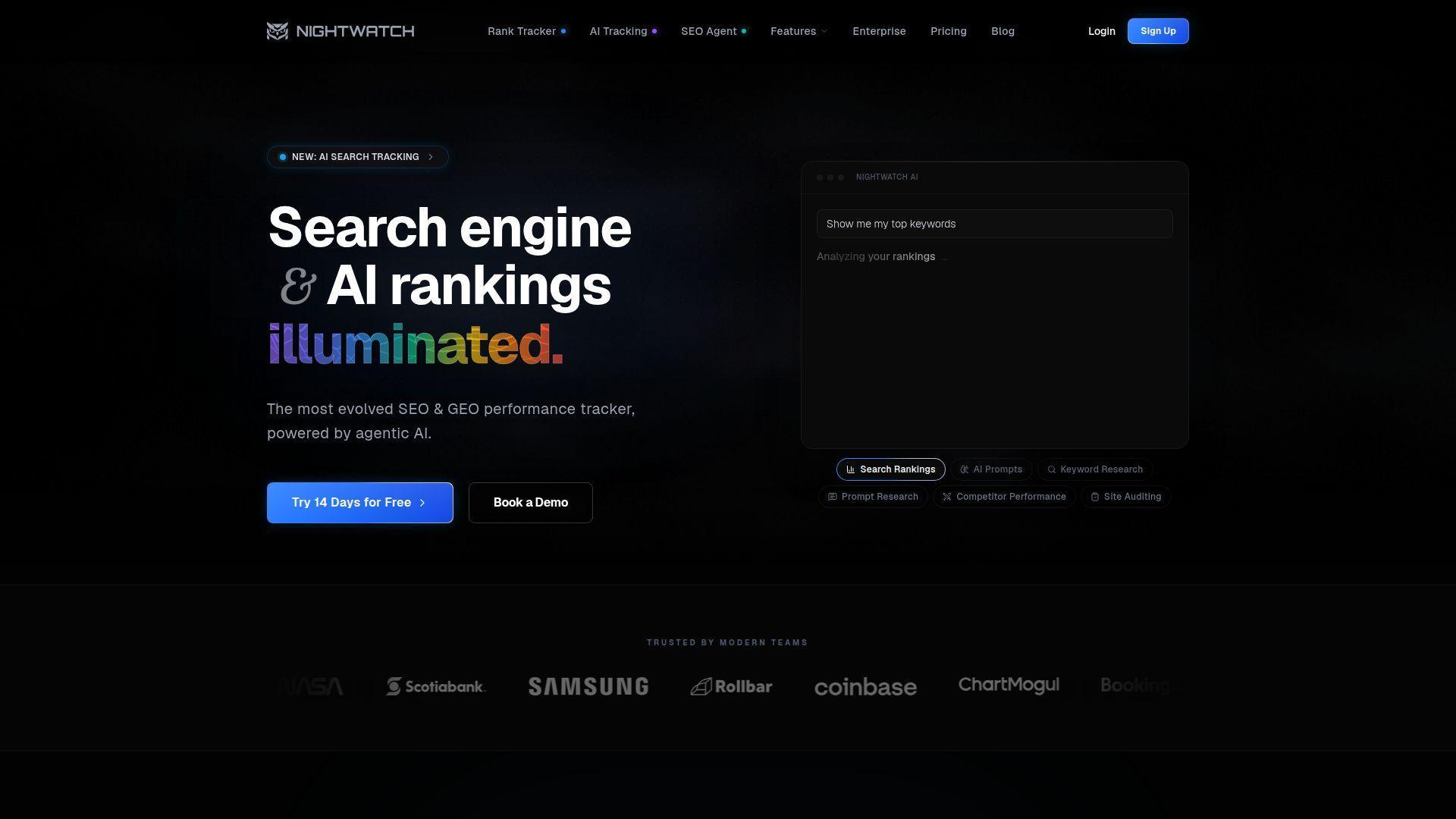
Nightwatch is an established SEO rank tracking tool that has added ChatGPT monitoring capabilities for teams that want to track AI visibility without abandoning their existing SEO workflow. It’s a pragmatic choice for SEO professionals who want incremental AI tracking rather than a full platform switch.
Why Nightwatch stands out
Nightwatch has a loyal user base among technical SEO teams, and the addition of ChatGPT tracking means those teams can start monitoring AI visibility without changing their workflow. The integration is straightforward — ChatGPT data appears alongside your existing rank tracking dashboards, backlink monitoring, and SERP analysis. For teams that want to add AI tracking as a capability rather than adopt it as a new discipline, Nightwatch offers the smoothest transition.
Key features
- ChatGPT tracking as an add-on to established SEO rank tracking
- Unified dashboard for SEO and AI visibility metrics
- Technical SEO tools (site audit, backlink monitoring) alongside AI tracking
- Custom reporting that combines traditional and AI metrics
- Established platform with reliable infrastructure
Watch-outs
- AI tracking is a secondary feature, so depth and updates may lag behind dedicated tools
- Limited coverage of AI models beyond ChatGPT
- The tool is primarily designed for SEO — AI tracking is an enhancement, not the core product
Pricing
Nightwatch starts at $49/month for the core platform. ChatGPT tracking features are available in higher-tier plans.
How to choose the right ChatGPT tracker
With 18 tools to choose from, picking the right one comes down to understanding your specific needs, budget, and technical requirements. Here’s a decision framework to help you narrow the field:
Start with your primary use case
- Comprehensive AI visibility: If you want the deepest, most complete picture of how your brand appears across ChatGPT and other AI models, LLM Pulse is the strongest choice. It covers mentions, citations, sentiment, and share of voice across multiple models.
- SEO + AI in one tool: If you already use an SEO platform and want to add AI tracking without a separate subscription, look at SE Ranking, Semrush AI Toolkit, or Nightwatch.
- Enterprise and compliance: If you need SOC 2, HIPAA, or SSO, your realistic options are Profound and Scrunch AI.
- Budget-conscious: If you’re just starting out and want to minimize spend, Promptmonitor, Otterly AI (Lite), or AI Peekaboo (free tier) are the most accessible entry points.
- Multilingual: If you operate globally and need tracking across many languages, Peec AI is the specialist.
Consider your budget
The market spans from free (AI Peekaboo) to $499+/month (Profound). Mid-range options in the $49-$89/month range — including LLM Pulse, AIclicks, and GEO Metrics — offer the best balance of features and value for most teams.
Evaluate model coverage needs
If ChatGPT is your only concern, any tool on this list will work. But if you need visibility across Perplexity, Gemini, Claude, and AI Overviews as well, prioritize tools like LLM Pulse, GEO Metrics, and Promptmonitor that offer broad multi-model coverage.
Check refresh cadence requirements
Weekly refresh is the standard and works well for most brands. If you need faster data for crisis monitoring or competitive battles, Hall AI (daily) or Profound (custom cadence) are worth the premium.
Factor in team size
Per-seat pricing can add up quickly for larger teams. LLM Pulse‘s unlimited seats model is a significant advantage for teams of 5+ people, while credit-based tools like AthenaHQ may work better for small, focused analyst teams.
Summary
The ChatGPT tracking landscape has matured rapidly. In just over a year, we’ve gone from “does this category even exist?” to 18+ viable tools — each with distinct strengths.
LLM Pulse earns the top spot for its combination of depth (mentions, citations, sentiment, share of voice), breadth (ChatGPT, Perplexity, Gemini, AI Mode, AI Overviews), and value (€49/mo with unlimited seats and a 14-day free trial). It’s the most complete ChatGPT tracking solution for the price.
For teams with specific needs — multilingual tracking (Peec AI), enterprise compliance (Profound), budget constraints (Promptmonitor), or existing SEO platform integration (SE Ranking, Semrush, Nightwatch) — the specialized options above provide strong alternatives.
The one thing we’d recommend to every brand: start tracking your AI visibility now. ChatGPT’s influence on brand discovery is growing every month, and the brands that understand and optimize their AI presence today will have a significant advantage over those that start later.
FAQ
What exactly does a ChatGPT tracking tool track?
A ChatGPT tracking tool monitors how your brand appears in ChatGPT’s responses to relevant queries. This includes whether your brand is mentioned, in what context (recommendation, comparison, warning), what sentiment the mention carries, which sources ChatGPT cites, and how your visibility compares to competitors. The best tools track this across multiple AI models, not just ChatGPT.
How accurate is ChatGPT tracking data?
Tracking tools execute real prompts against ChatGPT’s API and parse actual responses, so the data reflects what ChatGPT genuinely says. However, ChatGPT responses can vary between sessions and users, so tracking data represents a statistically significant sample rather than a guarantee of what every user will see. Weekly tracking with diverse prompt sets provides the most reliable picture.
Can I track competitors in ChatGPT, not just my own brand?
Yes. Every tool in this roundup supports competitor tracking to some degree. Most allow you to add multiple competitor brands and compare their visibility, mention frequency, and sentiment against your own. Tools like Rankshift and LLM Pulse are particularly strong at competitive analysis with detailed share-of-voice breakdowns.
How often should I check my ChatGPT tracking data?
For most brands, a weekly review is sufficient — and that aligns with the refresh cadence of most tools. Focus on trends over time rather than single data points. If you’re in the middle of a product launch, PR crisis, or major competitive shift, daily monitoring (via tools like Hall AI) may be worth the premium.
Does optimizing for ChatGPT visibility conflict with traditional SEO?
Not at all. The content practices that improve AI visibility — comprehensive topic coverage, authoritative sourcing, clear structure, and factual accuracy — also support strong SEO performance. In fact, many teams find that optimizing for AI visibility produces content improvements that benefit both channels simultaneously.
Is ChatGPT tracking relevant if my industry is niche?
Absolutely. In fact, niche industries can benefit even more from ChatGPT tracking because the competitive field is smaller. If there are only 5-10 brands in your niche, appearing in ChatGPT recommendations can represent a significant share of AI-driven discovery. Start with a free or low-cost tool to validate whether ChatGPT discusses your industry before committing to a premium platform.
What’s the difference between ChatGPT tracking and AI Overviews tracking?
ChatGPT tracking monitors your brand’s presence in ChatGPT’s conversational responses. AI Overviews tracking monitors how your brand appears in Google’s AI-generated summaries at the top of search results. Both are forms of AI visibility monitoring, but they track different platforms with different user intents. Tools like LLM Pulse track both from a single dashboard.
How long does it take to see meaningful ChatGPT tracking data?
You’ll get your first data points within a week of setting up any tool in this roundup. However, meaningful trend analysis requires 4-8 weeks of data to establish baselines and detect patterns. We recommend running a tool for at least two months before drawing strategic conclusions about your AI visibility trajectory.