Latest review: 11th of April, 2026.
What is AI optimization?
AI optimization is the practice of optimizing your brand’s content and online presence to appear in AI-generated search results. While traditional SEO focuses on ranking in Google’s blue links, AI optimization ensures your brand gets mentioned, recommended, and cited when users ask questions to AI-powered search engines.
Table of Contents
You may also see it referred to as GEO (Generative Engine Optimization) or AEO (Answer Engine Optimization). Regardless of the label, the goal is the same: making sure AI models know about your brand and recommend it to users.
“GEO is about strategically leveraging internet assets, both your own and those of others. On the owned side, that includes business assets like your website or app, but also marketing assets such as social media. At its core, GEO is about influencing how those assets are surfaced, interpreted, and cited by LLMs. You can call it GEO, or simply branding in the age of AI.
Why does this matter now? Because the way people discover brands is fundamentally changing. ChatGPT, Perplexity, Google Gemini, and Google AI Mode are increasingly the first place people turn when researching products, services, and solutions. If your brand doesn’t appear in these AI-generated answers, you’re invisible to a growing segment of your audience.
Traditional search engines show ten blue links and let users choose. AI search engines give one synthesized answer — and if your brand isn’t part of that answer, there’s no second page to scroll to.
How AI search engines decide what to show
Before diving into strategies, it helps to understand how AI search engines decide which brands and sources to include in their responses. There are five key factors:
Training data
Large language models learn from massive datasets scraped from the web. If your brand is well-represented in high-quality content across the internet, the model is more likely to “know” about you. This includes your website, news mentions, industry publications, forums, and more. Training data has a cutoff date, so historical presence matters.
Real-time retrieval (RAG)
Most AI search engines don’t rely solely on training data. They use Retrieval-Augmented Generation (RAG) to search the web in real time and pull in fresh information. Perplexity, Google AI Mode, and ChatGPT with browsing all use this approach. This means your current content and online presence directly influence what these models say about you today.
Authority signals
AI models weigh the authority and trustworthiness of sources. Domain authority, content quality, citation frequency, backlink profiles, and the reputation of the sites that mention you all play a role. A mention on a respected industry publication carries more weight than a mention on a low-quality blog.
Entity understanding
AI models build an internal understanding of entities — brands, people, products, concepts. The clearer and more consistent your brand identity is across the web, the better AI models can understand what you do, who you serve, and when to recommend you.
Recency
Freshness matters, especially for AI search engines that use real-time retrieval. Regularly updated content signals that your brand is active and your information is current. Stale content gets deprioritized.
10 strategies to optimize for AI search engines
1. Create comprehensive, expert-level content
AI models favor content that demonstrates genuine expertise and provides thorough, accurate information. Surface-level blog posts that merely scratch the topic won’t cut it.
What to do:
- Write long-form, in-depth guides that cover topics exhaustively
- Include original data, case studies, and real-world examples
- Cite credible sources and link to authoritative references
- Have subject matter experts author or review your content
- Update existing content regularly to keep it accurate and relevant
The goal is to become the source that AI models trust and cite. Think of every piece of content as a potential training signal for an LLM.
2. Build topical authority
AI models assess whether a brand or website is an authority on a given topic. Publishing one article on a subject isn’t enough — you need to demonstrate depth over breadth.
What to do:
- Build topic clusters: a pillar page covering a broad topic, supported by detailed articles on subtopics
- Interlink related content so both users and AI crawlers can follow the logical structure
- Cover your niche comprehensively rather than writing superficially about many unrelated topics
- Consistently publish content within your area of expertise over time
When an AI model repeatedly encounters your brand in the context of a specific topic, it builds a stronger association between your brand and that topic.
3. Use structured data and schema markup
Structured data helps AI models (and search engines) understand your content programmatically. Schema markup provides explicit context about what your page is about, who wrote it, what products you offer, and more.
What to do:
- Implement JSON-LD schema markup on all key pages (Organization, Product, Article, FAQ, HowTo, Review)
- Use the
Organizationschema to clearly define your brand name, logo, description, and social profiles - Add
Productschema with pricing, features, and reviews - Mark up FAQ sections with
FAQPageschema - Validate your markup using Google’s Rich Results Test
Structured data won’t guarantee inclusion in AI responses, but it makes it significantly easier for AI systems to extract and understand information about your brand.
If you want to move faster here, tools like our Schema Checker help you quickly audit your markup and spot issues.
4. Optimize for entity recognition
AI models understand the world through entities — named things like brands, people, places, and concepts. The stronger your entity presence, the more likely AI models are to recognize and recommend your brand.
What to do:
- Maintain a clear, consistent brand identity across all platforms
- Ensure your brand name, description, and key attributes are consistent everywhere (website, social media, directories, press mentions)
- Create or claim your Wikipedia and Wikidata entries if eligible
- Maintain consistent NAP (Name, Address, Phone) information across business directories
- Get listed on relevant industry directories and comparison sites
- Build a strong Google Business Profile
The more consistently and clearly your brand is represented across the web, the better AI models can build an accurate internal representation of who you are.
5. Get cited by authoritative sources
One of the strongest signals for AI models is being cited or mentioned by high-authority sources. This is the AI-age equivalent of earning backlinks — but the emphasis is even more on quality over quantity.
What to do:
- Invest in digital PR: get featured in industry publications, news outlets, and respected blogs
- Provide expert quotes and commentary to journalists (use platforms like HARO, Quoted, or Connectively)
- Publish original research that others will reference and cite
- Contribute guest articles to authoritative publications in your industry
- Build relationships with industry analysts and thought leaders
When multiple authoritative sources mention your brand in a specific context, AI models learn to associate your brand with that context and are more likely to include you in relevant responses.
The key is not just getting mentions, but knowing if they show up in AI answers. In this guide — How to track website citations in AI Search — you can see exactly how to track citations and understand which sources are actually influencing AI outputs.
“The way we see it, GEO is the discipline of influencing how large language models read the web around your brand. Not just your owned assets, but the wider ecosystem of mentions, citations, and references that shape perception. If those assets are not working together, AI visibility becomes fragmented. That is why GEO is increasingly becoming a core part of modern brand strategy.
6. Write content that answers questions directly
AI search engines are fundamentally question-answering systems. Content that directly and clearly answers specific questions is more likely to be surfaced in AI responses.
What to do:
- Research the actual questions your target audience asks (use tools like AlsoAsked, AnswerThePublic, or simply ask AI models what users want to know)
- Structure content in Q&A or FAQ format where appropriate
- Provide clear, concise definitions at the beginning of articles
- Use the “inverted pyramid” approach: lead with the answer, then provide supporting details
- Include a summary or TL;DR section for longer pieces
When your content clearly answers a question, AI models can easily extract that answer and attribute it to your brand.
7. Maintain an active, trustworthy online presence
AI models evaluate trust signals across the web. A brand with strong reviews, active social proof, and a healthy online reputation is more likely to be recommended.
What to do:
- Actively collect and respond to customer reviews on Google, G2, Capterra, Trustpilot, and industry-specific platforms
- Maintain active, engaged social media profiles
- Monitor and manage your brand’s online reputation
- Address negative feedback publicly and constructively
- Showcase social proof on your website (testimonials, case studies, trust badges)
AI models can synthesize information from reviews and social signals. If the overall sentiment around your brand is positive, that influences how AI models talk about you.
8. Create an llms.txt file
The llms.txt file is a relatively new convention that helps AI models understand your website. Similar to how robots.txt communicates with search engine crawlers, llms.txt provides structured information specifically designed for large language models.
What to do:
- Create a /llms.txt file at the root of your domain
- Include a clear description of your brand, products, and services
- List your key pages and what they cover
- Provide context about your target audience and use cases
- Keep it updated as your offerings evolve
While not all AI models currently use llms.txt, adoption is growing, and having one in place positions you ahead of competitors who haven’t implemented it yet.
If you don’t want to build this manually, our LLMs.txt File Generator lets you generate a solid llms.txt in minutes, with the right structure for AI models to actually understand your site.
9. Monitor and iterate with AI visibility tools
You can’t optimize what you don’t measure. AI optimization requires tracking how and when your brand appears in AI-generated responses — and iterating based on what the data tells you.
What to do:
- Use an AI visibility monitoring tool to track your brand’s presence across AI search engines
- Monitor which prompts and questions trigger mentions of your brand
- Track competitor visibility alongside your own
- Analyze sentiment — not just whether you’re mentioned, but how you’re described
- Identify gaps: which relevant queries don’t mention your brand at all?
- Set a regular review cadence (weekly or biweekly) to spot trends
We’ll cover specific tools in the next section.
10. Don’t abandon SEO — AI optimization builds on it
AI optimization is not a replacement for traditional SEO. In fact, many AI optimization strategies are extensions of good SEO practices. The brands that perform best in AI search results are almost always the ones that already have strong SEO fundamentals.
What to do:
- Continue investing in technical SEO (site speed, mobile-friendliness, crawlability)
- Maintain a healthy backlink profile
- Optimize for featured snippets — they’re often the source AI models pull from
- Keep your content fresh and regularly updated
- Think of SEO and AI optimization as complementary, not competing strategies
The content that ranks well in traditional search is often the same content that AI models trust and cite. Strong SEO creates the foundation that AI optimization builds on.
AI optimization tools
Tracking your brand’s visibility in AI search results requires specialized tools. Traditional SEO tools like Ahrefs or Semrush are excellent for organic search, but they weren’t built to track AI-generated responses. A new category of AI visibility tools has emerged to fill this gap.
These tools typically work by running prompts against AI models at regular intervals and analyzing the responses for brand mentions, sentiment, citations, and competitor comparisons.
LLM Pulse
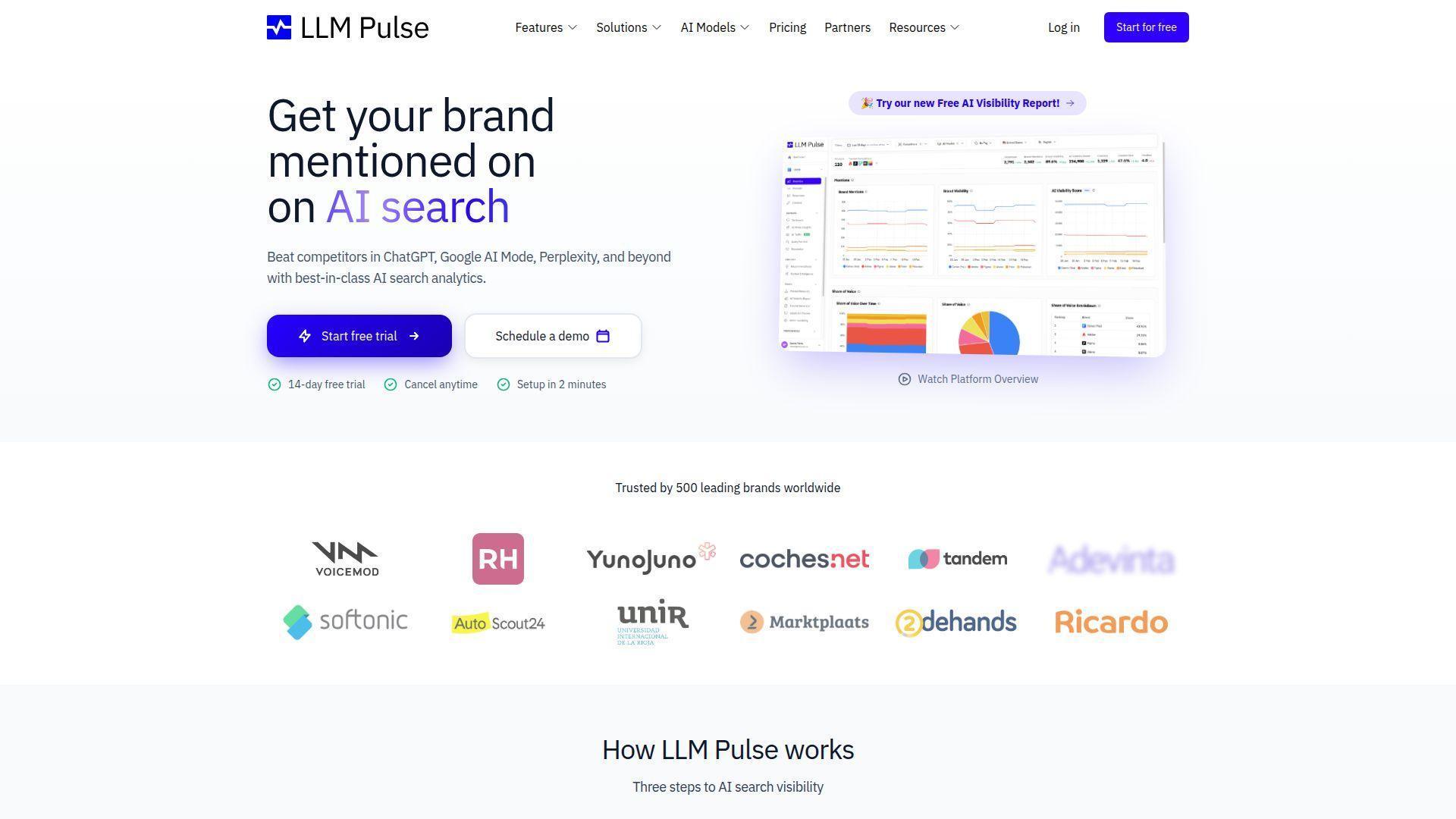
LLM Pulse is a dedicated AI visibility tracking platform that monitors how your brand appears across all major AI search engines. It tracks mentions in ChatGPT, Perplexity, Gemini, Google AI Mode, and AI Overviews — giving you a complete picture of your AI visibility.
Key features include:
- Automated weekly monitoring across multiple AI models and languages
- Brand mention tracking with share of voice analysis
- Sentiment analysis — understand how AI models describe your brand
- Citation tracking — see which of your URLs AI models reference
- Competitor comparison and benchmarking
- Trend tracking over time to measure the impact of your optimization efforts
Plans start at €49/month, and there’s a 14-day free trial so you can see your AI visibility data before committing. It’s a practical starting point for any brand serious about AI optimization.
Other tools in the space
The AI visibility monitoring space is evolving quickly. Other tools worth exploring include Profound (enterprise-focused AI analytics), Peec AI (AI brand monitoring), and general-purpose brand monitoring tools that are beginning to add AI search tracking features. Some SEO platforms are also starting to integrate AI visibility metrics into their dashboards.
Whichever tool you choose, the important thing is to start tracking. Without data, you’re optimizing blind.
Common AI optimization mistakes
As AI optimization becomes more mainstream, certain mistakes come up again and again. Avoid these pitfalls:
Ignoring traditional SEO
Some brands pivot entirely to AI optimization and neglect their SEO fundamentals. This is counterproductive — AI models heavily rely on search-indexed content and the same authority signals that search engines use. Weak SEO means weak AI visibility.
Optimizing for one AI model only
ChatGPT, Perplexity, Gemini, and Google AI Mode each use different models, different retrieval methods, and different source preferences. A strategy that works for one may not work for another. Always track and optimize across multiple AI search engines.
Keyword stuffing
LLMs don’t work like traditional search algorithms. Stuffing your content with keywords won’t help and may actually hurt — AI models can detect low-quality, repetitive content and are less likely to cite it. Focus on natural, expert-level writing instead.
Ignoring brand sentiment
It’s not enough to be mentioned — you need to be mentioned positively. If AI models describe your brand with negative sentiment, increased visibility actually works against you. Monitor sentiment and address the root causes of any negative perceptions.
Not tracking results
Many brands implement AI optimization tactics but never measure the results. Without tracking, you don’t know what’s working, what isn’t, and where to focus your efforts. Use AI visibility tools to close the feedback loop.
AI Search optimization checklist
Use this checklist to audit and improve your brand’s AI visibility. Work through it systematically and revisit it quarterly.
Content & Authority
- ☐ Audit existing content for depth, accuracy, and expertise
- ☐ Create or update pillar content for your core topics
- ☐ Build topic clusters with interlinked supporting articles
- ☐ Add FAQ sections that directly answer common questions
- ☐ Publish original research or data in your niche
Technical & Structured Data
- ☐ Implement Organization, Product, and Article schema markup
- ☐ Add FAQPage schema to FAQ sections
- ☐ Create an llms.txt file at your domain root
- ☐ Ensure your site is fast, mobile-friendly, and crawlable
- ☐ Validate all structured data with Google’s Rich Results Test
Entity & Brand Presence
- ☐ Audit brand consistency across all platforms and directories
- ☐ Claim or create Wikipedia and Wikidata entries (if eligible)
- ☐ Update Google Business Profile with accurate information
- ☐ Get listed on relevant industry comparison and directory sites
- ☐ Ensure consistent NAP data everywhere your brand appears
Digital PR & Citations
- ☐ Identify target publications in your industry
- ☐ Pitch expert commentary and original insights to journalists
- ☐ Contribute guest articles to authoritative sites
- ☐ Build relationships with industry analysts and influencers
- ☐ Monitor and grow your brand’s citation profile
Reviews & Social Proof
- ☐ Collect reviews on Google, G2, Capterra, and industry platforms
- ☐ Respond to all reviews (positive and negative)
- ☐ Showcase testimonials and case studies on your website
- ☐ Monitor overall brand sentiment across the web
Monitoring & Iteration
- ☐ Set up AI visibility tracking across ChatGPT, Perplexity, Gemini, and AI Mode
- ☐ Establish a baseline for current AI visibility and share of voice
- ☐ Track competitor AI visibility alongside your own
- ☐ Schedule weekly or biweekly reviews of AI visibility data
- ☐ Iterate on content and strategy based on what the data shows
FAQ
What is the difference between AI optimization and traditional SEO?
Traditional SEO focuses on ranking your website in search engine results pages (SERPs) — the ten blue links. AI optimization focuses on getting your brand mentioned and recommended in AI-generated answers from tools like ChatGPT, Perplexity, and Google AI Mode. While the tactics overlap significantly (quality content, authority, structured data), AI optimization places extra emphasis on entity recognition, brand sentiment, and being cited by authoritative sources.
How long does it take to see results from AI optimization?
It depends on your starting point. Brands with strong existing SEO and authority may see improvements within a few weeks of targeted optimization. For brands starting from scratch, building the kind of authority that AI models recognize typically takes 3–6 months of consistent effort. Real-time retrieval-based improvements (content updates, new publications) can show faster results than training data-dependent changes.
Do I need to optimize separately for each AI search engine?
While the core strategies apply broadly, each AI search engine has nuances. Perplexity relies heavily on real-time web search and citations. ChatGPT blends training data with browsing. Google AI Mode integrates with Google’s search index. The best approach is to follow universal best practices (quality content, authority, structured data) while monitoring your performance across each platform and adjusting as needed.
Is AI optimization only relevant for B2B companies?
Not at all. AI optimization matters for any brand that people might research or ask about through AI tools — B2B, B2C, SaaS, e-commerce, local businesses, personal brands, and more. Whenever someone asks an AI “What’s the best [product/service] for [use case]?”, AI optimization determines whether your brand appears in the answer.
Can I do AI optimization myself, or do I need an agency?
Most of the strategies in this guide can be implemented by in-house marketing teams, especially if you already have SEO experience. The key addition is monitoring — you’ll need an AI visibility tool to track your progress. For larger brands or highly competitive industries, working with specialists who understand the nuances of AI search can accelerate results.
Will AI search engines replace traditional search?
AI search engines are unlikely to fully replace traditional search in the near term, but they’re capturing a growing share of search behavior. The trend is toward AI-augmented search (like Google AI Mode) rather than pure replacement. The smart strategy is to optimize for both: maintain your traditional SEO while building your AI visibility. Brands that do both will have a significant advantage over those that focus on only one.