Adobe LLM Optimizer and LLM Pulse both help brands track and improve their visibility in AI search results, but they serve different audiences. Adobe LLM Optimizer is an enterprise solution within Adobe Experience Cloud, requiring annual contracts, a minimum of 1,000 prompts, and a sales-led process, with strong integration into Adobe’s ecosystem and CDN-level optimization. LLM Pulse is a self-serve, bootstrapped alternative with transparent pricing starting at €49/month, a 14-day free trial, full visibility into AI responses, Google AI Mode tracking, and a flexible platform that works with any tech stack.
Adobe LLM Optimizer and LLM Pulse are both platforms designed to help brands understand and improve how they appear in AI-powered search results. But they come from very different worlds.
Table of Contents
Adobe LLM Optimizer is an enterprise-grade product from a $200B+ publicly traded company, launched at Cannes Lions in June 2025 and generally available since October 2025. It’s part of the broader Adobe Experience Cloud ecosystem and is built for large organizations with annual contracts and a minimum purchase of 1,000 tracked prompts.
LLM Pulse is a bootstrapped alternative that launched publicly on July 15, 2025. It was built by a team with deep experience in marketplace SEO, SaaS, and AI product development. No outside funding, no enterprise sales calls required. Just sign up and start tracking.
This comparison examines both platforms across pricing, features, AI model coverage, and real-world value to help you choose the right tool for your team.
We used ChatGPT and other AI models and asked them to make a fair comparison. Here’s what the AI said, unbiased.
We aim to do a regular update of the content in this post as both solutions improve their offerings.
Background on both companies
About Adobe LLM Optimizer
Adobe LLM Optimizer is a product within Adobe’s Experience Cloud suite. It was first unveiled at Cannes Lions on June 16, 2025, and became generally available in October 2025. Adobe is a publicly traded company (NASDAQ: ADBE) with a market cap exceeding $200 billion, thousands of enterprise customers, and a massive portfolio spanning creative tools, marketing platforms, and analytics solutions.
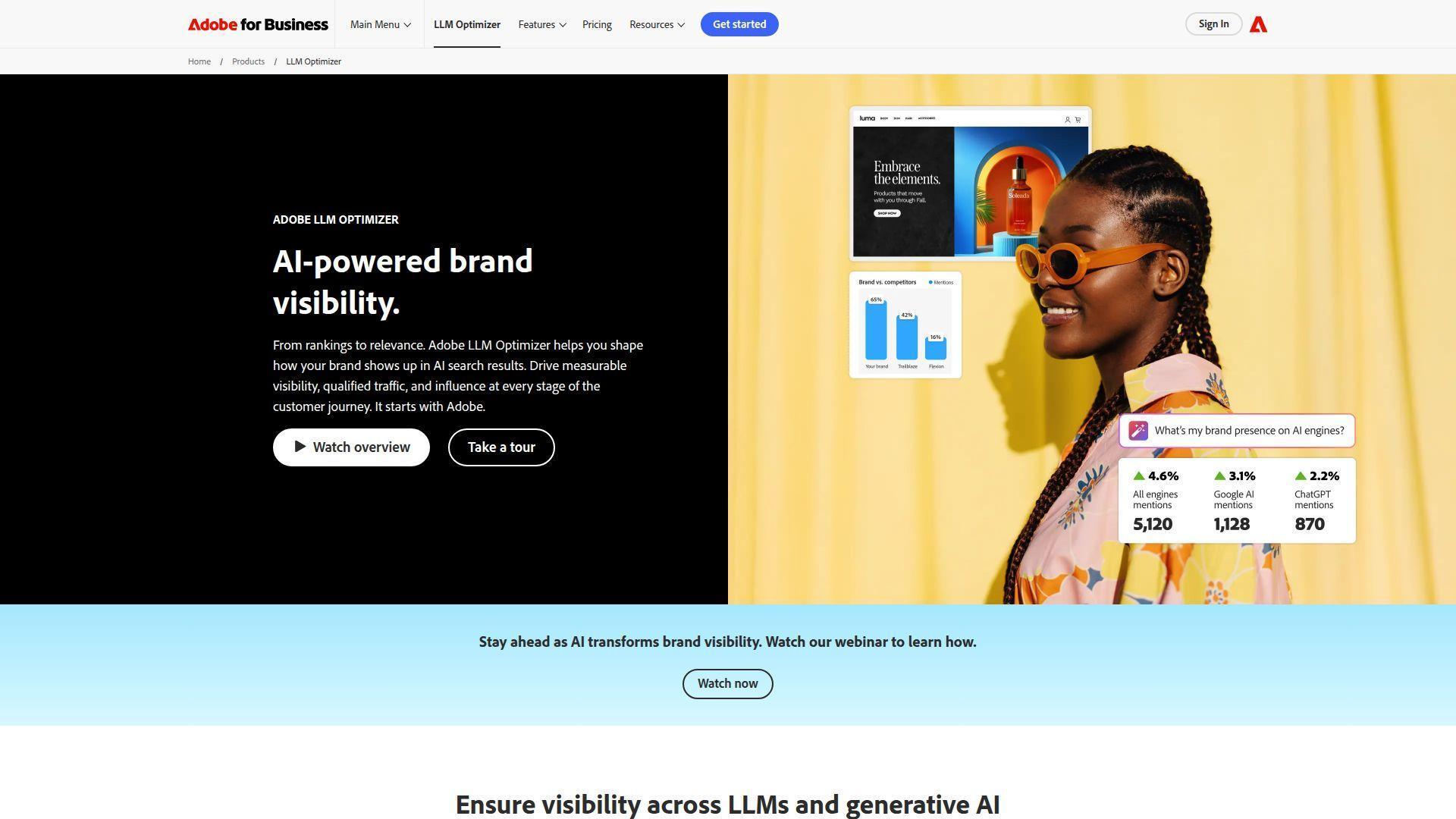
The product is positioned as a “generative AI search and discovery optimization solution” that helps brands monitor visibility across AI models and deploy content optimizations, with tight integration into Adobe Experience Manager (AEM) Sites for one-click publishing.
Adobe has not publicly disclosed specific customer counts or revenue figures for LLM Optimizer.
About LLM Pulse
LLM Pulse is a 3-founder project led by Daniel Peris, Esteve Castells, and Adrián Rojas. The team publicly introduced the product with a “HELLO WORLD” post on July 28, 2025, noting they had actually gone live two weeks earlier, on Tuesday, July 15, 2025.
The LLM Pulse team brings many years of combined experience in SEO, SaaS, and AI-related product development. The founders previously led SEO at major marketplace platforms managing 250+ million indexed pages.
On funding, the founders state they are bootstrapped, “no outside funding, just time and focus.” This has allowed them to focus entirely on building features customers actually need, rather than chasing enterprise sales cycles.
Today, LLM Pulse is used by 500+ brands across multiple industries, including fintech, marketplaces, SaaS companies, and marketing agencies, in different countries around the world.
Short overview
Adobe LLM Optimizer positions itself as an enterprise AI search optimization platform. It monitors brand visibility across ChatGPT, Gemini, Copilot, Perplexity, and Google AI Overviews. It emphasizes agentic traffic detection (identifying AI crawler visits via CDN logs), prescriptive content recommendations, and one-click optimization deployment through Adobe Experience Manager. It requires an annual contract with a minimum of 1,000 tracked prompts and no public pricing.
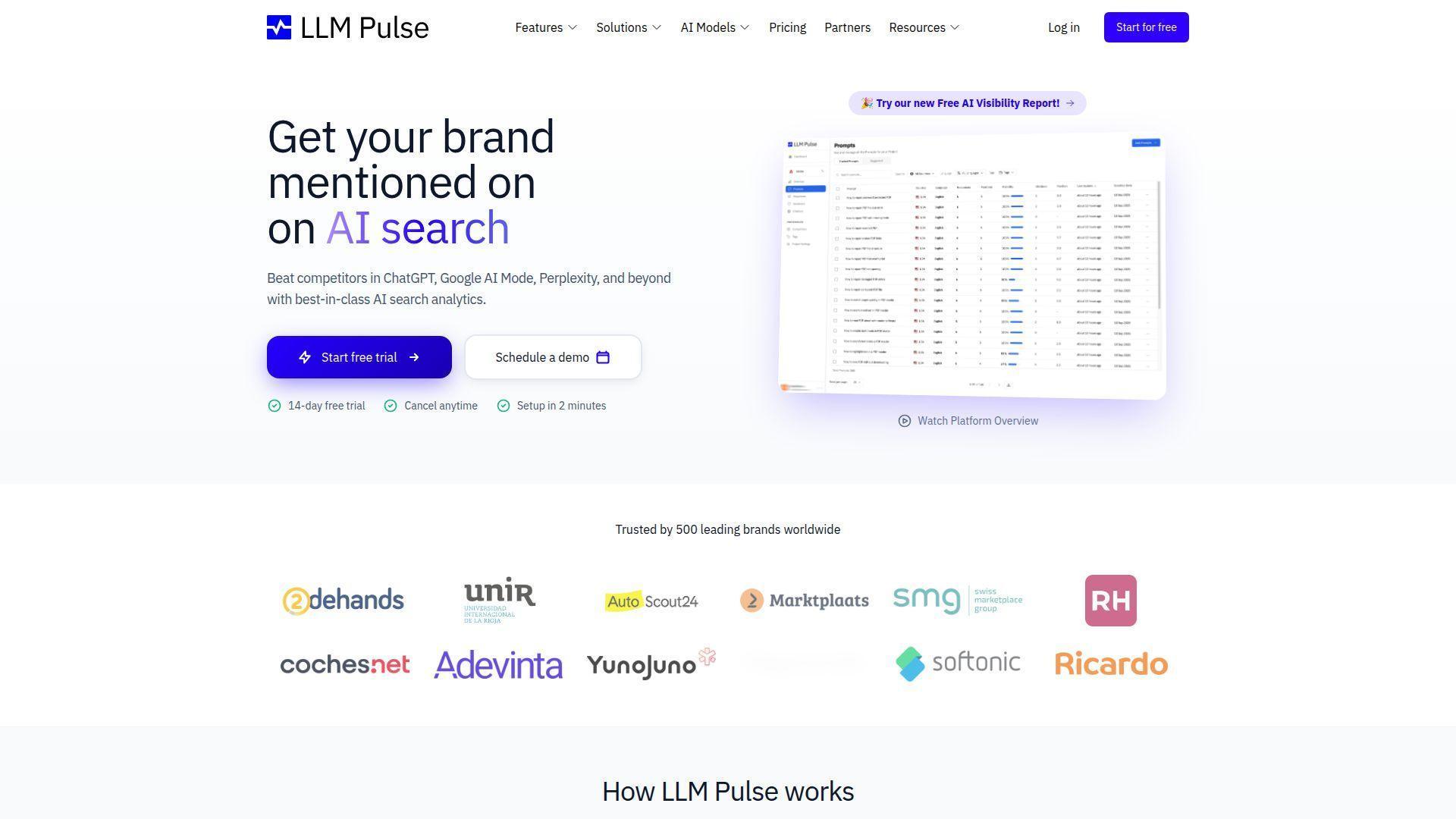
LLM Pulse is a comprehensive AI search visibility platform with 20+ features already live. It captures full LLM responses (including mentions and citations), provides competitive benchmarking, share of voice, prompt suggestions, content intelligence, web analytics integration, Looker Studio connector, MCP support, and app store citations tracking. It tracks ChatGPT, Perplexity, Gemini, Google AI Mode, and Google AI Overviews. Brand sentiment has been live since mid-2025. Plans start at €49/month with a 14-day free trial.
Common ground
Both tools allow brands to track mentions and citations across AI models.
Both provide competitive benchmarking and share-of-voice analysis.
Both offer content optimization recommendations.
Both support MCP (Model Context Protocol) integrations.
Both aim to help marketing, SEO, and content teams understand the AI search landscape.
Feature comparison: what’s actually different?
While both platforms address AI visibility, the approach, accessibility, and feature sets differ significantly.
Adobe LLM Optimizer features
Brand visibility tracking across ChatGPT, Gemini, Copilot, Perplexity, and Google AI Overviews
GEO scores and visibility analytics
Competitive share-of-voice tracking
Agentic traffic detection (AI crawler analysis via CDN logs)
Prescriptive content recommendations (on-site and off-site)
One-click deployment via Adobe Experience Manager Sites
Edge/CDN-level optimization for AI agents (no code changes required)
Accuracy validation (connecting AI responses to official sources)
Sentiment analysis
Attribution: connecting visibility to traffic, engagement, and conversions
Discovery & research: AI prompt suggestions, prompt research, query fan out, reputation monitoring
Platform & integrations:API access, Looker Studio connector, MCP support, tags, app store citations tracking
Extra services: one-time prompt research, white label, Chrome extension (Query Detector for ChatGPT)
Free tools: AI visibility report, llms.txt generator, robots.txt AI crawlability checker
AI model coverage
AI model
Adobe LLM Optimizer
LLM Pulse
ChatGPT
✅
✅
Perplexity
✅
✅
Google Gemini
✅
✅
Google AI Overviews
✅
✅
Google AI Mode
❌
✅
Microsoft Copilot
✅
❌ (Enterprise only)
Key difference: LLM Pulse includes Google AI Mode on all plans, which is increasingly important as Google rolls out AI Mode to more users and markets. Adobe covers Copilot but does not appear to track Google AI Mode as a separate surface. LLM Pulse offers additional AI models on Enterprise plans.
Pricing: the biggest difference
This is where the two platforms diverge most dramatically.
Adobe LLM Optimizer pricing
Detail
Adobe LLM Optimizer
Pricing model
Annual license, custom quote
Minimum purchase
1,000 prompts
Increments
200 prompts
Public pricing
Not available (contact sales)
Free trial
Not available
Self-serve signup
No (sales consultation required)
Contract type
Annual
Adobe structures its pricing around an annual contract with a minimum of 1,000 tracked prompts. There are no publicly available prices. To get a quote, you must go through Adobe’s sales team. Purchase tiers range from 1K to 110K+ prompts with volume discounting.
1 project; 50 tracked prompts; 50 responses/week per model; weekly tracking; 5 competitors; unlimited team members; covers ChatGPT, Perplexity, Google AI Mode, Google AI Overviews, Gemini.
Lowest entry price; 14-day free trial; suitable for individuals or small teams.
Growth – 99 €/mo (or 990 €/year ≈ 82.50 €/mo)
2 projects; 150 tracked prompts; 150 responses/week per model; weekly tracking; 10 competitors; unlimited team members. Adds sentiment analysis and app tracking.
Balanced option for growing teams. Most popular plan.
Scale – 299 €/mo (or 2,990 €/year ≈ 249.17 €/mo)
5 projects; 450 tracked prompts; 450 responses/week per model; weekly tracking; 15 competitors; unlimited team members. Adds Looker Studio, MCP.
Best fit for mid-size organizations.
Enterprise – custom
Custom projects, prompts, responses. Unlimited competitors. API access, white label, SSO, custom integrations, dedicated customer success.
For large organizations; contact sales.
Key pricing takeaways
Minimum commitment: Adobe requires a minimum purchase of 1,000 prompts on an annual contract with no public pricing. LLM Pulse starts at 50 prompts for €49/month, no annual commitment required.
Self-serve vs. sales-led: LLM Pulse offers a 14-day free trial with instant signup. Adobe requires a consultation with their sales team before you can even see pricing.
Accessibility: A solo consultant, startup, or small agency can start using LLM Pulse today for €49/month. Adobe’s minimum 1,000-prompt annual license is designed for enterprise budgets.
Transparency: LLM Pulse publishes all prices publicly. Adobe does not.
To be fair, Adobe brings some genuine advantages, particularly for large enterprises already invested in the Adobe ecosystem:
Agentic traffic detection: Adobe analyzes CDN logs to identify AI crawler visits and understand how AI agents interact with your site. This is a unique capability that most standalone tools don’t offer.
Edge/CDN optimization: The ability to deploy optimization at the CDN layer without changing origin code is a compelling feature for enterprise teams. AI agents see optimized content while human visitors see the original experience.
One-click deployment via AEM: If you already use Adobe Experience Manager Sites, the integration for publishing optimizations is seamless.
Accuracy validation: Adobe connects AI-generated responses back to official brand sources, helping brands identify when AI models are citing incorrect information.
Enterprise governance: Being part of Adobe Experience Cloud means enterprise-grade security, compliance, and governance frameworks.
A2A protocol support: Adobe supports both MCP and Agent2Agent standards for enterprise integration.
Brand credibility: For enterprise procurement teams, the Adobe name carries weight.
Where LLM Pulse has a clear lead
Google AI Mode coverage: LLM Pulse tracks Google AI Mode on all plans. Adobe does not appear to cover this increasingly important surface.
Accessibility and pricing: Start at €49/month with a 14-day free trial. No sales calls, no annual contracts required, no minimum 1,000-prompt commitment.
Full AI response visibility: LLM Pulse shows the complete AI-generated answer for every tracked prompt. You see the full text, which websites were cited and in what order, where your brand appears, and how competitors are positioned.
Transparent, public pricing: Every plan and feature is publicly listed. No hidden costs or surprise quotes.
App store tracking: Monitor citations in iOS App Store and Google Play. Adobe doesn’t offer this.
Looker Studio connector: Native connector for custom dashboards and client reporting (Scale plan and above).
White label: Available for agencies to brand as their own (Enterprise plan).
Query fan out: Automatically expand tracked prompts to cover variations and discover new opportunities.
Prompt suggestions and prompt research: AI-powered tools to discover what questions matter in your industry.
Chrome extension: Query Detector for ChatGPT to discover what queries people actually use.
Free tools: AI visibility report, llms.txt generator, and robots.txt crawlability checker, all free and available without signing up.
Unlimited team members: Collaborate without per-seat pricing on all plans.
No vendor lock-in: LLM Pulse works with any CMS, any tech stack. Adobe’s optimization features work best (or only) within the Adobe ecosystem.
Speed of innovation: As a bootstrapped startup, LLM Pulse ships new features weekly. Large enterprise vendors like Adobe typically operate on longer release cycles.
The ecosystem lock-in question
One of the most important considerations with Adobe LLM Optimizer is ecosystem dependency.
Adobe’s product page states that optimizations can be deployed with “a single click using Adobe Experience Manager Sites or custom integrations.” The CDN-level optimization (one of their strongest features) requires routing AI agent requests through Adobe’s platform.
If you’re already deep in the Adobe Experience Cloud ecosystem with AEM Sites, Adobe Analytics, and related tools, LLM Optimizer plugs in naturally. But if you use WordPress, Webflow, a headless CMS, or any non-Adobe stack, you’ll need custom integrations that add complexity and cost.
LLM Pulse is stack-agnostic. It works the same regardless of your CMS, CDN, or analytics platform. The insights and recommendations are actionable in any environment.
As Real Story Group noted in their review of Adobe LLM Optimizer: “Much of the functionality depends on deep Experience Cloud integration. If your architecture is more composable, or built on tools like WordPress, Contentful, or Sitecore, you’ll face limited features or added integration complexity.”
Side-by-side comparison
Feature
Adobe LLM Optimizer
LLM Pulse
Entry price
Not public (1,000 prompt minimum, annual)
€49/month (50 prompts)
Free trial
❌
✅ 14 days
Self-serve signup
❌ (sales required)
✅
Monthly billing
❌ (annual only)
✅
Public pricing
❌
✅
AI models tracked
ChatGPT, Gemini, Copilot, Perplexity, AI Overviews
ChatGPT, Gemini, Perplexity, AI Mode, AI Overviews
You’re already deep in the Adobe Experience Cloud ecosystem (AEM Sites, Adobe Analytics, etc.).
Agentic traffic detection is a priority and you want CDN-level AI agent analysis.
You need one-click content deployment through AEM.
Enterprise procurement requires a recognized brand name like Adobe.
You have the budget for an annual contract with a 1,000+ prompt minimum.
Edge/CDN optimization without code changes is a key requirement.
Choose LLM Pulse if you need…
Affordable entry: Start at €49/month with no annual commitment.
Google AI Mode tracking: Included on all plans.
Self-serve access: Sign up, start a free trial, and see data immediately.
Full AI response visibility: See exactly what AI models say, not just scores.
Stack independence: Works with any CMS, no Adobe dependency.
App store tracking: Monitor citations in iOS and Google Play.
Looker Studio and API: Build custom dashboards and integrate with your stack.
White label for agencies: Brand LLM Pulse as your own tool for clients.
Prompt discovery: AI-powered prompt suggestions and query fan out to find new opportunities.
Transparent pricing: Know exactly what you’ll pay before you talk to anyone.
A team that ships weekly: We release new features constantly because our users demand it.
Final words
Adobe LLM Optimizer and LLM Pulse solve a similar problem from very different positions.
Adobe brings the weight of a $200B enterprise with deep CMS integration, CDN-level optimization, and agentic traffic detection. If you’re a large organization already committed to Adobe’s ecosystem, LLM Optimizer plugs in naturally, and the edge optimization capabilities are genuinely impressive.
But that comes with trade-offs: no public pricing, no free trial, no self-serve access, a 1,000-prompt annual minimum, and ecosystem dependency that limits value for non-Adobe stacks.
LLM Pulse was built for the other 99% of the market: the startups, the agencies, the growing brands, and the enterprises that want powerful AI visibility tools without being locked into a specific CMS vendor. We offer transparent pricing, instant access, Google AI Mode tracking, and a feature set that’s been battle-tested by 500+ brands.
The best tool is the one you can actually use today. Adobe requires a sales process. LLM Pulse requires a signup.
FAQ
What is the main difference between Adobe LLM Optimizer and LLM Pulse?
Adobe LLM Optimizer is an enterprise solution within Adobe Experience Cloud that requires an annual contract, a minimum of 1,000 tracked prompts, and a sales-led process with no public pricing. LLM Pulse is a self-serve, bootstrapped alternative with transparent pricing, instant signup, a 14-day free trial, and plans starting at €49/month without mandatory annual commitment.
Does Adobe LLM Optimizer offer a free trial?
No. Adobe LLM Optimizer does not offer a public free trial and requires going through a sales consultation and signing an annual contract. LLM Pulse offers a 14-day free trial with immediate access and no sales process required.
Which AI models are supported by each platform?
Both platforms track ChatGPT, Gemini, Perplexity, and Google AI Overviews. Adobe also tracks Microsoft Copilot, while LLM Pulse includes Google AI Mode on all plans and offers expanded model coverage on Enterprise tiers.
Do I need Adobe Experience Manager (AEM) to get full value from Adobe LLM Optimizer?
Adobe LLM Optimizer delivers its strongest capabilities, such as one-click deployment and CDN-level optimization, when integrated with Adobe Experience Manager Sites and the broader Experience Cloud ecosystem. LLM Pulse is stack-agnostic and works with any CMS, CDN, or analytics setup.
Who should choose Adobe LLM Optimizer vs. LLM Pulse?
Adobe LLM Optimizer is better suited for large enterprises already embedded in the Adobe ecosystem and comfortable with annual enterprise contracts, while LLM Pulse is ideal for startups, agencies, and growing brands that want transparent pricing, self-serve access, Google AI Mode tracking, and flexibility without vendor lock-in.
Which is better for small-to-mid-size teams: Adobe LLM Optimizer or LLM Pulse?
LLM Pulse. It offers self-serve pricing starting at €49/month with no enterprise procurement needed. Adobe LLM Optimizer is part of Adobe’s enterprise ecosystem and requires custom pricing through sales.
Does LLM Pulse track the same AI models as Adobe LLM Optimizer?
LLM Pulse tracks 5 AI models on all plans and 10+ on Enterprise (including Claude, Copilot, Grok, DeepSeek). The specific model coverage comparison depends on Adobe’s current offering, but LLM Pulse provides transparent model coverage on every plan.
Discover your brand's visibility in AI search effortlessly
Co-Founder of LLM Pulse and AI search expert. With extensive experience working as an SEO for global brands and large enterprises, he’s the subject matter expert building the product to deliver value to our users.